Pimsleur Mandarin review: what 30 minutes a day actually teaches
Pimsleur's Mandarin course is 150 half-hour audio lessons. What its recall method does well, the character gap, prices from $14.95, and who should skip it.


Pimsleur is one of the few apps that has you speaking Chinese out loud from the first minute. It's also one of the few that barely teaches you to read it.
If you're deciding whether Pimsleur's Mandarin course is worth paying for, this review is for you: we look at what it teaches, what the research says about its method and what you'll still need.
Key takeaways
- The core habit is well proven. Trying to recall an answer before you hear it is one of the best-supported ways to learn.
- The famous schedule is not. Later studies found evenly spaced reviews work about as well as Pimsleur's ever-longer gaps.
- It's a starter course. All five levels add up to about 80 hours, far short of what everyday conversation takes.
- Reading is mostly missing. You read pinyin for four levels, and characters only start in Level 5.
- Monthly is the cheapest way through. At a lesson a day, the whole course costs about $100 on the monthly plan.
- Pair it with two things. Add a course that teaches characters, and someone, or something, that talks back.
Is Pimsleur right for you?
Your goal decides it more than anything else. Pick yours, with your time and budget, and we'll show a verdict and what an hour of study costs against the alternatives:
Is Pimsleur right for you?
Pick your goal, time, setting and budget: you get a verdict on Pimsleur and what an hour of study costs against five alternatives, from each company's own prices.
Time a day
Where you'll study
Monthly budget
Yes: a good fit
- It's built for complete beginners: you answer out loud every few seconds, the kind of recall practice research backs.
- It teaches pinyin, not characters, so reading will lag behind.
Hands-free is where Pimsleur shines: it's the only option here you can do in the car.
Your plan: Premium Monthly, $19.95 a month, with Voice Coach and the practice tools: about $1.31 an hour at 30 minutes a day.
All five levels take about 5 months at 30 minutes a day. Learners in Pimsleur's own study spent about 45 minutes on each 30-minute lesson.
Add: A little reading from the start, from Duolingo or a course like HelloChinese.
What an hour of study costs at 30 minutes a day

Option 1. Free
The same audio lessons without the app's extras, if your library has them; free.
Fits your goal Hands-free
Option 2. $1.31 an hour
Audio lessons you answer out loud; $19.95 a month at this pace.
Fits your goal Hands-free

Option 3. $0.79 an hour
An HSK-based app course with handwriting and speech recognition; $11.99 a month at this pace.
Fits your goal Needs a screen
Best fit first, then what suits your setting and budget, then price. Prices checked 7 October 2026. Hours aren't equal: an hour with a tutor is live conversation, an hour of Pimsleur is audio drills.
Sources: Pimsleur's Mandarin pages and FAQ; SayMei pricing; HelloChinese's App Store listing; italki's public directory (median of 763 Chinese tutors). Cost per hour divides a month's price by the hours you'd study (30 minutes a day is about 15.2 hours a month).
The rest of our review explains each verdict, starting with what actually happens in a lesson.
Each lesson is a conversation you answer aloud
Each lesson is about 30 minutes of audio. You hear a short dialogue between two native speakers, then an English narrator takes it apart, phrase by phrase.
Every few seconds, the narrator asks you to say something in Mandarin. You answer out loud in the pause. Then a native speaker says it correctly, and you check yourself.
Here's how one exchange works. It's our own example of the format, not a line from the course:
- Narrator: "How would you say, 'I'd like to drink tea'?"
- You, in the pause: 我想喝茶。 Wǒ xiǎng hē chá.
- Native speaker: the same sentence, said right, for you to repeat.
Words from earlier lessons keep coming back. Pimsleur asks you to do one lesson a day, without notes or a transcript. Here's the course at a glance:
| Pimsleur Mandarin | |
|---|---|
| Course | 5 levels of 30 lessons, about 30 minutes each |
| Total | About 75 hours of lessons, 80 with the reading lessons |
| New words | 300–500 per level, Pimsleur's range for its courses |
| Reading | Pinyin in Levels 1–4; selected characters in Level 5 |
| Speaking checks | Voice Coach scores phrases you say (Premium plans) |
| Hands-free | Yes: a driving mode and offline downloads |
| Price | $14.95–$20.95 a month, or $575 to own all five levels |
Source: Pimsleur's Mandarin pages and FAQ, checked 7 October 2026.
To us, it's a tidy, finishable course, built for one thing: getting you to speak.
Answering before you hear it is proven
The pause is Pimsleur's best idea, and of everything we read about the method, it has the strongest evidence. Pimsleur calls it the principle of anticipation. Researchers call it retrieval practice.
When you pull an answer out of memory, you keep it longer than when you simply hear it again. A review of 222 classroom studies found that quizzing yourself beats rereading. And recalling an answer teaches more than picking it from a list.
Pimsleur asks for the harder kind. You don't tap a tile; you build the sentence yourself, out loud, from an English cue. A learner who later switched apps on Reddit missed exactly that about Pimsleur: "It would describe a situation and ask you what you should say."
If you do one thing right with Pimsleur, make it this: answer before the voice does, even when you're not sure.
The memory schedule is the weaker claim
Pimsleur's other big idea is timing. In a 1967 paper, Paul Pimsleur proposed reminding learners of a word at ever-longer gaps, each about five times the one before. He called it graduated interval recall.
We worked his rule forward, starting five seconds after you learn a word:
Only the first four recalls fit inside one lesson
Pimsleur's 1967 rule: each gap is five times the last. Worked out from the paper, not timed in today's lessons.
| Recall | Gap since the last one | When it comes back |
|---|---|---|
| 1st | 5 seconds | Same lesson |
| 2nd | 25 seconds | Same lesson |
| 3rd | About 2 minutes | Same lesson |
| 4th | About 10 minutes | Same lesson |
| 5th | About 52 minutes | Same day |
| 6th | About 4 hours | Same day |
| 7th | About 22 hours | Next day |
| 8th | About 4½ days | Days later |
| 9th | About 23 days | Weeks later |
| 10th | About 113 days | Months later |
Source: Pimsleur, "A Memory Schedule", 1967. Each gap is 5 seconds raised to the recall's number; the paper gives the first four and the tenth.
Only the start of the schedule fits in a 30-minute lesson. The rest depends on you coming back tomorrow, and on later lessons bringing the word back.
Spacing itself is solid science. A 2022 review of 48 language-learning experiments found that spreading practice out has a medium-to-large effect.
The ever-longer part is shakier. That same review found evenly spaced and expanding gaps worked equally well. In one classic experiment, even gaps won after two days.
Pimsleur himself didn't claim proof. His paper said the schedule "would properly be the subject of a full-scale experimental investigation."
Our advice: don't fuss over the timing. Do a lesson a day, and the spacing takes care of itself.
Strong on recall, missing conversation and reading
Put together, Pimsleur gets the two hardest-to-fake parts right and leaves out three others. Here's how we score each part:
What research supports · Verdict · What Pimsleur does
Recalling answers, not just recognizing them
Strong
Asks for each answer out loud before giving it
Spreading practice over days
Strong
Brings old words back in later lessons
Gaps that grow each time
Unproven
Built in, but even gaps work about as well
Feedback on what you actually said
Partly
The audio can't hear you; Voice Coach scores phrases on Premium
Conversation with a partner
Missing
Scripted dialogues only
Reading and writing characters
Missing
Pinyin in Levels 1–4; a few characters in Level 5
Sources are linked in each section of this review.
That's a strong start and an incomplete course. The sections below take the gaps one at a time.
"Thirty minutes a day" usually means more
The lessons last 30 minutes. Doing them well takes longer.
The only outcome study we found is Pimsleur's own, from 2019. It followed adults learning Spanish, not Mandarin, for two months. Pimsleur paid for it, and there was no comparison group.
We read the full report. Learners spent a median of about 45 minutes on each 30-minute lesson, because many replayed parts. Only about three in ten finished Level 1 in the two months.
Most who finished moved up one step on the speaking test the study used. For most, that meant going from Novice Low to Novice Mid, the second rung of a ten-rung scale.
That's real progress, and we don't want to undersell it. But it's not quite the "basic real-world conversations" that Pimsleur's Mandarin page promises after Level 1, and Mandarin takes English speakers longer than Spanish.
Learners say the same thing in plainer words. One who finished all five levels of the French course wrote on Reddit that once the lessons got harder, each one took an hour or more of focused work.
So plan on 45 minutes a lesson. Pimsleur's rule is to move on once you get about four answers in five right, and to repeat the lesson until you do.
Five levels add up to about 80 hours
The whole Mandarin course is about 75 hours of audio, or 80 counting the reading lessons, by Pimsleur's own figures.
Each level adds 300 to 500 new words and phrases, the range Pimsleur gives for its courses.
Pimsleur says that takes you to "a high-intermediate level of speaking and understanding." We set its 80 hours against the course hours common goals take:
All five levels: past trip phrases, short of conversation
Hours of instruction from zero. Pimsleur's own figure against typical course hours for each goal.
- Published hours
- SayMei estimate
| Goal or course | Hours | Where the hours come from |
|---|---|---|
| Pimsleur Mandarin, all 5 levels | 75–80 | Pimsleur: 150 lessons, 80 hours with reading |
| Survival phrases for a trip | 20–60 | SayMei estimate |
| HSK 1 | 60–240 | TOCFL course hours |
| HSK 2 | 240–480 | TOCFL course hours |
| A 10-minute everyday conversation | 240–720 | TOCFL Levels 1–2 |
Source: Pimsleur's product pages; other hours from Taiwan's TOCFL guidelines, as mapped in how long it takes to learn Mandarin.
That's enough to get comfortable with the basics by ear. Real conversation usually takes hundreds of hours, whatever course you use, and the US State Department budgets about 2,200 class hours for professional Mandarin.
Some of the material shows its age, too. Pimsleur's own booklet dates the Level 1 recordings to 2000, and Level 5 came out in 2016.
Tones are taught by ear, not checked
Pimsleur teaches tones the way a patient teacher might in a car: by saying every word clearly and having you copy it.
New words are broken down from the end, a syllable at a time, then built back up. Pimsleur calls this back chaining. Its course booklet explains the four tones with one syllable said four ways:
- poem, 诗
- ten, 十
- history, 史
- to be, 是
The booklet also explains the rules for tone changes. The first one you'll meet is in hello, 你好: written nǐ hǎo, but said ní hǎo.
What the audio can't do is hear you. Say shí when you meant shì, and the lesson carries on. Premium plans add Voice Coach, which scores phrases you record, and Pimsleur's Voice Coach guide lists Mandarin among the languages it checks with speech recognition. It doesn't say whether the score checks tones.
The research says you need both halves. Listening training improves hearing new sounds more than saying them, and practice is skill-specific: you get better at the half you practise. Pimsleur drills saying. We found no tone-listening drills in its descriptions of the course.
So add the half Pimsleur skips:
- Ten minutes of tone-pair listening. Our free tone-pair trainer drills the two-syllable pairs that trip learners up.
- Someone who can hear you. A tutor, or a speaking partner who corrects your tones.
Our guide to learning Chinese tones as an adult has a full plan.
You'll read pinyin, not characters
Pimsleur's reading lessons teach pinyin, the Latin-letter spelling of Mandarin sounds, in Levels 1 to 4. Characters only begin in Level 5, and only a selection of them.
That matters the moment you leave the audio. A noodle shop in Beijing will write beef noodle soup as 牛肉面, in characters, with no pinyin above them. Even the first level of the HSK exam expects you to recognize 246 characters.
The reading lessons don't even use the words you learn to say. Pimsleur's FAQ says they teach different words from the audio lessons.
Characters stick best when you write them by hand. In one experiment with adult learners, handwriting built memory for a character's shape and meaning, while typing pinyin built only its sound.
If you want to read, we'd pair Pimsleur with a course that teaches characters from day one, and a graded reader to practise on. Pinyin gets you started; it won't get you through a menu.
There's no one to talk back
Every Pimsleur conversation is scripted. You never have to understand an answer you didn't expect, or explain yourself when someone misunderstands.
That's the gap that worries us most, because it's the part with the strongest evidence behind it. Across 28 studies, conversation with feedback had large effects on learning, and the gains held on later tests.
Pimsleur's answer is its AI Conversation Coach. But it's a beta for two languages, Latin American Spanish and French, and only on the All Access plan:
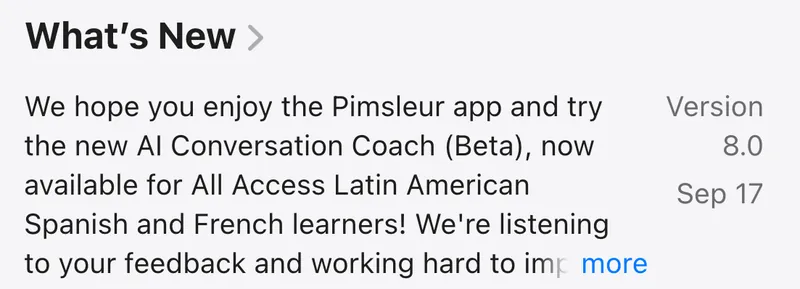
So for Mandarin, every conversation is still a recording. A 2016 review of the method put it bluntly: learners end up "merely reproducing the prescribed dialogues."
Pimsleur gets you ready to talk. You still need someone, or something, to talk to.
The monthly plan is the cheapest way through
Pimsleur sells Mandarin two ways: as a subscription, or as a purchase you keep. Subscriptions start at about $15 a month, and owning all five levels costs $575.
We added up what each way costs to finish the course at one lesson a day:
Source: Pimsleur's Mandarin pages, list prices before sales or tax. All Access plans cover all 51 of Pimsleur's languages.
Premium is the plan most people want, because the Audio plan drops Voice Coach and the practice tools:
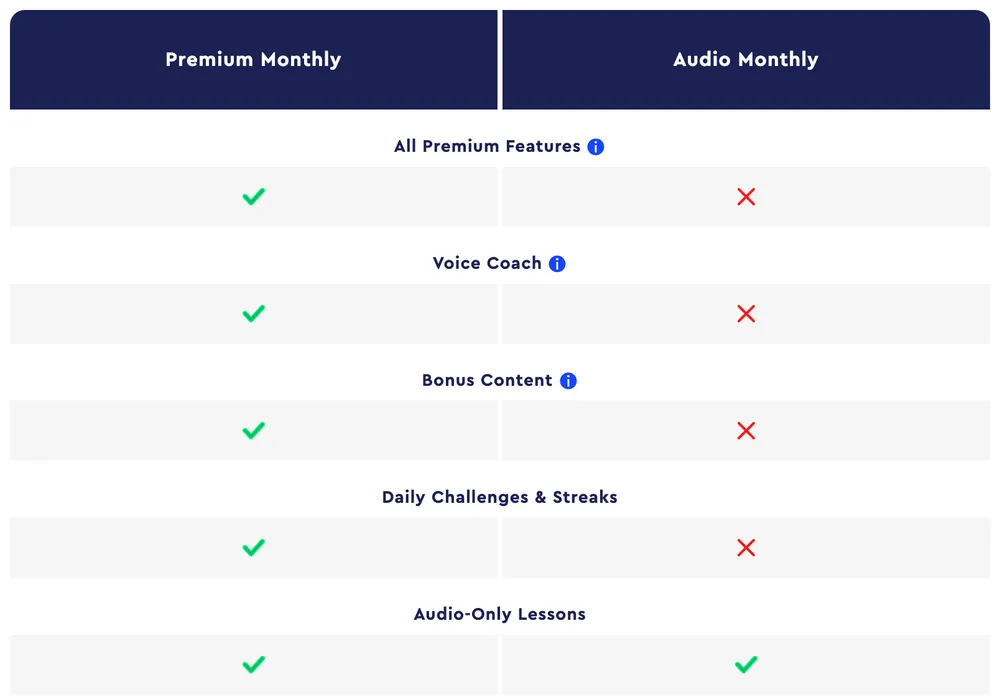
If you'd use Voice Coach, that's what the extra $5 a month buys.
Buying makes sense only if you'll replay the course for years. A fall sale took a quarter off the Mandarin lifetime prices when we checked:
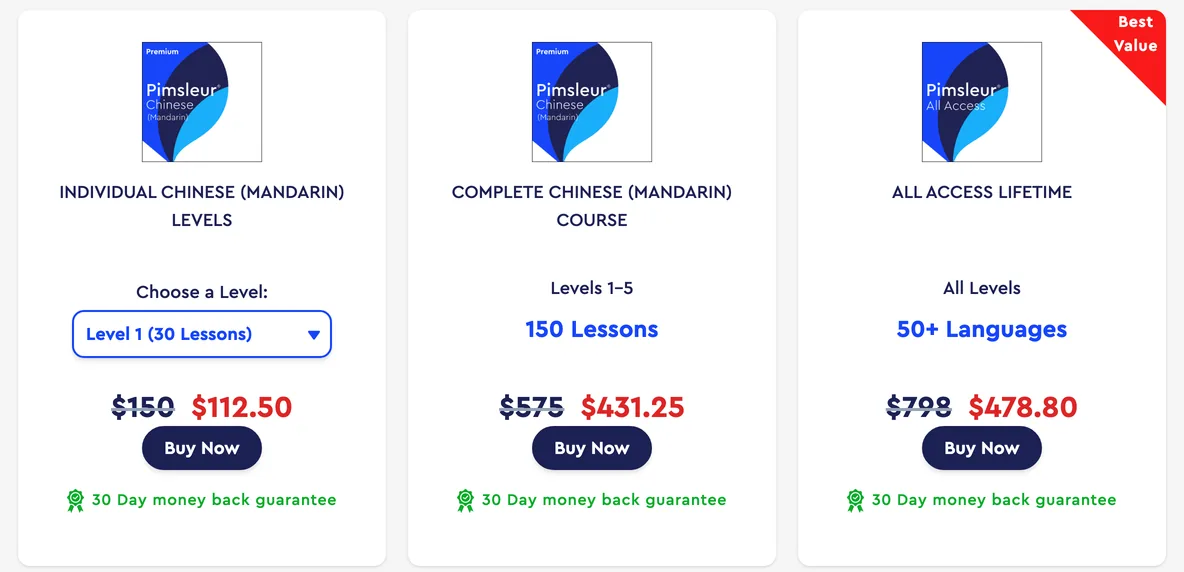
Even on sale, owning all five levels costs more than four times what finishing on Premium does.
Every plan covers you plus up to three people in your household, so a family can share one. Before you pay anything, there are three ways to try it:
- Take the free first lesson. Pimsleur offers one in every language it teaches.
- Use the 7-day trial. Cancel before it ends, or the first month is charged.
- Borrow it. Your library may lend the audio edition through the Libby app.
Pimsleur vs Duolingo: more speaking or more words
The two apps train opposite halves of the language. Duolingo teaches far more words. Pimsleur makes you say far more. We looked at Duolingo's Chinese course screen by screen for our own review, and the contrast is stark.
Here's how they compare for Mandarin:
| Pimsleur | Duolingo | |
|---|---|---|
| Price | From $14.95 a month | Free; paid plans optional |
| What you do | Answer out loud every few seconds | Mostly tap and pick on screen |
| Words | 300–500 per level, five levels | About 6,000 in the course |
| Characters | Pinyin until Level 5 | Characters with pinyin from the start |
| Conversation | Scripted | Video Call, on paid plans |
Sources: Pimsleur's pages; our review Is Duolingo good for learning Chinese?
If you can, use both, as we suggest to most beginners: Duolingo for characters and vocabulary, Pimsleur for speaking and listening. Neither one holds a real conversation with you.
Pimsleur suits commuters, not readers
We would pick Pimsleur if:
- You learn by ear. Everything happens in audio, with a driving mode and offline downloads.
- You're starting from zero. Pimsleur starts everyone at Level 1, and the pace is gentle.
- You want a plan you can finish. One lesson a day, and you're done in about five months.
- Pronunciation matters to you. Native speakers model every word, and you copy them again and again.
We'd skip it, or pair it with something else, if:
- You want to read and write. Characters barely appear.
- You're studying for the HSK. The course isn't organized around HSK word lists or reading.
- You already speak some Mandarin. Pimsleur says to start at Level 1 unless you can do Level 2's first lesson perfectly.
- You want conversation. Every exchange is scripted.
One caveat: hands-free doesn't mean mindless. Learners in a busy Reddit thread warn that the lessons need your full attention, which is hard in traffic.
The best pick for each goal
No single app does everything. Here's what we would pick for each goal, based on the facts in this review:
To start speaking, hands-free
- Pick
- Pimsleur
- Why
- Audio lessons you answer aloud, offline too
Pimsleur without paying
- Pick
- Your library
- Why
- Check Libby for the audio edition
A free daily habit and more words
- Pick
 Duolingo
- Why
- Free, with about 6,000 words
Characters and an HSK path
- Pick
- HelloChinese
- Why
- HSK-based course with handwriting
Live speaking practice with correction
- Pick
 SayMei
- Why
- Mei Lin replies in real time and corrects you
A human ear for your tones
- Pick
 italki tutor
- Why
- About $20 an hour for a median tutor
Sources: each app's listing, via our guides to AI apps and online tutors.
Where SayMei loses: it runs only in a web browser, so it can't come in the car, and at half an hour a day it costs more per hour than Pimsleur.
What to do next
If you go ahead with Pimsleur, here's what we suggest:
- Try before you pay. The first lesson is free, and the trial covers the rest of the first week.
- Answer before the voice does. That pause is where most of the learning happens.
- Repeat until it's easy. Move on when you get about four answers in five.
- Start characters early. A few minutes a day keeps reading from falling behind.
- Find someone, or something, to talk to. Real conversation is the part Pimsleur can't give you.
For more ways to practise out loud, read our guide to how to speak Chinese.
FAQ
Is Pimsleur good for learning Mandarin?
For speaking and listening from zero, yes. Its 150 audio lessons make you say each answer out loud before you hear it, which research strongly supports, and native speakers model every word. It's weak for reading, since Levels 1 to 4 teach pinyin rather than characters, and its dialogues are scripted. Treat it as a first course and pair it with characters and real conversation.
Does Pimsleur teach Chinese characters?
Barely. The reading lessons in Levels 1 to 4 teach pinyin, the Latin-letter spelling of Mandarin, and Level 5 adds a selection of characters. The reading lessons also use different words from the audio lessons. For comparison, the first level of the HSK exam expects you to recognize 246 characters. Add a character course, such as HelloChinese or SuperChinese, if you want to read.
Does Pimsleur Mandarin have transcripts?
No. Pimsleur says it doesn't offer transcripts, because writing things down during a lesson gets in the way of recall. Premium plans do show phrases in writing, in flash cards, a quiz and Speak Easy, a role-play with conversation transcripts. Pimsleur suggests using those only after the day's audio lesson, so the listening comes first.
Can you get Pimsleur Mandarin for free?
Partly. Pimsleur's first lesson is free, and subscriptions start with a 7-day free trial, though you must cancel before it ends to avoid a charge. Your public library may also lend the audio edition through OverDrive and its Libby app, at no cost. Library copies have the lessons and a reading booklet, but not the app's extras, such as Voice Coach.
What level does Pimsleur Mandarin get you to?
Pimsleur's course page says you'll reach "a high-intermediate level of speaking and understanding." No one has published results for the Mandarin course. The only study we found, Pimsleur's own on Spanish, saw most learners move up one step, to Novice Mid, after two months. At about 80 hours, the whole course is far short of the several hundred hours conversation usually takes.
Does Pimsleur teach Cantonese too?
Yes, as a separate course. Pimsleur sells Chinese (Cantonese) alongside Mandarin at the same subscription prices, and the All Access plan includes both. They're different spoken languages, so one course won't teach you the other. Our guide to Mandarin vs Cantonese explains how much the two overlap and which to learn first.
What do learners on Reddit say about Pimsleur?
Mostly that it's great for pronunciation and confidence, and not enough on its own. In one long r/languagelearning thread, learners praised how quickly it gets you answering aloud, and complained about the price, the lack of grammar and the narrow vocabulary. A learner who finished all five French levels said lessons took an hour or more once they got harder.
What's a good alternative to Pimsleur for Mandarin?
It depends on what you want it to do. For characters and an HSK path, try HelloChinese. For a free daily habit, Duolingo. For speaking practice that answers back and corrects you, SayMei's live lessons or an italki tutor, where the median Chinese teacher charges about $20 an hour. For Pimsleur's own audio lessons at no cost, check your local library.
Sources
Checked 7 October 2026 unless noted.
Pimsleur
- Learn Chinese (Mandarin): levels, lessons, plans and prices
- Mandarin lifetime subscription: purchase prices, hours, reading lessons
- Mandarin audio subscription: Audio vs Premium
- Pimsleur FAQ: one lesson a day, vocabulary per level, transcripts, reading lessons, purchase vs subscription
- Voice Coach guide (PDF): speech recognition by language, scoring, back chaining
- The Pimsleur Method
- Mandarin Chinese 1 culture notes (booklet, PDF): tones, tone changes, recording date
- Pimsleur on the App Store and Google Play: AI Conversation Coach languages (version 8.0, 17 September 2026), ratings
- Pimsleur Chinese (Mandarin) Level 5 at a public library (OverDrive)
Research and reviews
- Pimsleur, P. (1967). A memory schedule. Modern Language Journal 51(2), 73–75. Full text (ERIC)
- Vesselinov, R. & Grego, J. (2019). Pimsleur Efficacy Study, final report. Funded by Pimsleur.
- Choe, A. T. (2016). A critical review of Pimsleur language learning programs. Hawaiʻi Pacific University TESOL Working Paper Series 14, 108–120.
- Yang, C. et al. (2021). Testing (quizzing) boosts classroom learning. Psychological Bulletin 147(4). https://doi.org/10.1037/bul0000309
- Rowland, C. A. (2014). The effect of testing versus restudy on retention. Psychological Bulletin 140(6). https://doi.org/10.1037/a0037559
- Kim, S. K. & Webb, S. (2022). The effects of spaced practice on second language learning. Language Learning 72(1). https://doi.org/10.1111/lang.12479
- Karpicke, J. D. & Roediger, H. L. (2007). Expanding retrieval practice promotes short-term retention, but equally spaced retrieval enhances long-term retention. JEP: Learning, Memory, and Cognition 33(4). https://doi.org/10.1037/0278-7393.33.4.704
- Loewen, S. & Sato, M. (2018). Interaction and instructed second language acquisition. Language Teaching 51(3). https://doi.org/10.1017/s0261444818000125
- Sakai, M. & Moorman, C. (2018). Can perception training improve the production of second language phonemes? Applied Psycholinguistics 39(1). https://doi.org/10.1017/s0142716417000418
- Li, M. & DeKeyser, R. (2017). Perception practice, production practice, and musical ability in L2 Mandarin tone-word learning. Studies in Second Language Acquisition 39(4). https://doi.org/10.1017/s0272263116000358
- Guan, C. Q. et al. (2011). Writing strengthens orthography and alphabetic-coding strengthens phonology in learning to read Chinese. Journal of Educational Psychology 103(3). https://doi.org/10.1037/a0023730
Hours and other apps
- US State Department, Foreign Service Institute language training: about 2,200 class hours for Mandarin
- TOCFL Guidelines 2022, mapped to HSK levels in how long it takes to learn Mandarin
- HSK syllabus 2025: characters for HSK 1
- Duolingo's course word list and exercise types: Is Duolingo good for learning Chinese? (6 October 2026)
- HelloChinese and Duolingo prices: the best AI apps to learn Chinese
- italki's median tutor price: online Chinese tutors compared
- SayMei: pricing and free first lesson
Learners
Methods
Everything here comes from public pages read on 7 October 2026: Pimsleur's Mandarin pages, FAQ and Voice Coach guide, its App Store and Google Play listings, the 1967 paper, Pimsleur's 2019 efficacy report, a 2016 review, published research and four Reddit threads. We didn't subscribe or take lessons, so what Pimsleur says its course does is reported as its claim. Screenshots show public pages, captured without signing in.
- Costs to finish assume one lesson a day: 150 lessons is about five monthly payments. They ignore the free week and any sale.
- Cost per hour in the tool divides a month's price by the hours you'd study. At 30 minutes a day that's about 15.2 hours a month.
- Prices are US list prices on pimsleur.com. The App Store charges $19.99 and $20.99 for the monthly plans.
- The schedule chart applies the 1967 paper's rule, each gap five times the last, starting at five seconds. Pimsleur doesn't publish the spacing inside today's lessons.
- The Mandarin examples were checked against the CC-CEDICT dictionary.
If you spot a mistake, tell us: we fix errors.