Anki vs Chinese flashcard apps: which one should you use?
Anki is free but you build it. Pleco, Skritter and Hack Chinese bring audio and HSK lists. Six Chinese flashcard apps compared, plus a review-load simulator.

Learners argue about flashcard algorithms as if the choice decides everything. We ran the numbers, and how many new words you add each day matters far more.
This guide is for you if you're learning Mandarin and want one place to keep your words: we compare six apps on setup, audio, tones, HSK lists, scheduling, price and their phone screens, and you can simulate your own workload.
Key takeaways
- Anki is the most powerful app and the most work. It's free except on iPhone, but you choose the deck, the add-ons and the settings yourself.
- Chinese apps do the Chinese parts for you. Pleco, Skritter and Hack Chinese come with HSK lists, audio and tone help built in.
- FSRS predicts memory far better than SM-2. In a benchmark of real Anki reviews, its prediction error was under a third of SM-2's.
- The algorithm changes your workload less than you'd think. In our model, FSRS saves about one review in eight over your first three months.
- New words a day set your workload. Every new word a day turns into about five reviews a day within three months.
- SayMei's flashcards suit SayMei learners. They collect words from its lessons and songs, but the free plan stops at 10 words a day.
Spaced repetition is the part everyone agrees on
Every app in this guide does the same basic job: it shows you a word again just before you'd forget it. That's spaced repetition, one of the best-tested ideas in learning research.
A large review of spacing studies found that spreading practice out beats cramming the same practice together. Flashcard apps simply do the spreading for you.
We drew the curve from FSRS's memory model, the one Anki's option uses. Here's how quickly you'd forget a new word, and how much more slowly after two good reviews:
Each review makes forgetting slower
A new word drops to about 81% after a week. After two good reviews, it's still about 93% a month later.
Chance you'd remember a word, by days since you last reviewed it (FSRS-6's default memory model)
- A new word
- After two reviews
| Days since the last review | A new word | After two reviews |
|---|---|---|
| 0 days | 100% | 100% |
| 1 day | 95% | 100% |
| 3 days | 88% | 99% |
| 7 days | 81% | 98% |
| 14 days | 74% | 96% |
| 21 days | 70% | 94% |
| 30 days | 67% | 93% |
FSRS schedules the next review when this chance falls to your recall goal, 90% unless you change it. A new word here was answered Good on its first day (memory stability 2.3 days); two on-time reviews later its stability is 46 days. Source: FSRS-6's default parameters in ts-fsrs 5.4.1; our calculation.
Take know, 认识. Learn it today and the chance you'd still recall it slides each day. Review it on time twice, and a month away from it barely dents it. That's the whole trick: the app's job is to catch each word on the slope, before it slides too far.
Anki is powerful, but you build it
Anki is the free, open-source flashcard program most serious learners end up trying. It's free on computers, on the web and on Android. The official iPhone app, AnkiMobile, costs $24.99 once.
Anki knows nothing about Chinese. Out of the box it's a blank card with a front and a back, so you assemble the Chinese parts yourself:
- A deck. You can download a shared HSK deck from AnkiWeb or make your own. Many of the best-rated HSK decks date from the old HSK 2.0 lists.
- Audio and tone colours. The Chinese Support 3 add-on fills in pinyin, colours each tone and fetches audio from Google or Baidu. It runs on the computer version, and its author says it's still in beta.
- The scheduler. Anki still schedules with its old SM-2 algorithm until you switch on FSRS in the deck options.
None of this is hard, but it's an evening of work before your first review, and more if you make your own cards.
The payoff is control. You can add sentence cards, images, your own recordings, or a card for every word from your textbook. Nothing else in this guide lets you build exactly the deck you want.
If you enjoy setting up your tools, I'd start with Anki: it's the best free option there is. If you'd rather just study, read on.
Chinese apps do the Chinese parts for you
Pleco, Skritter and Hack Chinese were built for Chinese, so the parts Anki makes you assemble come ready. You get HSK lists, audio and tone help on day one.
We read each app's own pages, manuals and store listings. Here's what each one gives you before you change a single setting:
What each app gives you before you change a setting
The Chinese apps come ready; Anki gives you the parts and leaves the building to you.
| App | Setup | Audio | Tones | HSK lists | Phone app |
|---|---|---|---|---|---|
| Ankifree; $24.99 iPhone | You build it | Deck or add-on | Add-on | Shared decks | Yes |
| Pleco$29.99 once | Easy | Yes | Drills | 2026 lists | Yes |
| Skritter$14.99 a month | Easy | Native | Draw | 2021 lists | Yes |
| Hack Chinese$12–18 a month | Easy | Yes | Colours | 2026 lists | Web |
| SayMeifree 10 a day | Easy | Yes | Colours | 2026 lists | Web |
- Ready to use
- Partly, or you add it
Tones: Pleco has tone drills and tone colours; Skritter has you draw each tone. HSK lists: “2026 lists” are the HSK 3.0 exam vocabulary from the November 2025 syllabus; “2021 lists” follow the longer 2021 HSK 3.0 standard. Audio: Pleco's is free text-to-speech, with native recordings in its paid bundle; Skritter's native recordings cover HSK 1 to 4; Hack Chinese's is computer-generated. Web: no app to install; it runs in your phone's browser. Sources: each app's website, manual or US App Store listing, checked 8 October 2026.
The real difference, as we see it, is what each one is built around. Pleco is a dictionary first, Skritter a handwriting tutor, and Hack Chinese a vocabulary manager.
 Pleco: flashcards from your dictionary
Pleco is the dictionary many Chinese learners already use, and its flashcards grow straight out of it. One tap on any dictionary entry makes a card, and premade lists cover the HSK, including the 2026 HSK 3.0 lists added in August.
The flashcards worth using are paid. The free version shows cards at random; spaced repetition, tone drills and handwriting tests come in the $29.99 Basic Bundle, which you buy once. Characters and pinyin can show in tone colours, so buy, 买, and sell, 卖, differ in colour as well as shape.
I'd pick Pleco's flashcards if you look words up in Pleco anyway. An administrator on Chinese Forums put it simply: Pleco lets you "create flashcards with zero effort".
 Skritter: flashcards you write
Skritter makes you write each character on the screen and grades every stroke as you go. Its tone cards ask you to draw or tap the tone mark, so you practise tones as well as meanings.
Its decks cover the HSK levels, including HSK 3.0 decks built on the 2021 standard, and its audio for HSK 1 to 4 was recorded by a native speaker. It costs $14.99 a month or $99.99 a year. Free guest accounts get a few decks, but reviews need Premium.
In our view, Skritter is the only app here that trains handwriting properly. If you don't need to write, it's an expensive way to review words.
Hack Chinese: HSK vocabulary with no setup
Hack Chinese runs in your browser and does one job: it gets words into your memory and keeps them there. It starts by estimating the words you already know, then teaches the HSK words you don't.
Its lists include the new HSK 3.0 exam vocabulary. Every word has computer-generated audio, tones show in colour, and words you've remembered long enough stop coming back.
It costs $18 a month, or $12 a month paid yearly. You can try it for three weeks first, with no card.
There's no app to install and no handwriting, and Hack Chinese says plainly that you can't become fluent with it alone. For HSK word lists without any setup, we found nothing as smooth.
Quizlet and Memrise: fine for other jobs
Quizlet is a general study app where many classes share their word lists. You make sets or use other people's, and it adds spaced repetition and practice tests, but nothing is built for tones or characters. Use it when your teacher's list lives there.
Memrise is now mostly a phrase course with native-speaker videos. It reviews what its course teaches, so it's a course first, not a deck you build.
What a review looks like on a phone
You'll open your flashcard app every day, so its review screen matters more than its feature list. We collected one screen from each app:
One review screen from each app
Anki shows when a card comes back, Pleco and SayMei ask if you were right, and Skritter makes you draw.
Anki
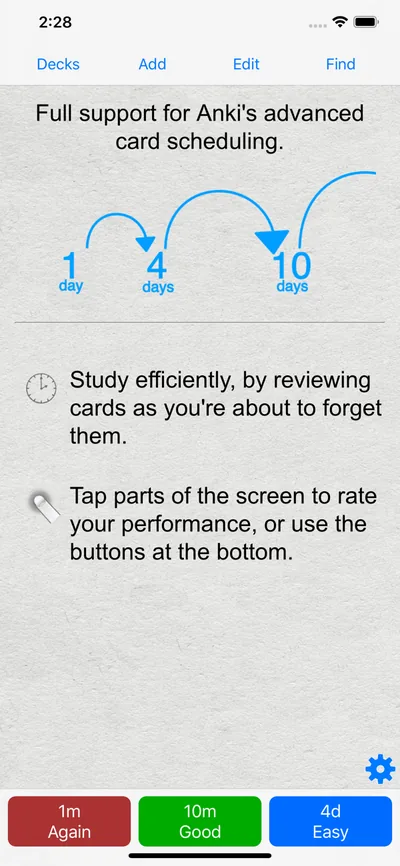
Each answer button shows when the card comes back: in a minute, ten minutes or four days.
Pleco
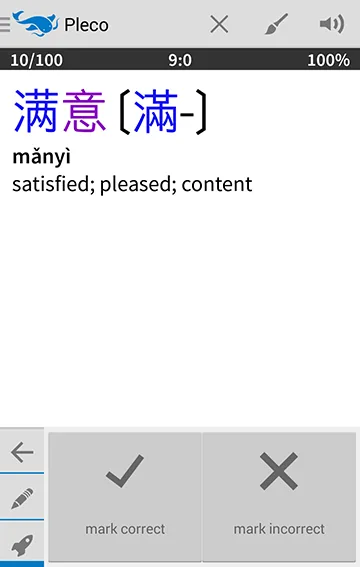
A self-graded card in tone colours: satisfied, 满意, then right or wrong.
Skritter
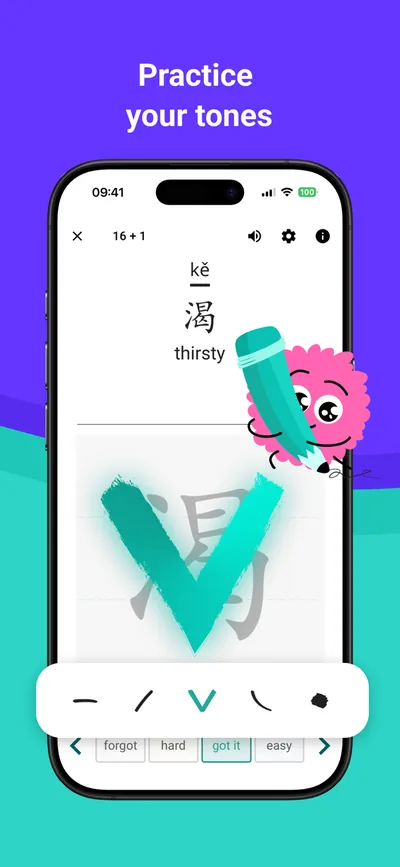
You draw the tone for thirsty, 渴, then grade yourself.
Hack Chinese
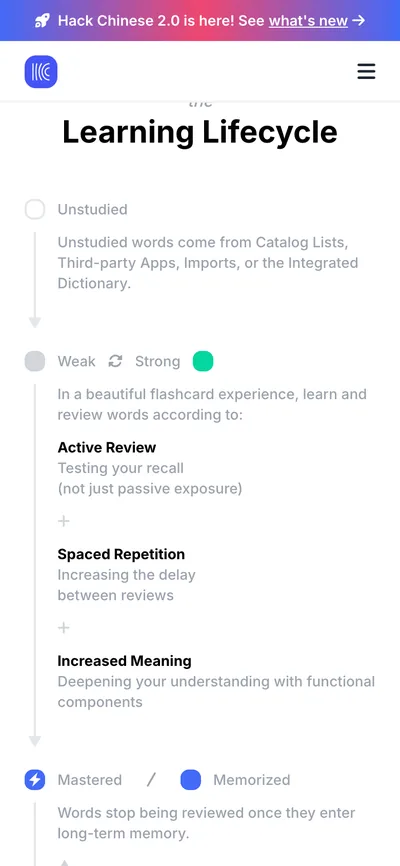
No public review screen; its home page explains that mastered words stop coming back.
Quizlet
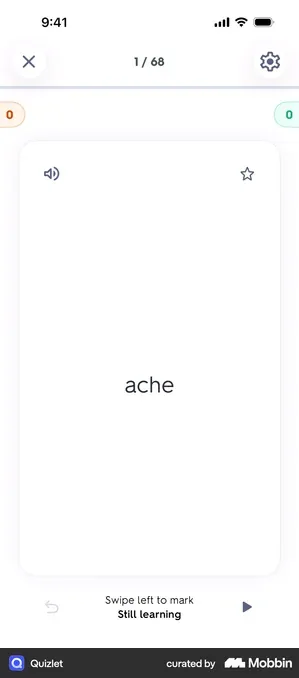
A general flashcard app, shown with an English set: swipe for still learning or know.
SayMei
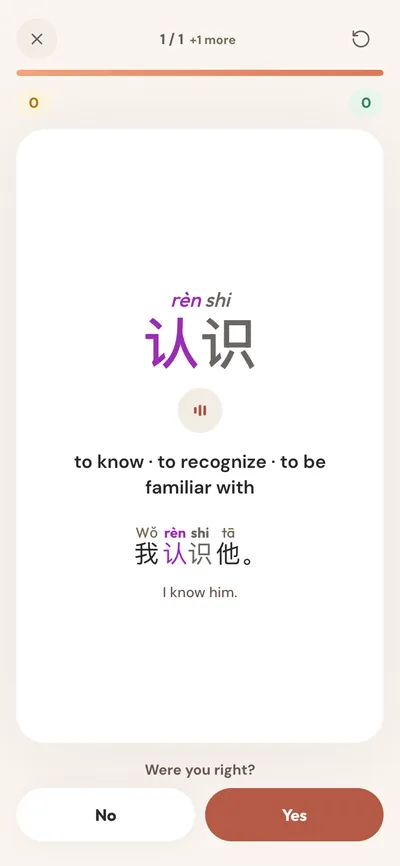
The answer side for know, 认识: audio, tone colours, a sentence, then “Were you right?”
Pictures: AnkiMobile's and Skritter's own App Store pictures; a page of Pleco's Android manual; Hack Chinese's home page, captured on a 390-pixel phone screen on 8 October 2026; a Quizlet screen from Mobbin's library of real app screens; SayMei's flashcards on a test account.
Notice how much each screen asks of you. Anki shows when the card will come back, Pleco and SayMei ask whether you were right, and Skritter makes you draw. None is better for everyone. I'd pick the one you'll want to open tomorrow.
FSRS predicts your memory far better
Every app has to guess when you're about to forget a word. FSRS, the Free Spaced Repetition Scheduler, makes that guess from a model of memory fitted to hundreds of millions of real reviews.
The older SM-2 algorithm, which Anki has used for years, grows each interval by a multiplier, the card's ease. FSRS instead tracks how hard each word is for you, how stable its memory is and how likely you are to recall it today.
The difference shows when you test the guesses against real reviews, which the FSRS team does in public. Here's how far each algorithm's predictions were from what Anki users actually remembered:
Source: Expertium's write-up of the open-spaced-repetition benchmark, RMSE in bins. SM-2 doesn't predict recall on its own, so the benchmark converts its intervals into a prediction.
Fitting matters too. Anki's Optimize button fits FSRS to your own reviews, and the fitted version beat the default settings for 84% of users in the same benchmark.
Here's which scheduler each app uses, and what it costs:
Anki
- Price
- Free; $24.99 once on iPhone
- Scheduler
- SM-2, or FSRS-6 when you switch it on
Pleco
- Price
- Free app; flashcards in a $29.99 bundle
- Scheduler
- Its own score-based system
Hack Chinese
- Price
- $12 to $18 a month
- Scheduler
- Its own, with presets
Skritter
- Price
- $14.99 a month or $99.99 a year
- Scheduler
- Its own interval multiplier
Quizlet
- Price
- Free with ads; Plus is paid
- Scheduler
- Its own spaced repetition
SayMei
- Price
- Free for 10 words a day; Premium $5.99 a month
- Scheduler
- FSRS-6, default settings
Sources: each app's website, help pages or US App Store listing, checked 8 October 2026.
Only Anki lets FSRS learn your memory, as far as we could find. Pleco, Skritter and Hack Chinese use their own rules, and SayMei uses FSRS-6 with the default settings for everyone.
New words a day decide your workload
A better algorithm saves you some reviews. How many new words you add decides how many reviews you'll have, and the difference is far bigger.
We built a model to show it. A simulated learner forgets the way FSRS's memory model says an average Anki user does, and each scheduler decides when every word comes back. Set your pace and see your next three months:
Review-load simulator
Pick how many new words you'll add each day and see the reviews that follow over 90 days, with FSRS and with Anki's old SM-2 settings.
New words a day
Recall goal for FSRS
52 reviews a day
by day 90 with FSRS at 90%: 11% fewer than SM-2, which asks for 59.
That's about 18 minutes a day, new words included, and you'd remember 95% of the 900 words you've learned.
Reviews due each day when you add 10 new words a day, in our model
- SM-2, Anki's defaults
- FSRS at 90%
| Day | FSRS at 90% | SM-2, Anki's defaults |
|---|---|---|
| Day 1 | 0 | 0 |
| Day 10 | 17 | 21 |
| Day 20 | 28 | 33 |
| Day 30 | 33 | 35 |
| Day 40 | 35 | 45 |
| Day 50 | 38 | 47 |
| Day 60 | 44 | 48 |
| Day 70 | 47 | 50 |
| Day 80 | 50 | 51 |
| Day 90 | 52 | 59 |
Our model: a learner who forgets the way FSRS-6's default memory model predicts, answers only Again or Good, and does every review on the day it's due. SM-2 uses Anki's default settings. Averages, not a forecast for you; the method is under How we compared.
Two things stood out when we ran it. The lines for FSRS and SM-2 stay close, and both keep climbing for the whole three months. Each new word you add today brings reviews for months, so the pile keeps growing long after your daily pace stays the same.
Your recall goal, called desired retention in Anki, moves the workload far more than the algorithm. Here's what changes at 10 new words a day:
Source: our model, described under How we compared. Minutes include learning the 10 new words.
Pushing from 90% to 95% costs more extra reviews than switching algorithms saves. So I'd keep the default unless the workload is too much, and then lower your new words before you lower the goal.
How many new words is right? Hack Chinese suggests no more than about 200 a month unless you study full-time. That's six or seven a day, which our model puts at under a quarter of an hour a day by the third month.
The best pick for each learner
There's no single best flashcard app, but there's a best one for each goal. Here's where we'd start:
Free, and as flexible as possible
- Our pick
- Anki
- Why
- Any card you can imagine, with FSRS fitted to you
You look words up in Pleco
- Our pick
- Pleco
- Why
- Every look-up is one tap from a card; you pay once
You want to write characters
- Our pick
- Skritter
- Why
- It grades every stroke
HSK words with no setup
- Our pick
- Hack Chinese
- Why
- It finds the words you don't know yet
Your class shares word lists
- Our pick
- Quizlet
- Why
- Your teacher's set is already there
You learn with SayMei's lessons
- Our pick
- SayMei
- Why
- Words from your lessons and songs save in one tap
Prices and features checked 8 October 2026.
Most learners need only one of these. Our guide to the best apps to learn Chinese shows where a flashcard app fits next to a course, a dictionary and speaking practice.
Where SayMei fits, and where it doesn't
Our flashcards are built for SayMei learners. Words you meet in lessons with Mei Lin, in the lesson songs and in listening dialogues save to your cards in one tap, so you review the words you've actually used.
Each card has audio and tone colours, and reviews take two taps: say whether you think you know the word, then whether you were right. They're scheduled with FSRS, the same algorithm as Anki's option, and you set your recall goal anywhere from 70% to 99%.
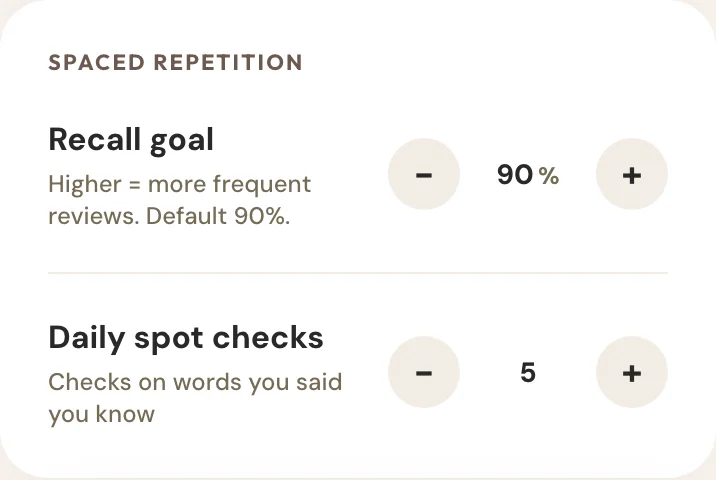
You can also load HSK lists in one tap. SayMei's built-in HSK 1 to 9 decks follow the HSK 3.0 exam syllabus published in November 2025, the same syllabus as its free HSK word lists, and TOCFL and the HSK Standard Course books are there too.
Where we lose:
- The free plan is small. It covers 10 words a day, reviews included, which our model says sustains only one or two new words a day. Premium removes the limit for $5.99 a month.
- It's browser-only. There's no app to install and no offline mode.
- It can't learn your memory yet. Everyone gets FSRS-6's default settings, which Anki beats once you fit FSRS to your reviews.
- It's words only. You can't write your own sentence cards, and there's no handwriting practice.
What to do next
- Decide how much setup you'll put up with. Build Anki if you enjoy it; pick a Chinese app if you don't.
- Run your pace through the simulator. Choose the number of new words you could still manage on a busy day.
- Switch on FSRS if you use Anki. Press Optimize once you've done a few hundred reviews.
- Keep your recall goal near the default. Lower your new words first when reviews pile up.
- Use your words out loud. Flashcards keep words in memory; speaking and reading make them yours.
If you're choosing your whole set of apps, start with our guide to the best apps to learn Chinese.
FAQ
Is Anki good for learning Chinese?
Yes, if you'll set it up. Anki is free on computers, the web and Android, and $24.99 once on iPhone. It doesn't know Chinese, so you add a deck and an add-on such as Chinese Support 3 for pinyin, tone colours and audio. Switch on FSRS in the deck options, because Anki keeps its old scheduler until you do.
Is Pleco's flashcard system worth it?
It is if Pleco is already your dictionary. Any entry becomes a card in one tap, and premade lists include the 2026 HSK 3.0 vocabulary. Spaced repetition, tone drills and handwriting tests come in the $29.99 Basic Bundle, a one-off purchase. The free version only shows cards in random order.
Is Hack Chinese better than Anki?
It's easier, not better. Hack Chinese needs no setup: it estimates the words you know, teaches the HSK words you don't, and adds audio and tone colours. Anki is free and far more flexible, and it can fit FSRS to your own memory. Hack Chinese costs $12 to $18 a month after a free trial, and runs only in a browser.
Do I need both Skritter and Anki?
Only if you want to write characters by hand. Skritter grades every stroke and drills tones, which Anki can't do well, but it costs $14.99 a month. If you only need to read and recognise words, one app is enough. Most learners need to write far fewer characters than they read.
Should I turn on FSRS in Anki?
Yes. FSRS has been built into Anki since late 2023, and in a benchmark of real Anki reviews it predicted recall better than the old algorithm for 99.6% of users. Turn it on in the deck options, keep desired retention at the default, and press Optimize once you have a few hundred reviews.
How many new Chinese words should I learn a day?
For most people, five to ten. In our model each new word a day turns into about five reviews a day within three months, so ten new words means roughly 50 reviews a day by then, about 18 minutes. Hack Chinese suggests a similar pace for anyone not studying full-time.
Is there a free Chinese flashcard app with audio?
Anki is free on computers and Android; add audio with a shared deck that includes it or the Chinese Support 3 add-on. Pleco is free with computer-voice audio, but its spaced repetition is paid. SayMei's flashcards have audio on every card and are free for 10 words a day.
Is Quizlet good for learning Chinese?
It's fine for a class word list, and weak on its own. Quizlet is a general study app: you make sets or use other people's, and it adds spaced repetition and an adaptive Learn mode. Nothing in it is built for tones or characters, so for your own vocabulary a Chinese app, or Anki with an HSK deck, does more.
How we compared
We compared what each app publishes about itself: websites, help pages, manuals and US App Store listings, read on 8 October 2026. We didn't test the apps hands-on, and we report each vendor's feature as its claim. The phone screens come from the apps' own App Store pictures and manuals, Mobbin's library of real app screens, and SayMei's own app.
The benchmark numbers come from the open-spaced-repetition project's benchmark, built on 727 million reviews from 10,000 Anki users with about 350 million used for testing, as summarised in Expertium's write-up. Its error measure is RMSE in bins: how far predicted recall sits from real recall, averaged over groups of similar reviews.
The review-load model follows one simulated learner for 90 days:
- Memory. The learner forgets the way FSRS-6's default memory model predicts. Its 21 settings come from ts-fsrs 5.4.1.
- First day. New words get a first answer in the shares the FSRS team measured across Anki users: Again 24%, Hard 9%, Good 50%, Easy 17%. Then they finish Anki's 1- and 10-minute learning steps.
- Reviews. The learner answers only Again or Good, and does every review on the day it's due. There are no daily limits, random spread or missed days.
- SM-2. Anki's default deck options: graduating interval 1 day, starting ease 2.5, and Again cuts ease by 0.2 and resets the interval to 1 day.
- Time. The FSRS project's average Anki answer times: about 12 seconds per remembered card and 19 seconds per forgotten one, plus a relearning step.
- The numbers are averages. We follow every path a word could take, weighted by its chance, so there's no randomness.
One caveat: because the learner forgets exactly as FSRS's model expects, the model favours FSRS. Real learners differ, which is why fitting FSRS to your own reviews helps.
We also looked at SayMei's own flashcard reviews, but too few learners have reached later reviews to publish a curve.
Sources
Checked 8 October 2026 unless noted.
Anki
- Anki downloads; AnkiMobile on the App Store; AnkiDroid on Google Play
- Anki manual: deck options and FSRS; Anki FAQ: what spaced repetition algorithm does Anki use?
- Anki 25.07 release notes (FSRS-6); Anki source code: default deck options and SM-2 review intervals
- AnkiWeb shared HSK decks; Chinese Support 3 add-on
Pleco, Skritter, Hack Chinese, Quizlet, Memrise
- Pleco on the App Store; Pleco bundles; Pleco flashcards manual; Pleco forums: flashcard profiles
- Skritter pricing and features; Skritter on the App Store; Skritter's spaced repetition; Skritter's HSK 1–4 recordings
- Hack Chinese pricing; Hack Chinese updates; Hack Chinese audio voices; Hack Chinese daily learning targets
- Quizlet on the App Store; Memrise on the App Store
Memory research and benchmarks
- Cepeda, N. J., et al. (2006). Distributed practice in verbal recall tasks. Psychological Bulletin 132(3). https://doi.org/10.1037/0033-2909.132.3.354
- Expertium, "Benchmark of Spaced Repetition Algorithms"; open-spaced-repetition SRS benchmark
- ts-fsrs (FSRS-6 default parameters); fsrs-rs simulator defaults
SayMei (our pages)
Methods
This guide draws on the public pages listed above, read on 8 October 2026. The phone screens are the apps' own App Store screenshots, a page of Pleco's manual, Hack Chinese's home page, a Quizlet screen from Mobbin's library of real app screens, and SayMei's flashcards captured on a test account. The charts and the simulator run on the FSRS-6 formulas and Anki's SM-2 rules described under How we compared. The Mandarin examples were checked against the CC-CEDICT dictionary. If you spot a mistake, tell us: we fix errors.