Can you learn Chinese through songs? What the research says
Songs help you remember Chinese words and phrases, but the melody overrides the tones. What history and research show, and how to learn from a song.

A catchy song can put a Chinese phrase in your head and keep it there. Getting that phrase's tones right is a different job, and songs can't do it for you.
If you're a beginner wondering whether songs deserve a place in your study time, this guide is for you. We'll go from 3,000 years of learning by song to what the lab studies found, then look at the apps that use songs today and at SayMei's own songs.
Key takeaways
- Songs are one of the oldest ways to learn. China taught children to read with chanted rhymes for centuries before anyone ran an experiment.
- A melody keeps the exact words. It works best when the tune is simple and repeats, and it helps most when you have to say the words yourself.
- Words come slowly, through repeats. One listen teaches little. Hearing the same song again and again adds up.
- Mandarin pop melodies mostly ignore the tones. You can't learn a word's tone from a song. Check every new word in speech.
- Pick songs by goal. Songs written for learners teach set words; real pop keeps you listening. SayMei's 175 free songs cover HSK 1.
People have learned through songs for 3,000 years
Long before textbooks, songs and chants were how people stored long texts. When we went looking, we found the same method on three continents.
In India, the Vedas were composed more than 3,500 years ago and have been chanted from memory ever since. UNESCO lists Vedic chanting as heritage of humanity, and describes the recitation techniques children learn to keep every sound exact.
Epic singers in the Balkans worked differently. In the 1930s, Milman Parry found they rebuilt each song from set phrases rather than memorising it word for word. The psychologist David Rubin later showed how rhythm and rhyme narrow down what can come next, so the memory has less to do.
China built its schooling on the same idea. Confucius told his son that without the Book of Songs he would have nothing to say: 不学诗,无以言 bù xué shī, wú yǐ yán. Children then learned to read with rhymed primers. The Thousand Character Classic uses 1,000 different characters in rhymed lines that are easy to chant. The Three Character Classic opens with a line generations of children chanted, "People at birth are good by nature":
人之初,性本善。 Rén zhī chū, xìng běn shàn.
Pupils recited it aloud, and understanding was left to come later.
We traced the idea from ancient chants to today's apps:
Songs have carried lessons for 3,000 years
When each tradition began, by era (eras are not to scale)
| Tradition | When it began |
|---|---|
| Vedic chanting, India | Ancient: by 1500 BCE |
| Book of Songs, China | Ancient: 1000–500 BCE |
| Thousand Character Classic, China | Medieval: 500s |
| Three Character Classic, China | Medieval: 1200s |
| The "ABC" song, Boston | 1800s: 1835 |
| Schoolhouse Rock! on US television | 1900s: 1973 |
| Jazz Chants for English learners | 1900s: 1978 |
| Lab tests of song and memory | 1900s: 1990s |
| Apps with Chinese songs and lyrics | 2000s: 2010s |
Sources: UNESCO, Chinese Text Initiative, The Met, World History Commons, American Songwriter, CBS News, National Diet Library, Wallace, 1994, FluentU on the App Store.
The modern versions are everywhere once you look. The ABC song shares its tune with "Twinkle, Twinkle, Little Star". Many Chinese children's first song, "Two Tigers", 两只老虎, is sung to Frère Jacques. In the 1970s, Schoolhouse Rock! set grammar and times tables to music for "rote memory".
Every one of these leans on two things: fixed wording and lots of repetition. As we'll see, the lab studies found the same.
A melody holds the words in place
Singing helps you remember exact wording, but only under the right conditions.
The classic test came from Wanda Wallace in 1994. People heard verses of a folk ballad, sung or spoken. When every verse used the same simple melody, the sung version was remembered better. When each verse had a new melody, singing did worse than speaking.
Later studies added two cautions. Songs are slower than speech, and when the spoken version was slowed to match, the advantage disappeared. And singing while you learn can split your attention: people recalled fewer words of a new song when they sang it back than when they spoke it.
The payoff can show up later. In one study, names sung to "Yankee Doodle" were no faster to learn, but quicker to relearn a week later.
The clearest test with a foreign language came from Edinburgh. Sixty students spent 15 minutes learning 20 Hungarian phrases by listening and repeating them: spoken, spoken in rhythm, or sung. This time all three versions took the same time. Here's how the speakers and singers scored:
Singing helped most when learners had to say the phrase
Average share of points on five tests, 60 adults learning 20 Hungarian phrases for 15 minutes
| Test | What the test asked | Learned by speaking | Learned by singing |
|---|---|---|---|
| Say the phrase | Hear English, say it in Hungarian | 10% | 20% |
| Short conversation | Answer in Hungarian | 23% | 37% |
| Give the meaning | Hear Hungarian, give the English | 38% | 45% |
| Vocabulary quiz | Multiple choice | 58% | 62% |
| Recognise the phrase | Spot the phrase you learned | 80% | 80% |
Source: Ludke, Ferreira & Overy, 2014, Table 3: mean scores as a share of possible points, rounded. Only the first two differences were statistically significant. The rhythmic-speaking group scored close to the speaking group.
Singing doubled what learners could say from memory, from about two phrases to four. Recognition didn't change at all.
So I'd use songs the way the studies did:
- Short lines you can hold in one breath.
- One simple tune that repeats from verse to verse.
- Many repeats, sung along, not just heard.
Expect songs to give you exact phrases to say, not understanding.
Songs teach words slowly, through repeats
Listening to songs does teach new words, but in the studies we read, each listen adds only a little.
A study of incidental learning from songs had learners hear songs one, three or five times. They picked up words without trying, more with each repeat, and words that came up more often were learned better. A review of 28 studies found a large effect of English songs on English vocabulary. The same review asks future studies for tighter designs, such as controlling how fast the songs go.
Recognising a word and using it are different, too. Five-year-olds in Spain recognised the words of a song after three lessons, but most couldn't produce them yet.
Two studies show what happens when learners also sing. Spanish-speaking children in Ecuador who learned an English passage as a song recalled and pronounced it better than children who learned it as a poem, and still did six months later. And 95 Chinese teenagers learning English learned more words, and pronounced them better, by singing lyrics than by reciting them.
Songs also replay themselves. Almost everyone gets a song stuck in their head now and then. Language teacher Tim Murphey once suggested that this "din" works as free rehearsal.
What I take from these studies: one song, many plays. Then say its words out loud, because hearing alone mostly builds recognition.
In Mandarin, the melody overrides the tones
This is where Chinese differs from Spanish or English. In Mandarin, pitch tells words apart, and a melody needs pitch too.
Take "buy", 买, and "sell", 卖. In speech, one dips and the other falls. In a song, both sit on whatever notes the composer wrote. Songwriters can choose words whose tones fit the tune, but Mandarin pop mostly doesn't, as a survey of Mandarin songs found.
The neatest evidence we found comes from songs released in both Mandarin and Cantonese. Linguist James Kirby compared eight pop songs with both kinds of lyrics on the same melodies. Here's how often the tune moved the same way as the words' tones:
Source: Kirby, 2022, Tables 2 and 3: 8 songs, 1,720 Cantonese and 1,644 Mandarin steps. In the rest, the melody or the tones stayed level while the other moved.
Cantonese songwriters keep the tones in order, high words on higher notes, and listeners use that order to follow the lyrics. Mandarin songs mostly don't. Some genres do better: by a different measure, the melody followed the tones over 65% of the time in two excerpts from Chinese musicals. Even the backup clues fade. A small study found tone length differences vanished once singers sang whole sentences.
Native listeners cope because they already know the words and lean on context. You don't have that yet. So I'd never learn a tone from a song: learn each word from speech, and keep songs for vocabulary and listening. Our guide to learning Chinese tones has the plan.
How apps use songs for Chinese today
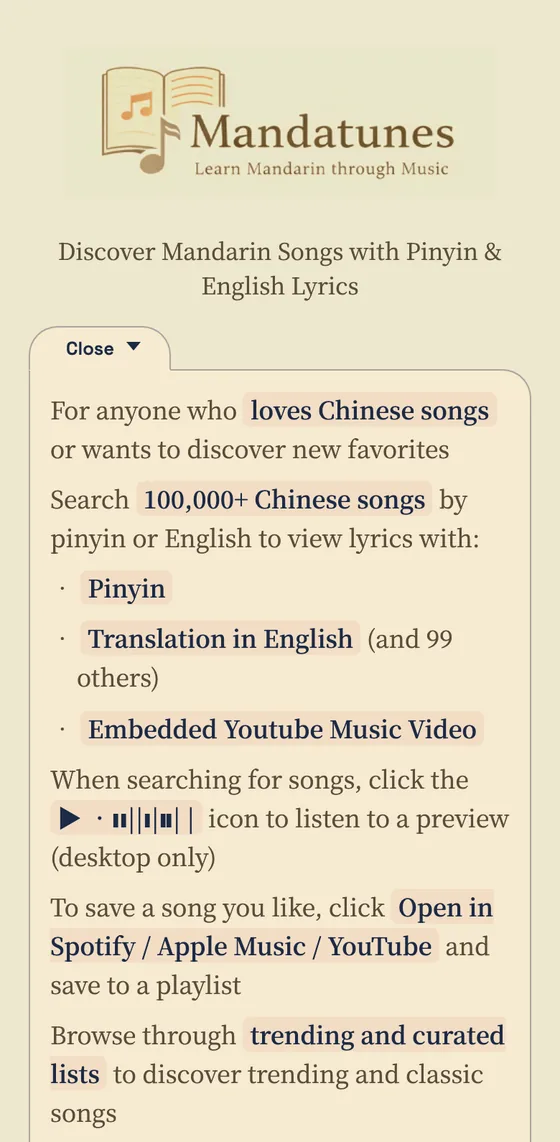
In our look at the market, apps use songs in three ways: tools for reading real Chinese pop, songs written for learners, and songs built from your own word list.
Each fits a different goal. We checked every product's public pages on 8 October 2026:
Best for · Pick · Cost
Songs written around HSK 1 lessons
Free, no account
Reading the lyrics of real Chinese pop
Free, no account
Studying famous songs line by line
Free preview lessons; full-lesson price not shown
Pinyin under songs you already stream
$11.99 a month after a free month
Music videos turned into quizzes
From $29.99 a month after a 14-day trial
Songs made from your own word list
5 songs a month free; $7.99 a month
Young children
Album to buy; free samples
Prices in US dollars, checked 8 October 2026 on each linked page. Apple Music shows pinyin on select Chinese songs; its listed translation pairs don't include Chinese to English. Mandarin Melody is an iOS app in beta.
One popular format skips Chinese for now: LyricsTraining, the game where you fill in missing lyrics, offers 13 languages, none of them Chinese.
If you love a real artist, start there: we think motivation counts for a lot. If you want set words at your level, pick songs written for learners.
Where SayMei's songs fit, and where they don't
We built SayMei's songs for one job: teaching the HSK 1 words and grammar from SayMei's lessons. We counted the whole catalogue from SayMei's public song list:
| What we counted | SayMei's songs |
|---|---|
| Songs | 175, all at HSK 1: 53 grammar songs, 122 word songs |
| Songs at HSK 2 or above | None |
| Typical length | 3 min 33 s; about 10 hours in all |
| Different words taught | 528 |
| HSK 1 words covered (2025 list) | 266 of 300 |
| Lyric lines with Chinese in them | About 2 in 3; the rest are English |
| How often a word song repeats each word | In 11 lines (median) |
Our count, 7–8 October 2026. Levels from the official 2025 HSK syllabus. Method in Methods.
The songs follow the older 500-word HSK 1 list. The 2025 syllabus cut HSK 1 to 300 words, so many of the songs' words now count as HSK 2 or 3:
Our count against the 2025 syllabus. Shares are rounded, so they add to 99%. Names such as Beijing, 北京, and phrases such as "wrong", 不对, aren't list entries.
If you're studying for the new HSK 1, the song finder below marks which words count at each level.
Our melodies aren't fitted to the tones, so SayMei's songs have the same problem as Mandarin pop. Instead, we put the spoken tones next to the music. Every Chinese line shows pinyin with tone marks, you can tap any word to look it up, and each song's key words play as spoken audio.
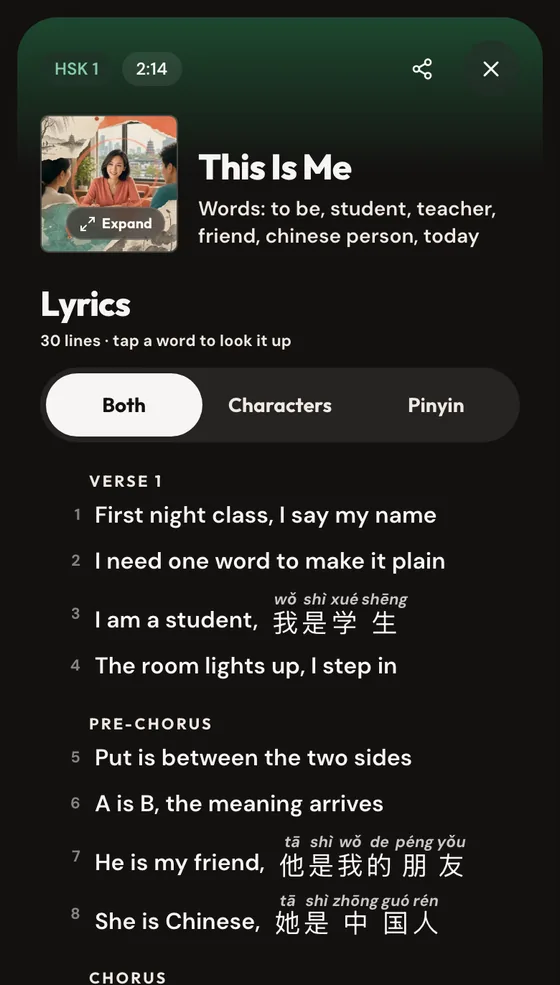
Where our songs fall short:
- They stop at HSK 1. There's nothing yet for HSK 2 and up.
- About a third of the lines are English. They explain the Chinese, but they're time you're not hearing Chinese.
- They aren't real Chinese pop. For that, use one of the tools above.
Pick your level and a topic to find a song for the words you need:
Find a SayMei song for the words you need
All 175 songs are in SayMei’s HSK 1 course. On the 2025 HSK syllabus, 156 of them teach HSK 1 words, 72 teach HSK 2 words and 61 teach words from HSK 3 or higher.
Words from
156 of 175 songs match
- 我I (HSK 1)
- 我们we (HSK 1)
- 你you (HSK 1)
- 你们you (HSK 1)
- 您you (HSK 1)
- 是to be (HSK 1)
- 学生student (HSK 1)
- 老师teacher (HSK 1)
- 朋友friend (HSK 1)
- 中国人Chinese person
- 今天today (HSK 1)
- 男male (HSK 1)
- 男人man
- 男孩儿boy
- 女female (HSK 1)
- 女人woman
- 女孩儿girl
Every song in SayMei’s public song list on 7 October 2026, in course order. Levels are each word’s level on the 2025 HSK syllabus; marked words are at the level you picked. Songs open on SayMei, free with no account.
Use songs alongside tone practice
Songs work best as one part of a routine. Here's the 15-minute routine I'd use with one song:
- Listen twice without reading, then once with the lyrics.
- Read the Chinese lines with pinyin and find the song's key words.
- Hear each key word spoken, not sung, and copy it in your normal voice.
- Sing along a few times. Now the melody is doing its job: holding the words.
- Say each line in your speaking voice, with the tones from step 3.
- Check a tricky tone with the Tone Checker or the tone-pair trainer.
Then play the song again tomorrow. Repeats are where the words come from.
Key takeaways
- Use songs for words and phrases. A simple, repeated tune keeps exact wording in your head.
- Replay one song many times. The research shows words build up with repeats, not from a single listen.
- Never learn a tone from a melody. Hear every new word spoken, then sing.
- Choose by goal. Learner songs for set words at your level, real pop for motivation.
Start with SayMei's 175 free HSK 1 songs: no account needed.
FAQ
Can you learn Chinese just by listening to songs?
You can pick up words and phrases, but slowly, and mostly for recognition. In one study, learners who heard songs more times learned more of their words. Songs won't teach you grammar or speaking on their own. Pair them with lessons or graded material, and say the words out loud.
Do Chinese songs keep the tones?
Mostly not in Mandarin pop. In eight songs released in both languages on the same melodies, the tune moved with the tones in 38% of steps for the Mandarin lyrics, against 77% for the Cantonese. Native listeners understand anyway from context. Learners should check each word's tone in speech.
Will singing along mess up my tones?
Not if you learn each word from speech first. The risk is learning a new word only from a song, where the melody has replaced its tone. Hear the word spoken, copy it in your speaking voice, then sing. SayMei's tone-pair trainer drills all 20 two-syllable tone patterns if a pair keeps slipping.
What are good Chinese songs for beginners?
Songs written for learners are easiest: short lines, slow, repeated, with pinyin. SayMei's 175 HSK 1 songs are free, with no account. For real pop, slow ballads with simple lyrics work best, read alongside a lyrics tool with pinyin and a translation, such as Mandatunes. Children's songs like "Two Tigers", 两只老虎, are good for absolute beginners.
Are there Chinese songs for HSK 2 and above?
Few are written for those levels. SayMei's songs stop at HSK 1, although 72 of them teach words from the 2025 HSK 2 list. ChineseAqua groups famous pop songs into lessons, and Mandarin Melody makes songs from a word list you give it. Beyond that, real Chinese pop is the main source.
Do songs help children learn a language?
Yes, for remembering words and sounds. Spanish-speaking children who learned an English passage as a song recalled and pronounced it better than with a spoken poem, six months later too. Preschoolers in another study recognised the song's words but couldn't yet say most of them.
Sources
History
- UNESCO. Tradition of Vedic chanting. Proclaimed 2003, inscribed 2008.
- Wills, M. (2020). How do we know that epic poems were recited from memory? JSTOR Daily, 28 February.
- Rubin, D. C. (1995). Memory in Oral Traditions: The Cognitive Psychology of Epic, Ballads, and Counting-out Rhymes. Oxford University Press.
- Confucius. Analects 16.13, Legge translation. Chinese Text Project.
- Chinese Text Initiative, University of Virginia. Shijing, introduction.
- The Metropolitan Museum of Art. The Thousand-Character Classic (Senjimon).
- World History Commons. Three-Character Classic.
- Jordan, D. K. Sān Zì Jīng, annotated text. University of California, San Diego.
- Uitti, J. (2023). The meaning behind the ABCs of "The Alphabet Song". American Songwriter, 15 June.
- China Daily HK (2022). Tiger earns its stripes as folk hero and role model. 31 January.
- CBS News (2019). Jay-Z, Cyndi Lauper, "Schoolhouse Rock" added to National Recording Registry. 20 March.
- Ahrens & Flaherty. Schoolhouse Rock.
- Graham, C. (1978). Jazz Chants. Oxford University Press. National Diet Library record.
Songs and memory
- Wallace, W. T. (1994). Memory for music: Effect of melody on recall of text. Journal of Experimental Psychology: Learning, Memory, and Cognition, 20(6), 1471–1485.
- Kilgour, A. R., Jakobson, L. S., & Cuddy, L. L. (2000). Music training and rate of presentation as mediators of text and song recall. Memory & Cognition, 28(5), 700–710.
- Racette, A., & Peretz, I. (2007). Learning lyrics: To sing or not to sing? Memory & Cognition, 35(2), 242–253.
- Rainey, D. W., & Larsen, J. D. (2002). The effect of familiar melodies on initial learning and long-term memory for unconnected text. Music Perception, 20(2), 173–186.
- Ludke, K. M., Ferreira, F., & Overy, K. (2014). Singing can facilitate foreign language learning. Memory & Cognition, 42(1), 41–52.
- Pavia, N., Webb, S., & Faez, F. (2019). Incidental vocabulary learning through listening to songs. Studies in Second Language Acquisition, 41(4), 745–768.
- Murphy Odo, D. (2021). Examining the influence of English songs on English L2 lexical learning: A quantitative meta-analytic review. Language, Culture and Curriculum.
- Coyle, Y., & Gómez Gracia, R. (2014). Using songs to enhance L2 vocabulary acquisition in preschool children. ELT Journal, 68(3), 276–285.
- Good, A. J., Russo, F. A., & Sullivan, J. (2015). The efficacy of singing in foreign-language learning. Psychology of Music, 43(5), 627–640.
- Zhang, Y., Baills, F., & Prieto, P. (2023). Singing songs facilitates L2 pronunciation and vocabulary learning. Languages, 8(3), 219.
- Liikkanen, L. A., & Jakubowski, K. (2020). Involuntary musical imagery as a component of ordinary music cognition. Psychonomic Bulletin & Review, 27(6), 1195–1217.
- Murphey, T. (1990). The song stuck in my head phenomenon: A melodic din in the LAD? System, 18(1), 53–64.
Tones in songs
- Kirby, J. P. (2022). Comparative tonal text-setting in Mandarin and Cantonese popular song. Proceedings of the 58th Annual Meeting of the Chicago Linguistic Society, 211–230.
- Wee, L.-H. (2007). Unraveling the relation between Mandarin tones and musical melody. Journal of Chinese Linguistics, 35(1), 128–144.
- Wong, P. C. M., & Diehl, R. L. (2002). How can the lyrics of a song in a tone language be understood? Psychology of Music, 30(2), 202–209.
- Zhang, R., & Kong, J. (2026). Tone-tune correspondence in Chinese musicals. Speech Prosody 2026.
- Zhang, Q., Zhu, L., & Jiang, X. (2024). Can we sing the tones of a tonal language? Speech Prosody 2024.
Apps and products, checked 8 October 2026: Mandatunes, ChineseAqua, Apple Music, FluentU, Mandarin Melody, Miss Panda Chinese, LyricsTraining.
SayMei: the public song list of 7 October 2026 and the music course; the HSK 2025 syllabus word lists as parsed for our HSK 3.0 guide; CC-CEDICT (MDBG release of 29 November 2025), CC BY-SA 4.0.
Methods
Every fact on this page links to its source, checked on 7 and 8 October 2026. We read the full text of Ludke, Ferreira & Overy (2014), Kirby (2022), Zhang & Kong (2026) and Zhang, Zhu & Jiang (2024), and the abstracts of the other studies. For Wallace (1994) we relied on Ludke and colleagues' summary. Product facts come from each company's public pages on 8 October 2026; we didn't sign up for or test any app.
The SayMei counts come from SayMei's public song list on 7 October 2026, the same 175 songs as on 6 October. We counted each song's listed target words, and matched them to the official 2025 HSK syllabus and the 2021 standard, as parsed for our HSK 3.0 guide. "Lines with Chinese" counts lyric lines that contain at least one Chinese character. A word's repeats count the lyric lines in its song that contain it; a one-character word counts only where it stands as a word, which we found by splitting the lines with the CC-CEDICT dictionary. No learner data was used.
The song finder lists every song in the order of SayMei's course. Its pinyin is the official 2025 syllabus spelling where the word is on it, and a standard dictionary spelling otherwise. While building it we corrected some of the song data's pinyin and English, such as "rain", 雨, which the data spelled yù. Topics are our own grouping.
What we didn't do. We didn't measure how closely SayMei's melodies follow the tones, and we didn't run listening tests.
If you spot a mistake, tell us.