LingoAce review for parents: prices, teachers, refunds and the fine print
Our LingoAce review for parents: price per class and per year, teachers, levels against the new HSK, refund and expiry rules, and 162 recent reviews.


LingoAce publishes a price range, not a price list. You hear what a package costs from a sales consultant, usually after your child's free trial class.
This review is for parents weighing LingoAce for a child aged 3 to 15. We checked its prices, terms, privacy policy and store listings, and read 162 recent reviews, most of them by parents and children.
Key takeaways
- Children rate the teachers highly. A kind, patient teacher is what children praise most in recent App Store reviews.
- The price list stays private. LingoAce publishes only a range per class and quotes packages after the trial.
- Budget for a year. At the two classes a week LingoAce advises, a year costs at least about $1,500.
- Refunds exist, with fine print. You get back unused paid classes minus a fee, while bonus classes and instalment plans get nothing.
- Expect calls after the trial. Sales calls are one of the two complaints families raise most in recent low-star reviews.
- Its HSK labels follow the old exam. LingoAce's level chart matches the old HSK word lists, and the new HSK asks for more.
Strong teachers, a weaker company around them
LingoAce does the teaching well and the business around it less well. We read its terms, payment agreements and store listings, then the reviews, and scored each part:
What you need · Verdict · What LingoAce gives you
A teacher your child likes
Strong
One-to-one classes with a teacher you choose and can change
A clear path through levels
Strong
Four programmes and 12 levels, with a test every fourth lesson
Progress you can see
Strong
Reports, homework marks and class recordings for parents
A level you can trust for exams
Partly
HSK labels that follow the old word lists
Prices you can compare
Partly
A range of $14.20 to $30 a class; packages quoted after the trial
An easy way out
Partly
Refunds of unused paid classes minus 3%; none on instalment plans
Calm after the trial
Missing
Sales calls and messages that some families can't stop
Sources: LingoAce's website, terms and payment agreements, its App Store and Google Play listings, and the reviews we read, checked 6 November 2026. Each row is explained below.
If your child needs a live adult to talk Chinese with, LingoAce delivers that. Go in knowing the money rules, because that's where most complaints start.
What LingoAce sells today
LingoAce is a Singapore company that sells live online classes to children aged 3 to 15. It teaches Chinese, English and maths, mostly one to one, by video call.
Hugh Yao founded it in 2017, its own history says. Its biggest funding rounds, led by investors including Sequoia Capital India and Tiger Global, raised $160 million. It now runs in-person ACE Academy centres in Singapore, the US and Australia too.
For Chinese, it sells four programmes by age and level:
- Preschool, for ages 3 to 5: games, songs and stories for children who speak Mandarin at home.
- Core, for ages 5 to 15: for beginners, and for children who hear some Chinese at home.
- Discovery: the intermediate programme, for the same ages.
- Advanced: for confident speakers, up to exam preparation.
One-to-one classes last 25 or 55 minutes, and they're taught in Chinese, at your child's level. LingoAce also runs small groups of up to six children, and a Singapore version follows the local school syllabus.
Each family gets a team: a course consultant who places you and sells the package, a learning advisor for ongoing help, the teacher and IT support. You use two apps. LingoAce Student runs the classes and homework, and LingoAce Connect handles booking, reports and replays for parents. Classes work on a computer, an iPad or an Android device.
One caveat: treat LingoAce's own numbers as marketing. Its pages put its teacher count anywhere from 4,000 to 9,000.
So you're buying a school, not a marketplace. LingoAce chooses the course and suggests the teacher, and you choose the times.
Twelve levels, labelled with the old HSK
LingoAce's main course runs through 12 levels, from about age six into the teens. Its level chart pairs its levels with the YCT, China's test for school-age children, and with the HSK, its main test for teens and adults. The top level points at AP® Chinese.
Each unit is four lessons: three new ones, then a review with a test. LingoAce's FAQ says what a beginner should manage. After two weeks, a child can greet people, as in hello, 你好, and count to ten. After six months, they can hold short conversations about hobbies and food.
The HSK labels are the catch. LingoAce pairs Level 5 with both YCT 4 and HSK 3, the match in the YCT syllabus. That match was drawn for the old HSK, when HSK 3 also had 600 words.
The new HSK, which starts on 13 December, asks for more at every level. Here's what each HSK level on LingoAce's chart asks for, old exam against new:
Sources: LingoAce's placement guide; CTI's 2009 word totals for the old HSK and the November 2025 syllabus for the new one, as counted in our HSK 3.0 guide. LingoAce doesn't say which HSK it means, or how many words each level teaches.
The gap starts early. When we matched all 600 YCT words to the new HSK lists, word for word, the full YCT 4 list covered about two thirds of the new HSK 1.
So read LingoAce's HSK labels as a rough guide. If your child is aiming at a test, check the new word lists and try a sample paper before you book a date.
The teachers are why families stay
Children praise LingoAce's teachers more than anything else. In the App Store reviews children wrote over the last two years, about two in five mention a kind or patient teacher.
LingoAce says its teachers are hard to get into. Its FAQ asks for a four-year degree, a teaching certificate or licence, and at least two years of teaching, tutoring, coaching or mentoring. Its Chinese-language blog adds that its Chinese teachers are native speakers with a Mandarin certificate at level 2-A or above, 二级甲等. It also claims that 2% of applicants get through.
Those are LingoAce's own claims, and we found no outside check of them. What you can check is the teacher, and we think that matters more. Profiles show each teacher's years of experience before you book, as this booking screen from its listing shows:
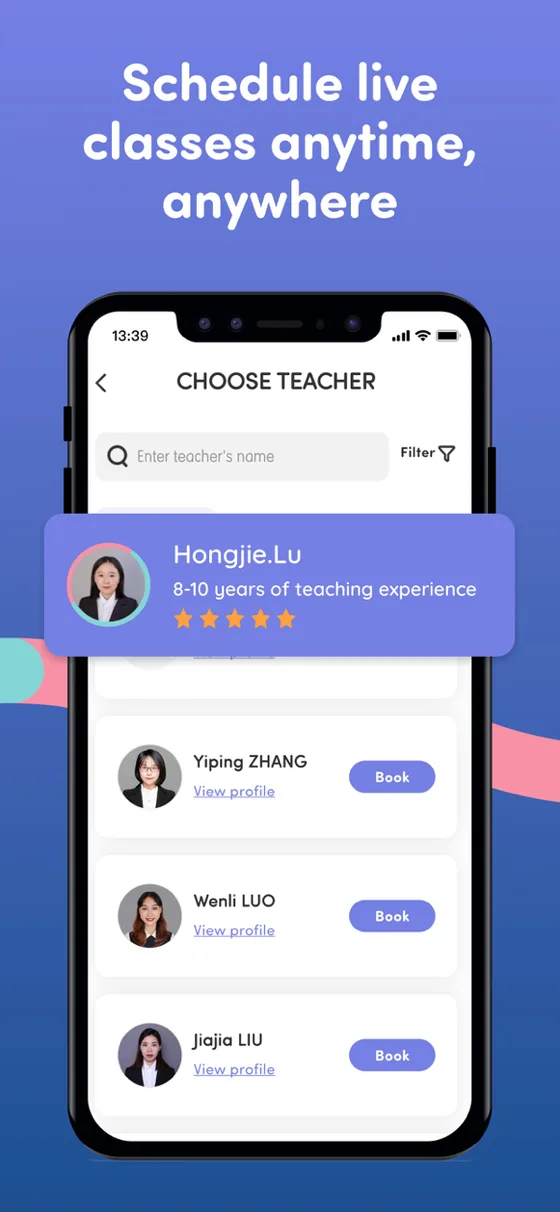
You can also change teachers at any time, and the new teacher sees your child's history.
The teacher is also where things go wrong. In our sample of recent App Store reviews, nine children and four parents describe a strict, rude or unhelpful teacher.
Some teachers are unhappy, too. Thirteen of the 40 latest one- and two-star Trustpilot reviews come from teachers or job applicants, mostly about fines and pay cuts. And teachers do change: one British parent there said their child's teacher was switched without explanation.
So we'd use the trial to judge the teacher, not the slides. If your child isn't comfortable after a few classes, ask for someone else.
A class is games, rewards and all-Chinese talk
A LingoAce class is a video call over animated slides. The teacher speaks Chinese at your child's level and keeps things moving with games, songs and on-screen rewards. Here's a class from LingoAce's App Store listing:
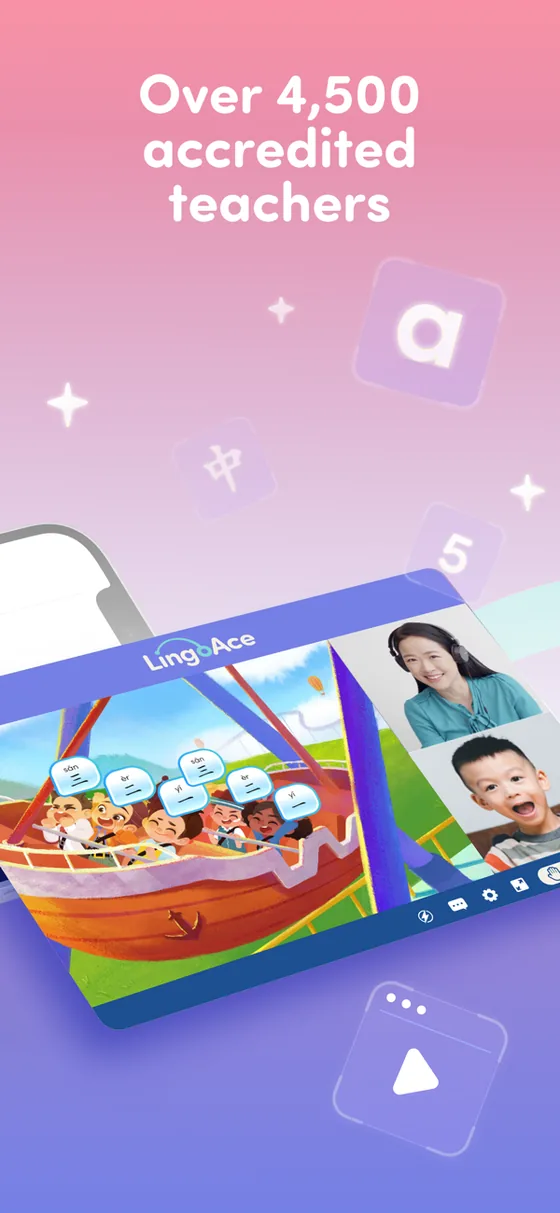
The live teacher is the big advantage over an app. A teacher hears tones, the pitch patterns that change a word's meaning. Buy, 买, and sell, 卖, differ only in tone, and a teacher can stop, model it again and wait for the repeat. Our guide to Chinese tones explains why that matters early.
All-Chinese classes suit children who hear Mandarin at home. A beginner from an English-speaking home may struggle at first. One child wrote on the App Store that they cried in a class taught entirely in Chinese, before learning the teacher spoke English too. The Chinese teachers LingoAce shows on its site list English as well as Chinese.
Homework comes in two kinds: games in the app and printed sheets. You photograph the sheets and upload them, and the teacher marks them. This is where families meet the app's bugs, from a camera that over-brightens the page to uploads that stall.
LingoAce recommends at least two classes a week, and the days between are yours. Young children also need you nearby during class: a Canadian parent wrote on the App Store in May that they had to be there the whole time.
Children like the classes; parents fault the company
LingoAce's ratings depend on where you look, and recent written reviews run lowest. Here's each store, with Trustpilot and our own sample:
Sources: the App Store and Google Play listings of both apps, and Trustpilot, which notes that LingoAce invites customers to review it. The last row is our average of the written reviews since November 2024 in Apple's feeds for six countries.
People who write reviews skew unhappy, so the last row sits below the rest. Still, the drop is recent. Written reviews averaged over four stars in 2021, and about three or lower in every year since 2023.
Who writes matters more. We read all 122 reviews from the last two years and sorted them by writer. Children wrote about half of them and gave LingoAce more stars than parents did.
Children write about the classes. About two in five praise a kind teacher, and nearly one in four calls the lessons boring or babyish. A child in the US put it simply on the App Store in July: "the teachers are patient like HECK."
Parents write about the company. Here's what the 25 parents in our sample raised:
Source: our reading of every written review of both apps since 1 November 2024 in Apple's feeds for the US, Canada, the UK, Australia, Singapore and New Zealand.
A Canadian parent on the App Store summed up the split in April: "The teachers are good, but everything else is extremely poorly managed."
Trustpilot tells the same story. LingoAce's profile there is overwhelmingly five-star, but we read the 40 most recent one- and two-star reviews. Of the 26 from families with a complaint, here's what they raised:
Source: Trustpilot, read 6 November 2026, our coding. The other 14 of the 40 came from teachers, job applicants, or a reviewer who gave no reason.
So judge the classes and the company separately. Many children enjoy the first, and the second is where parents get frustrated.
How much does LingoAce cost?
LingoAce publishes a range: $14.20 to $30 a class, depending on the programme and the package. The exact price comes from a course consultant, usually after the trial. You buy either a package of prepaid classes or a subscription with a set number of classes each billing period, the terms say.
Bigger packages cost less per class, according to a 2023 review that LingoAce sponsored. The class length matters too: that review put a 25-minute class at about $15 and a 55-minute class at about $30.
LingoAce advises at least two classes a week. Here's what a year costs at its published prices:
At two classes a week, a year costs about $1,500 to $3,100
A year of LingoAce classes at its lowest and highest published price per class, US dollars
| How often | US$ a year | Classes a year |
|---|---|---|
| One class a week | 738–1,560 | 52 |
| Two a week, as LingoAce advises | 1,477–3,120 | 104 |
| Three a week | 2,215–4,680 | 156 |
Source: LingoAce's pricing page and FAQ, 6 November 2026, and our arithmetic. Prices differ by country and promotion.
What parents report paying fits that range, or runs above it:
- A US parent, September 2026: about $23 a class, for group maths lessons, on Trustpilot.
- A Singapore parent, May 2025: S$77 for one 55-minute class added later, on Google Play.
- A Canadian parent, May 2026: $1,400 for classes, on the App Store.
For comparison, the median Chinese teacher on italki charges about $20 an hour, by our count of 783 teachers. There you pick and vet the teacher yourself, and nobody builds a course or reports back to you.
We'd want the price per class in writing before paying, along with the answers to the questions further down this page.
Does LingoAce give refunds?
Yes, for one-to-one packages, until the classes expire. The payment agreement for 1-on-1 programmes, revised in January 2024, sets a formula:
- Start with what you paid, not counting any payment processing fee.
- Take off every class used, at the package's average price per paid class.
- Take off any gift box LingoAce sent you.
- Keep 97% of the rest, because LingoAce charges a 3% administration fee.
Here's how that works out for a 48-class package at the top published price, after 12 classes:
| Step | US$ |
|---|---|
| You paid for 48 classes at $30 | 1,440.00 |
| Minus 12 classes used | −360.00 |
| Minus the 3% fee | −32.40 |
| Refund | 1,047.60 |
Source: LingoAce's payment agreement for 1-on-1 programmes, read 6 November 2026, and our arithmetic on an example package.
Four things get nothing back:
- Bonus classes. You use paid classes first, and the formula leaves bonus ones out.
- Instalment plans. A package bought on a pay-later plan can't be refunded.
- Expired classes. Once a class passes its expiry date, its value is gone.
- Missed classes. There are no make-ups, so cancel at least 24 hours ahead.
Small groups are stricter. Their payment agreement refunds you in full, minus classes used, only within 14 days of the first class.
Subscriptions end through your consultant or advisor, at least 24 hours before the next billing date. The terms give you three months to dispute a charge, in writing. In the US, they send bigger disputes to individual arbitration, outside small claims court.
Every package expires, and bigger ones last longer. Here's LingoAce's expiry table, with how many classes a week use each package up in time:
| Package | Expires after | Classes a week to use it |
|---|---|---|
| 4 classes | 2 months | 0.5 |
| 8 classes | 3 months | 0.6 |
| 24 classes | 12 months | 0.5 |
| 48 classes | 18 months | 0.6 |
| 60 classes | 2 years | 0.6 |
| 97–120 classes | 3 years | 0.8 |
| 121–191 classes | 4 years | 0.9 |
| 192 or more | 5 years | 0.7 |
Source: LingoAce's terms, for classes bought since 1 October 2022, and our arithmetic at the top of each band, or at 192 for the last.
So expiry only bites if you stop for months. By our arithmetic, one class a week uses up any package of up to 260 classes in time. At two a week, a 48-class package lasts about six months.
If you might want out, pay in one go rather than on a pay-later plan. And treat bonus classes as a bonus, not a reason to buy a bigger package.
A free trial, then the sales calls
LingoAce's trial costs nothing, and it doesn't ask for a credit card. You give your name, email and phone number, a course consultant calls to check your child's level, and your child gets one live class with a teacher. A short report and a package offer follow.
Plan for the calls. Sales calls or messages that kept coming are one of the two top complaints in families' recent one- and two-star Trustpilot reviews. Five of the 25 parents in our App Store sample raise them, and LingoAce's own review page lists "aggressive communication after a free trial" among the complaints it has seen.
One Australian parent wrote on the App Store in July of callers "harassing us again and again with different phone numbers". That's the extreme, but the complaint recurs in reviews from several countries.
So if you try it, we suggest an email you check, and a no in writing if you don't buy. Ask to be taken off the call list at the same time. The trial credit itself can't be refunded or passed on, the terms say.
Seven questions to ask before you pay
Most of the complaints we read trace back to something a parent didn't know when they paid. We'd put these questions to the course consultant and ask for the answers in writing:
- What does each class cost in this package, and when we renew? A Singapore parent on Google Play found the classes added later far pricier than the first ones.
- How many classes are paid, and how many are bonus? Bonus classes have no refund value, and two recent Trustpilot reviews say a bonus or a discount depended on posting on social media.
- When do the classes expire, and can we pause? The terms set expiry dates and don't mention pausing.
- Can we keep the trial teacher? One parent on Trustpilot says they were told yes, then found that teacher unavailable.
- What would we get back if we stopped after a month? Ask the consultant to run the refund formula on your package.
- Is this an instalment plan or a subscription? Instalment purchases can't be refunded, and subscriptions need notice before each billing date.
- For a group class, how many children will be in it? The terms cap groups at six, and the refund window is short.
If the answers don't match what you were told on the phone, that's your cue to wait.
Safety and privacy: good controls, a basic seal
LingoAce gives parents a lot of visibility. Classes are recorded, and you can replay them for a month, or for up to a year on request. Reports after classes show how your child is doing in each skill:
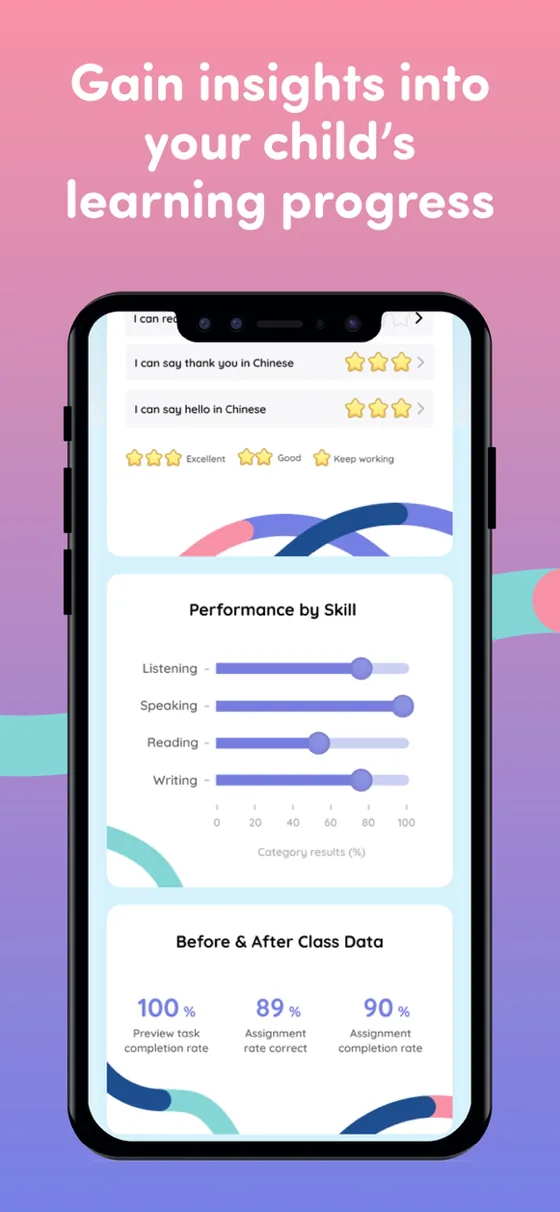
The privacy policy, updated in June 2025, says recordings stay inside LingoAce unless you agree otherwise. Children's data isn't used for targeted advertising, and you can switch recording off or ask LingoAce to delete your child's data.
Its safety seal is narrower than the name suggests. LingoAce has been a kidSAFE member since 2019, with the SAFE CERTIFIED seal. kidSAFE describes that seal as a baseline set of online safety best practices, and as a stepping stone to its separate COPPA certification, which LingoAce doesn't display.
A few reviews raise concerns we can't verify. Two Trustpilot reviews from May 2026 allege weak checks on teachers' identity papers. One is about LingoAce's English teachers, and the other says some teachers post class photos and videos on social media without parents' consent.
A former teacher wrote there in March 2026 that when they reported a parent slapping a pupil, they were told LingoAce could only remind the parents. One child's App Store review, from November 2025, says a teacher threatened them. They're a handful among hundreds of reviews, but they're a reason to stay close.
So keep recordings on, sit in on the first few classes and watch a replay now and then. With young children, you'll be nearby anyway.
Who LingoAce suits, and who should skip it
We think LingoAce suits you if:
- You speak Chinese at home. The all-Chinese classes and the Preschool programme are built for families like yours. Our guide for heritage speakers explains the head start a Chinese-speaking home gives a child.
- Your child needs a live adult. A teacher keeps a six-year-old talking in a way an app can't.
- You want to see progress. Recordings, homework marks and skill reports show what's happening.
- You can budget about $1,500 a year or more. That's two classes a week at the cheapest published price.
We suggest skipping it, or looking hard first, if:
- You want to pay month by month. The best prices come with prepaid packages that expire.
- Your child is older and bores easily. Some older children in our sample call the content babyish or childish.
- You're aiming at the new HSK. Check the levels against the new word lists first.
- You can't face sales calls. Expect follow-up after the trial.
The best alternatives for each goal
No one option suits every child. If LingoAce isn't the right fit, here's what we'd look at for each goal, with our pick for each:
A cheaper one-to-one teacher
- Pick
 An italki tutor
- Price
- About $20 an hour
- Why
- The median Chinese teacher; you choose and vet them
A wider choice of tutors
- Pick
- A Preply tutor
- Price
- $13–29 an hour on average
- Why
- You subscribe, and unused lessons expire
A test to aim at
- Pick
- The YCT
- Price
- $15–30 a level at one US centre
- Why
- China's four-level test for school-age children
Practice between classes
- Pick
 SayMei's kids' workbooks
- Price
- Free with a SayMei account
- Why
- Printable books by age, most with audio
Listening at home
- Pick
- SayMei's HSK 1 listening
- Price
- Free
- Why
- Short dialogues with audio, pinyin and English
Sources: our guides to online Chinese tutors, October 2026, and to the YCT, November 2026; SayMei's own pages.
Three reviews we read compare LingoAce with WuKong, another live school for children. We couldn't read WuKong's prices, so we haven't ranked it. For marketplaces, our italki vs Preply comparison covers trials and refunds on both.
Where SayMei fits, and where it doesn't
SayMei doesn't teach children live, and it has no course built for them. What we make for families is printable: kids' workbooks by age, from first words to stories and handwriting, with pinyin and English for the grown-up.
They're free with a SayMei account, and the account should be yours. SayMei doesn't knowingly collect personal information from children under 13, as its privacy policy says.
We also make practice books for YCT 1, YCT 2 and both YCT speaking tests. They're practice in the test's format, written by SayMei, not official papers. For listening at home, there are ten audio units for children.
SayMei's main product, speaking lessons with Mei Lin, its AI tutor, isn't designed for children, so it plays no part here. Nothing we make replaces a live teacher who knows your child. SayMei isn't affiliated with or endorsed by LingoAce, by CTI, which runs the YCT and HSK, or by the College Board, which runs AP.
What to do next
- Book the trial with your eyes open. Use it to judge the teacher, and expect a sales call afterwards.
- Get the terms in writing. Ask for the price per class, the class length, the paid and bonus classes, and the expiry date.
- Buy the smallest package that works. Pay in one go, so a refund stays possible.
- Stay close for the first weeks. Sit in, keep recordings on, and ask to switch teachers if your child isn't comfortable.
- Keep Chinese going between classes. A few minutes of listening or a picture talk at home keeps the words alive.
If a test is your goal, start with our YCT guide for parents.
FAQ
How much does LingoAce cost per class?
LingoAce publishes a range of $14.20 to $30 a class, depending on the programme, the class length and the package. Bigger packages bring the price down, a sponsored review says. LingoAce doesn't publish package prices: a course consultant quotes them, usually after the free trial. At the two classes a week LingoAce recommends, a year costs roughly $1,500 to $3,100 at those prices.
Is LingoAce worth the money?
For a child who needs a live teacher and enjoys one, many families think so. Children's App Store reviews praise the teachers more than anything else. It's poor value if you want flexibility, because the best prices need prepaid packages that expire, or if your child finds the lessons babyish. Compare a year's cost with a tutor you choose yourself before you buy.
Does LingoAce give refunds?
Yes, for one-to-one packages before they expire. You get back the price of unused paid classes, at the package's average price, minus any gift box and a 3% fee. Bonus classes, expired classes and packages bought on an instalment plan get nothing back. Small-group packages are refundable only within 14 days of the first class.
Is the LingoAce free trial really free?
Yes. It's one live one-to-one class, and LingoAce doesn't ask for a credit card. A course consultant checks your child's level first. You give your name, email and phone number to book it. The cost is your time: sales follow-up is a common complaint, so say no in writing if you don't buy, and ask to be taken off the call list.
Are LingoAce teachers qualified?
LingoAce's FAQ asks teachers for a degree, a teaching certificate or licence, and at least two years of teaching, tutoring, coaching or mentoring. Its Chinese-language blog adds that its Chinese teachers are native speakers with a Mandarin certificate at level 2-A or above. We found no outside check of these claims. You see each teacher's experience before you book, and you can change teachers at any time.
Do LingoAce classes expire?
Yes. Under its terms, classes bought since October 2022 expire after two months for a 4-class package, rising to five years for 192 classes or more. A 48-class package lasts 18 months. One class a week uses up any package of up to 260 classes in time, but a long break can cost you classes, and expired classes can't be refunded.
Is LingoAce safe for children?
It has sensible controls. Classes are recorded and parents can replay them for a month, recordings stay inside the company unless you agree otherwise, and children's data isn't used for targeted ads. Its kidSAFE seal is the basic safety seal, not kidSAFE's COPPA certification. A few reviews raise concerns we couldn't verify, so sit in on the first classes.
Can LingoAce prepare my child for the YCT or HSK?
It can help. LingoAce's chart pairs its 12 levels with YCT and HSK levels, and its advanced stage includes exam preparation. But its HSK labels match the old exam's word lists, and the new HSK, from 13 December 2026, asks for more words at every level. For a test, add the official sample papers and the new word lists.
Sources
Checked 6 November 2026 unless noted. No accounts were created, no trial was booked and nothing was bought.
LingoAce
- lingoace.com, its Chinese programmes, pricing, FAQ, teachers, trial steps and company history
- Terms and conditions; payment agreement for 1-on-1 programmes (revised 18 January 2024); payment agreement for small groups (revised 18 January 2024); privacy policy (updated 17 June 2025)
- LingoAce's level placement guide, its reviews page and its Chinese-language blog post on teachers (5 January 2024)
Stores and reviews
- LingoAce for Student and LingoAce Connect on the US App Store: ratings, descriptions and listing images; Apple's public review feeds for the US, Canada, the UK, Australia, Singapore and New Zealand
- LingoAce Student and LingoAce Connect on Google Play: ratings, downloads, data safety and visible reviews
- LingoAce on Trustpilot: score, star shares and the 40 latest one- and two-star reviews
Safety
Other reviews
- Mandarin Mama's LingoAce review (25 May 2023; sponsored by LingoAce)
HSK and YCT
- CTI's 2009 introduction of HSK 2.0; the November 2025 HSK syllabus; CTI's HSK 3.0 launch notice
- Our guides to the YCT, HSK 3.0 and online Chinese tutors
Methods
We read LingoAce's website, terms, payment agreements, privacy policy and store listings on 6 November 2026. We didn't sign up, book a trial or take classes, so every feature here is what LingoAce says or what parents and children report, and we say which.
- The App Store reviews are every written review of LingoAce's two apps in Apple's public feeds for six countries: 318, from 2019 to 4 November 2026. We read the 122 since 1 November 2024 in full and coded each by hand, by writer and by subject. A review can count under several subjects.
- Children or parents: a review counts as a child's when it's written as the pupil, and as a parent's when it's written as the buyer. We couldn't tell for 31 of the 122.
- The Trustpilot reviews are the 40 most recent one- and two-star reviews on 6 November 2026, from 15 August 2025 to late October 2026. We read them through a text fetch several times and coded each by writer and complaint.
- A year's cost multiplies LingoAce's lowest and highest published price per class by 52, 104 or 156 classes.
- The refund example applies LingoAce's formula to a 48-class package at $30 a class. It's an illustration, not a real quote.
- Classes a week to use a package divides the top of each package band, or 192 for the open-ended last band, by the weeks before it expires, at 52 weeks a year.
- The HSK chart sets LingoAce's own level chart against the old and new HSK word totals. LingoAce doesn't publish what each level teaches.
- The scorecard is our judgment from those sources, not a test of the classes.
- The screenshots are LingoAce's own App Store images, shown unedited for review.
- Mandarin examples were checked against the CC-CEDICT dictionary.
We couldn't read Reddit threads or WuKong's prices with our tools, so neither appears here. If you spot a mistake, tell us: we fix errors.