SayMei vs ChatGPT for Learning Chinese: Purpose-Built Tutor vs Voice Mode
An honest SayMei vs ChatGPT Voice Mode comparison across Mandarin tones, HSK 3.0 progression, measure words, stories, flashcards, and 2026 pricing.


ChatGPT Voice Mode and SayMei are often compared by learners trying to pick one AI speaking partner for Mandarin—and they excel at noticeably different jobs. ChatGPT gives you an infinitely patient, general-purpose voice and text assistant for custom role-plays, business scenarios, and long open discussions up to 3 hours a day on ChatGPT Go ($8/mo) or Plus ($20/mo). SayMei is ours, and it surrounds live spoken lessons with Mei Lin by adding what a general chatbot lacks: HSK 3.0 word progression, pitch-contour tone checks, FSRS flashcards, 169 audio books, and 437 PDF workbooks for $5.99 a month.
Published studies and teacher tests highlight real blind spots when beginners treat ChatGPT alone as a Mandarin teacher—especially around tones, pinyin rules, measure words, and level control.
Side-by-side comparison: SayMei vs ChatGPT Voice Mode
Compare what happens when you study Mandarin with a dedicated Chinese tutor app versus an unguided general chatbot.
Dimension · Winner ·  SayMei ·
 ChatGPT Voice Mode
Speaking & AI conversation
Split
Structured HSK-paced video conversations with Mei Lin + toggleable transcript & grammar cards
Unlimited open topic agility with natural interruptions; requires manual prompts every chat
Curriculum & HSK 3.0 scope
SayMei
Nov 2025 HSK 3.0 lists 1–9; 1,800+ lessons (2026 rewrite 1–4); 3,500+ dialogues 1–6
No course map, placement tracking, or reliable HSK word-list memory
Monthly pricing & free access
Split
$5.99/mo Premium (200 rolling live min); free 1st lesson + 437 PDFs & tone/HSK tools
Free fluctuating voice cap; Go $8/mo & Plus $20/mo web ($19.99 iOS) give up to 3 hr/day
Graded stories, flashcards & PDFs
SayMei
169 audio books (HSK 1–3), FSRS flashcards, slow 0.75×/0.5× audio, 437 PDFs
Text generation on demand; no native FSRS deck, audiobook library, or verified audio PDFs
Pronunciation & tone depth
SayMei
On-device Tone Checker (80% across 984 clips), Tone Pair & Sandhi checkers
OpenAI warns transcripts aren't verbatim; Hacking Chinese Sep 2026 test exposed invented tone errors
Character writing vs live speech
SayMei
Characters web tool (1,200 writing / 1,940 reading) + 6 田字格 PDFs; live speaking focus
No stroke-order interface, canvas, or traceable grid worksheets; text explanations only
Speech recognition, tones, and AI tutor conversational feedback
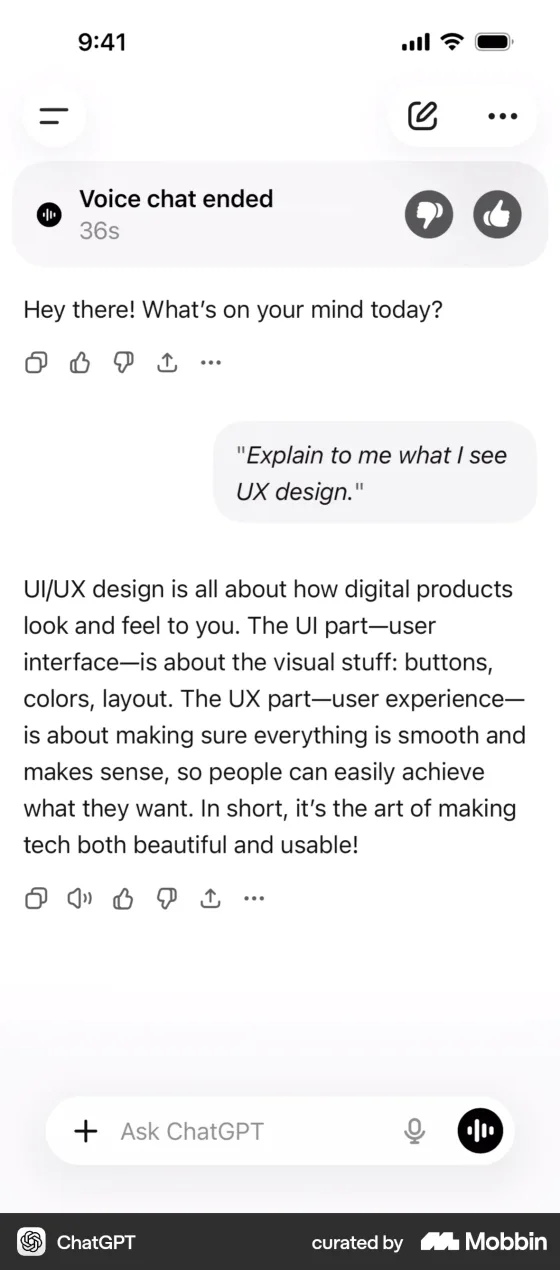
ChatGPT wins on sheer conversational stamina and unconstrained topic imagination, while SayMei wins cleanly on beginner scaffolding, transcript accuracy for study, and Mandarin tone reliability. On ChatGPT Go ($8/mo) or Plus ($20/mo), GPT-Live-1.1 lets intermediate and advanced learners improvise mock interviews, historical debates, or hobby chats up to three hours a day, sensing interruptions naturally once voice language is set to Chinese in Settings.
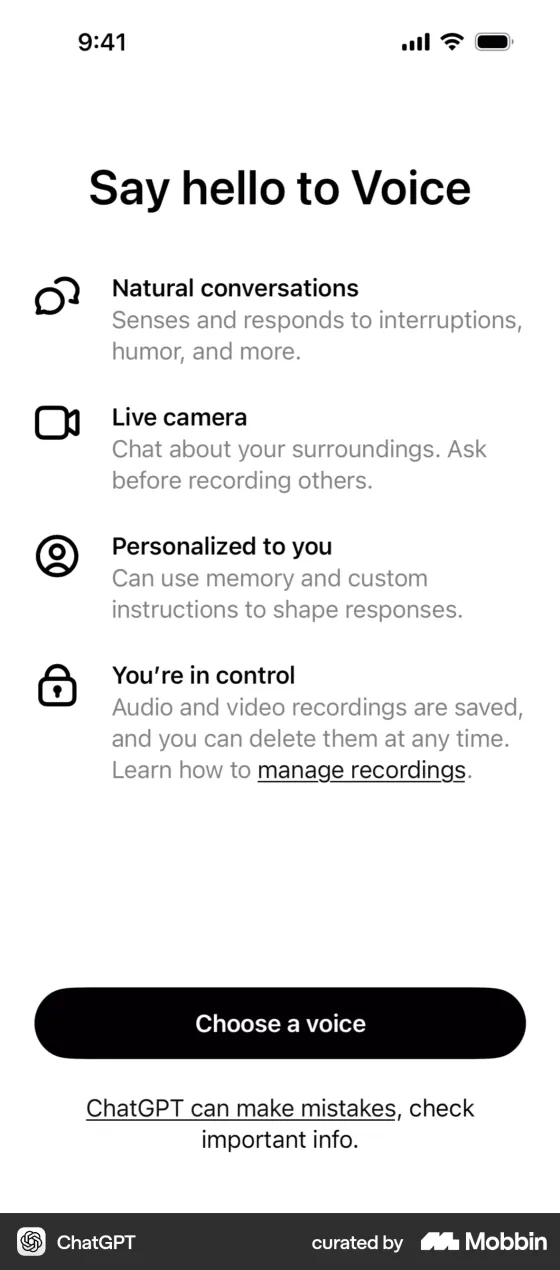
Yet OpenAI's own ChatGPT Voice help page notes explicitly that voice-call transcripts "are not verbatim records"—and teachers repeatedly warn beginners against confusing fluent conversational replies with accurate Mandarin hearing. A clean transcript after a ChatGPT voice call does not verify that you hit the right tone, because general speech models infer intended words from English-weighted or contextual probability and smooth over tone errors.
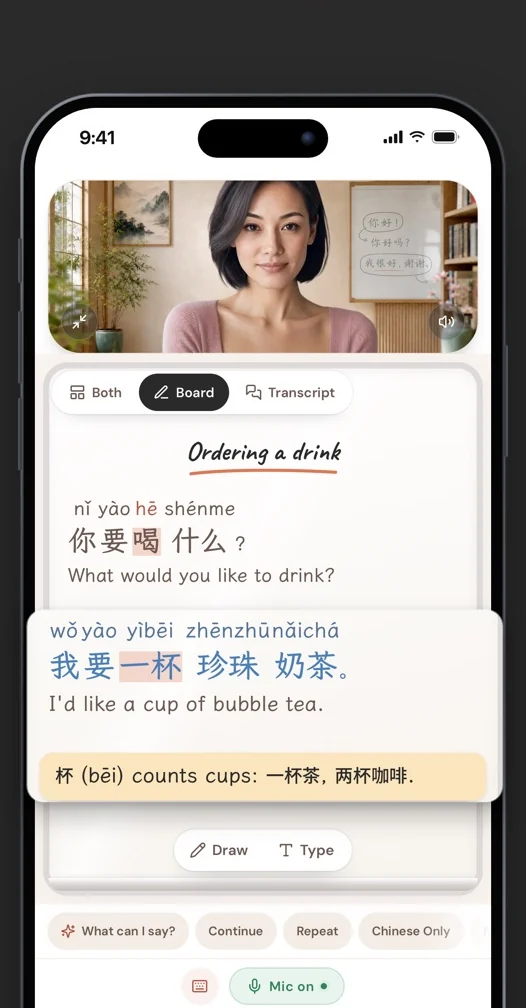
SayMei designs every live lesson around learning controls ChatGPT lacks cleanly in voice mode: toggleable Simplified characters, tone-marked pinyin, and English underneath Mei Lin's live spoken turns, slow-speed replay inside companion dialogues (0.75× and 0.5× pitch-preserved audio), and inline grammar correction cards mid-lesson rather than burying feedback in a wall of post-call text.
At the same time, note SayMei's boundary honestly: SayMei Premium grants 200 live Mei Lin minutes per month (roughly 30 sessions of 6–7 minutes, rolling over while subscribed, or $2.99 for 100 extra minutes), whereas heavy intermediate speakers talking over an hour daily in freeform Mandarin get longer raw microphone hours on ChatGPT Go or Plus if they already subscribe for work.
Structured curriculum and HSK 1–6 / HSK 3.0 coverage
SayMei wins hands-down on syllabus structure because ChatGPT has no Mandarin curriculum, memory of your known character count, or verified HSK 3.0 word boundaries. Unless you painstakingly copy-paste word banks into custom instructions every few weeks, ChatGPT routinely leaks HSK 5–6 idioms into an HSK 1 conversation, misclassifies which words sit on old HSK 2.0 versus the November 2025 HSK 3.0 syllabus, and forgets what you struggled with three days earlier.
Academic evaluations pinpoint specific Mandarin blind spots even in modern flagship LLMs:
- Grammar edits: Lin (2024) benchmarked LLMs on YACLC Chinese learner error correction against multi-editor human baselines and found GPT-4 caught roughly half of real grammar edits (while Llama 3 70B hit 42%).
- Classifiers / measure words: Zhang and colleagues (2025) measured Chinese measure-word prediction and showed GPT-4 hit 51% match against writers' choices compared with 70% for a specialized fine-tuned model.
- Pinyin consistency: Rovira-Esteva (2025) evaluated chatbot pinyin transcription and noted bots beat traditional converters yet still broke official word-splitting and neutral-tone rules unpredictably.
SayMei replaces guesswork with verified curriculum plumbing: November 2025 HSK 3.0 lists (HSK 1–9), a free Chinese level test, 1,800+ structured lessons (its 2026 prompt refresh covers HSK 1–4 across 1,183 targeted prompts while HSK 5–6 run on earlier formats), over 3,500 topical dialogues spanning HSK 1–6, and a dedicated Grammar Checker built to suggest the smallest targeted correction.
Pricing and what is genuinely free vs. paid
SayMei costs less than both paid ChatGPT tiers ($5.99/mo vs $8/mo Go or $19.99–$20/mo Plus), though ChatGPT's free tier offers useful ad-hoc written chat and fluctuating voice previews if you already live inside OpenAI's ecosystem. On ChatGPT, Free accounts get fluctuating limited Live Voice minutes; ChatGPT Go costs $8/mo and Plus costs $20/mo web ($19.99/mo iOS) for up to three hours daily of Live voice plus flagship models. SayMei Premium costs $5.99 a month after a 7-day 100-minute trial (card required, $0 today, 24h billing reminder), delivering 200 rolling live minutes plus Stories, FSRS flashcards, and full HSK Test Prep—or $2.99 for 100 never-expiring extra Boost minutes.
Monthly US subscription pricing: SayMei vs ChatGPT (Nov 2026)
SayMei is built solely around Mandarin learning; ChatGPT plans cover all work/general tasks as well.
| Plan | US$ a month | Plan cap & features |
|---|---|---|
| ChatGPT Free | 0 | Fluctuating limited Live voice; unlimited text (usage limits apply); no course tools |
| SayMei Stories Unlimited | 2.99 | Graded HSK 1–3 audiobooks standalone (included in Premium) |
| SayMei Premium | 5.99 | 200 live min/mo (roll over), Stories, FSRS flashcards, full HSK prep |
| ChatGPT Go | 8 | Up to ~3 hr/day Live voice + general chatbot usage; zero Mandarin course tools |
| ChatGPT Plus | 19.99–20 | $19.99 iOS / $20 web; up to ~3 hr/day voice + flagship work models |
Free Mandarin utility on SayMei stretches well beyond a chat box: your first 10-minute live Mei Lin lesson opens without signup or card in most countries (2nd free with free account; 7-day trial elsewhere), alongside permanent free-account access to daily 1 dialogue speaking turn, 10 flashcards/reviews, Tone Checker, Grammar Checker, HSK 1–9 word lists, Characters, 8 full Stories books, and all 437 printable PDF workbooks.
SayMei is also an app for iPhone and Android: get the app.
Graded audio stories, flashcards, dialogues, and printable PDF workbooks
SayMei gives Mandarin learners a full ecosystem for memory retention and extensive input, whereas ChatGPT generates stateless disposable text without spaced repetition, native-narrated audio books, or layout-verified printable sheets. Ask ChatGPT for a "short HSK 2 story," and it can generate text quickly—yet you get no calibrated voice playback speeds, no guaranteed vocabulary strictness, no tap-to-save SRS deck, and no clickable word lookups across chapters.
SayMei bundles 169 multi-chapter graded audio books (1,161 chapters) up to HSK 3 (plus one free HSK 4 title) with Simplified and Traditional toggles, over 3,500 dialogues across HSK 1–6 featuring 0.75× and 0.5× pitch-preserved playback, FSRS memory scheduling (90% default target recall), and 437 free printable PDF workbooks (431 illustrated books and 6 direct HSK 1–6 writing books). Even offline flashcards sync inside SayMei's iOS and Android apps for review anywhere, while live calls and Stories need internet access.
Pronunciation and tone feedback depth
This is the single biggest danger of relying on ChatGPT Voice Mode as a Mandarin beginner: ChatGPT cannot reliably diagnose or score Mandarin tones. In a September 2026 experiment published on Hacking Chinese, Olle Linge uploaded the exact same native Beijing teacher recording of 麻烦你把盐递给我 máfan nǐ bǎ yán dì gěi wǒ ("please pass me the salt") to ChatGPT five times and asked for a pronunciation score. ChatGPT rated the identical audio anywhere from 7 to 9 out of 10—and hallucinated nonexistent errors, claiming máfan requires two rising tones when its second syllable is neutral.
By contrast, SayMei does not pretend a chat LLM can score syllable pitch cleanly on its own. Instead, SayMei pairs Mei Lin's conversational guidance with an on-device Tone Checker that draws your real spoken pitch curve directly against a reference model—naming the right tone 80% of the time across 984 reference recordings—alongside the 16-pattern Tone Pair Trainer and Tone Sandhi Checker. (Live Mei Lin calls do not print a numeric 0–100 rating either; use Tone Checker whenever you want acoustic pitch diagnosis.)
Character writing practice vs. live speaking practice
Neither app is an in-call handwriting whiteboard like Skritter, yet SayMei supports serious character reading and writing practice cleanly while ChatGPT offers typed explanation only. ChatGPT can tell you radical breakdowns or mnemonic stories if asked—though LLMs occasionally misstate stroke counts—and gives zero tracing grid or character SRS tracking.
SayMei focuses live voice lessons purely on speaking and listening rather than glass-screen tracing, while backing learners with its free Characters tool (1,200 writing / 1,940 reading characters aligned to HSK 3.0) and six dedicated printable 田字格 HSK 1–6 writing workbooks for practice on paper.
Choose ChatGPT Voice Mode if...
Choose ChatGPT Voice Mode if you already manage your own Mandarin study materials cleanly or need marathon daily unscripted conversation at an intermediate+ level.
- You already pay $8–$20/mo for ChatGPT Go or Plus at work: Adding informal Chinese chats on an existing subscription costs zero extra dollars.
- You want specialized role-plays outside textbook topics: Practising startup pitches, legal terms, medical interviews, or technical engineering jargon fits general LLM agility well.
- You are intermediate+ (HSK 4–6+) and already have solid tones: Learners whose pronunciation and tones are already vetted by teachers can use Voice Mode purely for high-volume fluency mileage (up to 3 hr/day on Go/Plus).
- You enjoy writing and refining custom study prompts: If directing your own tutor setup feels natural, ChatGPT adapts to almost any game or rule set.
Choose SayMei if...
Choose SayMei if you want an affordable Mandarin system that teaches structure, checks acoustic tones, remembers your flashcards, and eliminates prompt engineering.
- You are HSK 1–4 or fixing tones early: SayMei gives calibrated speaking pace, toggleable pinyin/characters, inline grammar fixes, and acoustic Tone Checker curves so tone mistakes do not fossilize.
- You want curriculum, stories, FSRS cards, and PDFs connected: 169 audio books, 3,500+ dialogues, Characters, HSK 1–9 lists, and 437 workbooks work together automatically without managing prompts or spreadsheets.
- You want dedicated Mandarin study for $5.99/mo: SayMei Premium undercuts both ChatGPT Go ($8/mo) and ChatGPT Plus ($19.99–$20/mo) while rolling unused live minutes month to month.
- You prefer visual Mandarin controls inside voice calls: Seeing characters, pinyin, English hints, and grammar notes in a live lesson screen avoids ChatGPT's non-verbatim transcript surprises.
Inspect free tools, 7-day trial rules, and monthly rollover details on SayMei pricing.
FAQ
Can ChatGPT Voice Mode replace a Chinese app like SayMei?
For most beginners and HSK learners, ChatGPT Voice Mode cannot fully replace a structured app like SayMei. While ChatGPT handles patient role-play well, it lacks HSK 3.0 word tracking, spaced repetition flashcards, audio storybooks, tone pitch checking, and slow phonetic replay—and OpenAI warns voice transcripts are not verbatim records. Pairing or switching to SayMei fixes all five gaps at $5.99/mo.
Why shouldn't beginners rely on ChatGPT to judge Mandarin tones?
Testing proves general chatbots hallucinate tone ratings. In a September 2026 Hacking Chinese benchmark, ChatGPT gave the exact same native speaker recording scores from 7 to 9 out of 10 across five uploads and falsely criticized a correct neutral tone. SayMei separates tone checking into an on-device acoustic pitch tool (80% accurate on 984 clips) plus tone-pair drills alongside live conversation.
Which is cheaper for speaking Chinese: SayMei or ChatGPT?
SayMei Premium costs $5.99 a month (200 rolling live minutes, plus Stories, FSRS cards, and HSK tools), making it cheaper than both ChatGPT Go ($8/mo) and ChatGPT Plus ($19.99 iOS / $20 web). ChatGPT's free tier offers limited fluctuating Voice time for $0, while SayMei leaves 1 dialogue session/day, Tone Checker, HSK lists, 8 full Stories, and 437 PDFs free permanently with an account.
How accurate is ChatGPT on Chinese grammar and measure words?
ChatGPT explains general grammar decently yet still makes measurable slips in Mandarin testing. Academic benchmarks found GPT-4 caught roughly half of real human-editor corrections on YACLC learner essays (Lin 2024) and predicted writers' measure words accurately 51% of the time versus 70% for task-trained models (Zhang 2025). SayMei builds inline measure-word and HSK grammar notes directly into live lessons and Grammar Checker.
Does ChatGPT know the new HSK 3.0 word lists?
ChatGPT frequently blends old HSK 2.0, HSK 3.0 (November 2025 revision), and arbitrary conversational words unless you paste exact word lists into every prompt. SayMei integrates November 2025 HSK 3.0 lists directly into free vocabulary tools (HSK 1–9), Characters (1,200 writing / 1,940 reading), HSK Test Prep, and 437 printable workbooks.
What if I talk for more than 200 minutes a month?
SayMei Premium includes 200 rolling live minutes each month (~30 sessions of 6–7 min), plus $2.99 Boost Packs adding 100 never-expiring live minutes and unlimited free-access dialogues/Stories inside Premium. If you already speak comfortably at HSK 4+ and want two hours a day of freeform mic time, pairing SayMei's stories/flashcards with ChatGPT Go ($8/mo, 3 hr/day ceiling) works well.
Does SayMei work in countries or regions without the iOS app?
SayMei runs identically in any modern desktop or mobile browser across saymei.app as well as on iPhone and Android (note the iPhone App Store build excludes EU countries, mainland China, Morocco, and Afghanistan, where web access serves every lesson cleanly). ChatGPT Voice runs on web, iOS, and Android outside OpenAI's unsupported territories.
What is the smartest way to combine ChatGPT and SayMei?
Use SayMei as your core Mandarin anchor—following Mei Lin's paced lessons, FSRS flashcards, Tone Checker pitch feedback, and HSK 1–3 graded stories—and reserve ChatGPT strictly as an occasional free typed/voice sandbox when you want to rehearse niche career jargon or ask creative brainstorming questions in Chinese.
Sources
Checked and verified 27 November 2026 from OpenAI help center pricing/docs, peer-reviewed Chinese NLP studies, and SayMei production sources.
SayMei
- SayMei pricing and free tier limits, Tone Checker, Stories library, and printable workbooks
- SayMei iPhone and Android pages
ChatGPT & Research
- ChatGPT pricing and ChatGPT Voice help documentation
- Linge, O. (2026). No, ChatGPT can't analyse your Mandarin pronunciation. Hacking Chinese, 13 September 2026.
- Rovira-Esteva, S. (2025). Evaluating current tools for pinyin transcription. International Chinese Language Education Communications 3(1).
- Zhang, Z. et al. (2025). Comparing and understanding Chinese classifier prediction in language models. BlackboxNLP 2025.
- Lin, S. (2024). Evaluating LLMs' grammatical error correction performance in learner Chinese. PLOS ONE 19(10), e0312881.
- Renner, J., Yu, S. & Guder, A. (2026). ChatGPT Voice Mode in CFL beginner classrooms. Chinese as a Second Language Research 15(1).
- SayMei guides: Learn Chinese with AI and Best AI Apps to Learn Chinese
Methods
- Editorial disclosure: SayMei is our product. Plan limits, rolling live minute pools, story counts (169 books, 1,161 chapters), workbook counts (437 PDFs), and Tone Checker benchmark results (80% across 984 clips) come straight from SayMei production files and test results.
- ChatGPT & study sourcing: Plan rates (Free, Go $8/mo, Plus $19.99–$20/mo, ~3 hr/day GPT-Live-1.1 limit) and non-verbatim transcript disclaimers come from OpenAI's US pricing and Voice Mode documentation checked November 2026. Quantitative error studies quote published percentages from Lin (2024), Zhang et al. (2025), Rovira-Esteva (2025), and Hacking Chinese (2026).
- Balance check: We state clearly where ChatGPT wins—high daily voice ceilings on Go/Plus, unlimited unscripted niche role-plays, and zero extra cost if already subscribed for work—alongside SayMei's own boundaries (200 rolling monthly call minutes before Boosts, HSK 3 story cap, and online call requirement).
- Corrections: OpenAI adjusts Free, Go, and Voice limits frequently. If any rate or model behavior shifts, tell us and we will update this page.
ChatGPT is a trademark of OpenAI; SayMei is not affiliated with or endorsed by OpenAI.