Conversation · Total beginner
200 Common Mandarin Phrases: Basic Chinese Phrasebook with Pinyin
You call the staff with 服务员, pay by WeChat, show a driver an address on your phone and ask for a pharmacy. Made for learners starting from zero, with a note on when to use every phrase.
- Level:
- Total beginner · HSK 1
- Format:
- Workbook · PDF · 31 pages · US Letter (prints on A4)
- Price:
- Free · free with a saymei account · updated Oct 27, 2026
Download the free PDF: create a free SayMei account on this page, and we'll email you a copy too.
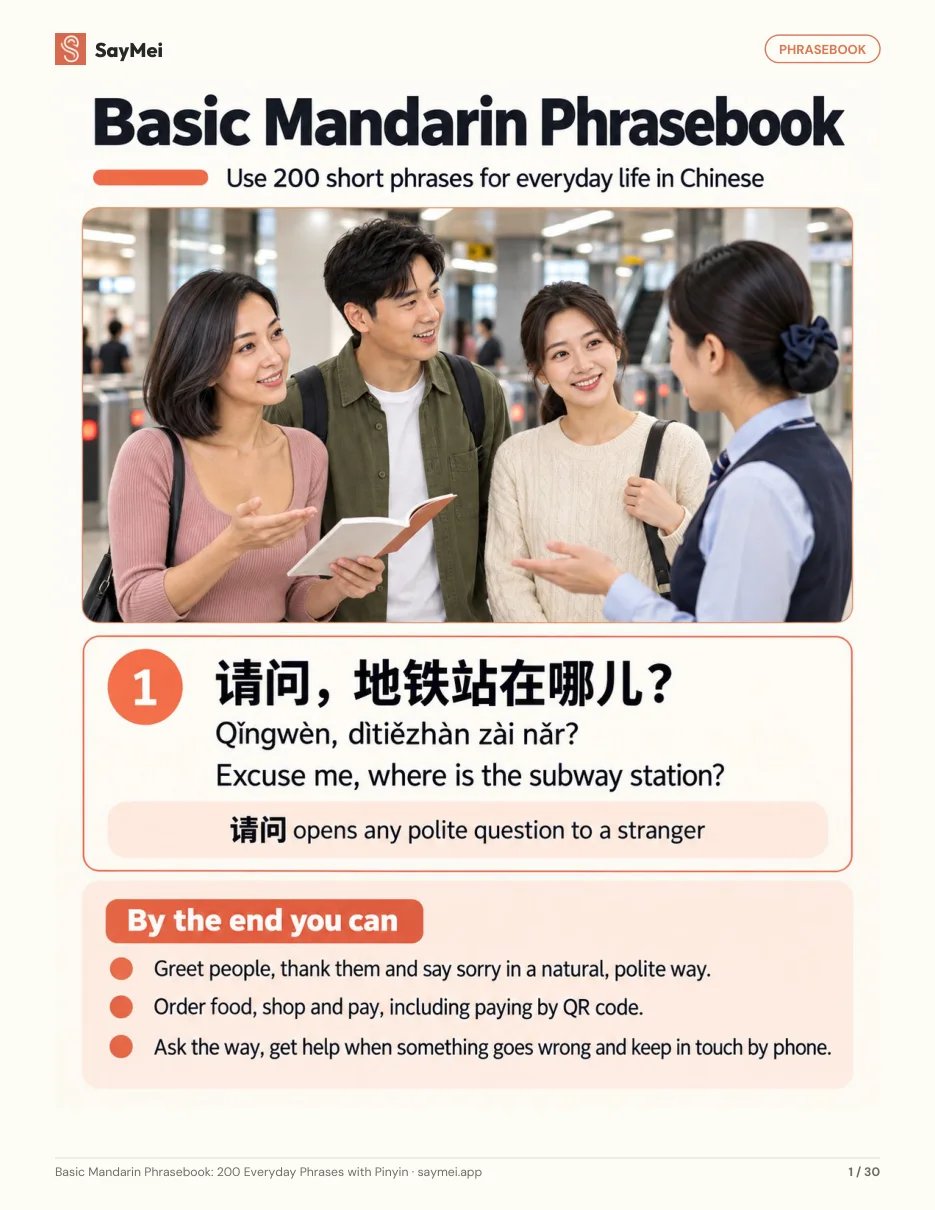
请问,地铁站在哪儿? · Qǐngwèn, dìtiězhàn zài nǎr? · Excuse me, where is the subway station?
By the end you can
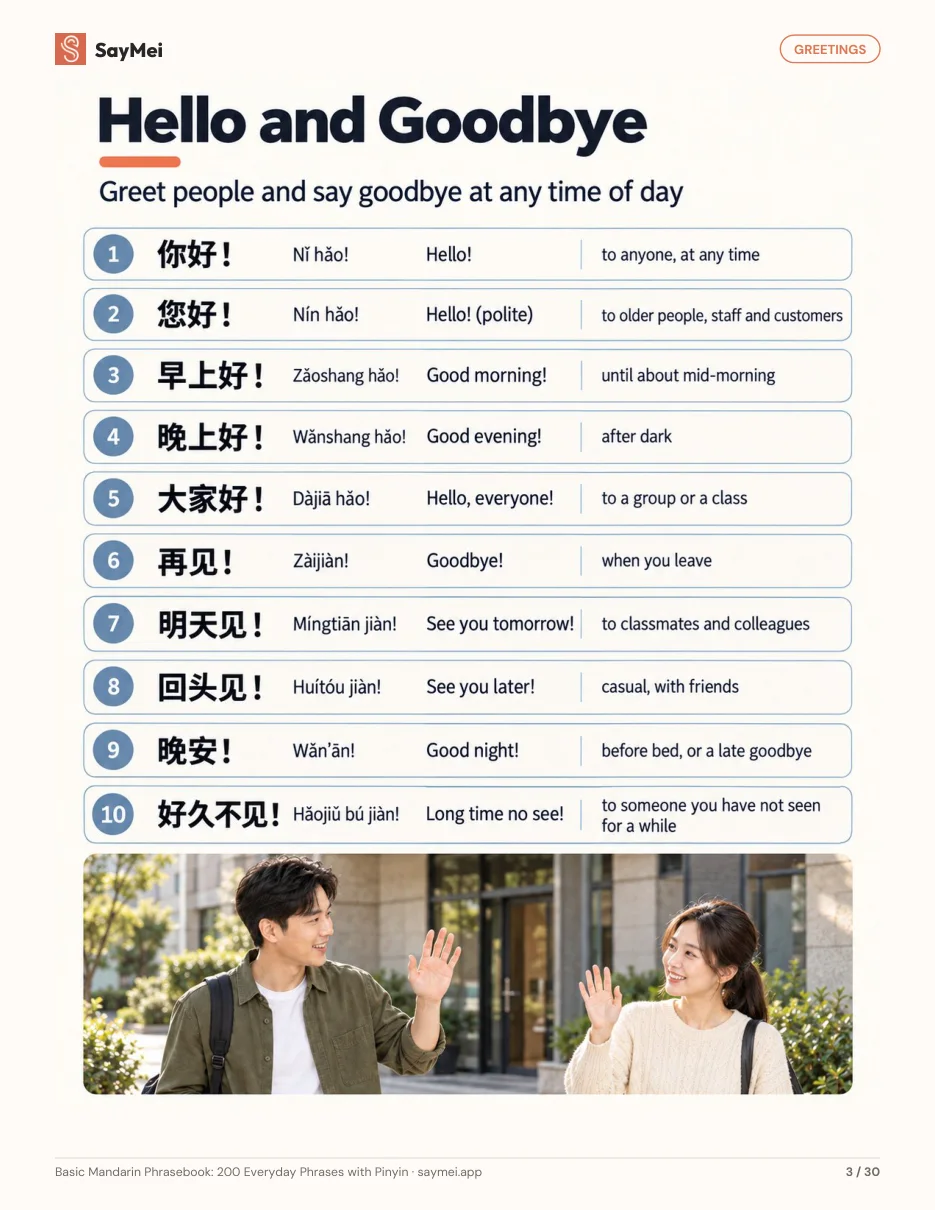
- Greet people the right way for the time and the person. Ten greetings, each with a note on when to use it: 您好 for older people and staff, 早上好 until mid-morning, 好久不见 for a friend you haven't seen in a while.
好久不见! · Hǎojiǔ bú jiàn! · Long time no see! - Keep a friendly chat going for a minute. Hand a question back with 你呢, say you speak a little Chinese, and answer a compliment on your Chinese the modest way.
哪里哪里。 · Nǎli nǎli. · Oh, not really. - Order a meal and say what you can't eat. Call the staff with 服务员, ask if you scan the code to order, ask for a dish not spicy, and put your allergy after 对.
我对花生过敏。 · Wǒ duì huāshēng guòmǐn. · I'm allergic to peanuts. - Shop, haggle kindly and pay by phone. Ask the price, say it's too expensive with a smile, ask for another size or colour, then pay by WeChat, card or cash and ask about returns.
可以用微信付吗? · Kěyǐ yòng Wēixìn fù ma? · Can I pay with WeChat? - Take a taxi, the subway or a bus. Address a driver as 师傅, show an address on your phone, ask where to change lines and say you want to get off.
请到这个地址。 · Qǐng dào zhège dìzhǐ. · Please take me to this address. - Check in at a hotel and ask for what you need. Check in, ask about breakfast and the Wi-Fi, ask for help in your room, and check out.
- Say what hurts and get help when something goes wrong. Say you have a headache or a fever, ask for a pharmacy, call for an ambulance (120 in mainland China), report a lost phone and ask someone to slow down.
请说慢一点儿。 · Qǐng shuō màn yìdiǎnr. · Please speak a bit more slowly. - React, share feelings and keep in touch on WeChat. Say yes, no and maybe, say how you feel, swap WeChat, send a message, and say you're on your way.
我们加个微信吧。 · Wǒmen jiā ge Wēixìn ba. · Let's add each other on WeChat.
What’s inside
- Greetings: Hello and Goodbye
- Politeness: Please, Thank You and Sorry
- Meeting people: Names and Introductions
- Small talk: Easy Small Talk
- Drills: Greetings and Meeting People
- Time: Time and Days
- Numbers: Numbers in Daily Life
- Food: Ordering Food
- Drinks: Drinks and Paying the Bill
- Drills: Time, Numbers and Food
- Shopping: In a Shop or Market
- Paying: Paying and Returns
- Directions: Asking the Way
- Transport: Taxis, Trains and Buses
- Drills: Shopping and Getting Around
- Hotels: Checking In · Requests and Checking Out
- Help: Health and Emergencies
- Problems: When Things Go Wrong
- Drills: Hotels and Help
- Reactions: Quick Reactions
- Feelings: Feelings and Opinions
- Phones: WeChat and Calls
- Apps: Photos, Maps and Group Chats
- Roleplay: A Day Out
- Wallet cards: Emergency Wallet Cards
How to use this book
Twenty phrase pages of ten phrases each, grouped by topic, with a drill page after every four. Learn one topic group at a time and say each phrase aloud with its note in mind.
- Pages 3–7: Greetings and meeting people. Hello and goodbye, please and thank you, names and small talk. Then the drills on page 7.
- Pages 8–12: Time, numbers and food. Times, days, numbers in daily life, ordering food and drinks, and the bill.
- Pages 13–17: Shopping and getting around. Prices, sizes, paying by phone, returns, directions and transport.
- Pages 18–22: Hotels and help. Checking in and out, health, emergencies and things going wrong.
- Pages 23–27: Reactions, phones and a day out. Quick reactions, feelings, WeChat and calls, then act out the day-out scene with a partner.
- Before a trip: Wallet cards. Cut out the eight emergency cards on page 28 and keep them with your passport.
Who it’s for
Travellers, new arrivals and total beginners who want useful phrases for daily life in China: eating out, shopping, getting around, hotels and getting help.
Before you start: Nothing. Every phrase has characters, pinyin and English, and a short note on when to use it, so you can start on any topic page.
Frequently asked questions
Is it only a list of phrases?
Mostly, by design: twenty pages of ten phrases, grouped by topic from greetings and food to hotels and getting help. There are also four drill pages with gap fills and short speaking tasks, a role-play of a day out, and cut-out emergency cards.
How should I work through it?
Learn one topic group at a time and say each phrase aloud with its note in mind, then do the drill page that follows every four phrase pages. You can start on any topic page, since every phrase has characters, pinyin and English.
Does it cover paying by phone in China?
Yes. Page 14 has phrases for paying with WeChat, asking who scans the code, paying by card or cash, and asking for a receipt or a return. Page 10 covers scanning a QR code to order.
What if I get sick or lose something?
Pages 20 and 21 cover saying you have a headache or a fever, asking for a pharmacy, calling for an ambulance (120 in mainland China) and reporting a lost phone. Page 28 has eight emergency cards to cut out and keep with your passport.
Is there audio?
The PDF has no audio. Every phrase has pinyin with tone marks, so you can say it from the page.
What should I use next?
Chinese Phrase Flashcards gives you 96 everyday phrases as cut-out cards, each with a likely reply and free audio, so you can drill them out loud.
Do I need a SayMei account?
Yes, to download the PDF, and the account is free: sign up with Google, Apple or your email address. With it we email you a copy of the workbook, keep every workbook you download on your account on all your devices, save your place in the free online practice, and you can practise speaking with Mei Lin, SayMei's AI tutor.
How do I print it?
The PDF is US Letter size. On A4 paper, choose "Fit to page" (or "Scale to fit") in the print dialog so nothing is cut off. Print the whole workbook or only the pages you need; colour looks best, and black and white works too.
Keep going
Your First 14 Days of Spoken Mandarin · Five Beginner Mandarin Mini-Stories · Your 30-Day Mandarin Plan · Chinese Numbers, Dates and Telling Time: Prices, Weekdays and the Clock · Browse all 294 workbooks
Version 2026-10 · Updated Oct 27, 2026 · Report a correction