Grammar · Beginner to pre-intermediate
Beginner Chinese Grammar Workbook: 24 Core Patterns
The 24 patterns beginners need, one a page, with the classic mistakes and practice after every two
- Level:
- Beginner · HSK 1–2
- Format:
- Workbook · PDF · 51 pages · US Letter (prints on A4)
- Price:
- Free · free with a saymei account · updated Oct 27, 2026
Download the free PDF: create a free SayMei account on this page, and we'll email you a copy too.
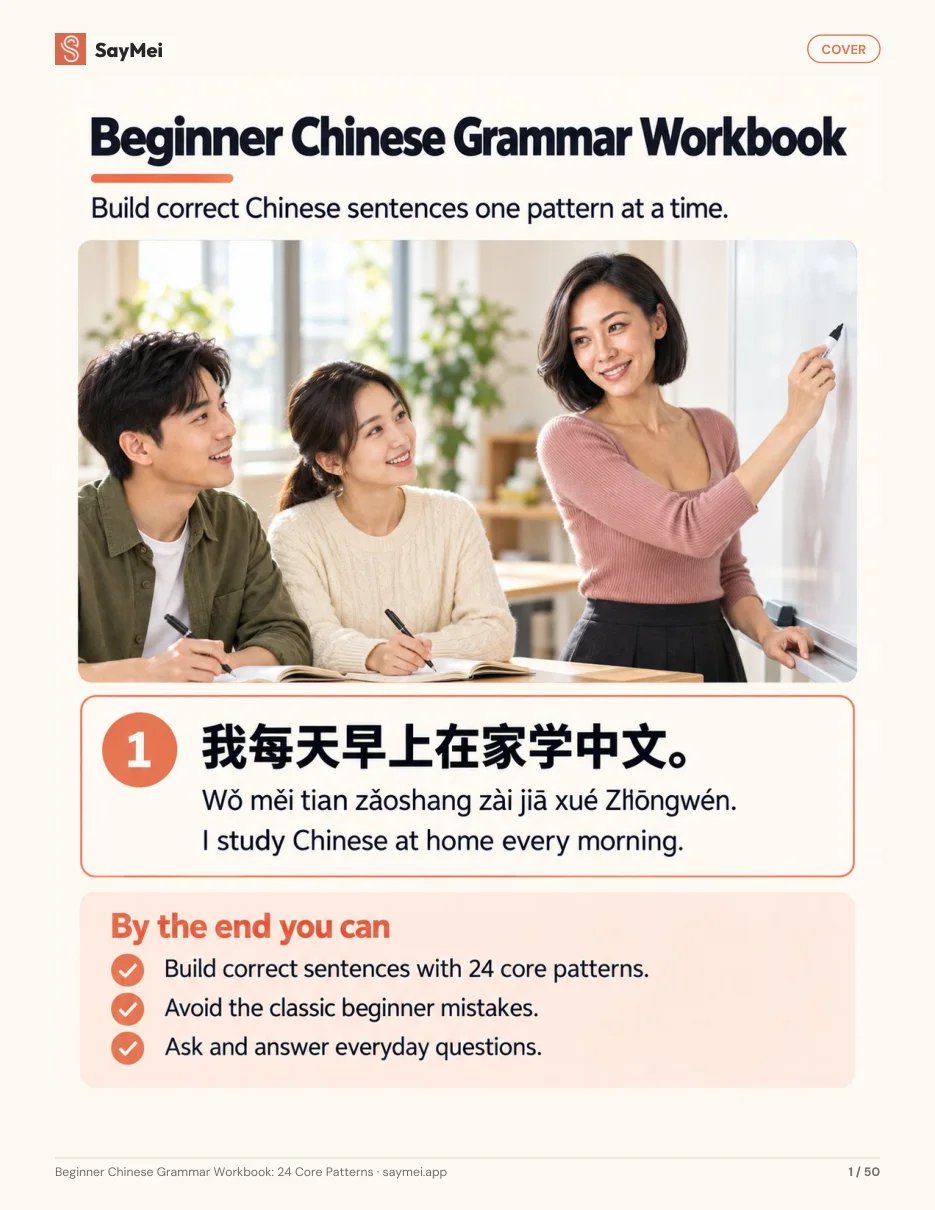
我每天早上在家学中文。 · Wǒ měi tiān zǎoshang zài jiā xué Zhōngwén. · I study Chinese at home every morning.
By the end you can
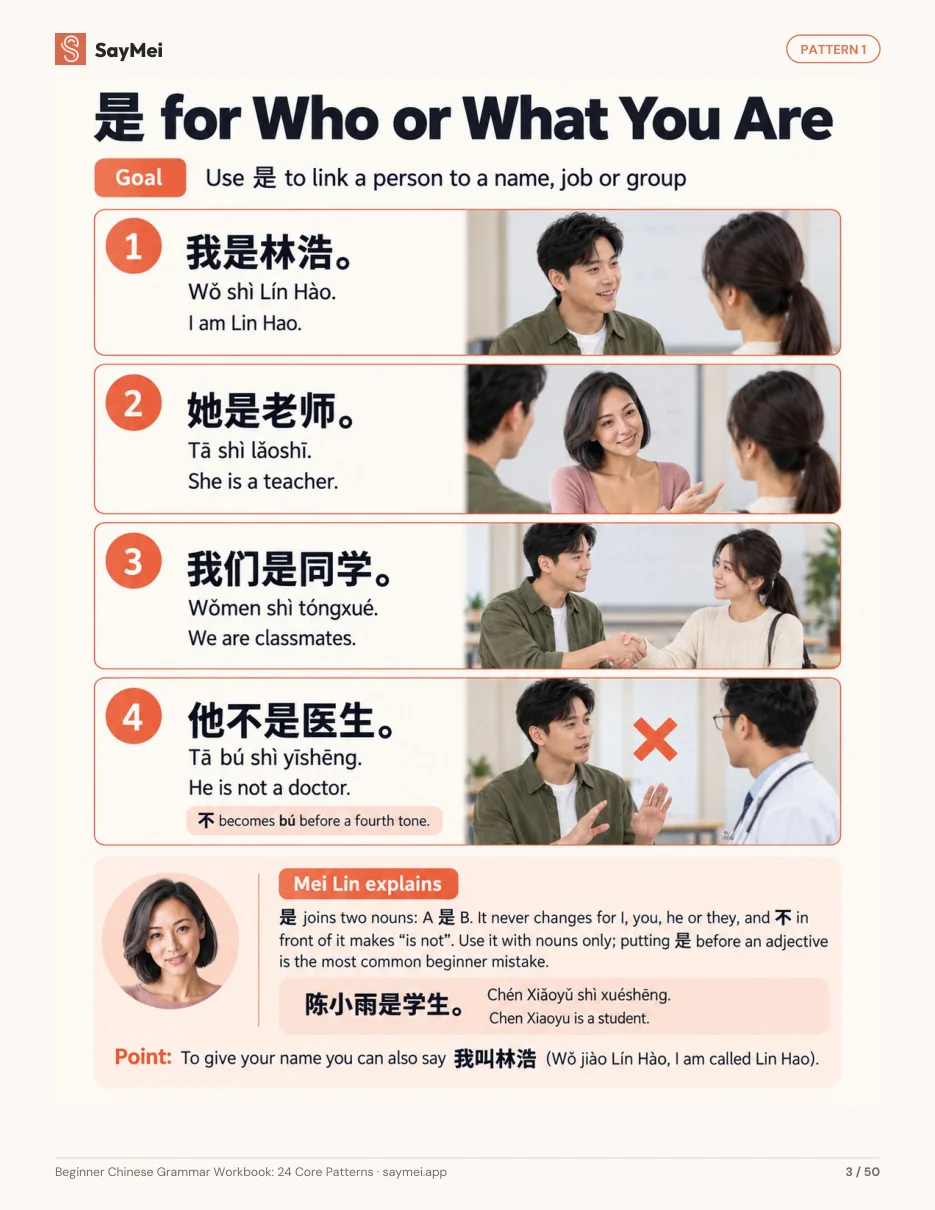
- Use 是 for nouns and 很 + adjective for descriptions. 是 joins two nouns. Adjectives work like verbs, so they need no 是: 我是高兴 is the most common beginner mistake, and the practice page has you fix it.
我很高兴。 · Wǒ hěn gāoxìng. · I am happy. - Ask questions without moving any words. Add 吗 to any statement for a yes-or-no question, and put 什么, 谁 or 哪儿 where the answer would go.
你去哪儿? · Nǐ qù nǎr? · Where are you going? - Ask back with 呢 and show whose with 的. Hand a question back with 你呢, and put 的 between the owner and the thing, which close family often drops.
我很好,你呢? · Wǒ hěn hǎo, nǐ ne? · I'm fine, and you? - Say what there is and where it is. 有 and 没有 for having (never 不有), and person or thing + 在 + place for where it is, with no 是.
你的手机在这儿。 · Nǐ de shǒujī zài zhèr. · Your phone is here. - Put time and place before the verb, and count with measure words. The basic order is who + when + where + do, where English puts time and place at the end. Then count with a number, 个, 本 or 件, and a noun.
我早上在家学中文。 · Wǒ zǎoshang zài jiā xué Zhōngwén. · I study Chinese at home in the morning. - Choose 不 or 没, and say what you want with 想 and 要. 不 for habits, wishes and plans, 没 for something that didn't happen. 是 and adjectives always take 不, and 有 always takes 没.
我昨天没喝咖啡。 · Wǒ zuótiān méi hē kāfēi. · I didn't drink coffee yesterday. - Pick the right "can" and talk about finished actions. 会 for a skill, 能 for being able right now, 可以 for permission. Then 了 for a finished action, 过 for experience, and 在 or 正在 for what's happening now.
今天我不能游泳。 · Jīntiān wǒ bù néng yóuyǒng. · I can't swim today. - Compare things and say "too" and "a bit". Put 也 and 都 before the verb, ask "A or B?" with 还是, compare with A 比 B + adjective (no 很), and use 太…了, 有点儿 and 一点儿.
茶比咖啡便宜。 · Chá bǐ kāfēi piányi. · Tea is cheaper than coffee. - Give reasons, order your steps and make suggestions. 因为…所以 for reasons, 但是 for contrast, 先…再 for what comes first, 去 + place + activity, and 吧 for friendly suggestions.
我们先去书店,再去看电影。 · Wǒmen xiān qù shūdiàn, zài qù kàn diànyǐng. · Bookstore first, then the movie.
What’s inside
- Pattern 1: 是 for Who or What You Are
- Pattern 2: 很 + Adjective, With No 是
- Practice 1–2: Practice: 是 and 很
- Pattern 3: 吗 for Yes-or-No Questions
- Pattern 4: Question Words Stay in Place
- Practice 3–4: Practice: 吗 and Question Words
- Pattern 5: 呢 to Ask Back
- Pattern 6: 的 for Possession
- Practice 5–6: Practice: 呢 and 的
- Pattern 7: 有 and 没有
- Pattern 8: 在 for Location
- Practice 7–8: Practice: 有, 没有 and 在
- Review 1–8: Review: Patterns 1–8
- Pattern 9: Who + When + Where + Do
- Pattern 10: Measure Words 个, 本, 件
- Practice 9–10: Practice: Order and Measure Words
- Pattern 11: 不 or 没: Two Kinds of "Not"
- Pattern 12: 想 and 要 for Wants and Plans
- Practice 11–12: Practice: 不, 没, 想 and 要
- Pattern 13: 会, 能 and 可以 for "Can"
- Pattern 14: 了 for a Finished Action
- Practice 13–14: Practice: "Can" and 了
- Pattern 15: 过 for Life Experience
- Pattern 16: 在 and 正在 for Actions Now
- Practice 15–16: Practice: 过 and 在
- Review 9–16: Review: Patterns 9–16
- Pattern 17: 也 and 都 Go Before the Verb
- Pattern 18: 还是 and Two Kinds of "Or"
- Practice 17–18: Practice: 也, 都 and Two Kinds of Or
- Pattern 19: 比 for Comparisons
- Pattern 20: 太…了, 有点儿 and 一点儿
- Practice 19–20: Practice: 比, 太, 有点儿 and 一点儿
- Pattern 21: 因为…所以 and 但是
- Pattern 22: 先…再 for the Order of Events
- Practice 21–22: Practice: Reasons and Steps
- Pattern 23: 去 + Place + Activity
- Pattern 24: 吧 for Suggestions
- Practice 23–24: Practice: 去 + Place and 吧
- Review 17–24: Review: Patterns 17–24
- Reference 1: Patterns 1–8 at a Glance
- Reference 2: Patterns 9–16 at a Glance
- Reference 3: Patterns 17–24 at a Glance
How to use this book
One pattern a page, a practice page after every two, and a review after every eight. Two patterns and their practice page make a good session.
- Sessions 1–4: Patterns 1–8. 是, 很, questions, 呢, 的, 有 and 在. Read each example aloud, then do the practice page without looking back.
- Session 5: Review 1–8. Use patterns 1–8 together in the conversation on page 15.
- Sessions 6–9: Patterns 9–16. Word order, measure words, 不 and 没, 想 and 要, the three "cans", 了, 过 and 正在. Then the phone-call review on page 28.
- Sessions 10–13: Patterns 17–24. 也 and 都, 还是, 比, 太 and 有点儿, reasons, steps, 去 + place and 吧. Then plan a day out on page 41.
- After that: Keep the reference pages. Pages 42–44 list all 24 patterns with one example and the mistake to avoid. Check them whenever a sentence feels wrong.
Who it’s for
Beginners who know some words and phrases but want to build their own correct sentences, and anyone who keeps making the same few mistakes.
Before you start: A small vocabulary and pinyin with tone marks. Every example has pinyin and English, and many use the same two friends, Lin Hao and Chen Xiaoyu.
Frequently asked questions
Which mistakes does it cover?
The classic beginner ones: 是 before an adjective, moving the question word to the front, 不有 instead of 没有, putting time and place after the verb, 很 inside a 比 sentence, and mixing up 不 and 没.
Is it enough on its own?
It covers 24 core beginner patterns, with practice after every two and three reviews. Pair it with speaking practice, since knowing a pattern and saying it in time are different skills.
What comes after it?
Intermediate Chinese Grammar Workbook picks up with 20 patterns for longer sentences: complements, 把 and 被, and linked pairs like 虽然…但是.
Is this workbook free?
Yes. The whole 51-page PDF is free, and you can look through its pages here before you download. There's no card and nothing to pay.
Do I need a SayMei account?
Yes, to download the PDF, and the account is free: sign up with Google, Apple or your email address. With it we email you a copy of the workbook, keep every workbook you download on your account on all your devices, save your place in the free online practice, and you can practise speaking with Mei Lin, SayMei's AI tutor.
How do I print it?
The PDF is US Letter size. On A4 paper, choose "Fit to page" (or "Scale to fit") in the print dialog so nothing is cut off. Print the whole workbook or only the pages you need; colour looks best, and black and white works too.
Can I print copies for my class?
Yes. Print as many copies as you like for your own class or family. To share it, send this page: everyone can download their own copy.
Keep going
Intermediate Chinese Grammar Workbook: 20 Patterns for Longer Sentences · Chinese Sentence Structure: Build Sentences from Short to Long · Compare Things in Mandarin: 比, 更, 最 & 没有 · The SayMei Chinese Grammar Practice Book · Browse all 294 workbooks
Version 2026-10 · Updated Oct 27, 2026 · Report a correction