The most common Chinese grammar mistakes, from real learner writing
We counted 33,833 mistakes teachers marked in real learner essays. The ones learners make most, a fix for each, and a quick quiz to spot them yourself.

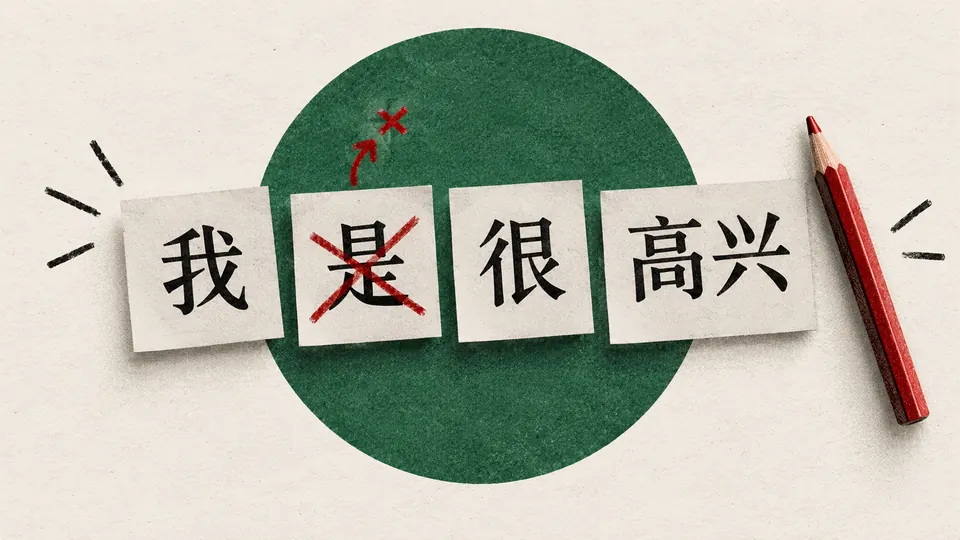
Every list of Chinese grammar mistakes seems to start with word order. We counted 33,833 mistakes in real learner essays. Word order was about one in 15.
If you're an English speaker learning Chinese, from your first sentences to about HSK 4, this list is for you. You'll get the mistakes learners really make, a fix for each one, and a quiz to test yourself.
Key takeaways
- A wrong or missing word is behind most mistakes. Together they make up three mistakes in four, and word order is the smallest group.
- 了 and 的 go wrong in both directions. They're the words learners most often leave out, and the words they most often add.
- "Look" isn't "see". Writing 看 where 看到 belongs was the most common wrong verb in the essays.
- Some mistakes fade, and others stick. Slips with 了 and with time words drop sharply at higher levels, while picking the right word barely improves.
- English speakers start with an edge. They made fewer word-order mistakes than other learners, and forgot 是 about half as often.
Most lists of Chinese mistakes come from a teacher's memory. We wanted counts.
So we went through the TOCFL learner corpus: 2,837 essays written for Taiwan's official Chinese test, from beginner level A2 to advanced C1. Trained native speakers marked every grammar mistake in them and wrote the fix. We counted all of those marks, by kind of mistake, by grammar point, by level and by the writer's first language. You'll find how we counted at the end.
Most mistakes are a wrong or missing word
Teachers sort learner mistakes into four kinds: a wrong word, a missing word, an extra word, or words in the wrong order. Wrong and missing words are most of them.
Here's how the four kinds split in our count, next to a separate set of HSK essays from mainland China:
Source: our count of 33,833 mistakes in the TOCFL learner corpus; HSK figures from the 2016 shared task on learner grammar, 24,797 mistakes.
Two tests, two places, two writing systems, and the same pattern. If you're making mistakes, they're most likely about choosing words, not putting them in order.
What are the most common Chinese grammar mistakes?
Small words, mostly. We grouped the marked mistakes by grammar point and ranked the groups:
Source: our count of the TOCFL learner corpus. Each mistake sits in one group; the rest are spread across smaller groups.
The little grammar words are where the marks pile up. Here are the ten words that most often went missing or got added:
Source: our count of the TOCFL learner corpus, words in simplified characters.
So the quickest check you can make is a small one: before anything else, look for a missing or extra 了 and 的.
The rest of this guide takes the big mistakes in order, with a fix for each. We skip two catch-alls, a missing subject or object and linking words, because no single rule fixes them.
"Look" isn't "see"
The biggest group of mistakes is simply the wrong verb, noun or adjective. And one verb fix stood out: writing "look", 看, where the writer needed "see", 看到.
In Chinese, seeing is looking with a result, so the verb takes an ending. The same goes for "find", 找到, and "hear", 听到. To say "Have you seen my phone?":
- Wrong: 你看我的手机了吗? Nǐ kàn wǒ de shǒujī le ma?
- Right: 你看到我的手机了吗? Nǐ kàndào wǒ de shǒujī le ma?
The wrong version isn't nonsense. It asks "Did you look at my phone?", which is a different question. In the essays, 看, 听, 找 and 买 without their endings caused nearly 200 of the verb mistakes.
So when you learn a verb, learn its result too. 找 is hunting for your keys; 找到 is the moment you find them.
Little adverbs go missing
Adverbs are the second-biggest group, and the trouble isn't fancy ones. It's 就, 都, 很 and 也, left out or put in the wrong place.
就 alone went missing 480 times. It's the glue in "as soon as", 一…就… yī…jiù…. To say "I'll call you as soon as I get home":
- Wrong: 我一到家给你打电话。 Wǒ yí dào jiā gěi nǐ dǎ diànhuà.
- Right: 我一到家就给你打电话。 Wǒ yí dào jiā jiù gěi nǐ dǎ diànhuà.
Position matters just as much. "Too", 也, and "all", 都, sit right before the verb, never at the end like the English "too". So you say 我也喜欢咖啡, "I like coffee too", and never 我喜欢也咖啡.
Here's a quick check before you speak: if your English sentence has "too", "also" or "all", the Chinese adverb goes before the verb.
Finished actions need 了 le ; past states don't
了 is the word learners left out most, and the word they added most. Both slips come from the same idea, that 了 is a past tense like the English "-ed". It isn't, and if you treat it that way, you'll make both slips.
了 after a verb says an action is finished, usually with a number or a specific thing: bought three books, read that letter. A past state, like being busy, takes no 了 at all, because the time word already says when. Here are both slips.
To say "I bought three books yesterday":
- Wrong: 我昨天买三本书。 Wǒ zuótiān mǎi sān běn shū.
- Right: 我昨天买了三本书。 Wǒ zuótiān mǎile sān běn shū.
To say "I was busy yesterday":
- Wrong: 我昨天很忙了。 Wǒ zuótiān hěn máng le.
- Right: 我昨天很忙。 Wǒ zuótiān hěn máng.
The good news: this is the mistake that fades fastest. For the same amount of writing, the top two levels made about a quarter as many 了 slips as beginners. The level chart shows it.
Don't drop the 的 de before a noun
的 went missing more than a thousand times. It's the word that joins a description to a noun, like "the food my mum made". To say "This is the food my mum made":
- Wrong: 这是我妈妈做菜。 Zhè shì wǒ māma zuò cài.
- Right: 这是我妈妈做的菜。 Zhè shì wǒ māma zuò de cài.
Then there are its two sound-alikes, 地 and 得. Writing 的 where 地 belongs was the most common swap of the three. Here's the rule of thumb:
- Before a noun: 的, as in my book, 我的书.
- Before a verb, to say how: 地, as in walk slowly, 慢慢地走.
- After a verb, to rate it: 得, as in speaks fast, 说得很快.
They all sound the same, so this only matters when you write. It's also stubborn: advanced writers mixed the three up at least as often as beginners did.
"Will" and "can" are different words
English uses "can" and "will" for lots of jobs. Chinese splits them across 会, 能, 可以 and 要, and learners most often left out 会.
会 does two jobs: a skill you've learned, like swimming, and "will", for a prediction. 可以 asks for or gives permission. 能 is about being able to, right now. To say "Can I sit here?":
- Wrong: 我会坐这儿吗? Wǒ huì zuò zhèr ma?
- Right: 我可以坐这儿吗? Wǒ kěyǐ zuò zhèr ma?
And to predict "You'll definitely like this place":
- Wrong: 你一定喜欢这个地方。 Nǐ yídìng xǐhuan zhège dìfang.
- Right: 你一定会喜欢这个地方。 Nǐ yídìng huì xǐhuan zhège dìfang.
Without 会, that second sentence means "you must like this place", a guess about now. One small word turns a promise into an assumption.
Don't use 个 ge for everything
Every number needs a measure word before its noun. The common slip is leaning on the all-purpose measure word, 个. Using 个 where 件 belongs was the most common wrong measure word in the essays.
To say "I bought a shirt":
- Wrong: 我买了一个衬衫。 Wǒ mǎile yí ge chènshān.
- Right: 我买了一件衬衫。 Wǒ mǎile yí jiàn chènshān.
个 is fine for people and for plenty of things. But clothes and matters take 件, books take 本, and films take 部. When you learn a noun, learn its measure word with it, or look one up in our Measure Word Finder.
Adjectives skip 是 shì , but nouns need it
Every list warns you not to put 是 before an adjective. That mistake is real. But in the essays, learners left 是 out more often than they added it.
To say "This dish is very spicy":
- Wrong: 这个菜是辣。 Zhège cài shì là.
- Right: 这个菜很辣。 Zhège cài hěn là.
To say "My hobby is reading":
- Wrong: 我的爱好看书。 Wǒ de àihào kàn shū.
- Right: 我的爱好是看书。 Wǒ de àihào shì kàn shū.
The rule: an adjective joins its subject with 很, which often doesn't mean "very". 是 joins two nouns, or a noun and an activity. Of the unneeded 是 in the essays, about one in four came right before an adjective, often as 是很.
Put when and where before the verb
This is the mistake most lists lead with, and it's real. English puts time and place at the end; Chinese puts them before the verb. But time-and-place slips were only 1% of the mistakes, and they fade fast.
The order is who, when, where, then what happens. To say "I go to the gym in the morning":
- Wrong: 我去健身房早上。 Wǒ qù jiànshēnfáng zǎoshang.
- Right: 我早上去健身房。 Wǒ zǎoshang qù jiànshēnfáng.
Places sit in the same slot, after "at", 在. It was the preposition learners left out most. To say "I study in the library":
- Wrong: 我图书馆学习。 Wǒ túshūguǎn xuéxí.
- Right: 我在图书馆学习。 Wǒ zài túshūguǎn xuéxí.
For the same amount of writing, beginners made nearly seven times as many time-and-place slips as upper-level writers. Once the pattern clicks for you, it stays.
Two famous mistakes are rare in real writing
The 把 sentence and the choice between 不 and 没 fill whole chapters of grammar books. In the essays, each was well under 1% of the mistakes.
Part of the reason is that learners rarely use 把 at all. When they did use it in another large learner corpus, about one 把 sentence in eight went wrong. Here's the fix for each.
To say "Please put the book on the table":
- Wrong: 请把书放。 Qǐng bǎ shū fàng.
- Right: 请把书放在桌子上。 Qǐng bǎ shū fàng zài zhuōzi shang.
After 把, a thing and a verb, say what happens to the thing: where it goes, or how it ends up.
To say "I didn't go to work yesterday":
- Wrong: 我昨天不去上班。 Wǒ zuótiān bú qù shàngbān.
- Right: 我昨天没去上班。 Wǒ zuótiān méi qù shàngbān.
没 says something didn't happen. 不 is for habits, likes, the future and adjectives. Rare in the data doesn't mean optional: it means you'll meet these once the basics are steady.
Some mistakes fade, and others stick
For the same amount of writing, the top levels made about a third fewer mistakes than beginners. But the drop was uneven. Here's how much of each mistake was left at B2 and C1, compared with beginner level A2:
Source: our count of the TOCFL learner corpus. B2 and C1 are pooled, 599 essays; A2 is 850.
The pattern makes sense. 了 and word order follow rules, and rules click with practice. Choosing the right word depends on vocabulary, which grows slowly. Slips with 的, 地 and 得 even grow, probably because stronger writers attempt longer descriptions.
So once your basics are steady, your fastest progress comes from words, not rules. Notice which verb a native speaker uses, and copy it.
English speakers are better at word order
Of the 2,837 essays, 452 were by English speakers. They made mistakes at the same overall rate as everyone else, and mostly the same ones. Three things stood out:
| Per 1,000 characters | English speakers | Everyone else |
|---|---|---|
| All mistakes | 34.0 | 33.7 |
| Word order | 2.0 | 2.4 |
| Leaving out 是 | 0.3 | 0.5 |
| Writing 一个, any use | 3.9 | 2.9 |
Source: our count of the TOCFL learner corpus. The word-order and 是 gaps are too large to be chance; the overall rates match.
- Word order. English and Chinese both run subject, verb, object. Japanese, the biggest group of writers, puts the verb last.
- The verb "to be". English has one, so English speakers rarely forget 是 in sentences like "my hobby is reading".
- The word "a". English speakers wrote 一个 about a third more often. A 2015 study of the same test found English speakers using it even where Chinese leaves it out, as if it were the English "a".
So if English is your first language, word order probably isn't your biggest problem. Watch your verbs, your 了 and your 一个.
Test yourself: spot the mistake
Ready to try? Here are ten sentence pairs, one for each mistake in this guide. Pick the one that's right:
Spot the mistake
10 pairs of sentences, one for each mistake in this guide. Pick the one that's right, then see how you did on each kind of mistake.
You want to say: “Have you seen my phone?”
Pick the sentence that says it correctly.
Every sentence is our own, and each word and its pinyin was checked against CC-CEDICT. Unsure about a sentence of your own? Paste it into the free Grammar Checker.
If you missed one, its section above has the rule and another example.
The cheat sheet: wrong to right
Here's every fix from this guide on one screen:
| Mistake | Wrong | Right |
|---|---|---|
| Seeing and finding | 看, 找 | 看到, 找到 |
| "Too" at the end | 喜欢也 | 也喜欢 |
| A finished action | 买三本书 | 买了三本书 |
| A past state | 很忙了 | 很忙 |
| A description before a noun | 妈妈做菜 | 妈妈做的菜 |
| Asking permission | 我会坐 | 我可以坐 |
| Clothes and matters | 一个衬衫 | 一件衬衫 |
| An adjective | 是辣 | 很辣 |
| Time words | 去健身房早上 | 早上去健身房 |
| Something that didn't happen | 昨天不去 | 昨天没去 |
Every example is our own sentence, and every word and its pinyin was checked against CC-CEDICT.
Keep this list next to you when you write, and check one line at a time.
What to do next
- Learn verbs with their endings. Memorise 看到, 找到 and 听到 as words of their own.
- Check each finished action for 了. Then take it off past states like busy, 忙.
- Look for a missing 的. Any description in front of a noun needs one.
- Put when and where before the verb. Who, when, where, then what.
- Get feedback on real sentences. Paste one into our free Grammar Checker to see the fix and why, or browse the grammar library by level.
The fastest way to fix a mistake is to hear it corrected while you talk. Your first lesson with Mei Lin is free.
FAQ
Is 了 the past tense in Chinese?
No. 了 after a verb marks a finished action. 了 at the end of a sentence marks a change, so it can describe the present: 我饿了, "I'm hungry now". Past states and habits take no 了, as in 我昨天很忙, "I was busy yesterday". In the essays we counted, learners left 了 out about 1,400 times and added it where it didn't belong about 900 times.
What's the difference between 不 and 没?
没 says something didn't happen: 我昨天没去上班 wǒ zuótiān méi qù shàngbān, "I didn't go to work yesterday". It's also the only way to negate 有: 我没有时间, "I don't have time". 不 is for habits, likes, the future and adjectives: 我不喜欢咖啡, "I don't like coffee". A past habit still takes 不: 他以前不吃肉, "he didn't use to eat meat".
Why is 我是累 wrong?
Because Chinese adjectives work like verbs, so they don't need 是. Join the subject and the adjective with 很, which often doesn't mean "very": 我很累, "I'm tired". 是 joins two nouns, as in 我是学生, "I'm a student". In our count, about one unneeded 是 in four came right before an adjective, often as 是很.
Do you always need a measure word in Chinese?
Between a number, or 这 or 那, and a noun, yes: a book is 一本书, never 一书. 个 is the safe default in speech, but books take 本 and clothes 件. English speakers also add 一个 where Chinese leaves it out: one study found English-speaking learners wrote it about 70% more often than Japanese learners.
What's the difference between 的, 地 and 得?
All three are read de. 的 goes before a noun: my book, 我的书. 地 goes before a verb to say how: walk slowly, 慢慢地走. 得 goes after a verb to say how well: speaks fast, 说得很快. In the essays, writing 的 where 地 belongs was the most common swap of the three, and it didn't get rarer at higher levels.
Where do time words go in a Chinese sentence?
Before the verb, usually right after the subject: 我早上去健身房 wǒ zǎoshang qù jiànshēnfáng, "I go to the gym in the morning". They can also open the sentence. How long something lasts is the exception, and goes after the verb: 我学了两个小时 wǒ xuéle liǎng ge xiǎoshí, "I studied for two hours". In our count, time-and-place slips were only 1% of mistakes.
Sources
- NYCU NLP Lab, TOCFL learner corpus (GitHub release, commit 411218480a, 28 February 2024; read 7 Oct 2026). https://github.com/NYCU-NLP/TOCFL
- Lee, L.-H., Tseng, Y.-H. & Chang, L.-P. (2018). Building a TOCFL learner corpus for Chinese grammatical error diagnosis. Proceedings of LREC 2018, 2298–2304. https://aclanthology.org/L18-1363.pdf
- Lee, L.-H., Rao, G., Yu, L.-C., Xun, E., Zhang, B. & Chang, L.-P. (2016). Overview of NLP-TEA 2016 shared task for Chinese grammatical error diagnosis. https://aclanthology.org/W16-4906.pdf
- Rao, G., Zhang, B. & Xun, E. (2017). IJCNLP-2017 Task 1: Chinese grammatical error diagnosis. https://aclanthology.org/I17-4001.pdf
- Rao, G., Gong, Q., Zhang, B. & Xun, E. (2018). Overview of NLPTEA-2018 shared task: Chinese grammatical error diagnosis. https://aclanthology.org/W18-3706.pdf
- Rao, G., Yang, E. & Zhang, B. (2020). Overview of NLPTEA-2020 shared task for Chinese grammatical error diagnosis. https://aclanthology.org/2020.nlptea-1.4.pdf
- Zhang Baolin (2017). 关于德语背景汉语学习者语料库的构建 (slides, FACH 2017, Vienna). https://fach2017wien.univie.ac.at/fileadmin/user_upload/k_fach2017wien/Abstracts_PPT/ZHANG_Baolin.pdf
- Mochizuki, K., Sano, H., Shen, Y.-M. & Wu, C.-H. (2015). Cross-linguistic error types of misused Chinese based on learners' corpora. International Journal of Computational Linguistics and Chinese Language Processing 20(1), 97–114. https://aclanthology.org/O15-2007.pdf
- Xu, H. Y., Lu, X. & Březina, V. (2019). Acquisition of the Chinese particle le by L2 learners: a corpus-based approach. In Computational and Corpus Approaches to Chinese Language Learning. Springer. https://doi.org/10.1007/978-981-13-3570-9_10
- CC-CEDICT, MDBG release of 29 November 2025. https://www.mdbg.net/chinese/dictionary?page=cc-cedict
- SayMei, Grammar Checker and free first lesson (read 7 Oct 2026). /tools/chinese-grammar-coach and /live/first-lesson
Methods
- The essays. The TOCFL learner corpus as released by the NYCU NLP Lab, which asks users to cite Lee, Tseng and Chang (2018). It holds 2,837 essays from Taiwan's computer-based TOCFL writing test, written 2007–2012 at four levels: A2 (850 essays), B1 (1,388), B2 (503) and C1 (96). Only passing essays are included, scored 3 to 5 out of 5. Writers came from 45 first languages; 452 essays were by English speakers.
- The marks. Spelling was corrected first. Then trained native-speaker annotators tagged each grammar mistake with one of 124 tags, four kinds times 36 grammar categories, and wrote the correction. We counted all 33,833 tagged mistakes in the release. The paper reports 33,835; three annotations in the files carry no tag.
- Our counting rules. A mistake's kind is its tag's first letter. Grammar points group tags by category: for example, 了, 过 and 着 are every aspect-particle tag. A word counts as left out when a missing-word tag's correction is exactly that word, and as added when an extra-word tag marks exactly that word. Rates are per 1,000 characters, punctuation included. Words are shown in simplified characters; the essays use traditional ones. We publish counts only, never essay text.
- One judgment call. "About one unneeded 是 in four before an adjective" comes from checking the character after each extra 是 against degree words such as 很 and a list of common adjectives. Treat it as an estimate.
- English speakers. We compared their rates per 1,000 characters with everyone else's using a Poisson test. Word order differed at p = 0.001 and leaving out 是 at p < 0.001; the overall rate didn't differ. We don't report gaps that could be chance, such as using 个 for other measure words (p = 0.07).
- The HSK comparison. Published counts from the HSK track of the 2016 shared task (24,797 mistakes in 10,071 sentences). Later HSK sets put word order between 7.4% and 9.0%.
- Data we checked but didn't count. The HSK-based shared-task data, MuCGEC and YACLC are free for research but not for company use, so we used only their published figures or left them out. The NLPCC 2018 data has no licence.
- The examples. Every example sentence is ours, not taken from the essays. Each word and its pinyin was checked against CC-CEDICT. Pinyin shows the spoken tone of 一 and 不, as in yí ge and bú qù.
- Limits. These are written exam essays from Taiwan, mostly by intermediate learners, and higher levels wrote harder tasks. Speech, and your first weeks of Chinese, may look different. The counts also depend on the annotators' judgment. If you spot a mistake, tell us.