Conversation · Beginner to pre-intermediate
Business Chinese Phrases: Meetings, Introductions and Client Dinners
You hand over business cards with both hands, count prices in 万, disagree without a flat no and give a toast at a client dinner. For learners who work with Chinese companies or clients.
- Level:
- Beginner · HSK 1–2
- Format:
- Workbook · PDF · 26 pages · US Letter (prints on A4)
- Price:
- Free · free with a saymei account · updated Nov 4, 2026
Listening audio: play every track free, no account needed.
Download the free PDF: create a free SayMei account on this page, and we'll email you a copy too.
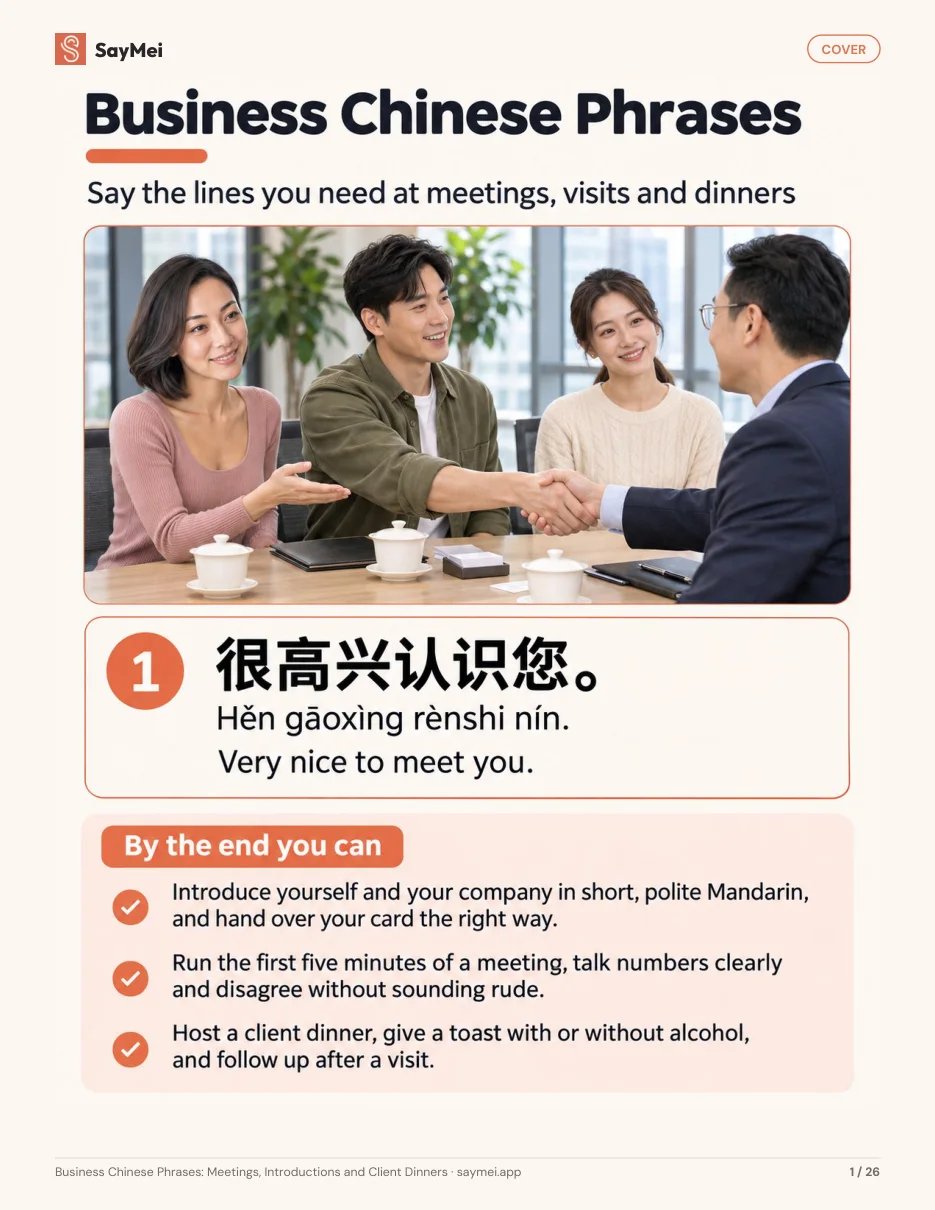
很高兴认识您。 · Hěn gāoxìng rènshi nín. · Very nice to meet you.
By the end you can
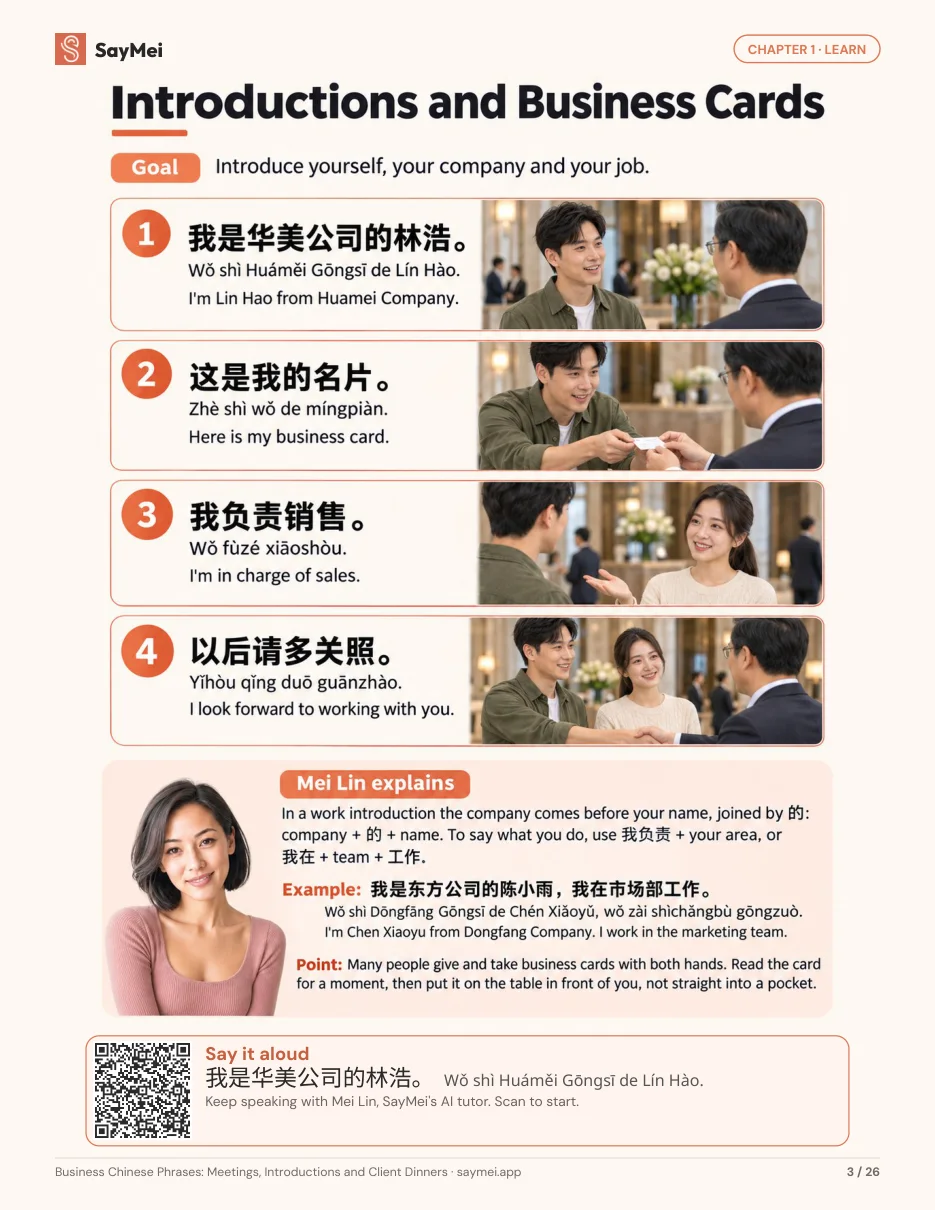
- Introduce yourself, your company and your job. Put the company before your name with 的, say what you do with 我负责, and give and take business cards with both hands.
我是华美公司的林浩。 · Wǒ shì Huáměi Gōngsī de Lín Hào. · I'm Lin Hao from Huamei Company. - Make small talk, then open and close a meeting. Ask 路上顺利吗?, offer tea or coffee, answer short and ask back with 您呢. Then start, move on and close with 吧 lines that sound like friendly suggestions.
今天就到这里吧。 · Jīntiān jiù dào zhèlǐ ba. · Let's stop here for today. - Say no politely and suggest another way. Say something good first, then 不过 and the problem made smaller with 有点. Suggest a change with 能不能, and hear 我们再考虑一下 as a likely no.
这个想法不错,不过时间有点紧。 · Zhège xiǎngfǎ búcuò, búguò shíjiān yǒudiǎn jǐn. · That's a good idea, but the timing is a bit tight. - Talk prices, amounts and deadlines clearly. Count big numbers in 万 (ten thousand), ask for the total and the latest delivery date, and say a figure back to check it.
一共十二万元。 · Yígòng shí'èr wàn yuán. · It's 120,000 yuan in total. - Handle phone and video calls. Check they can hear you, ask them to speak up, share your screen and offer to call back, softening each action with 一下.
我来共享一下屏幕。 · Wǒ lái gòngxiǎng yíxià píngmù. · Let me share my screen. - Host a client dinner and toast, with or without alcohol. Toast with 我敬您一杯 and 为我们的合作干杯, look after your guests, and join every toast with tea using 以茶代酒.
我不喝酒,我以茶代酒。 · Wǒ bù hē jiǔ, wǒ yǐ chá dài jiǔ. · I don't drink, so I'll toast with tea. - Ask good questions on a visit and promise the next step. Ask about staff and monthly output with 多少 and 几, ask before you take photos, then thank your host and say when you'll email or call with 给您.
我回去以后给您发邮件。 · Wǒ huíqu yǐhòu gěi nín fā yóujiàn. · I'll email you when I get back.
What’s inside
- Chapter 1: Learn: Introductions and Business Cards · Practice: Introduce Yourself and Your Firm
- Chapter 2: Learn: Small Talk Before a Meeting · Practice: Fill the First Five Minutes
- Chapter 3: Learn: Running a Meeting · Practice: Open, Move On and Close
- Chapter 4: Learn: Agree, Disagree and Suggest · Practice: Disagree Politely
- Chapter 5: Learn: Numbers, Prices and Deadlines · Practice: Talk Numbers Clearly
- Chapter 6: Learn: Phone and Video Calls · Practice: Run a Short Call
- Chapter 7: Learn: Client Dinners and Toasts · Practice: Toast and Host a Dinner
- Chapter 8: Learn: Visiting an Office or Factory · Practice: Ask Good Questions on a Visit
- Chapter 9: Learn: Thank-Yous and Follow-Ups · Practice: Close the Visit and Follow Up
- Review: A Supplier Visit, Start to Finish
How to use this book
Nine chapters, each a Learn and a Practice page, then a review. Play the chapter's free audio, pause it and say each line back before you look at the pinyin. End each chapter by saying its roleplay out loud. At two chapters a week, that's about five weeks.
- Week 1: Introductions and small talk. Chapters 1 and 2. Write your own introduction with your company and job, then answer the small-talk questions on the audio and ask back with 您呢.
- Week 2: Run a meeting and disagree softly. Chapters 3 and 4. Lead a two-topic meeting with 吧 lines, then turn a flat no from your own work into a 不过 and 有点 line.
- Week 3: Numbers and calls. Chapters 5 and 6. Count in 万 until 十二万 comes quickly, write down the amounts on the audio, and say the call lines before your next video meeting.
- Week 4: Dinner and the visit. Chapters 7 and 8. Learn one toast and 以茶代酒 by heart, then ask the three factory-visit questions on page 18 out loud.
- Week 5: Follow up, then the whole visit. Chapter 9 and the review. Promise the next step with 给您发邮件, then play Lin Hao in the supplier visit on page 21 and check your answers at the back.
Who it’s for
Adult beginners who work with Chinese companies or clients: sales and buying staff, managers on supplier visits, and anyone with a meeting, video call or client dinner in Mandarin coming up. It keeps to speaking: meetings, calls, visits and dinners.
Before you start: Basic greetings and numbers help, but every line has characters, pinyin and English. The free audio reads each line with a pause to say it back, and the answers and the audio script are at the back.
Frequently asked questions
What's inside?
Nine chapters, each a Learn page and a Practice page: introductions and business cards, small talk before a meeting, running a meeting, disagreeing politely, numbers and deadlines, phone and video calls, client dinners and toasts, office or factory visits, and follow-ups. A supplier visit on page 21 brings it all together.
How much Chinese do I need?
Basic greetings and numbers help, but every line has characters, pinyin and English. The book keeps to speaking: meetings, calls, visits and dinners.
How long does it take?
At two chapters a week, about five weeks. Play each chapter's free audio, pause it and say each line back before you look at the pinyin, then end the chapter by saying its roleplay out loud. The answers and the audio script are at the back.
Do I have to drink alcohol at a client dinner?
No. The book says plainly that you never have to drink alcohol to do business. Chapter 7 teaches 我不喝酒,我以茶代酒: you raise your tea and join every toast. There's a line for when you're driving too, and a tip about touching glasses a little lower than your host's as a sign of respect.
What does it mean when a Chinese partner says 我们再考虑一下?
Often probably not. Chapter 4 explains that 我们再考虑一下 (let us think about it a little more) and 这个有点难 can be a polite no, and suggests you ask kindly what would help instead of pushing for a yes.
Does it cover business emails?
The book keeps to spoken Mandarin. For writing the follow-up email, it points you to Chinese Work Emails & Messages, and for booking and customer-service calls to Mandarin Phone Calls.
Do I need a SayMei account?
Yes, to download the PDF, and the account is free: sign up with Google, Apple or your email address. With it we email you a copy of the workbook, keep every workbook you download on your account on all your devices, save your place in the free online practice, and you can practise speaking with Mei Lin, SayMei's AI tutor.
How do I print it?
The PDF is US Letter size. On A4 paper, choose "Fit to page" (or "Scale to fit") in the print dialog so nothing is cut off. Print the whole workbook or only the pages you need; colour looks best, and black and white works too.
Keep going
Everyday Mandarin Conversations: 20 Short Dialogues to Read and Say · Keep a Mandarin Conversation Going · Mandarin at Home: Everyday Family Phrases · Talk About Your Day: Mandarin Daily Routines Workbook · Browse all 294 workbooks
Version 2026-11 · Updated Nov 4, 2026 · Report a correction