Conversation · Beginner to pre-intermediate
Everyday Mandarin Conversations: 20 Short Dialogues to Read and Say
You chat with a neighbour, ask for a better price on apples, report a problem with your hotel room and give a gift with both hands. For beginners who know greetings and a few basic words.
- Level:
- Beginner · HSK 1–2
- Format:
- Workbook · PDF · 42 pages · US Letter (prints on A4)
- Price:
- Free · free with a saymei account · updated Oct 27, 2026
Download the free PDF: create a free SayMei account on this page, and we'll email you a copy too.
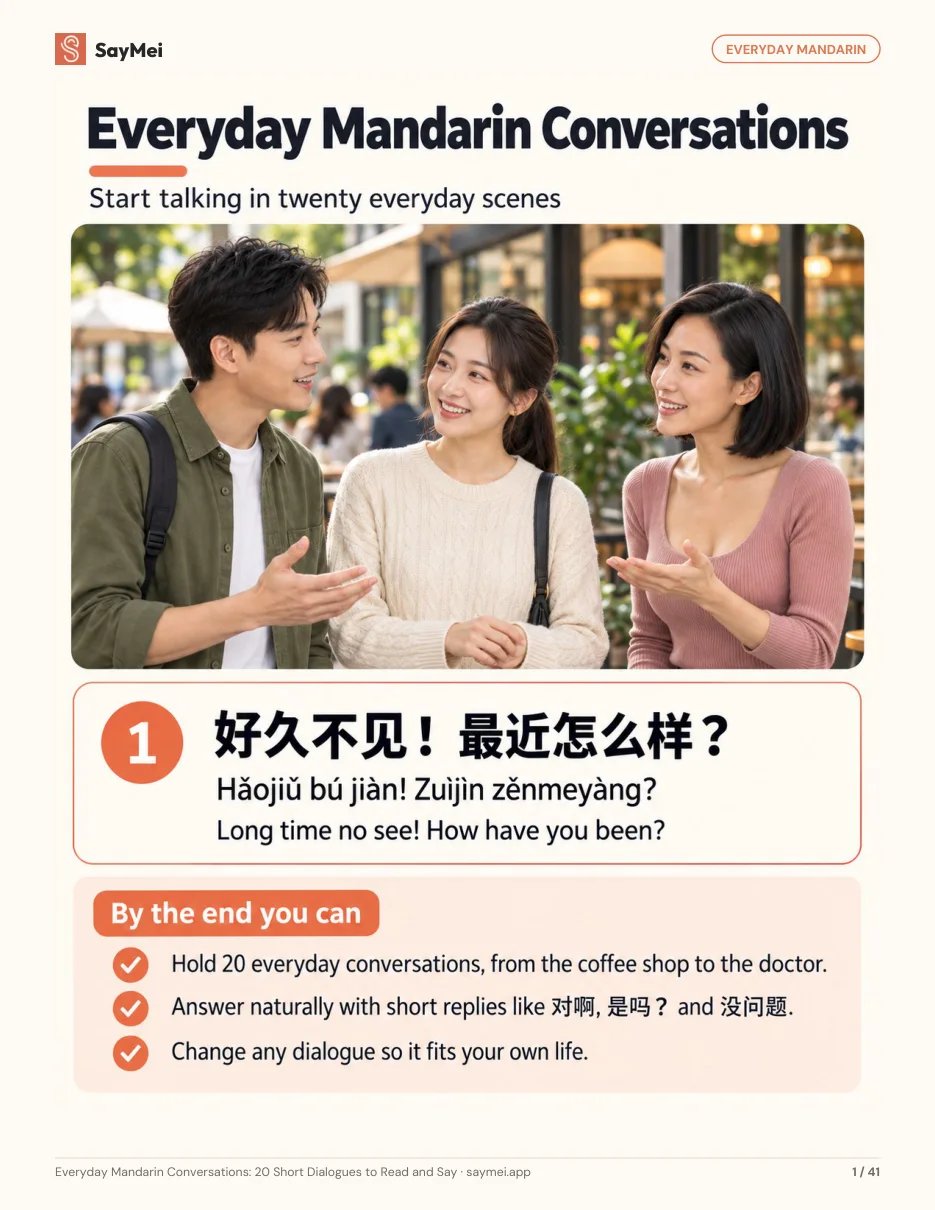
好久不见!最近怎么样? · Hǎojiǔ bú jiàn! Zuìjìn zěnmeyàng? · Long time no see! How have you been?
By the end you can
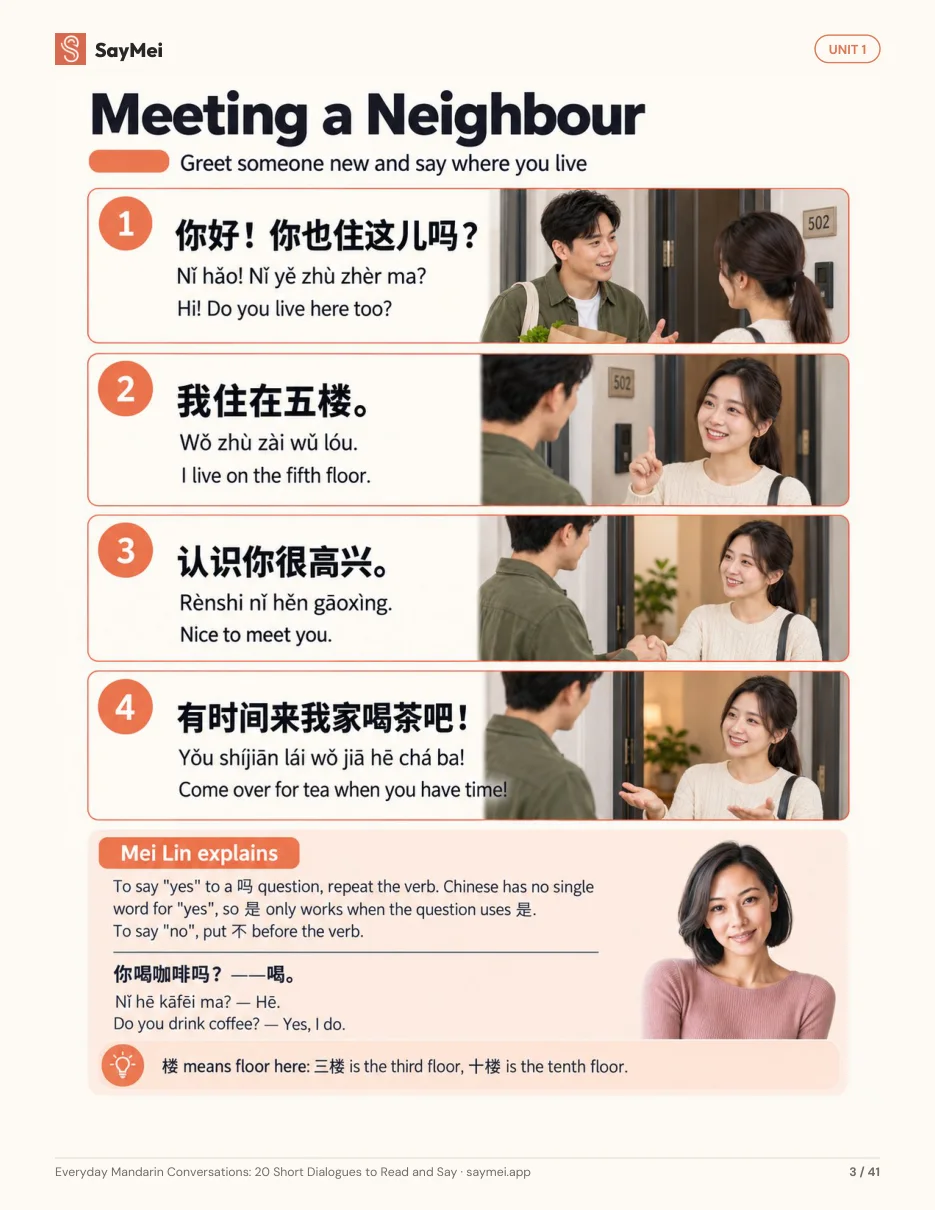
- Meet a neighbour and invite them over. Say which floor you live on, ask where someone works, and answer "yes" the Chinese way by repeating the verb.
有时间来我家喝茶吧! · Yǒu shíjiān lái wǒ jiā hē chá ba! · Come over for tea when you have time! - Buy fruit and ask for a better price. Ask how the apples are sold, get your change, and put 一点儿 after an adjective to ask for a bit more of it.
有点儿贵。便宜一点儿吧? · Yǒudiǎnr guì. Piányi yìdiǎnr ba? · That's a bit expensive. Could you make it cheaper? - Ask the way, take a taxi and check in at a hotel. Ask how to get somewhere, ask if it's far with adjective 不 adjective, tell a driver where to stop, and report a problem with your room.
远不远? · Yuǎn bu yuǎn? · Is it far? - Make a plan, then move it politely. Suggest a plan with 吧, agree on a time, and say sorry and move it with 有事, which needs no further reason.
不好意思,我那天有事。 · Bù hǎoyìsi, wǒ nà tiān yǒu shì. · Sorry, I have something on that day. - Say what's wrong at the doctor and the pharmacy. Say what hurts, complain gently with 有点儿 before an adjective, and follow advice on how often to take medicine.
我头疼,有点儿累。 · Wǒ tóu téng, yǒudiǎnr lèi. · I have a headache and I'm a bit tired. - Book a table and order dishes. Book by phone for a time and a group size, count people with 位, order with 来 plus a number and a dish, and ask for the bill.
今天晚上七点,四位,可以吗? · Jīntiān wǎnshang qī diǎn, sì wèi, kěyǐ ma? · Tonight at seven, for four. Is that OK? - Meet a new team, wish happy birthday and give a gift. Introduce yourself at work and join the team for lunch, then give a gift and accept one politely, with both hands.
这是给你的。 · Zhè shì gěi nǐ de. · This is for you. - Talk about your weekend and leave without sounding rude. Say what you did with 了, then give a reason before you go, the way a polite guest does.
时间不早了,我得走了。 · Shíjiān bù zǎo le, wǒ děi zǒu le. · It's getting late. I have to go. - Answer with the short replies people really use. Choose between 对啊, 是吗, 没问题, 没关系 and 太好了, then write and say a six-line dialogue of your own.
没问题 · méi wèntí · No problem.
What’s inside
- Unit 1: Meeting a Neighbour · Dialogue 1: At the Front Door · Dialogue 2: At the Coffee Shop
- Unit 2: Shopping for Fruit · Dialogue 1: At the Fruit Stall · Dialogue 2: Paying at the Shop
- Unit 3: Getting Around Town · Dialogue 1: Asking the Way · Dialogue 2: Taking a Taxi
- Unit 4: At the Hotel · Dialogue 1: At the Front Desk · Dialogue 2: A Problem With the Room
- Unit 5: Making Plans · Dialogue 1: Plans for Saturday · Dialogue 2: Changing the Plan
- Unit 6: Feeling Unwell · Dialogue 1: At the Doctor · Dialogue 2: At the Pharmacy
- Unit 7: Eating Out · Dialogue 1: Booking by Phone · Dialogue 2: Ordering Food
- Unit 8: At Work · Dialogue 1: First Day at Work · Dialogue 2: Lunch With the Team
- Unit 9: Birthdays and Gifts · Dialogue 1: It's Your Birthday! · Dialogue 2: Giving a Gift
- Unit 10: The Weekend and Goodbyes · Dialogue 1: How Was Your Weekend? · Dialogue 2: Saying Goodbye
- Mixed practice: Choose the Natural Reply
- Make it yours: Write Your Own Dialogue
- Replies and fillers 1: Quick Replies You Will Use
- Replies and fillers 2: More Replies and Fillers
How to use this book
Ten units of three pages: a Learn page with four key lines, then two six-line dialogues to read, practise and make your own. One unit every two days takes about three weeks.
- Each unit, day 1: Learn the key lines. Read the four lines aloud and the Mei Lin note on the grammar or culture behind them.
- Each unit, day 2: Read and change the dialogues. Read both dialogues aloud, do the exercise, then say them again with your own details, as each Say it task asks.
- Units 1–5: Out and about. Neighbours, fruit stalls, directions and taxis, hotels, and making and changing plans.
- Units 6–10: Life with people. The doctor, eating out, a first day at work, birthdays and gifts, and the weekend.
- Last: Make it yours. Choose the natural reply on page 33, then write and say your own six-line dialogue on page 34.
- Any time: Quick replies. Keep pages 35 and 36 nearby: short replies and fillers that keep a conversation going.
Who it’s for
Beginners who know greetings and some basic words and want to use them in real exchanges: with neighbours, in shops, at the doctor, at work and with friends.
Before you start: Reading pinyin helps. Every line is printed in characters, pinyin and English, and each Learn page explains the one grammar point or custom you need for that unit.
Frequently asked questions
Which conversations are in the book?
Twenty dialogues in ten units: a neighbour, a fruit stall, directions and a taxi, a hotel, making and changing plans, the doctor and the pharmacy, eating out, a first day at work, birthdays and gifts, and the weekend and goodbyes. Each unit has a Learn page with four key lines and two six-line dialogues.
How do I make a dialogue my own?
Each dialogue ends with a Say it task that asks you to change details, like your floor or where you work, and say it with a partner. Page 34 then walks you through writing a six-line dialogue for a new situation.
Is there any grammar in it?
A little, where you need it. Each Learn page has a Mei Lin note on one point, such as 一点儿 after an adjective, 吧 for suggestions, or giving a reason before you leave.
How long does it take?
One unit every two days takes about three weeks: the key lines on the first day, then both dialogues on the second, said again with your own details. Pages 35 and 36 hold quick replies and fillers to keep nearby.
Is there audio?
The PDF has no audio. Every line has pinyin with tone marks, so you can act out each dialogue with a partner.
Do I need a SayMei account?
Yes, to download the PDF, and the account is free: sign up with Google, Apple or your email address. With it we email you a copy of the workbook, keep every workbook you download on your account on all your devices, save your place in the free online practice, and you can practise speaking with Mei Lin, SayMei's AI tutor.
How do I print it?
The PDF is US Letter size. On A4 paper, choose "Fit to page" (or "Scale to fit") in the print dialog so nothing is cut off. Print the whole workbook or only the pages you need; colour looks best, and black and white works too.
Keep going
Business Chinese Phrases: Meetings, Introductions and Client Dinners · Keep a Mandarin Conversation Going · Mandarin at Home: Everyday Family Phrases · Talk About Your Day: Mandarin Daily Routines Workbook · Browse all 294 workbooks
Version 2026-10 · Updated Oct 27, 2026 · Report a correction