Conversation · Total beginner
Chinese Greetings Cheat Sheet: Hello, Goodbye and Everyday Greetings
You'll know what to say when you meet a neighbour, your boss or a group, and how to answer the phone or start a WeChat chat. Made for learners starting from zero, with every line on the free audio.
- Level:
- Total beginner · HSK 1
- Format:
- Reference guide · PDF · 10 pages · US Letter (prints on A4)
- Price:
- Free · free with a saymei account · updated Nov 4, 2026
Listening audio: play every track free, no account needed.
Download the free PDF: create a free SayMei account on this page, and we'll email you a copy too.
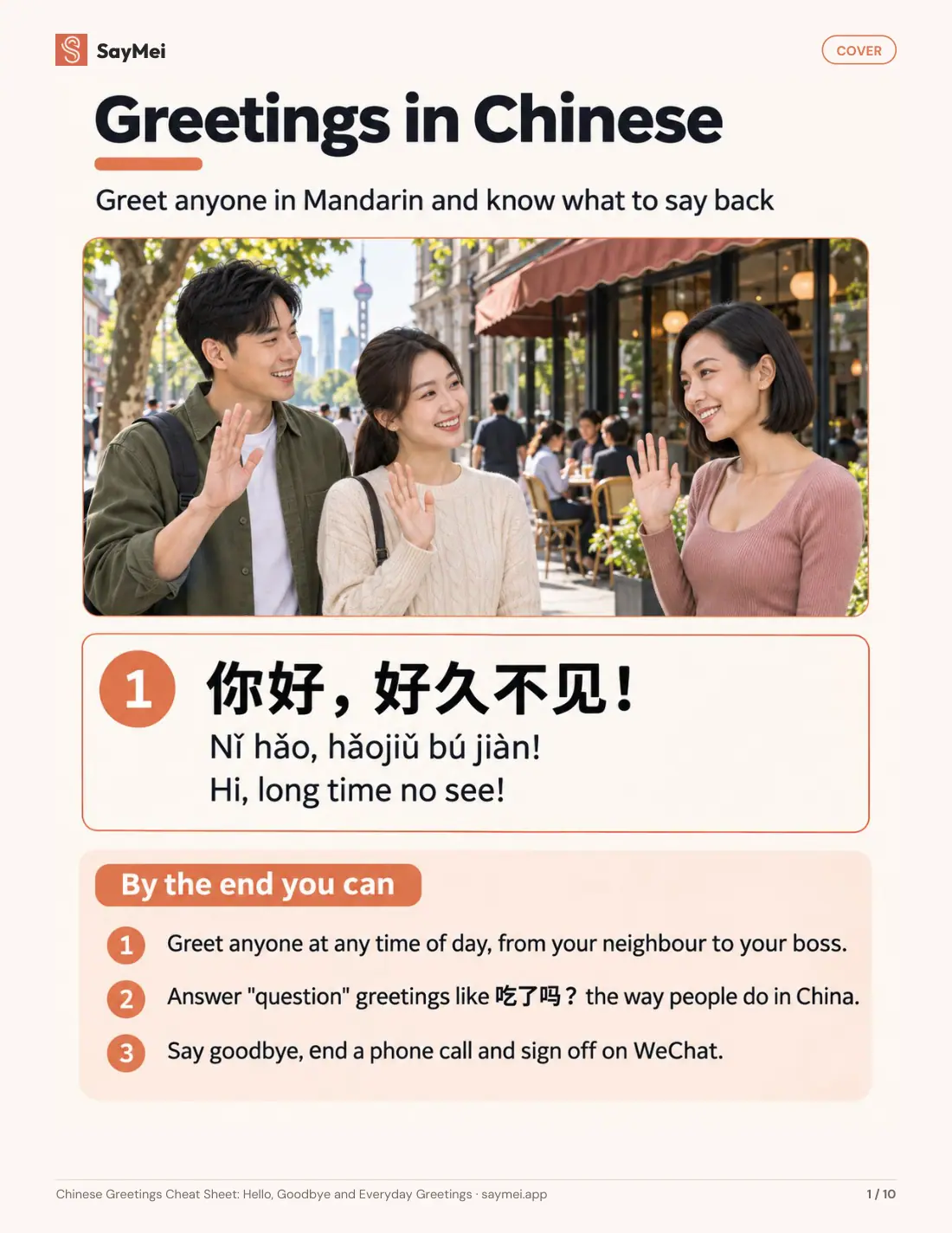
你好,好久不见! · Nǐ hǎo, hǎojiǔ bú jiàn! · Hi, long time no see!
By the end you can
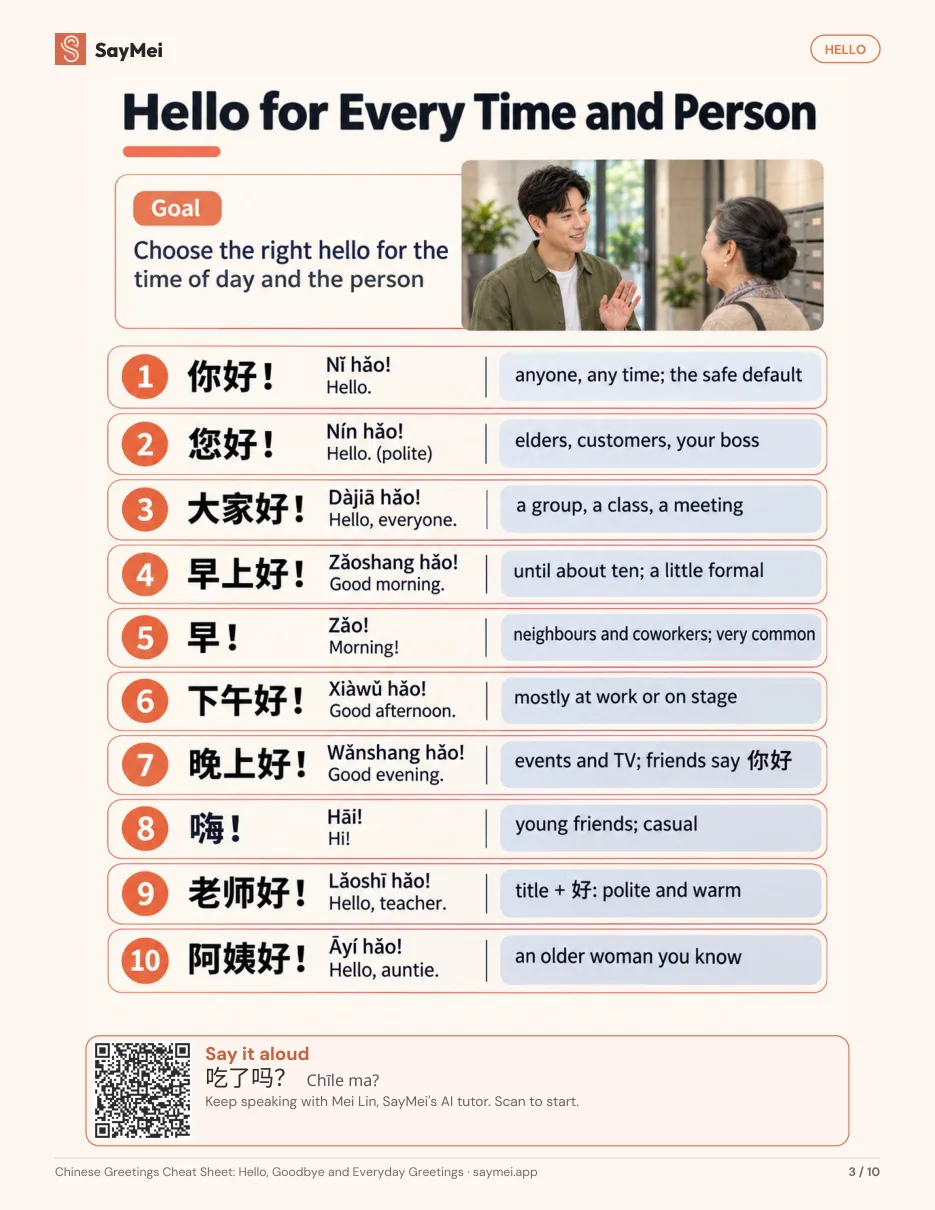
- Pick the right hello for the person and the time of day. Ten hellos with a note on who each is for: 您好 for elders, customers and your boss, 大家好 for a group, 早 for neighbours and coworkers.
您好! · Nín hǎo! · Hello. (polite) - Answer greetings that sound like questions. Neighbours greet you by naming what you are doing. Give a short yes and ask back with 你呢, the way people do in China.
吃了吗? · Chīle ma? · Have you eaten? (Hi!) - Greet old friends, new people and guests. Say long time no see and reply to it, ask how someone has been, say nice to meet you, and welcome a guest at the door.
最近怎么样? · Zuìjìn zěnmeyàng? · How have you been? - Say goodbye ten ways. From 再见 and 拜拜 to leaving before the others, a host's 慢走 at the door, and a late-evening 早点儿休息.
我先走了。 · Wǒ xiān zǒu le. · I'll head off now. - Start and end phone calls and WeChat chats. Answer the phone with 喂, say who is calling, open a message with 在吗, and sign off for the night.
晚安,明天聊。 · Wǎn'ān, míngtiān liáo. · Good night, talk tomorrow. - Choose a greeting by ear and in short scenes. Circle the greeting that fits each moment, pick replies to lines on the audio, and find the lines in three short meetings.
好,路上小心! · Hǎo, lùshang xiǎoxīn! · OK, get home safe!
What’s inside
- Hello: Hello for Every Time and Person · Greet Like a Local · Long Time No See and Welcome
- Goodbye: Goodbye, See You, Take Care · Phone, Voice Message and WeChat
- Practice: Which Greeting Fits? · Three Short Meetings
How to use this book
Nine short pages you can read in one sitting and keep by the door. Play each chapter's audio, say every line in the pause, then use them on real people the same day.
- Day 1: Hello. Read pages 3 to 5 with the audio for chapter 1. Say each hello with energy, and notice the note that tells you who it is for.
- Day 2: Goodbye, calls and messages. Pages 6 and 7 with the audio for chapter 2. Send a friend 在吗 or 晚安 on WeChat to try one out.
- Day 3: Practice. Do pages 8 and 9: circle the greetings, play the three audio lines and pick the replies, then check the answer key on page 10.
- After that: Say them out loud. Act out the three meetings on page 9 with a partner, change the time of day, and pin the pages you need most where you will see them.
Who it’s for
Total beginners who want to greet people in Mandarin the way people in China do: travellers, people with Chinese friends, family or coworkers, and learners who know 你好 and want the rest.
Before you start: Nothing. Every line has pinyin and English, and the free audio reads each one with a pause for you to say it back.
Frequently asked questions
What's on the nine pages?
Five pages of greetings: hellos for each time and person, the question greetings neighbours use, long time no see and welcome, ten goodbyes, and phone calls and WeChat. Then two practice pages, ending in three short meetings with a neighbour, a boss and a friend, and an answer key on page 10.
When should I use 您好 instead of 你好?
你好 is the safe default for anyone. 您好 is the polite form for elders, customers and your boss. The note beside each line on page 3 says who it suits.
What do I say back when someone asks 吃了吗?
It is a hello, so keep it short: 吃了,你呢? (Yes, and you?). Page 4 gives the usual replies to four of these question greetings, such as 去哪儿啊? and 下班了?
How do I say goodbye besides 再见?
Page 6 has ten ways: 拜拜 for friends and shops, 明天见 for classmates and coworkers, 我先走了 when you leave before the others, 慢走 from a host to a leaving guest, and 早点儿休息 late in the evening.
Is there audio?
Yes, free on the book's audio page: one track for each chapter, with every Chinese line read once and a pause to say it back. The code on page 2 opens it.
Do I need a SayMei account?
Yes, to download the PDF, and the account is free: sign up with Google, Apple or your email address. With it we email you a copy of the workbook, keep every workbook you download on your account on all your devices, save your place in the free online practice, and you can practise speaking with Mei Lin, SayMei's AI tutor.
How do I print it?
The PDF is US Letter size. On A4 paper, choose "Fit to page" (or "Scale to fit") in the print dialog so nothing is cut off. Print the whole workbook or only the pages you need; colour looks best, and black and white works too.
Keep going
Your First 14 Days of Spoken Mandarin · Five Beginner Mandarin Mini-Stories · Your 30-Day Mandarin Plan · Chinese Numbers, Dates and Telling Time: Prices, Weekdays and the Clock · Browse all 294 workbooks
Version 2026-11 · Updated Nov 4, 2026 · Report a correction