Culture · Beginner (HSK 2–3)
Chinese Myths and Legends in Easy Chinese: 8 Stories to Read, Hear and Retell
Eight famous Chinese myths, from Pangu to Lady White Snake, told in easy Mandarin with pinyin and audio, and retold aloud in your own words
- Level:
- HSK 2 (new HSK)
- Format:
- Workbook · PDF · 25 pages · US Letter (prints on A4)
- Price:
- Free · free with a saymei account · updated Nov 4, 2026
Listening audio: play every track free, no account needed.
Download the free PDF: create a free SayMei account on this page, and we'll email you a copy too.
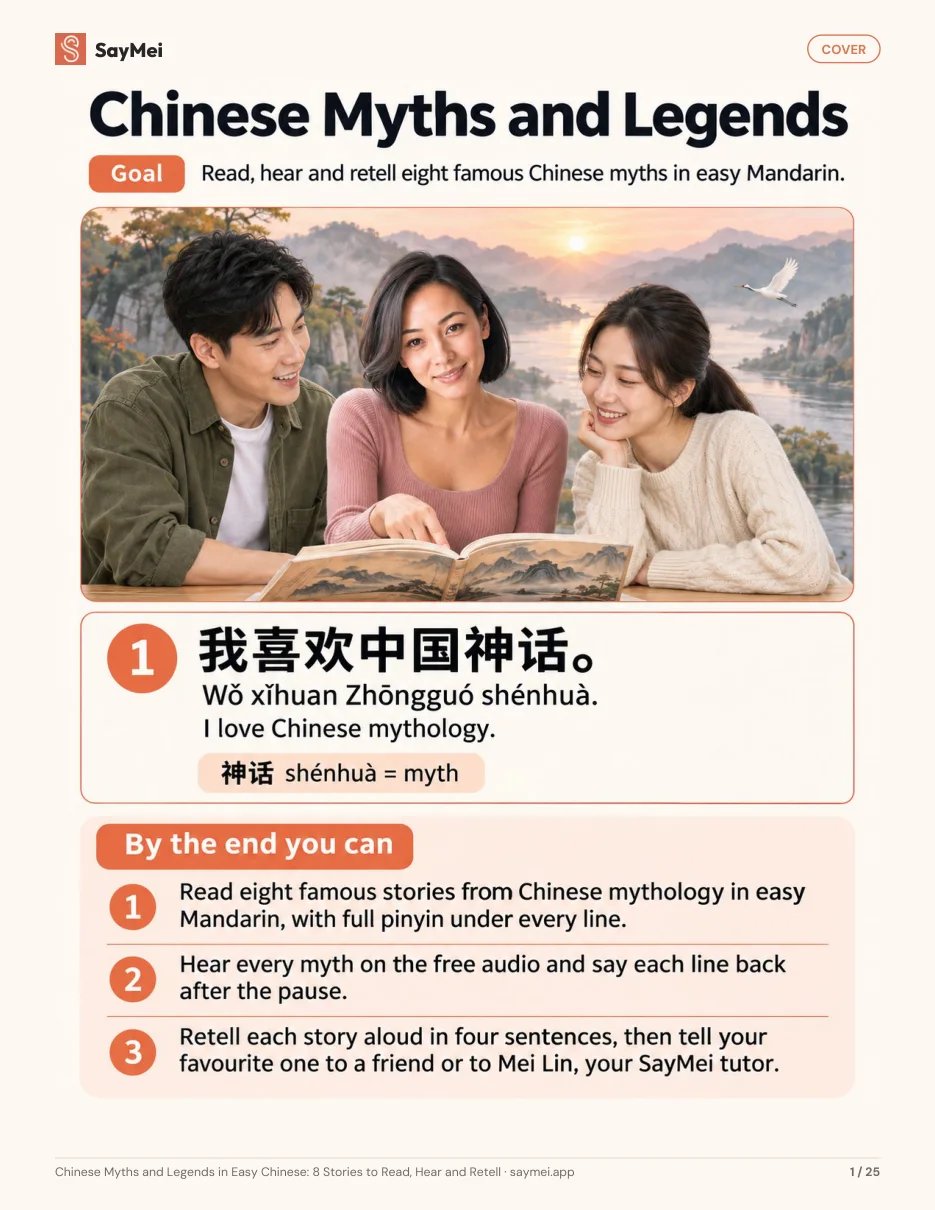
我喜欢中国神话。 · Wǒ xǐhuan Zhōngguó shénhuà. · I love Chinese mythology.
By the end you can
- Tell how Pangu made the world and Nüwa mended the sky. Open a story with 很久很久以前 and use 变成 to say what turned into what: the sky, the earth, the sun and the moon.
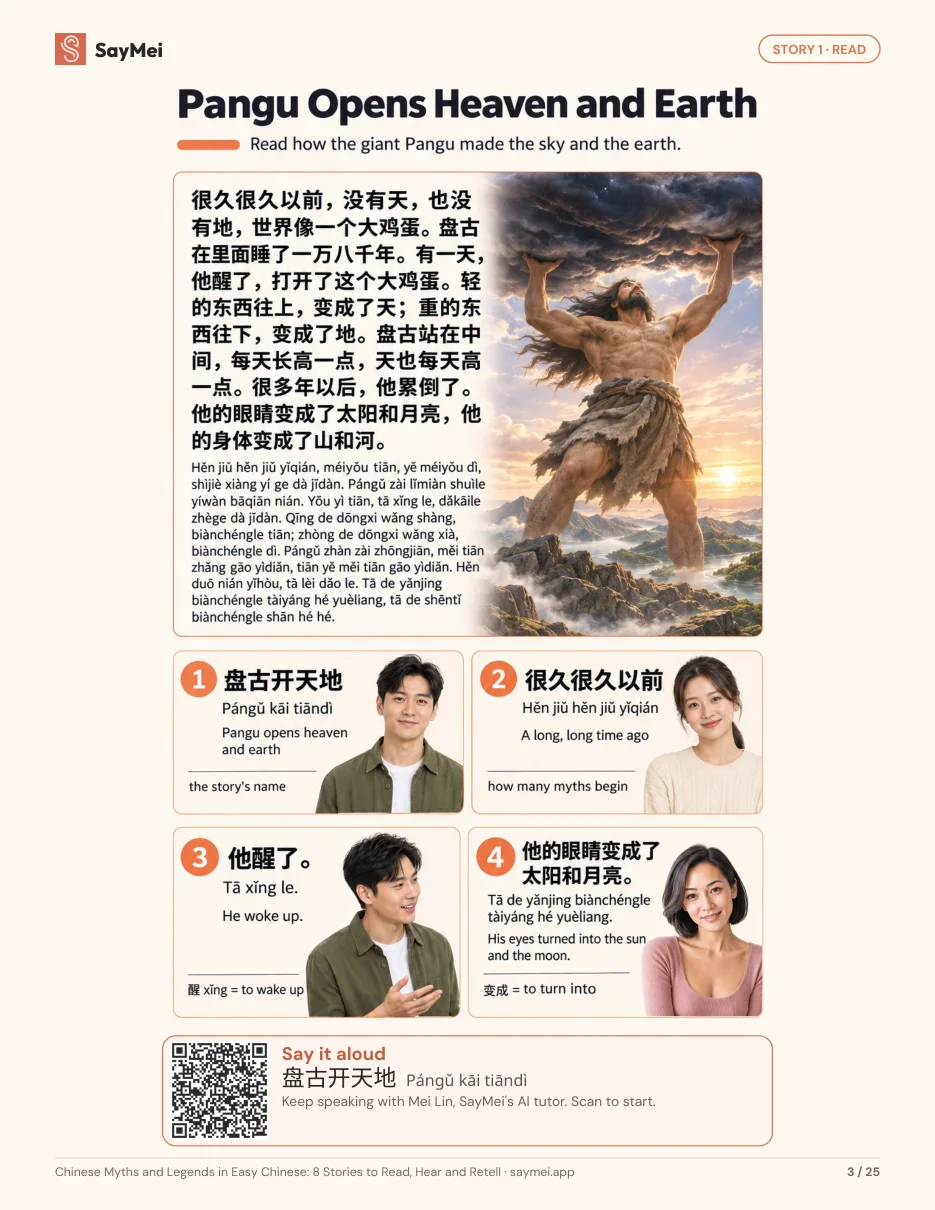
他的眼睛变成了太阳和月亮。 · Tā de yǎnjing biànchéngle tàiyáng hé yuèliang. · His eyes turned into the sun and the moon. - Retell the two sun myths: Houyi and Kuafu. Say someone is good at something with 很会 + verb, count the suns with 个, and say "more and more" with 越来越 + adjective.
我越来越累了。 · Wǒ yuè lái yuè lèi le. · I'm getting more and more tired. - Tell the story of Jingwei, the bird who fills the sea. Follow the little bird and the sea as they talk, and learn why people say 精卫填海 of someone who never gives up.
你永远做不完! · Nǐ yǒngyuǎn zuò bu wán! · You'll never finish! - Tell how Yu the Great tamed the flood. Say you've found a way with 想了一个办法, and meet 三过家门而不入, the saying for someone who puts the job first.
我想了一个办法。 · Wǒ xiǎngle yí ge bànfǎ. · I've thought of a way. - Tell the Cowherd and the Weaver Girl, the story behind Qixi. Say how often something happens with 见一次面, and name the 银河 and the magpie bridge where the lovers meet each year.
我们每年见一次面。 · Wǒmen měi nián jiàn yí cì miàn. · We meet once a year. - Tell the Legend of the White Snake, set at West Lake. Lend something to someone with 借给 + person, and know the real places in the story: 西湖 and Leifeng Pagoda in Hangzhou.
我借给你一把伞。 · Wǒ jiè gěi nǐ yì bǎ sǎn. · I'll lend you an umbrella. - Tell your favourite myth to a friend over dinner. Use twenty words the myths share, then name your favourite story, tell it in three sentences and say why you like it with 因为.
我最喜欢这个故事。 · Wǒ zuì xǐhuan zhège gùshi. · This story is my favourite.
What’s inside
- Story 1: Pangu wakes inside a giant egg and pushes heaven and earth apart. Words: 醒, 变成, 很久很久以前. Read: Pangu Opens Heaven and Earth · Retell: Retell: Pangu Opens the World
- Story 2: Nüwa makes people from yellow earth and mends the sky with stones of five colours, plus a listening check. Read: Nüwa Mends the Sky · Retell: Retell: Nüwa Mends the Sky
- Story 3: Ten suns burn the earth until Houyi shoots down nine. Words: 射, 很会 + verb, 一个一个地. Read: Houyi Shoots the Suns · Retell: Retell: Houyi Shoots the Suns
- Story 4: Kuafu runs after the sun and drinks the Yellow River dry. Grammar: 越来越 + adjective. Read: Kuafu Chases the Sun · Retell: Retell: Kuafu Chases the Sun
- Story 5: Yandi's daughter becomes the bird Jingwei and drops stones into the sea, day after day. Read: Jingwei Fills the Sea · Retell: Retell: Jingwei Fills the Sea
- Story 6: Yu opens a way for the floodwater and passes his own door three times without going in. Read: Yu the Great Tames the Flood · Retell: Retell: Yu Tames the Flood
- Story 7: The Cowherd and the Weaver Girl, parted by the Milky Way, meet once a year on a bridge of magpies. Read: The Cowherd and the Weaver Girl · Retell: Retell: Cowherd and Weaver Girl
- Story 8: A white snake becomes a woman, meets Xu Xian at West Lake and ends up under Leifeng Pagoda. Read: Lady White Snake · Retell: Retell: Lady White Snake
- Story words: Twenty words in ten pairs that come back across the myths, from 天 and 地 to 结婚 and 见面. Twenty Words the Myths Share
- Review: A dinner conversation about a favourite myth, a choose-the-reply check, then your own myth in three sentences. Tell a Myth Over Dinner
How to use this book
Each myth takes about 20 minutes: a story page, then a retell page. Listen once with the book closed, read along and say each line back in the pause, then retell it from memory. At two myths a week, that's about four weeks.
- Week 1: How the world began. Stories 1 and 2, Pangu and Nüwa. Retell each in four sentences, starting with 很久很久以前 and beginning the last one with 最后.
- Week 2: The sun stories. Stories 3 and 4, Houyi and Kuafu. Say 太热了 on the next hot day and use 越来越 in a sentence about your own week.
- Week 3: Never giving up. Stories 5 and 6, Jingwei and Yu the Great. Learn the two sayings that come from them and when people use each one.
- Week 4: The love stories. Stories 7 and 8, the Cowherd and the Weaver Girl, and Lady White Snake. Retell each with 见一次面 and 借给.
- Last session: Story words and dinner talk. Say a sentence with each word pair on page 19, act out the dinner dialogue on page 20, then tell a friend your favourite myth.
Who it’s for
Adult learners at about HSK 2–3 who want stories to read and retell, and anyone curious about the myths behind Chinese sayings, festivals like Qixi and places like West Lake.
Before you start: Some HSK 1–2 Chinese helps. The stories use HSK 1–2 words wherever they can, harder words like 射 and 补 are explained in the phrase notes, and full pinyin sits under every line. The answers are at the back.
Frequently asked questions
Which myths are in the book?
Eight: Pangu Opens Heaven and Earth, Nüwa Mends the Sky, Houyi Shoots the Suns, Kuafu Chases the Sun, Jingwei Fills the Sea, Yu the Great Tames the Flood, the Cowherd and the Weaver Girl, and Lady White Snake. Chang'e and Qu Yuan are told in Mid-Autumn, Dragon Boat and Other Chinese Festivals, so this book leaves them out.
Do Chinese people still use these stories in everyday talk?
Yes. The book shows two: people say 精卫填海 of someone who never gives up, and 三过家门而不入 of someone who puts the job first. The Cowherd and the Weaver Girl is the story behind Qixi, and you can still visit West Lake and Leifeng Pagoda in Hangzhou.
Is there audio?
Yes, free on the book's audio page: one track for each myth, one for the story words and one for the dinner dialogue. Each line is read with a pause to say it back, and the short listening checks on the retell pages are on the audio too. The code on page 2 opens it.
Is this workbook free?
Yes. The whole 25-page PDF is free, and you can look through its pages here before you download. There's no card and nothing to pay.
Do I need a SayMei account?
Yes, to download the PDF, and the account is free: sign up with Google, Apple or your email address. With it we email you a copy of the workbook, keep every workbook you download on your account on all your devices, save your place in the free online practice, and you can practise speaking with Mei Lin, SayMei's AI tutor.
How do I print it?
The PDF is US Letter size. On A4 paper, choose "Fit to page" (or "Scale to fit") in the print dialog so nothing is cut off. Print the whole workbook or only the pages you need; colour looks best, and black and white works too.
Can I print copies for my class?
Yes. Print as many copies as you like for your own class or family. To share it, send this page: everyone can download their own copy.
Keep going
Everyday Chengyu: Meaning, Context & Misuse Practice · Chinese New Year 2027 Workbook: Year of the Goat Greetings & Customs · Learn Chinese with C-Dramas: 100 Phrases You Hear in Every Drama · Chinese Wishes for Every Occasion: Birthdays, Weddings and Get Well · Browse all 294 workbooks
Version 2026-11 · Updated Nov 4, 2026 · Report a correction