Conversation · Total beginner
Chinese Numbers 1–100 Chart: Pinyin, Tones and Practice
You build any number up to 99 from ten digits, keep 四 and 十 apart, and say a price in 块, a time and your phone number. Made for learners starting from zero.
- Level:
- Total beginner · HSK 1
- Format:
- Reference guide · PDF · 10 pages · US Letter (prints on A4)
- Price:
- Free · free with a saymei account · updated Nov 4, 2026
Listening audio: play every track free, no account needed.
Download the free PDF: create a free SayMei account on this page, and we'll email you a copy too.
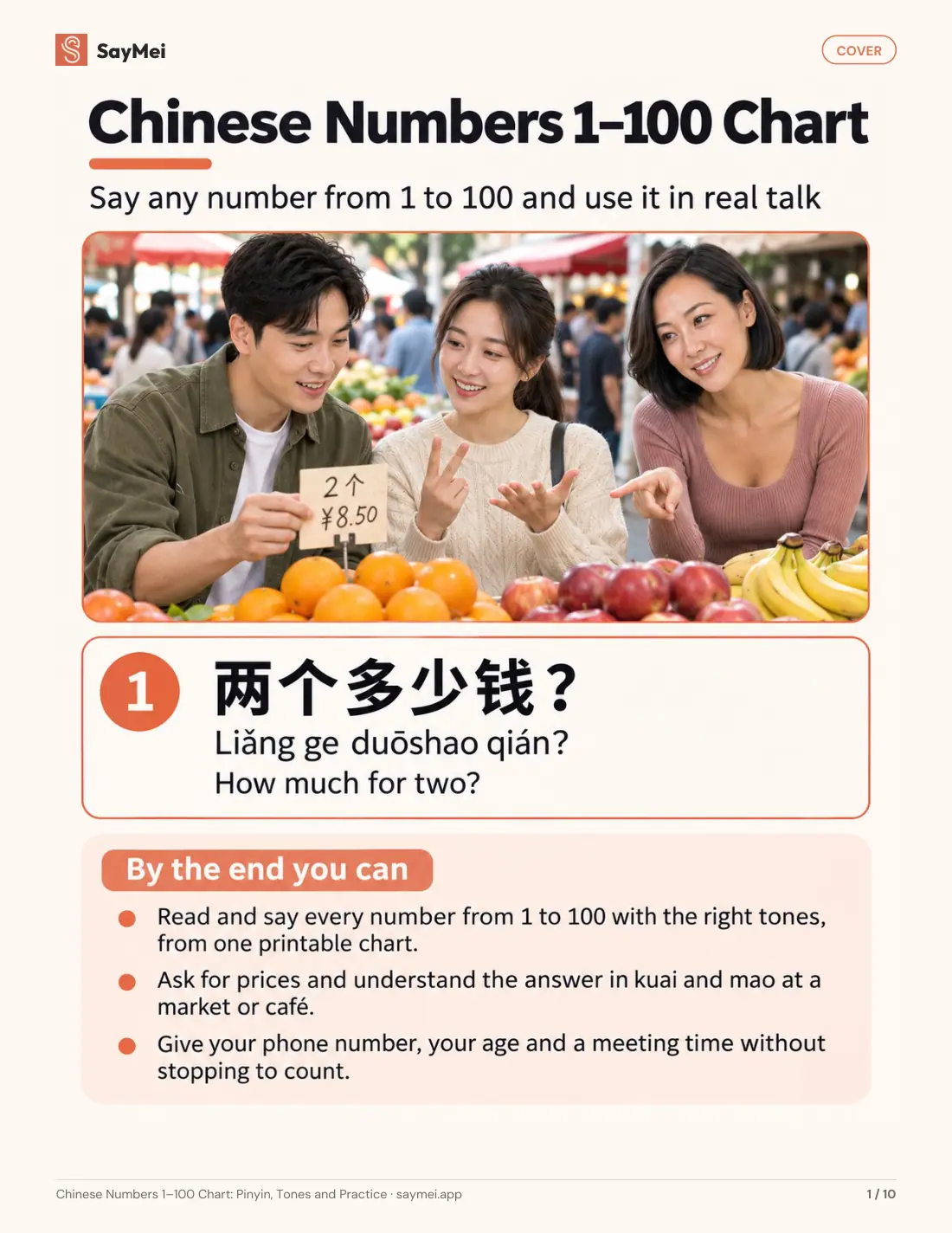
两个多少钱? · Liǎng ge duōshao qián? · How much for two?
By the end you can
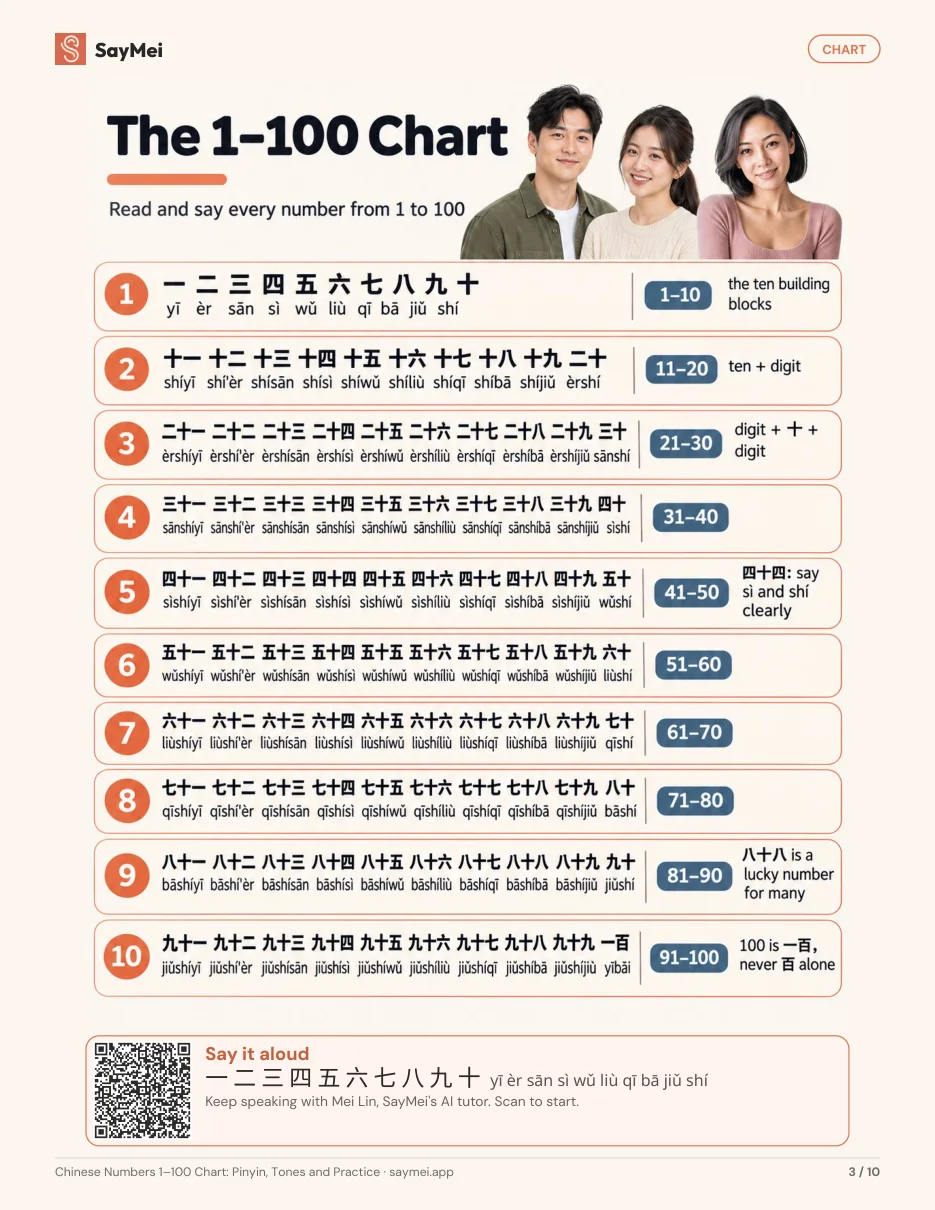
- Read and say every number from 1 to 100. One printable chart, one row per ten, with characters and pinyin for every number. Read across, then down, and the whole system is in front of you.
七十八 · qīshíbā · seventy-eight (seven tens + eight) - Build any number from 11 to 99 from ten digits. 11 to 19 are 十 plus a digit, the tens put the digit first, so every number up to 99 is digit + 十 + digit. A hundred is 一百, never 百 alone.
我住三十六号。 · Wǒ zhù sānshíliù hào. · I live at number thirty-six. - Keep 四 (four) and 十 (ten) apart. Say sì short and falling, let shí rise with the tongue curled back, and ask when you aren't sure which one you heard.
四十还是十四? · Sìshí háishi shísì? · Forty or fourteen? - Choose 两 or 二 and place 零. Use 两 before a measure word when you count things and 二 inside bigger numbers. 零 fills an empty tens place: 105 is 一百零五, but 150 is 一百五十.
两个苹果 · liǎng ge píngguǒ · two apples - Say 一 with the right tone. 一 is yī when you count, yí before a fourth tone and yì before tones one, two and three, so 一百 is said yìbǎi.
一块钱 · yí kuài qián · one kuai (one yuan) - Say and understand prices in kuai and mao. Menus write 元 and 角, but people say 块 and 毛. Turn written prices into spoken ones and pick out the price you hear on the audio.
茶四块五。 · Chá sì kuài wǔ. · The tea is four fifty. - Give a time, your phone number and your age. Times use 点, with 两点 for 2:00 and 半 for half past. Read phone numbers digit by digit with 幺 for 1, and put 岁 after your age.
我们两点半上课。 · Wǒmen liǎng diǎn bàn shàngkè. · Our class starts at half past two.
What’s inside
- Chart: The 1–100 Chart
- System: How Chinese Numbers Are Built · Two Twos, Zero and the Tones of 一
- Drills: Prices with 块 and 毛 · Time, Phone Numbers and Ages
- Review: Numbers in Real Talk
How to use this book
Print page 3 and pin it where you'll see it every day. The free audio reads each row with a pause to say it back. Work through one page a day and the book takes about a week, then keep reading the chart aloud.
- Day 1: Read the chart aloud. Play the chart track and say each row back in the pause. Read across, then down, and say every number out loud, never just in your head.
- Day 2: How the numbers are built. Page 4. Build numbers from digit + 十 + digit, and say 四十还是十四? until sì and shí sound different.
- Day 3: 两, 零 and the tones of 一. Page 5. Count things with 两, place 零 in numbers like 一百零五, and say 一 as yī, yí or yì.
- Days 4–5: Prices, times, phone numbers and ages. Pages 6 and 7. Do the listening questions with the audio, then say your own phone number digit by digit and your age with 岁.
- Day 6: Numbers in real talk. Page 8. Read the market and phone dialogue, answer the questions, then act out buying three of something with a friend. Check your answers at the back.
- Week 2: One read-through a day. Read the whole chart aloud once a day for a week. The tones start to feel natural, and you stop counting up to a number before you say it.
Who it’s for
Total beginners who need Chinese numbers in daily life: hearing a price at a market or café, giving a phone number, saying an age or agreeing a time to meet.
Before you start: Nothing. Every number has characters and pinyin with tone marks, and the free audio reads the chart and the drills with pauses to say them back. The answers are at the back.
Frequently asked questions
What's inside?
The 1–100 chart on page 3, one row per ten, then a page on how the numbers are built, a page on 两, 零 and the tones of 一, and drills for prices, times, phone numbers and ages. Page 8 is a market and phone dialogue, and the answers are at the back.
How long does it take?
About a week at one page a day. Then the book suggests reading the whole chart aloud once a day for another week, until you stop counting up to a number before you say it.
Why do people say 块 when the menu says 元?
Menus and price tags write 元 and 角, but in speech people say 块 and 毛. ¥3.50 is written 三元五角 and said 三块五, and the last 毛 is often dropped. Page 6 drills this, with prices to listen for on the audio.
When do I use 两 and when 二?
Use 两 before a measure word when you count things, as in 两个苹果 (two apples), and for 2:00 (两点). Use 二 when you count and inside bigger numbers, as in 十二个人 (twelve people) and 二十.
Why is 一百 said yìbǎi?
一 changes tone. It is yī when you count, yí before a fourth tone, and yì before tones one, two and three, so 一百 is yìbǎi. Page 5 explains it.
Is there audio?
Yes, free on the book's page, in four tracks: the chart, how the numbers are built, the drills and the closing dialogue. Each row is read with a pause so you can say it back.
Do I need a SayMei account?
Yes, to download the PDF, and the account is free: sign up with Google, Apple or your email address. With it we email you a copy of the workbook, keep every workbook you download on your account on all your devices, save your place in the free online practice, and you can practise speaking with Mei Lin, SayMei's AI tutor.
How do I print it?
The PDF is US Letter size. On A4 paper, choose "Fit to page" (or "Scale to fit") in the print dialog so nothing is cut off. Print the whole workbook or only the pages you need; colour looks best, and black and white works too.
Keep going
Chinese Numbers, Dates and Telling Time: Prices, Weekdays and the Clock · Your First 14 Days of Spoken Mandarin · Five Beginner Mandarin Mini-Stories · Your 30-Day Mandarin Plan · Browse all 294 workbooks
Version 2026-11 · Updated Nov 4, 2026 · Report a correction