Kids · Kids workbook
Chinese Radicals Worksheets for Kids: Printable Pack
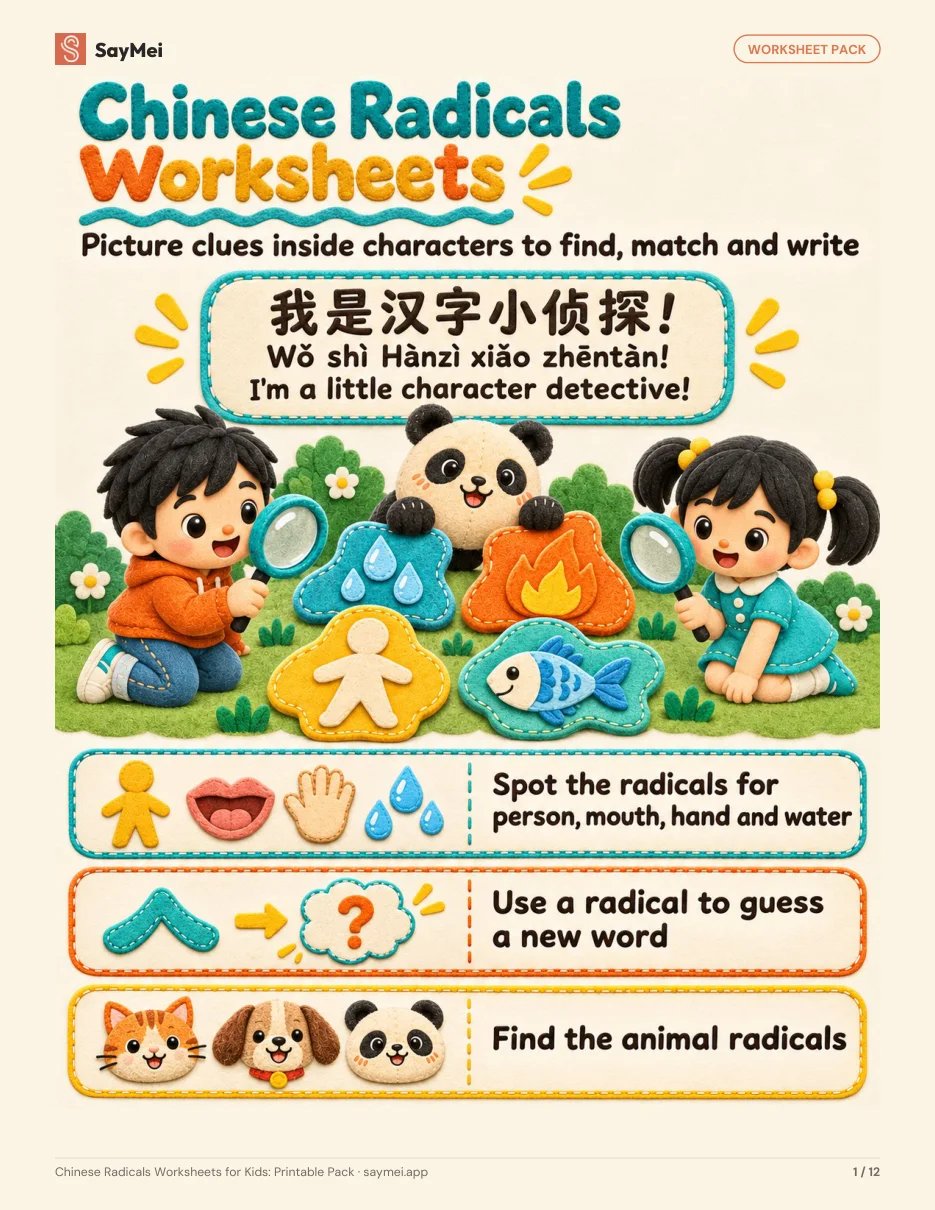
Your child finds the picture clues in characters, like 亻 for a person and 氵 for water, and uses them to work out 汤 and 狼. For ages 7 to 9, and you don't need any Chinese to help.
- Level:
- Kids 7–9
- Format:
- Worksheet pack · PDF · 13 pages · US Letter (prints on A4)
- Price:
- Free · free with a saymei account · updated Nov 12, 2026
Download the free PDF: create a free SayMei account on this page, and we'll email you a copy too.
我是汉字小侦探! · Wǒ shì Hànzì xiǎo zhēntàn! · I'm a little character detective!
By the end you can
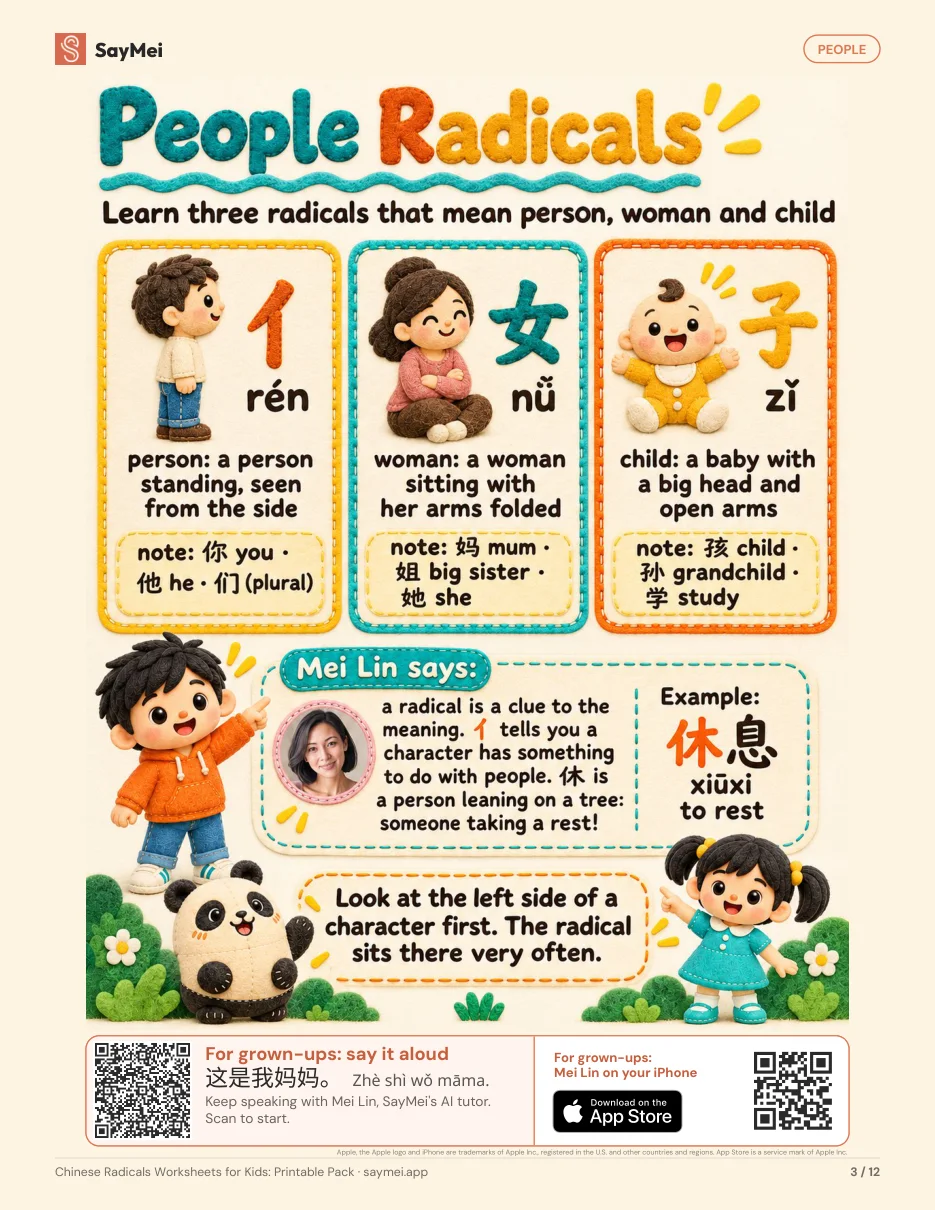
- Spot the people radicals 亻, 女 and 子. 亻 is a person seen from the side, 女 a woman sitting with folded arms and 子 a baby with open arms. Look at the left side of a character first: the radical sits there very often.
休息 · xiūxi · to rest - Guess a new character from its radical. Your child writes the radical they find in 妹, 住 and 孩, then uses it to guess that 姥 is grandma and 做 is something a person does.
妹 · mèi · little sister - Find 口, 目 and 扌 for mouth, eye and hand. 吃 and 叫 have the mouth, 看 and 睡 the eye, 打 and 抱 the hand. 看 is a hand over an eye, like shading your eyes from the sun to see far away.
看书 · kàn shū · to read a book - Pick the right action word by its radical. Your child answers questions like which one you do with your hands, 推 or 唱, by finding the radical, then claps and says what they did.
我拍手。 · Wǒ pāi shǒu. · I clap my hands. - Find water, fire and rain. 氵 is three drops of water and 雨 is rain falling from a cloud. 火 is rising flames, and at the bottom of a character it becomes four dots, 灬. Two dots, 冫, mean ice, as in 冷.
今天很热。 · Jīntiān hěn rè. · It's very hot today. - Guess new words from water and fire. Your child finds the radical in 雪, 洗 and 灯, guesses that 汤 is soup and 烧 is to burn, then says where they're going before snack time.
我去洗手。 · Wǒ qù xǐ shǒu. · I'm going to wash my hands. - Find the animal radicals 犭, 鸟 and 鱼. 犭 marks furry animals like 猫 and 狗, 鸟 birds like 鸭 and 鹅, and 鱼 fish like 鲨. Your child guesses that 鸽 is a pigeon and 狼 is a wolf.
我喜欢小猫。 · Wǒ xǐhuan xiǎo māo. · I like kittens.
What’s inside
- People: People Radicals · Find the People Radicals
- Mouth, eye, hand: Mouth, Eye and Hand · Find Mouth, Eye and Hand
- Water, fire, rain: Water, Fire and Rain · Find Water, Fire and Rain
- Animals: Animals, Birds and Fish · Find the Animal Radicals
The pages come from Chinese Radicals for Kids: 30 Picture Puzzles (Ages 7–10).
How to use this book
About ten minutes a day is plenty. Each set is a Meet page, then a Puzzle page with the same three radicals. Read each Chinese line aloud with its pinyin, let your child say it back and point, then do the puzzles together.
- Day 1: People. Pages 3 and 4. Meet 亻, 女 and 子, find them in 妹, 住 and 孩, and guess 姥 and 做 from their radicals.
- Day 2: Mouth, eye and hand. Pages 5 and 6. Meet 口, 目 and 扌, find them in 喝, 睛 and 抱, and pick the action word that fits each question.
- Day 3: Water, fire and rain. Pages 7 and 8. Meet 氵, 火 and 雨, count the dots in 氵 and 冫, and guess 汤 and 烧.
- Day 4: Animals. Pages 9 and 10. Meet 犭, 鸟 and 鱼, find them in 鸭, 猴 and 鲨, and guess 鸽 and 狼. The answers are on pages 11 and 12.
Who it’s for
Children aged 7 to 9 who are ready to look inside characters and use their parts to guess meanings, with a parent at home or a teacher in class.
Before you start: It helps if your child knows a few characters, such as 你, 他 and 妈, since the radicals are found inside them. Every word has pinyin and English, so you don't need to speak Chinese yourself. You'll need a pencil.
Frequently asked questions
What's inside this pack?
Eight worksheets on pages 3 to 10, taken from SayMei's kids workbooks: four puzzle sets, each a Meet page and a Puzzle page, for people, for mouth, eye and hand, for water, fire and rain, and for animals. The answer key is on pages 11 and 12.
What is a radical?
A radical is a part of a character that gives a clue to its meaning. 亻 tells you a character has to do with people, as in 你 and 他, and 氵 tells you it has to do with water, as in 河 and 洗. The radical often sits on the left.
Which radicals does it teach?
Twelve: 亻 person, 女 woman and 子 child; 口 mouth, 目 eye and 扌 hand; 氵 water, 火 fire and 雨 rain; 犭 furry animal, 鸟 bird and 鱼 fish. Tips also show 灬, the four-dot fire, and 冫, the two-dot ice.
Is a radical always right about the meaning?
Not always. Page 9 points out that 鲸 (whale) has the fish radical although a whale is not a fish, because the radical shows what people thought long ago. A radical is a clue to start from.
What age is it for?
Ages 7 to 9. Your child writes down the radical they find and picks between two meanings, so it suits children who can already read and write a little. The puzzle characters have pinyin, so you can read them aloud and check the guesses together.
Is there audio?
No, this pack has no audio. Every Chinese line has pinyin and English, so you can read it aloud yourself, and short tips explain each radical in plain English, such as the dots in 氵 and 冫.
Do I need a SayMei account?
Yes, to download the PDF, and the account is free: sign up with Google, Apple or your email address. With it we email you a copy of the workbook, keep every workbook you download on your account on all your devices, save your place in the free online practice, and you can practise speaking with Mei Lin, SayMei's AI tutor.
How do I print it?
The PDF is US Letter size. On A4 paper, choose "Fit to page" (or "Scale to fit") in the print dialog so nothing is cut off. Print the whole workbook or only the pages you need; colour looks best, and black and white works too.
Keep going
Mandarin for Kids: Animals & Fruit · Colors and Numbers in Chinese for Kids: Printable Worksheets (Ages 4–6) · Mandarin for Kids: My Family & Me · Mandarin for Kids: Yummy Food & Snacks · Browse all 340 workbooks
Version 2026-11 · Updated Nov 12, 2026 · Report a correction