Conversation · Beginner
Chinese Slang and WeChat Texting Cheat Sheet
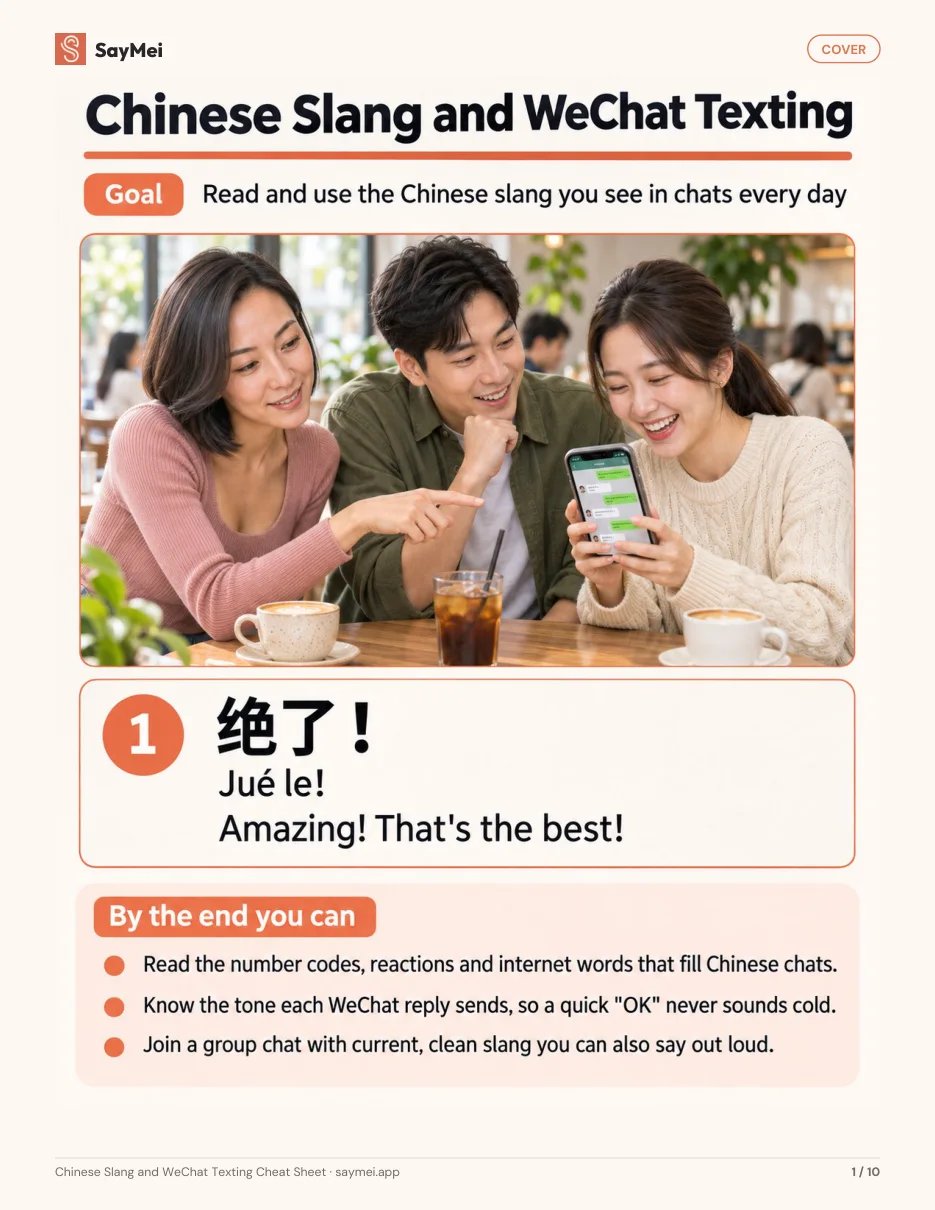
You find out what 666, 520 and 绝了 mean, which WeChat replies can read as cold, and how to thank someone for a red packet. For learners who chat with Chinese friends or colleagues on WeChat.
- Level:
- Beginner · HSK 1
- Format:
- Reference guide · PDF · 10 pages · US Letter (prints on A4)
- Price:
- Free · free with a saymei account · updated Nov 4, 2026
Listening audio: play every track free, no account needed.
Download the free PDF: create a free SayMei account on this page, and we'll email you a copy too.
绝了! · Jué le! · Amazing! That's the best!
By the end you can
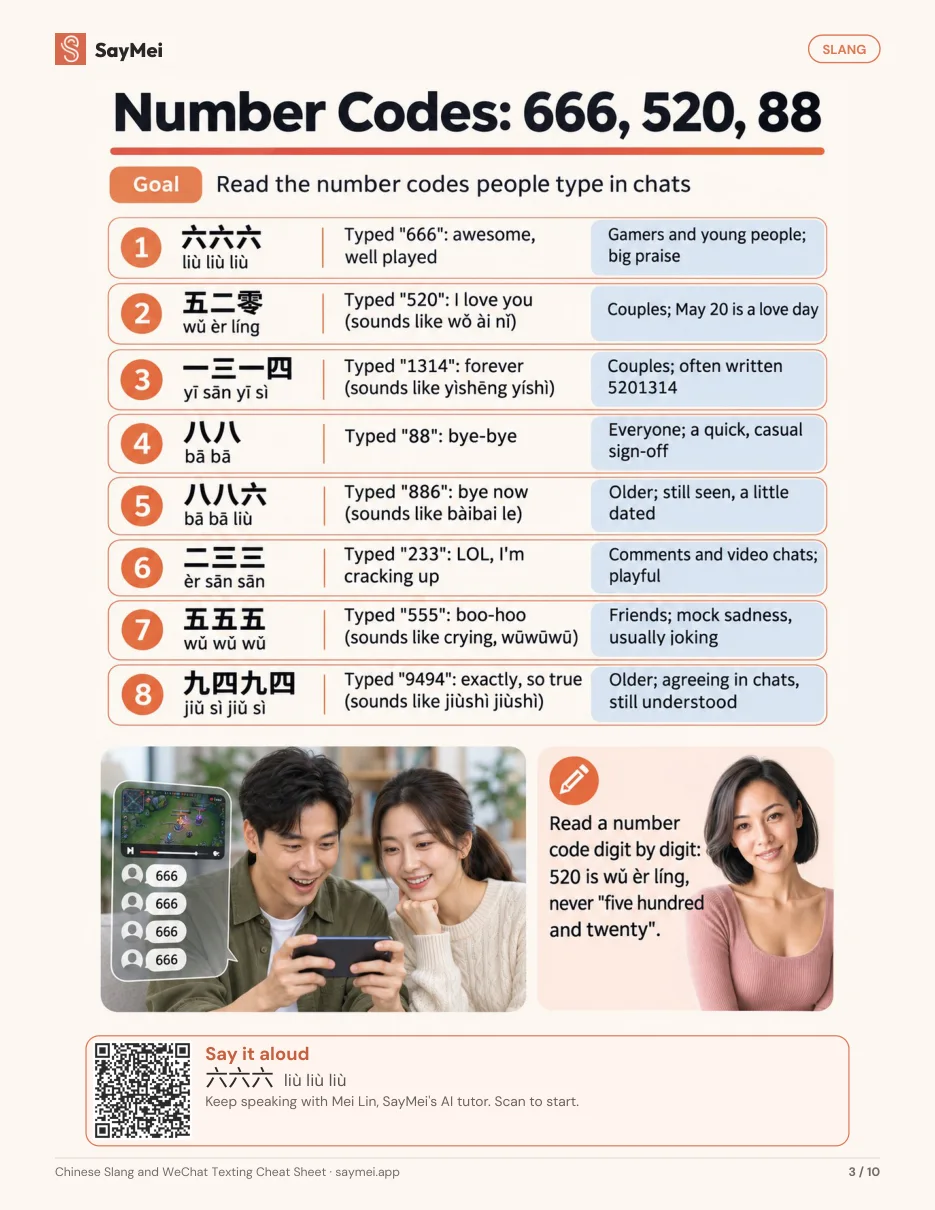
- Read the number codes people type in chats. Read 666, 520, 1314, 88 and 233 digit by digit and know what each one means. 520 sounds like wǒ ài nǐ, so couples type it for I love you.
五二零 · wǔ èr líng · Typed "520": I love you - React to news, food and jokes like a friend. Praise a great meal with 绝了, call a price or plot twist 离谱, sigh 无语 at mild annoyance, and make any reaction stronger with 太……了.
好家伙 · hǎo jiāhuo · Whoa! Wow! (surprise) - Understand the internet words in posts and chats. Tell 种草 from 拔草, know what 打卡, 网红 and 吃瓜 mean, and see why 社恐 and 社牛 are opposites.
摸鱼 · mōyú · To slack off at work - Choose a WeChat reply that sends the right tone. Reply 收到 or 好的 to a boss or teacher and save 好哒 and 嗯嗯 for friends. A single 嗯 or 好 can read as cold, and 好吧 sounds reluctant.
收到! · Shōudào! · Got it! - Use stickers, voice messages and red packets politely. Send a sticker as the whole reply, keep voice messages short, grab a group red packet and thank the sender the playful way.
谢谢老板! · Xièxie lǎobǎn! · Thanks, boss! (to the sender) - Know which slang sounds dated. Rows marked Older, such as 886, 9494 and yyds (永远的神), are still understood but sound a little dated, so you understand them and pick fresher words to say.
永远的神 · yǒngyuǎn de shén · Typed "yyds": the best ever, the GOAT - Follow a group chat and reply in it. Read a seven-message chat where three friends plan hotpot, answer questions about it, then write and say your own cheerful reply.
好哒!我八点到,你们先吃! · Hǎo da! Wǒ bā diǎn dào, nǐmen xiān chī! · Okey-dokey! I'll get there at eight, so start eating!
What’s inside
- Slang: Number Codes: 666, 520, 88 · Reactions You Will Hear · Internet Words People Use
- WeChat: Reply Right on WeChat · Texting, Stickers and Red Packets
- Practice: Reply Like a Local · A Group Chat Plans Dinner
How to use this book
Print the sheet and keep it near your phone. Work through one page a day with its audio, say each line with the feeling it carries, then test yourself on the two practice pages.
- Days 1–3: Number codes, reactions and internet words. Play the first audio chapter and say each word in the pause after it. Read number codes digit by digit: 520 is wǔ èr líng.
- Days 4–5: WeChat replies, stickers and red packets. Play the second chapter. Pick the reply you would send a teacher and the one you would send a friend, and say both aloud.
- Day 6: Reply Like a Local. Do page 8: choose the right replies, write what 520 and 233 mean, and circle the words you hear in two voice messages from the third chapter.
- Day 7: Group chat review. Read the hotpot chat on page 9, answer the questions, then say your own reply. Check everything against the answer key and audio script on page 10.
- Any day: Keep speaking. Scan the code on page 3, 6 or 8 to keep speaking with Mei Lin, SayMei's AI tutor.
Who it’s for
Learners who chat with Chinese friends, partners, family or colleagues on WeChat, and anyone who keeps seeing 666 or 哈哈哈 in comments and wants to know what they mean and when to use them.
Before you start: Basic Chinese helps. Every word has characters, pinyin and English, with a note on who uses it and how it sounds. To type these words on your phone, see the free book How to Type in Chinese.
Frequently asked questions
What's on the sheet?
Five pages of words: number codes like 666 and 88, reactions like 离谱 and 无语, internet words like 种草 and 吃瓜, WeChat replies, and stickers, voice messages and red packets. Two practice pages end with a group chat where three friends plan hotpot, and the answer key is on page 10.
How do I read number codes like 520 and 666?
Digit by digit, never as one big number. 520 is wǔ èr líng, which sounds like wǒ ài nǐ, I love you. 666 is liù liù liù, big praise for a good play. Page 3 has eight codes.
What should I reply to my boss or teacher on WeChat?
收到 or 好的. Save 好哒 and 嗯嗯 for friends. A single 嗯 or 好 can read as cold, and 好吧 sounds reluctant, so page 6 shows which reply sends which tone.
Is any of the slang rude or out of date?
The book keeps to clean slang you can say out loud. Some words are for friends only: 摸鱼 is a joke you never make to the boss. Rows marked Older, such as 886 and yyds, are still understood but sound a little dated.
Is there audio?
Yes, free on the book's audio page, in three chapters for pages 3–5, 6–7 and 8–9. Every Chinese line is read once, then you get a pause to say it back. The code on page 2 opens it, and the voice message script is in the answer key on page 10.
How much Chinese do I need?
Basic Chinese helps. Every word has characters, pinyin and English, with a note on who uses it and how it sounds. To type these words on your phone, see How to Type in Chinese.
Do I need a SayMei account?
Yes, to download the PDF, and the account is free: sign up with Google, Apple or your email address. With it we email you a copy of the workbook, keep every workbook you download on your account on all your devices, save your place in the free online practice, and you can practise speaking with Mei Lin, SayMei's AI tutor.
How do I print it?
The PDF is US Letter size. On A4 paper, choose "Fit to page" (or "Scale to fit") in the print dialog so nothing is cut off. Print the whole workbook or only the pages you need; colour looks best, and black and white works too.
Keep going
Keep a Mandarin Conversation Going · Talk About Your Day: Mandarin Daily Routines Workbook · Hobbies in Chinese: Sports, Free Time and Invitations · Spoken Mandarin Days 15–30: Your Next Two Weeks of Speaking · Browse all 294 workbooks
Version 2026-11 · Updated Nov 4, 2026 · Report a correction