Conversation · Beginner
Spoken Mandarin Days 15–30: Your Next Two Weeks of Speaking
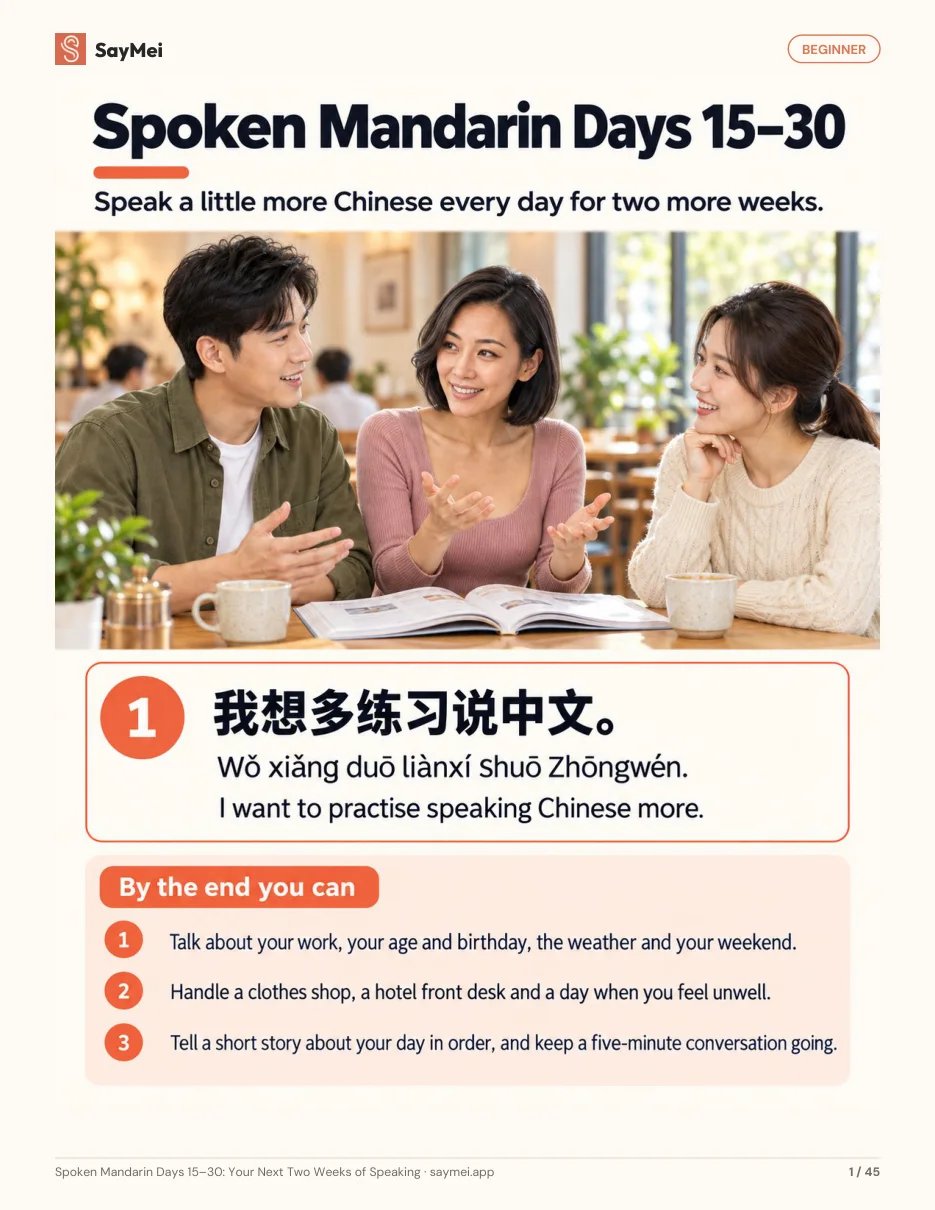
You talk about your job and the weather, ask for a bigger size and book a hotel room, then hold a five-minute conversation on Day 30. For learners who can already introduce themselves and order in a café.
- Level:
- Beginner · HSK 1
- Format:
- Workbook · PDF · 46 pages · US Letter (prints on A4)
- Price:
- Free · free with a saymei account · updated Oct 27, 2026
Download the free PDF: create a free SayMei account on this page, and we'll email you a copy too.
我想多练习说中文。 · Wǒ xiǎng duō liànxí shuō Zhōngwén. · I want to practise speaking Chinese more.
By the end you can
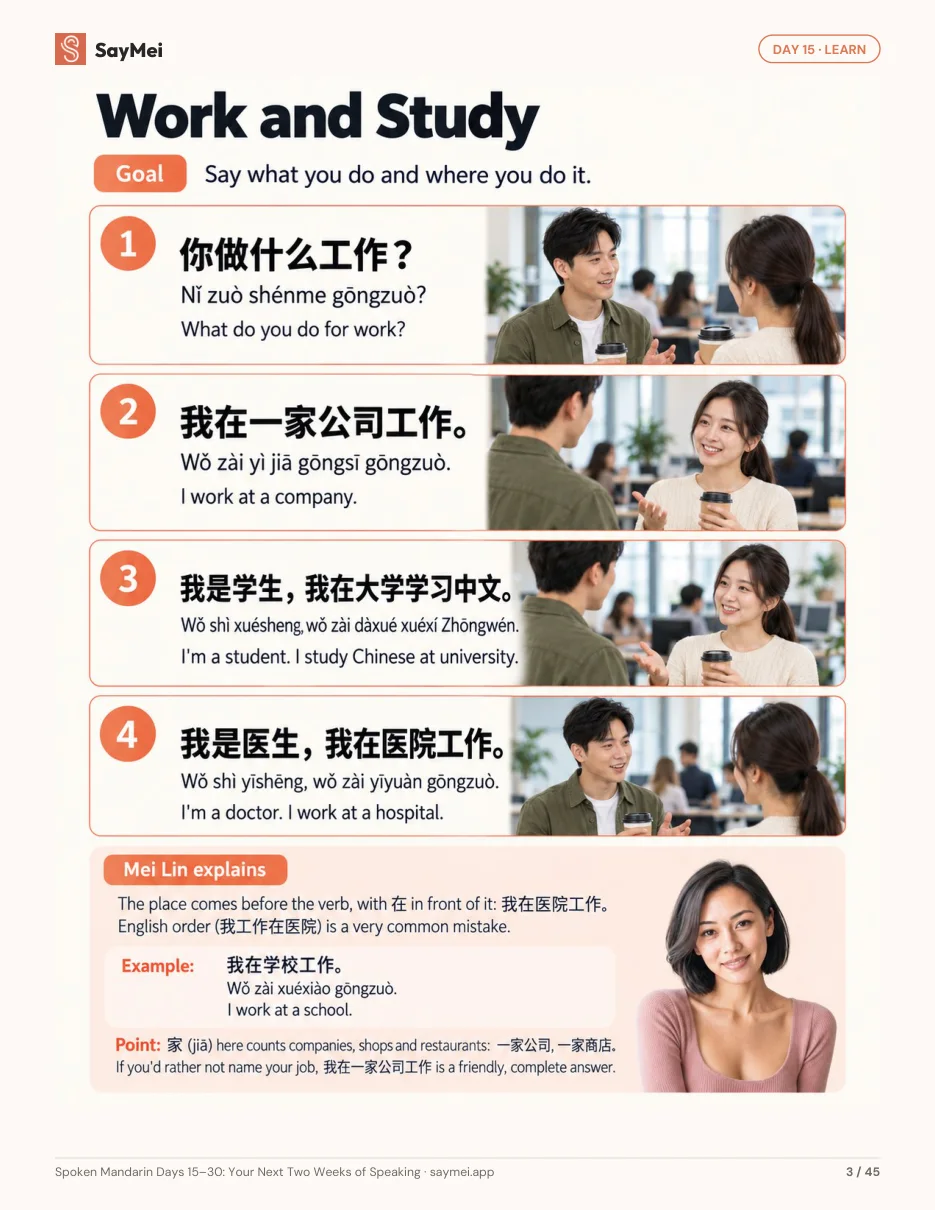
- Say what you do, how old you are and when your birthday is. Say where you work with 在 before the verb, give your age and birthday month first, and read out a phone number digit by digit with yāo for 1.
我在一家公司工作。 · Wǒ zài yì jiā gōngsī gōngzuò. · I work at a company. - Start a chat about the weather. Ask what the weather is like, say it's a bit cold with 有点儿, and ask if it will rain tomorrow.
今天有点儿冷。 · Jīntiān yǒudiǎnr lěng. · It's a bit cold today. - Ask for another size or colour in a clothes shop. Ask the price of the red one, say it's too small with 太小了, ask for a bigger one and take the white one.
有没有大一点儿的? · Yǒu méiyǒu dà yìdiǎnr de? · Do you have a bigger one? - Say you feel unwell and suggest help. Say you don't feel well, name what hurts with the body part before 疼, and suggest going to the hospital with 吧.
我头疼。 · Wǒ tóu téng. · I have a headache. - Ask how to get somewhere and how long it takes. Ask the way to the airport with 怎么去, then ask and say how long a trip takes by subway or taxi.
坐地铁要多长时间? · Zuò dìtiě yào duō cháng shíjiān? · How long does it take by subway? - Say what you have and haven't done with 过. Ask if someone has ever been somewhere, say how many times with 两次, and say you never have with 没 + verb + 过.
你去过中国吗? · Nǐ qùguo Zhōngguó ma? · Have you ever been to China? - Compare two things with 比. Say which is colder, cheaper or faster with A 比 B + adjective, and learn why 很 never goes before the adjective here.
地铁比公交车快。 · Dìtiě bǐ gōngjiāochē kuài. · The subway is faster than the bus. - Ask someone to repeat or slow down. Say you didn't catch something, ask for it again, and ask what a word means so the conversation keeps going.
请说慢一点儿。 · Qǐng shuō màn yìdiǎnr. · Please speak a bit more slowly. - Book a hotel room and order food your way. Ask for a room and say how many nights, ask if there's Wi-Fi, then ask what's good, order not too spicy and ask for the bill.
不要太辣。 · Bú yào tài là. · Not too spicy, please. - Tell your day in order and keep a five-minute conversation going. Link three steps of your day with 就, say what you plan to do with 打算, then answer, add a detail and ask back.
吃了早饭,我就去公司。 · Chīle zǎofàn, wǒ jiù qù gōngsī. · After breakfast I go straight to the office.
What’s inside
- Day 15: Learn: Work and Study · Practice: Your Job in Two Lines
- Day 16: Learn: Ages and Birthdays · Practice: Dates and Ages
- Day 17: Learn: Phone Numbers · Practice: Digits on the Phone
- Day 18: Learn: Weather Small Talk · Practice: Hot, Cold and Rainy
- Day 19: Learn: Sizes and Colours · Practice: In the Clothes Shop
- Day 20: Learn: Feeling Unwell · Practice: Aches and Help
- Day 21: Learn: Getting There and How Long · Practice: Routes and Times
- Day 22: Learn: Things You Have Done · Practice: Have You Ever?
- Review: Days 15–22: A New Coworker
- Day 23: Learn: Compare with 比 · Practice: This or That?
- Day 24: Learn: When You Don't Understand · Practice: Keep the Talk Going
- Day 25: Learn: Booking a Hotel Room · Practice: At the Front Desk
- Day 26: Learn: Restaurant, Round Two · Practice: Order to Your Taste
- Day 27: Learn: Weekends and Hobbies · Practice: Your Free Time
- Day 28: Learn: Plans and Wishes · Practice: Wishes and Plans
- Day 29: Learn: Tell Your Day in Order · Practice: Then, Straight After
- Day 30: Learn: A Five-Minute Conversation · Practice: Answer, Add, Ask Back
- Checklist: What You Can Say Now
- Final Review: Coffee with Mei Lin's Friend
How to use this book
One day at a time, as in the first book: a Learn page with four lines and a Mei Lin note, then a Practice page to write and say your own. Sixteen days, then a checklist and a final review.
- Days 15–18: About you. Your work, your age and birthday, your phone number and the weather. Say each line aloud twice: once looking, once from memory.
- Days 19–22: Out and about. A clothes shop, feeling unwell, routes and travel times, and things you have done with 过.
- Review: A new coworker. Act out the first chat at work on page 19, which uses only Days 15–22.
- Days 23–26: Getting by. Comparing with 比, asking someone to repeat or slow down, booking a hotel room and ordering in a restaurant.
- Days 27–30: Longer talk. Weekends and hobbies, plans, telling your day in order, and a five-minute conversation.
- Final review: Check and act it out. Tick the checklist on page 36, go back to any day you can't tick, then act out the café chat on page 37.
Who it’s for
Beginners who finished Your First 14 Days of Spoken Mandarin, or who can already introduce themselves, order in a café and ask a price, and now want two more weeks of everyday speaking.
Before you start: The basics from the first book: greetings, numbers, 想要, 在哪儿 and 了 for yesterday. Every line is printed in characters, pinyin and English, and some Mei Lin notes point back to earlier days.
Frequently asked questions
What's inside the sixteen days?
Each day is a Learn page with four lines and a short note, then a Practice page to write and say your own. You cover work, birthdays, phone numbers, the weather, a clothes shop, feeling unwell, comparing with 比, a hotel and a restaurant. A review on page 19 is a first chat with a new coworker.
Do I need the first book before this one?
It helps. Days 15–30 pick up where Your First 14 Days ends and some notes refer back to it. If you can already introduce yourself, order a drink and ask a price, you can start here.
How should I work through it?
One day at a time: say each line aloud twice, once looking and once from memory, then do the Practice page. After Day 30, tick the checklist on page 36 and go back to any day you can't tick.
Is there audio?
The PDF has no audio. Every line has characters, pinyin with tone marks and English, so you can say it from the page.
What does the final review ask me to do?
Page 37 is an eight-line café conversation in which Lin Hao meets Xiao Wang, using all 30 days. You rewrite lines from cues, then act it out with a partner without reading, the second time as yourself.
What comes after Day 30?
Spoken Mandarin Days 31–60 is the next book: a month of everyday speaking, from fruit markets and taxis to phone calls and train tickets, with free audio for every line.
Do I need a SayMei account?
Yes, to download the PDF, and the account is free: sign up with Google, Apple or your email address. With it we email you a copy of the workbook, keep every workbook you download on your account on all your devices, save your place in the free online practice, and you can practise speaking with Mei Lin, SayMei's AI tutor.
How do I print it?
The PDF is US Letter size. On A4 paper, choose "Fit to page" (or "Scale to fit") in the print dialog so nothing is cut off. Print the whole workbook or only the pages you need; colour looks best, and black and white works too.
Keep going
Your First 14 Days of Spoken Mandarin · Everyday Mandarin Conversations: 20 Short Dialogues to Read and Say · Keep a Mandarin Conversation Going · Talk About Your Day: Mandarin Daily Routines Workbook · Browse all 294 workbooks
Version 2026-10 · Updated Oct 27, 2026 · Report a correction