Reading · Beginner to pre-intermediate
Elementary Chinese Short Stories with Pinyin: 8 Everyday Stories
Eight two-part stories with full pinyin, comprehension questions and retell practice for beginners

- Level:
- Beginner · HSK 1–2
- Format:
- Workbook · PDF · 37 pages · US Letter (prints on A4)
- Price:
- Free · free with a saymei account · updated Oct 27, 2026
Download the free PDF: create a free SayMei account on this page, and we'll email you a copy too.
东西已经送到了。 · Dōngxi yǐjīng sòngdào le. · Your things have already been delivered.
By the end you can
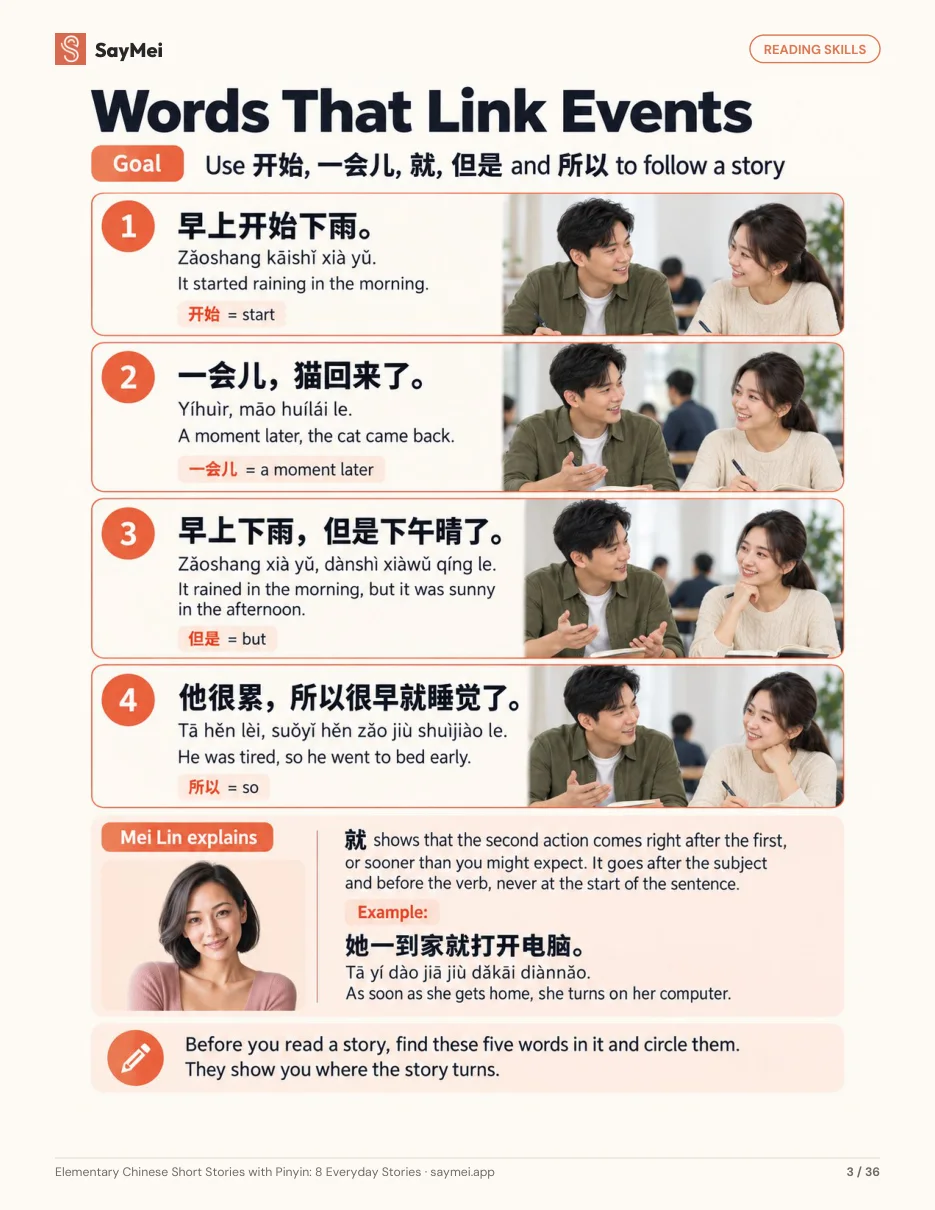
- Follow a story with five linking words. Before Story 1, learn 开始, 一会儿, 就, 但是 and 所以, the words that show where a story turns, with a Mei Lin note on where 就 goes.
他很累,所以很早就睡觉了。 · Tā hěn lèi, suǒyǐ hěn zǎo jiù shuìjiào le. · He was tired, so he went to bed early. - Read eight two-part stories with pinyin. Each story runs over two pages, with the pinyin under the Hanzi and three key lines in English. Story 1 starts with fruit delivered to the wrong door.
东西已经送到了。 · Dōngxi yǐjīng sòngdào le. · The things have already been delivered. - Say where things are with 上面, 下面 and 里面. Story 2 is about a lost cat, and its check page asks you to place things on, under and inside with 上面, 下面 and 里面.
上面写的是二零三。 · Shàngmiàn xiě de shì èr líng sān. · It says 203 on it. - Talk about your work and how you travel. Stories 3 and 4 follow Lin Hao's first day at a coffee shop and a missed bus, then ask about your own job and how you get there.
你经常坐公交车吗? · Nǐ jīngcháng zuò gōngjiāochē ma? · Do you often take the bus? - Talk about home cooking and lost things. Story 5 turns eggs and rice into a late-night dinner, Story 6 adds opposite words, and in Story 7 Lin Hao leaves his phone in a taxi.
妈妈做的饭真好吃! · Māma zuò de fàn zhēn hǎochī! · Mum's cooking is really good! - Use 最, 也 and 过 to talk about places to eat. Story 8 is a very long wait at a popular noodle shop. Its check page practises 最, 也 and 过, and asks about places near you.
我不想等一个小时。 · Wǒ bù xiǎng děng yí ge xiǎoshí. · I don't want to wait an hour. - Answer questions about each story in Chinese. Every check page asks questions about the story to answer with a short sentence, often has you put events in order, and asks about your own life.
小雨在等什么? · Xiǎoyǔ zài děng shénme? · What is Xiaoyu waiting for? - Retell a story in 5–6 sentences. Each check page ends with a spoken retell, with a model line to start from and boxes to tick each time you say it.
小雨打开门,但是门口什么也没有。 · Xiǎoyǔ dǎkāi mén, dànshì ménkǒu shénme yě méiyǒu. · Xiaoyu opened the door, but there was nothing there.
What’s inside
- Reading skills: Words That Link Events
- Story 1: Part 1: The Fruit at the Wrong Door · Part 2: Grandma Wang's Surprise
- Story 1 practice: Check Story 1
- Story 2: Part 1: Where Is Xiaohua? · Part 2: Look Up!
- Story 2 practice: Check Story 2
- Story 3: Part 1: Lin Hao's First Day · Part 2: A Name on Every Cup
- Story 3 practice: Check Story 3
- Story 4: Part 1: The Bus That Didn't Stop · Part 2: A Ride with a Friend
- Story 4 practice: Check Story 4
- Story 5: Part 1: Mum Comes to Visit · Part 2: The Best Egg Fried Rice
- Story 5 practice: Check Story 5
- Story 6: Part 1: A Rainy Saturday · Part 2: Game Night at Mei Lin's
- Story 6 practice: Check Story 6
- Story 7: Part 1: The Phone in the Taxi · Part 2: A Call from Downstairs
- Story 7 practice: Check Story 7
- Story 8: Part 1: The Best Noodle Shop · Part 2: The Little Shop Next Door
- Story 8 practice: Check Story 8
- Review: Remember the Stories?
- Word cards 1: Useful Words: Set 1
- Word cards 2: Useful Words: Set 2
- Word list 1: Story Words: Stories 1–4
- Word list 2: Story Words: Stories 5–8
How to use this book
Three pages per story: Part 1, Part 2 and a check page. One story a sitting is a good pace, with the word cards and lists at the back to review as you go.
- First: Learn the five linking words. Read page 3. Before each story, find the five words in it and circle them: they show you where the story turns.
- Each story: Read both parts. Read the Hanzi with the pinyin, then read it again looking at the Hanzi only. Say the key lines aloud.
- Each story: Check and retell. Answer the questions, order the events, then retell the story in 5–6 sentences without looking.
- After Story 8: Review. Act out the chat on page 28, match the sentences to stories, and say which story you liked best and why.
- Any time: Words at the back. Pages 29–32 have 16 useful words on cards and the key words of each story, with the story they come from.
Who it’s for
Beginners who can read simple sentences with pinyin and want longer stories with a plot, plus questions and retelling to make the words stick.
Before you start: Basic sentences with 在, 有 and 了, and everyday words for food, home and travel. The pinyin is under every story, so you don't need to read Hanzi without help yet.
Frequently asked questions
Is there an English translation of each story?
Each story has full pinyin under the Hanzi, and three key lines per part are translated into English. The whole story isn't translated, so you read it in Chinese.
How is this different from the intermediate short stories?
These eight stories have pinyin under the text. Intermediate Chinese Short Stories drops the pinyin and adds inference questions and summary writing.
Who are the people in the stories?
Chen Xiaoyu, Lin Hao who lives upstairs, their teacher Mei Lin, and neighbours like Grandma Wang. They come back across the eight stories, so you get to know them.
Is this workbook free?
Yes. The whole 37-page PDF is free, and you can look through its pages here before you download. There's no card and nothing to pay.
Do I need a SayMei account?
Yes, to download the PDF, and the account is free: sign up with Google, Apple or your email address. With it we email you a copy of the workbook, keep every workbook you download on your account on all your devices, save your place in the free online practice, and you can practise speaking with Mei Lin, SayMei's AI tutor.
How do I print it?
The PDF is US Letter size. On A4 paper, choose "Fit to page" (or "Scale to fit") in the print dialog so nothing is cut off. Print the whole workbook or only the pages you need; colour looks best, and black and white works too.
Can I print copies for my class?
Yes. Print as many copies as you like for your own class or family. To share it, send this page: everyone can download their own copy.
Keep going
Intermediate Chinese Short Stories: 8 Stories to Read Without Pinyin · Guess the Sound: Chinese Phonetic Components in Practice · Read Chinese Without Pinyin: A Guided Transition Workbook · Weather & Seasons: Read Forecasts and Make Plans · Browse all 294 workbooks
Version 2026-10 · Updated Oct 27, 2026 · Report a correction