Pronunciation · Beginner
Mandarin Tongue Twisters: 20 Rhymes for Clearer Pronunciation
Twenty Chinese tongue twisters for the sounds and tones English speakers find hardest, with pinyin, audio and how to practise them

- Level:
- Beginner · HSK 1
- Format:
- Reference guide · PDF · 11 pages · US Letter (prints on A4)
- Price:
- Free · free with a saymei account · updated Nov 4, 2026
Listening audio: play every track free, no account needed.
Download the free PDF: create a free SayMei account on this page, and we'll email you a copy too.
四十四只石狮子。 · Sìshísì zhī shí shīzi. · Forty-four stone lions.
By the end you can
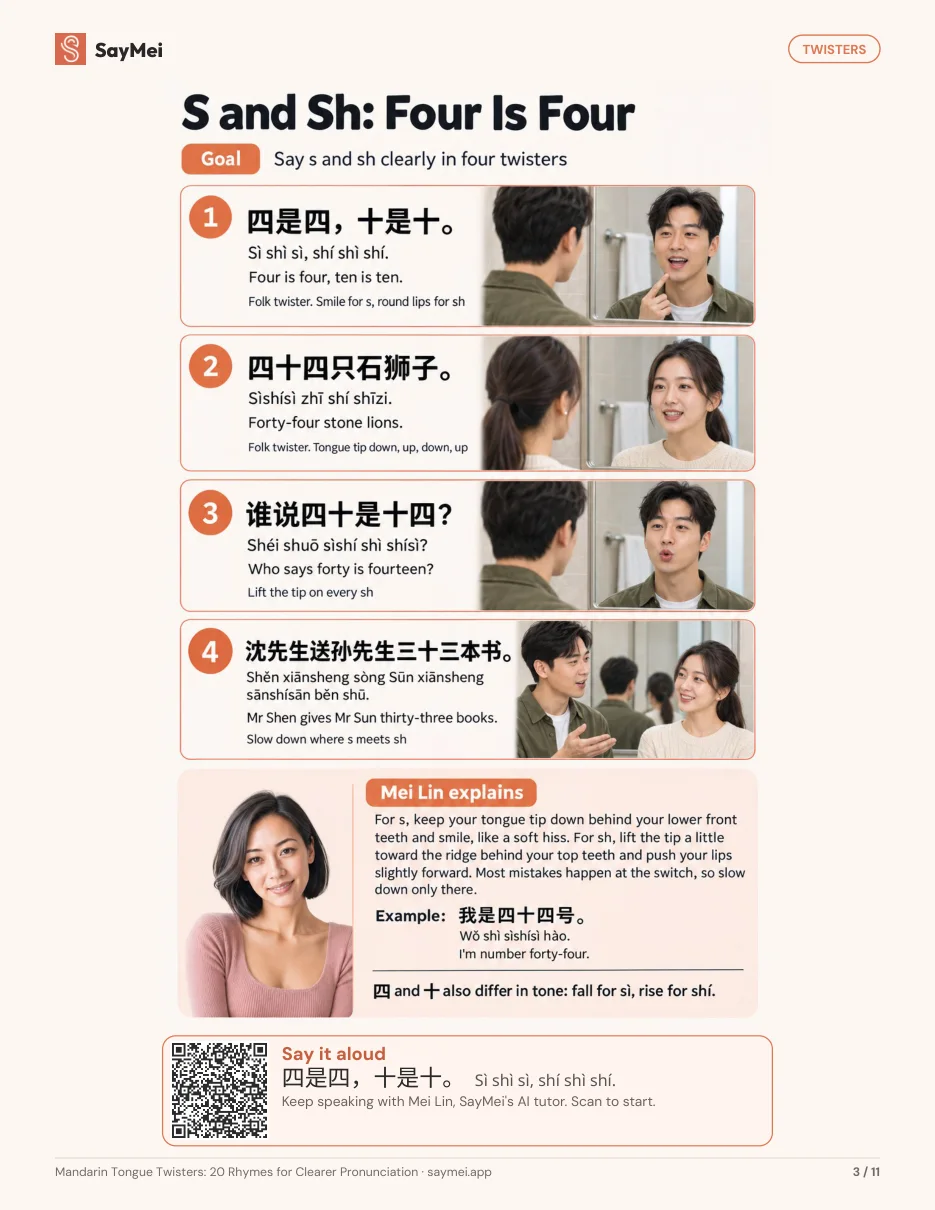
- Say s and sh clearly, even at the switch. Keep the tongue tip down and smile for s, lift it toward the ridge behind your top teeth for sh, and slow down only where the two meet.
四是四,十是十。 · Sì shì sì, shí shì shí. · Four is four, ten is ten. - Switch between z, c and zh, ch. C and ch push out a strong puff of air while z and zh push out almost none. A tissue in front of your mouth shows the difference.
这次猜错,下次再猜。 · Zhè cì cāi cuò, xià cì zài cāi. · Wrong this time, guess again next time. - Keep n and l apart. Both start with the tongue tip in the same place. For n the air goes through your nose, for l around the sides of your tongue: pinch your nose to check.
你拿蓝的,我拿绿的。 · Nǐ ná lán de, wǒ ná lǜ de. · You take the blue one, I'll take the green one. - Say j, q, x and ü with a smile. Rest the tongue tip behind your lower teeth and smile. After j, q, x and y a written u is really ü, so 去 is never koo.
下雪了,小许去学校。 · Xià xuě le, Xiǎo Xǔ qù xuéxiào. · It's snowing; Xiao Xu goes to school. - Keep your four tones steady at speed. A third tone inside a sentence stays low and moves straight on, with no rise. Practise with the classic mother-and-horse twister and tang in all four tones.
汤太烫,糖太甜,我先躺一躺。 · Tāng tài tàng, táng tài tián, wǒ xiān tǎng yi tǎng. · The soup's too hot, the sweets too sweet, so I'll lie down for a bit. - Get the tone changes of 一 and 不 right. Before a fourth tone both become second tone (yí cì, bú qù). Before other tones 一 is yì and 不 stays bù, and in counting 一 stays yī.
不是不去,是不能去。 · Bú shì bú qù, shì bù néng qù. · It's not that I won't go; I can't go. - Time yourself and hear your progress. Listen and sort the sounds, time your fastest clear version, then record your best five twisters and compare the takes.
What’s inside
- Twisters: S and Sh: Four Is Four · Z, C and Zh, Ch: Tea on the Table · N and L: Grandma's Milk · J, Q, X and Ü: Snow Day · The Four Tones: Mother and Horse · Tone Changes for Yi and Bu
- Practice: Time Yourself, Mark Hard Sounds · Your Best Five, Recorded
How to use this book
Twenty twisters on six pages, grouped by the sounds English speakers mix up, then two practice pages. Say each one three times: slowly, at normal speed, then fast while every sound stays clear. Speed always comes last.
- Day 1: S and sh. Read the mouth tip under each twister on page 3, use a small mirror, and play the free audio to say each twister back in the pause.
- Days 2–3: Z, c, zh, ch, then n and l. Pages 4 and 5. Do the tissue test for the puff of air, and say the n and l twisters once with your nose pinched, then normally.
- Days 4–5: J, q, x, ü and the four tones. Pages 6 and 7. Smile for j, q and x, and trace each tone in the air with your hand the first few times.
- Day 6: 一 and 不. Page 8. Mark the tone of every 一 and 不 before you start, then say the three twisters without stopping to think.
- Day 7: Sort and time. Page 9: listen and circle the word you hear, write the tones, and write your fastest clear time in the margin.
- Every week after: Your best five. Page 10: record your five best twisters on your phone, play them back, and compare with last week's takes.
Who it’s for
Beginners and improving learners whose Mandarin gets muddy at speed, especially English speakers who mix up s and sh, z and zh or n and l, or whose tones flatten when they talk faster.
Before you start: Know pinyin and the four tones. Every twister has characters, pinyin, English and a tip on the mouth position, and the free audio reads each one slowly with a pause to say it back.
Frequently asked questions
Are these traditional Chinese tongue twisters?
Some are. Classic folk twisters such as 四是四,十是十 and 妈妈骑马 are marked as folk twisters in the book. The others were written for it, each built around one sound group so you drill exactly the sounds you mix up.
Is there audio?
Yes, free on the book's page on saymei.app. It reads each twister slowly, then pauses so you can say it back, and it plays the listening questions on page 9. The code on page 2 opens it.
How fast should I go?
Only as fast as you can while every sound stays clear. Say each twister slowly, then at normal speed, then fast. If a sound slips, slow down at that spot only. Most mistakes happen at the switch between two sounds.
Is this workbook free?
Yes. The whole 11-page PDF is free, and you can look through its pages here before you download. There's no card and nothing to pay.
Do I need a SayMei account?
Yes, to download the PDF, and the account is free: sign up with Google, Apple or your email address. With it we email you a copy of the workbook, keep every workbook you download on your account on all your devices, save your place in the free online practice, and you can practise speaking with Mei Lin, SayMei's AI tutor.
How do I print it?
The PDF is US Letter size. On A4 paper, choose "Fit to page" (or "Scale to fit") in the print dialog so nothing is cut off. Print the whole workbook or only the pages you need; colour looks best, and black and white works too.
Can I print copies for my class?
Yes. Print as many copies as you like for your own class or family. To share it, send this page: everyone can download their own copy.
Keep going
Chinese Tone Chart and Tone Pair Practice: 20 Tone Pairs · Tone Changes in Everyday Mandarin · Mandarin Pronunciation Guide for English Speakers · Pinyin Chart with Pronunciation Cues: Initials, Finals and Spelling Rules · Browse all 294 workbooks
Version 2026-11 · Updated Nov 4, 2026 · Report a correction