Conversation · Total beginner
How to Introduce Yourself in Chinese: Phrases and Follow-Up Questions
You swap names, say where you're from, send the question back with 你呢 and politely sidestep a question about your age. Made for learners starting from zero who want their first two-way conversations.
- Level:
- Total beginner · HSK 1
- Format:
- Workbook · PDF · 22 pages · US Letter (prints on A4)
- Price:
- Free · free with a saymei account · updated Oct 8, 2026
Download the free PDF: create a free SayMei account on this page, and we'll email you a copy too.
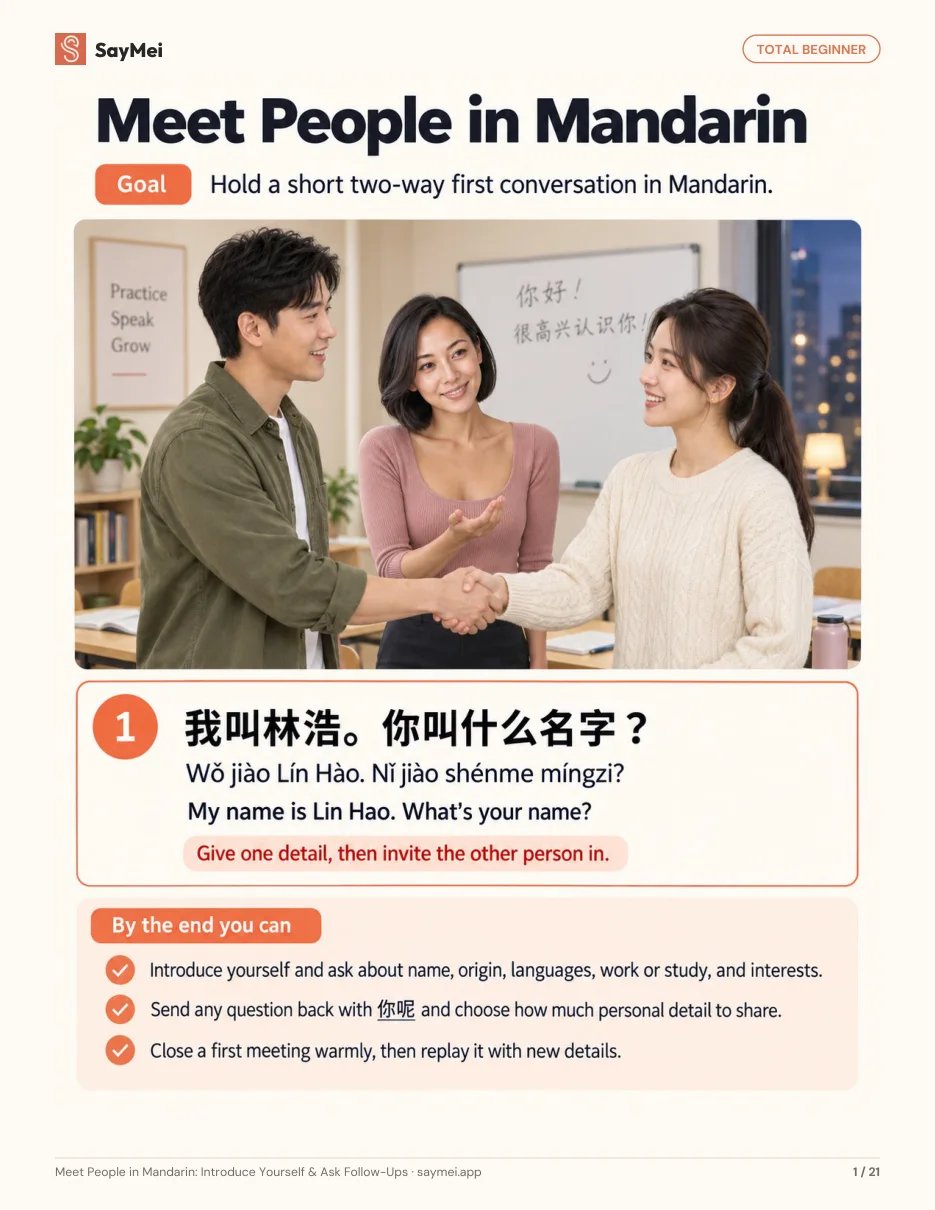
我叫林浩。你叫什么名字? · Wǒ jiào Lín Hào. Nǐ jiào shénme míngzi? · My name is Lin Hao. What's your name?
By the end you can
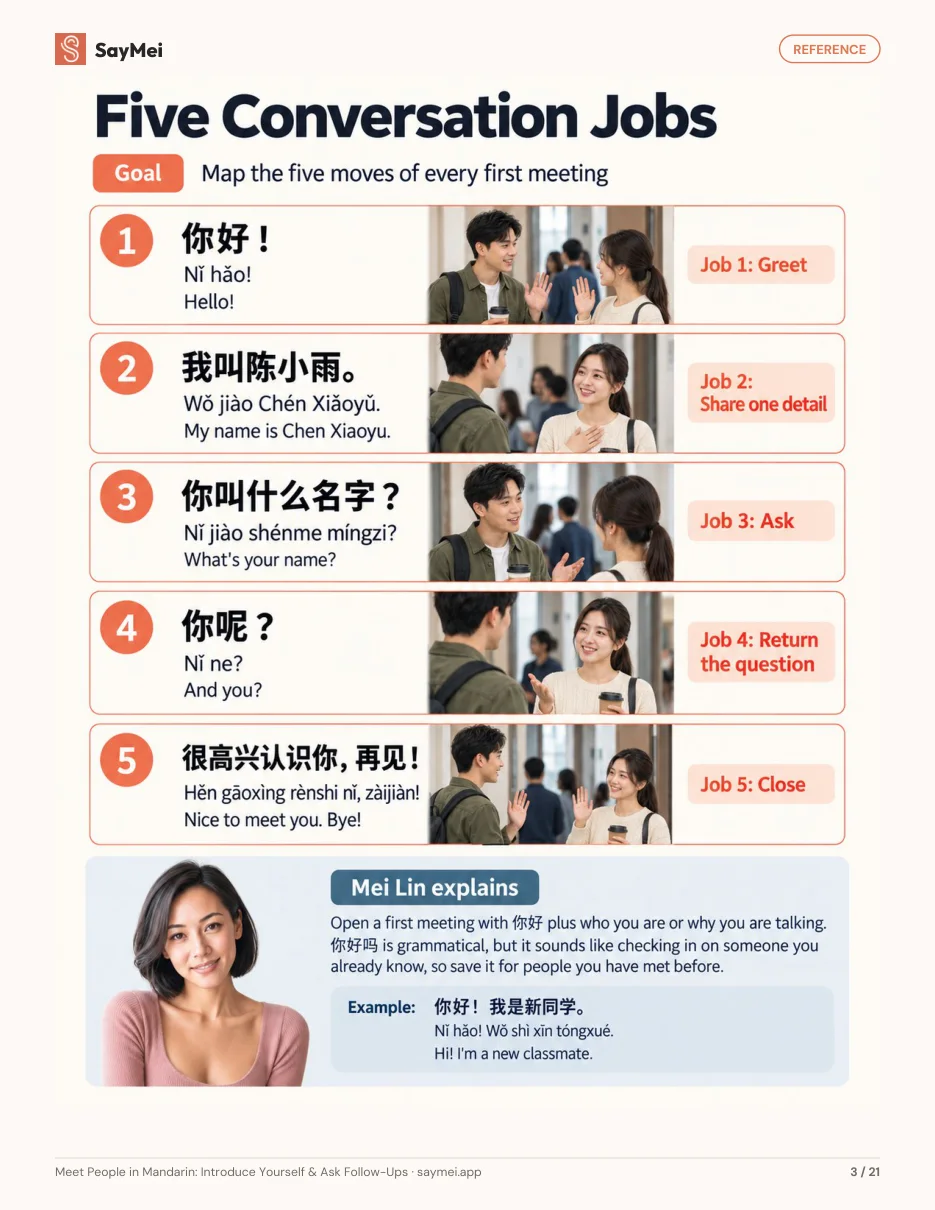
- Run a first meeting in five moves. Greet, share one detail, ask, hand the question back, and close. The map on page 3 shows each move with one line you can use.
很高兴认识你,再见! · Hěn gāoxìng rènshi nǐ, zàijiàn! · Nice to meet you. Bye! - Swap names in both directions. Say your name with 我叫, ask with 你叫什么名字?, and answer 很高兴认识你 with 我也很高兴认识你.
你叫什么名字? · Nǐ jiào shénme míngzi? · What's your name? - Say where you're from and send the question back. Add 人 to a country for your nationality, name your city with 来自, and turn the question around with 你呢? after you've answered.
我是英国人。 · Wǒ shì Yīngguó rén. · I'm British. - Talk about the languages you speak. Ask with 会说, join languages with 和, and answer modestly with 一点 placed before the language.
我会说英语和一点中文。 · Wǒ huì shuō Yīngyǔ hé yìdiǎn Zhōngwén. · I can speak English and a little Chinese. - Say what you do and answer yes-no questions with the verb. Put the place before 工作, and answer a 吗 question by repeating its verb: 是 or 不是, 会 or 不会.
我在学校工作。 · Wǒ zài xuéxiào gōngzuò. · I work at a school. - Share an interest and agree with 也. Say what you like doing, agree with 也 right after the subject, and keep the topic going with one follow-up question.
我喜欢跑步。你呢? · Wǒ xǐhuan pǎobù. Nǐ ne? · I like running. And you? - Choose how much personal detail to share. Answer questions about age, work or marriage with a range, a general answer, or a polite change of subject.
我们聊点儿别的吧。 · Wǒmen liáo diǎnr biéde ba. · Let's talk about something else. - Role-play a whole first meeting, then replay it. Act out a seven-line meeting between Lin Hao and Chen Xiaoyu, replay it as someone new, and plan your own two-minute exchange with the eight question cards.
What’s inside
- Reference: Five Conversation Jobs
- Day 1: Learn: Trade Names · Practice: Swap Names Both Ways
- Day 2: Learn: Say Where You're From · Practice: Origins and Asking Back
- Day 3: Learn: Talk About Languages · Practice: Languages You Speak
- Day 4: Learn: Talk About Work and Study · Practice: Work, Study, Yes and No
- Day 5: Learn: Share an Interest · Practice: Interests and Follow-Ups
- Day 6: Learn: Choose What to Share · Practice: Specific, General, or Redirect
- Review: Role-Play a First Meeting
- Cards: Question Cards
- Plan: Plan Your Two-Minute Exchange
How to use this book
Six days, each a Learn page and a Practice page. Learn every question together with its answer, so you can ask as well as reply, then cover the pinyin and say each line before you check the model.
- Day 1: Names. Read the five conversation jobs, then greet someone and swap names both ways.
- Days 2–3: Where you're from and languages. Say your country and city, send the question back with 你呢, and talk about the languages you speak.
- Days 4–5: Work, study and interests. Say what you do, answer yes-no questions with the verb, and share an interest with 也.
- Day 6: Choose what to share. Practise a range, a general answer and a polite redirect for personal questions.
- Review: Role-play and plan. Act out the first meeting, cut out the question cards, and fill in the two-minute plan with your own safe answers and a warm close.
Who it’s for
Total beginners who want their first two-way conversations: meeting classmates, colleagues, a partner's family or people while travelling.
Before you start: Nothing. Every line is printed in characters, pinyin and English. Fictional names, places and jobs are fine: the book says so, and the goal is the pattern, not your personal information.
Frequently asked questions
What's in the book?
Six days, each a Learn page and a Practice page: names, where you're from, languages, work and study, interests, and choosing what to share. Then you role-play a whole first meeting, cut out eight question cards and plan your own two-minute exchange.
Why doesn't the book start with 你好吗?
Mei Lin's note on page 3 explains it: 你好吗 is grammatical, but it sounds like checking in on someone you already know. For a first meeting, the book uses 你好 plus who you are or why you're talking.
What if someone asks my age or whether I'm married?
Day 6 covers this. In China these questions can come up early in small talk. The book gives three ways to answer: a range like 我三十多岁, a general answer, or a polite redirect such as 这个我不太想说.
What are the question cards for?
Page 17 has eight question cards, each with a sample answer. Cut them out and practise asking and answering with a partner until you can do both without looking.
Do I have to use my real details?
No. The book says fictional names, places and jobs are fine, because the goal is the pattern, not your personal information. Every line is printed in characters, pinyin and English.
What should I use next?
Your First 14 Days of Spoken Mandarin gives you one short exchange a day, from saying your name to ordering a drink and asking the way. Both books are also inside Free Mandarin Textbook for Beginners: The SayMei Practice Book, with five more beginner workbooks.
Do I need a SayMei account?
Yes, to download the PDF, and the account is free: sign up with Google, Apple or your email address. With it we email you a copy of the workbook, keep every workbook you download on your account on all your devices, save your place in the free online practice, and you can practise speaking with Mei Lin, SayMei's AI tutor.
How do I print it?
The PDF is US Letter size. On A4 paper, choose "Fit to page" (or "Scale to fit") in the print dialog so nothing is cut off. Print the whole workbook or only the pages you need; colour looks best, and black and white works too.
Keep going
Your First 14 Days of Spoken Mandarin · Five Beginner Mandarin Mini-Stories · Your 30-Day Mandarin Plan · Chinese Numbers, Dates and Telling Time: Prices, Weekdays and the Clock · Browse all 294 workbooks
Version 2026-10 · Updated Oct 8, 2026 · Report a correction