Exams · O Level Chinese (about HSK 5-6)
O Level Chinese Composition and Email Writing Practice with Model Answers
Formal and informal emails and three kinds of O Level Chinese composition, each with a plan and a model answer, plus openings and transitions to reuse, with audio
- Level:
- O Level Chinese (about HSK 5-6)
- Format:
- Workbook · PDF · 19 pages · US Letter (prints on A4)
- Price:
- Free · free with a saymei account · updated Nov 4, 2026
Listening audio: play every track free, no account needed.
Download the free PDF: create a free SayMei account on this page, and we'll email you a copy too.
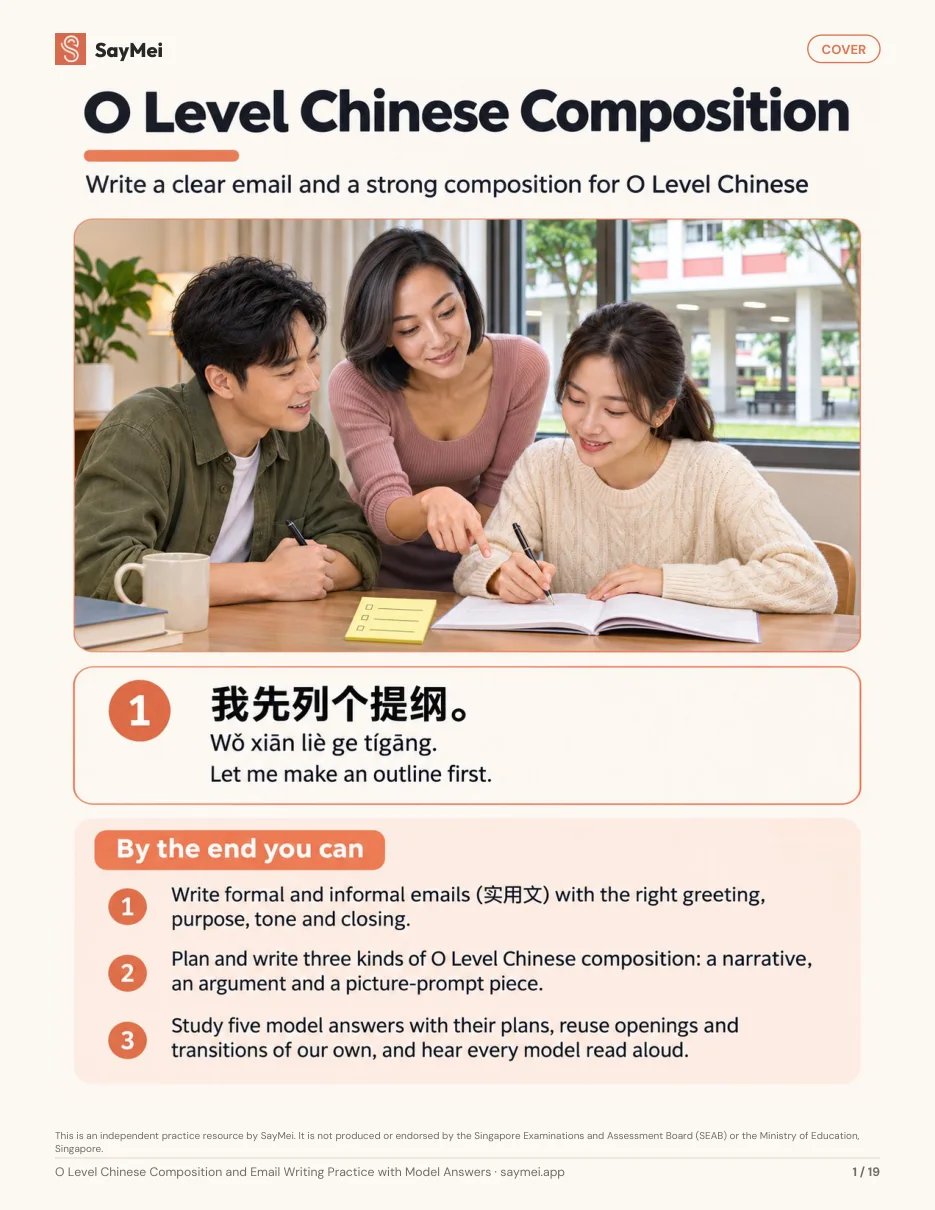
我先列个提纲。 · Wǒ xiān liè ge tígāng. · Let me make an outline first.
By the end you can
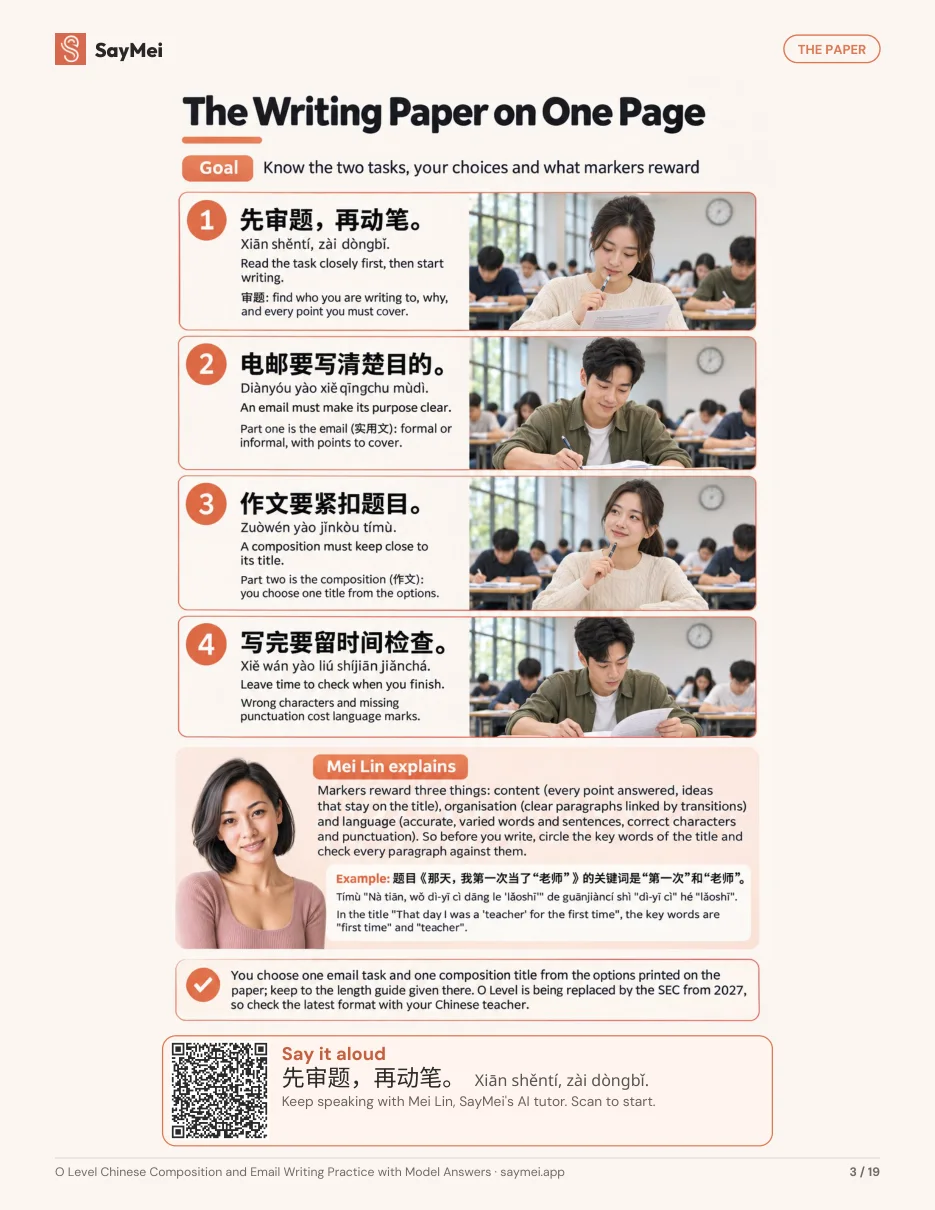
- Know the two writing tasks and read a title closely. One email (实用文) and one composition (作文), each chosen from the options. Find who you write to and why, circle the key words of the title, and check every paragraph against them.
先审题,再动笔。 · Xiān shěntí, zài dòngbǐ. · Read the task closely first, then start writing. - Open, state your purpose and close in the right tone. Formal: 尊敬的 with surname and title, 您, a clear purpose and 敬上. Informal: 亲爱的, a friendly line, and 哦 or 啦 for a friend only.
我写这封电邮,是想询问一些详情。 · Wǒ xiě zhè fēng diànyóu, shì xiǎng xúnwèn yìxiē xiángqíng. · I am writing to ask for some details. - Write a formal email to a community club. The study room now shuts at eight: give each point its own paragraph, describe the problem politely, make two suggestions and offer to help.
黄经理,我想跟您提两个建议,希望您考虑一下。 · Huáng jīnglǐ, wǒ xiǎng gēn nín tí liǎng ge jiànyì, xīwàng nín kǎolǜ yíxià. · Manager Huang, I'd like to make two suggestions, and I hope you will consider them. - Write a warm reply to a friend who is moving overseas. Comfort her, give advice with 与其…不如 and 只要, and invite her to one last outing before she leaves.
走之前,我们一起去东海岸骑脚车吧! · Zǒu zhīqián, wǒmen yìqǐ qù Dōnghǎi'àn qí jiǎochē ba! · Before you leave, let's go cycling at East Coast together! - Build a narrative in four parts and an argument from evidence. 开头, 经过, 高潮 and 结尾 for a story; for an argument, one clear view (论点), points backed by evidence (论据), and a paragraph that answers the other side.
结尾要呼应开头。 · Jiéwěi yào hūyìng kāitóu. · The ending should echo the opening. - Reuse openings, transitions and endings. Ten lines to set a mood, move time forward, lead into the climax, answer the other side and end, plus ways to show a feeling through the body.
我的心怦怦直跳,手心里全是汗。 · Wǒ de xīn pēngpēng zhí tiào, shǒuxīn lǐ quán shì hàn. · My heart pounded and my palms were wet with sweat. - Write three compositions with model answers, then retell one aloud. A narrative about a choice you regret, an argument on holiday part-time jobs and a picture prompt set in a hawker centre, then a two-minute retelling from your outline.
我认为假期打工利大于弊,因为它能让我们明白赚钱不容易。 · Wǒ rènwéi jiàqī dǎgōng lì dà yú bì, yīnwèi tā néng ràng wǒmen míngbai zhuànqián bù róngyì. · I think holiday jobs do more good than harm, because they show us that earning money is not easy.
What’s inside
- The paper: The Writing Paper on One Page
- Email: Email Formats: Formal and Informal · Email 1: A Formal Email · Email 2: An Informal Email
- Composition: How a Composition Is Built · Openings, Transitions and Endings · Narrative: A Choice I Regret · Argument: Holiday Part-Time Jobs · Extra Practice: Lunchtime Rush
- Review: Tell Your Composition Aloud
- Plan: Your 8-Week Writing Plan
How to use this book
On each task page, do the short drills, plan for five minutes, write with a timer, then compare with the Model answer (SayMei) in the key and read it aloud with the free audio. The book's own plan takes eight weeks.
- Week 1: The paper and the email formats. Read pages 3 and 4, then write the formal and informal openings and closings from memory and check them.
- Weeks 2–3: Two emails. Page 5, then page 6, with a timer. Circle every place where 你 should be 您, then write one more informal email about real news from your school.
- Week 4: How a composition is built. Learn the structures on page 7, then use five lines from page 8 in sentences of your own.
- Weeks 5–6: Narrative and argument. Page 9: underline your turning point and add a detail that shows a feeling. Page 10: check for one view, two points with evidence and a paragraph on the other side.
- Week 7: Picture prompt and retelling. Write the picture composition on page 11, then retell it aloud in two minutes from your outline, as on page 12.
- Week 8: A full timed sitting. Write one email and one composition in a single sitting, and keep five minutes to check characters and punctuation.
Who it’s for
Secondary school students in Singapore preparing for the O Level Chinese writing paper, and Chinese teachers who want email and composition tasks with plans and model answers.
Before you start: Chinese at about HSK 5 to 6. The tasks and models are in Chinese, the drills have English notes, and the free audio reads every model answer and Chinese line with a pause to say it back.
Frequently asked questions
Does it cover both parts of the writing paper?
Yes: the email (实用文), formal and informal, and the composition (作文) as a narrative and an argument, plus a picture prompt for extra practice (not an O Level task type). Each task has short drills, a plan and a Model answer (SayMei) in the key.
O Level is changing to the SEC. Is this still useful?
O Level is being replaced by the Singapore-Cambridge Secondary Education Certificate (SEC) from 2027. The book's work on reading a task, tone, structure and planning applies to any Chinese writing paper, but check the latest format and length guide with your Chinese teacher.
Should I memorise the model answers?
No. Write your own ideas in your own words. Use the models to see how a plan turns into paragraphs, and read them aloud with the audio to make their words and sentence patterns your own.
Is this workbook free?
Yes. The whole 19-page PDF is free, and you can look through its pages here before you download. There's no card and nothing to pay.
Do I need a SayMei account?
Yes, to download the PDF, and the account is free: sign up with Google, Apple or your email address. With it we email you a copy of the workbook, keep every workbook you download on your account on all your devices, save your place in the free online practice, and you can practise speaking with Mei Lin, SayMei's AI tutor.
How do I print it?
The PDF is US Letter size. On A4 paper, choose "Fit to page" (or "Scale to fit") in the print dialog so nothing is cut off. Print the whole workbook or only the pages you need; colour looks best, and black and white works too.
Can I print copies for my class?
Yes. Print as many copies as you like for your own class or family. To share it, send this page: everyone can download their own copy.
Keep going
O Level Chinese Oral Practice: Reading Aloud and Video Conversation with Model Answers · AP® Chinese Speaking Practice: Project Presentation and Q&A (2027 Format) · AP® Chinese Story Narration and Email Response Practice: 10 Prompts with Model Answers · GCSE Chinese Speaking Practice: Role Plays, Picture Tasks and Conversation Questions · More exam practice · Browse all 294 workbooks
This is an independent practice resource by SayMei. It is not produced or endorsed by the Singapore Examinations and Assessment Board (SEAB) or the Ministry of Education, Singapore.
Version 2026-11 · Updated Nov 4, 2026 · Report a correction