Pronunciation · Beginner
Pinyin Practice Worksheets: Tones, Initials and Finals with Answer Key
You take syllables apart into initial, final and tone, put every tone mark on the right letter and work out when 一 and 不 change their tone. For beginners, and for learners who picked up Mandarin by ear.
- Level:
- Beginner · HSK 1
- Format:
- Worksheet pack · PDF · 35 pages · US Letter (prints on A4)
- Price:
- Free · free with a saymei account · updated Nov 11, 2026
Download the free PDF: create a free SayMei account on this page, and we'll email you a copy too.
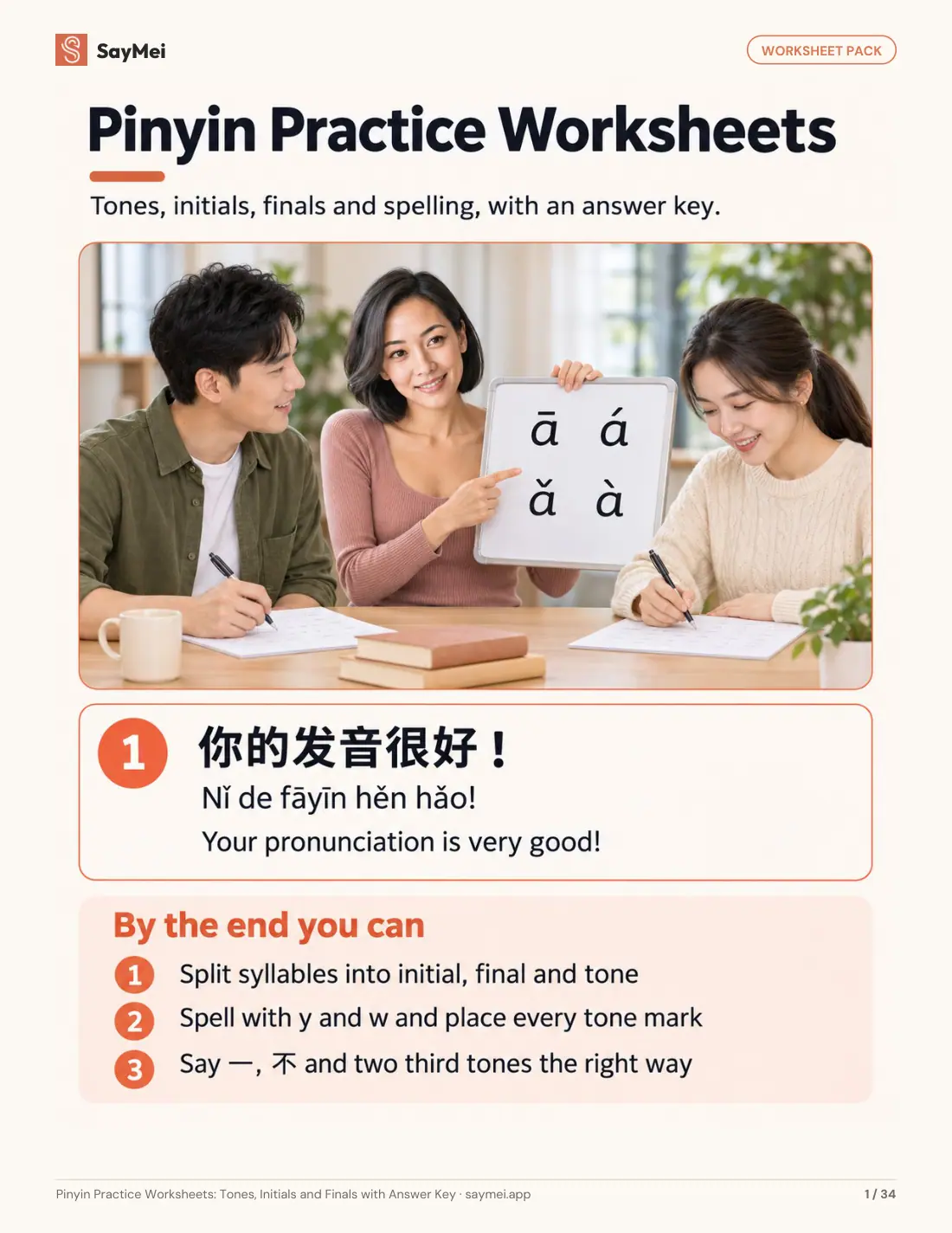
你的发音很好! · Nǐ de fāyīn hěn hǎo! · Your pronunciation is very good!
By the end you can
- Split any syllable into initial, final and tone. Find the first sound and the ending of real words, spot syllables with no initial, and sort finals into their families.
他来。 · Tā lái. · He is coming. - Name each tone and write its mark. Write tone numbers, add marks to bare syllables, and find the light syllable in words like 爸爸 and 谢谢.
妈妈好! · Māma hǎo! · Hello, Mum! - Tell look-alike initials apart. Choose b or p, d or t, n or l, g or k, and curled zh ch sh r or flat z c s, and tell an i that says ee from an i that buzzes.
十四不是四十。 · Shísì bú shì sìshí. · Fourteen is not forty. - Spell single, compound and nasal finals. Pick u or ü, find the hidden ü after j, q and x, spot ai, ei, ao and ou, and choose -n or -ng.
我很忙。 · Wǒ hěn máng. · I'm very busy. - Spell with y and w and place every tone mark. Rewrite ie as ye and uo as wo, shorten iou, uei and uen to iu, ui and un, and put the mark on the right letter, as in liù and guì.
我也要。 · Wǒ yě yào. · I want one too. - Write names and places, and type them. Use capitals and tone marks for names like Běijīng, add an apostrophe before a, o or e inside a word, and write the letters a pinyin keyboard needs.
西安 · Xī'ān · Xi'an - Say two third tones in a row. Decide whether a third tone rises like a second tone or stays low and short, and mark the syllable that changes in pairs like 你好.
今天很忙,很累,可是很好! · Jīntiān hěn máng, hěn lèi, kěshì hěn hǎo! · Today I'm really busy and tired, but I'm good! - Choose the tone you say for 不 and 一. Say bú before a fourth tone and bù elsewhere, and choose yī, yí or yì for 一 in counting, numbers and quantities like 一杯 and 一块.
不要,谢谢。我不喝咖啡。 · Bú yào, xièxie. Wǒ bù hē kāfēi. · No, thanks. I don't drink coffee. - Keep neutral tones light. Circle the light syllable in words like 东西 and 名字, judge whether it sits higher or lower, and ask A-not-A questions with a light bu.
你忙不忙?你去不去? · Nǐ máng bu máng? Nǐ qù bu qù? · Are you busy? Are you going?
What’s inside
- Charts: Initials · Finals · Spelling and Tone-Mark Rules
- Syllables and tones: Practice: Parts of a Syllable · Practice: Tones
- Initials and finals: Practice: Single Finals · Practice: b p m f d t n l · Practice: g k h and j q x · Practice: zh ch sh r and z c s
- Finals: Practice: ai ei ao ou · Practice: Nasal Finals
- Spelling: Practice: y and w Spellings · Practice: Tone-Mark Placement
- Tones and names: Practice: Tone Changes · Practice: Words, Names and Places
- Tone changes: Rise or Stay Low? · Bù or Bú? · Yī, Yí or Yì? · Keep It Light
- Build syllables: Take Syllables Apart · Assemble the Finished Syllable · Place Tones, Mark Boundaries
The pages come from The Chinese Alphabet: Pinyin Workbook for Beginners in 12 Lessons · Tone Sandhi in Everyday Mandarin: Third Tone, Yī and Bù Tone Changes · Pinyin Chart with Pronunciation Cues: Initials, Finals and Spelling Rules.
How to use this book
The pack works from printed pinyin, with no audio needed. Say every answer out loud as you write it, first slowly and then at normal speed, and check your tone marks against the key on pages 25 to 34.
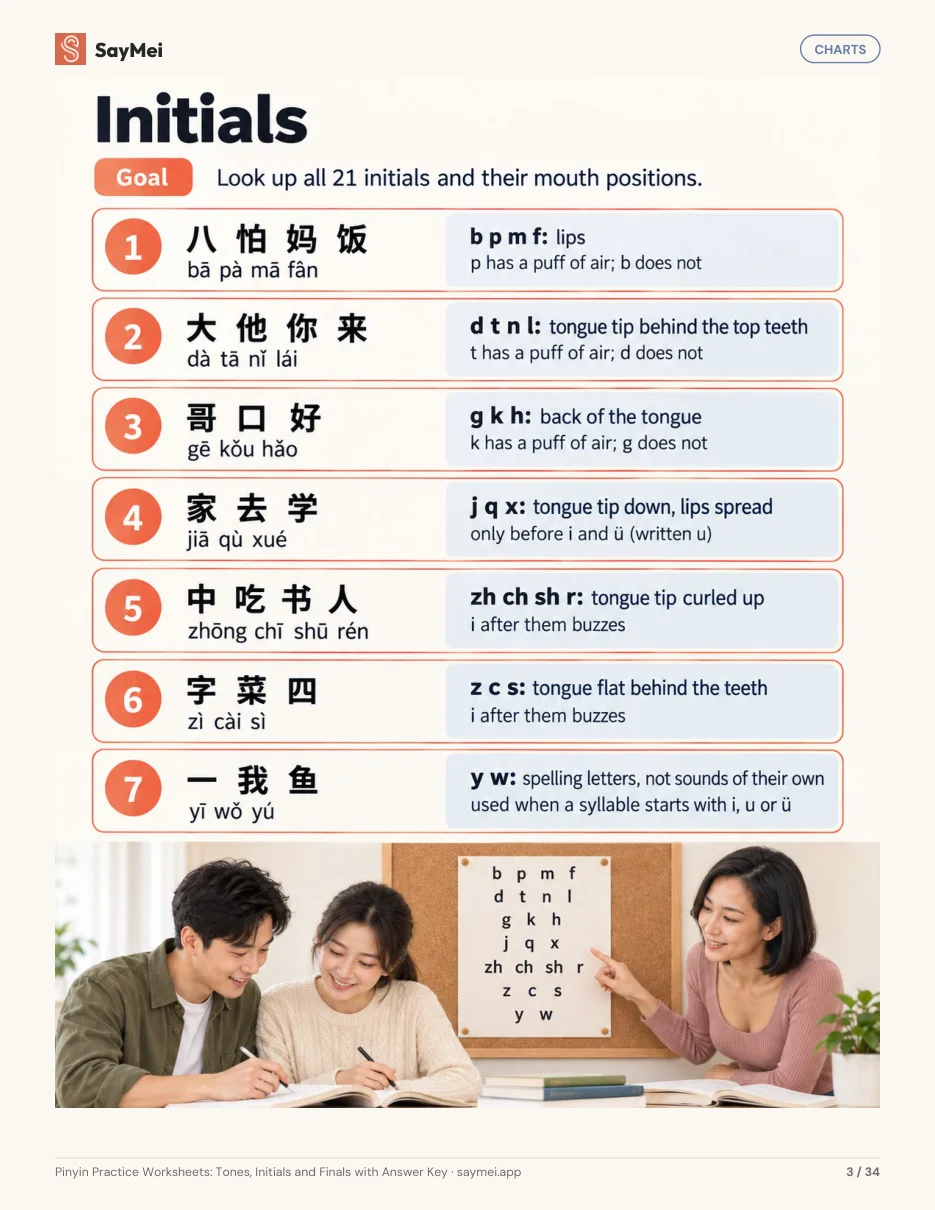
- Session 1: Read the three charts. Pages 3 to 5: the 21 initials, every final and the spelling rules. Keep them beside you for the rest of the pack.
- Session 2: Syllables, tones and initials. Pages 6 to 11: take syllables apart, write tone marks and tell similar initials apart.
- Session 3: Finals and spelling. Pages 12 to 15: compound and nasal finals, y and w spellings and tone-mark placement.
- Session 4: Tone changes, names and places. Pages 16 to 21: 一, 不, two third tones and the neutral tone, plus names, places and typing.
- Session 5: Build syllables back up. Pages 22 to 24: take syllables apart, write the finished spelling from its parts and fix misplaced marks.
- After every page: Check and say it. Mark your answers with the key, then say each corrected syllable aloud. The Say it box has no single right answer: say your own version.
Who it’s for
Beginners learning to read and write pinyin, learners who picked up Mandarin by ear and want to spell it, and tutors who need a printed pinyin drill. Every page comes from one of SayMei's pinyin workbooks.
Before you start: Nothing for the charts and pages 6 to 17, which start from single sounds. The tone-change pages from page 18 are easier once you know the four tones.
Frequently asked questions
What's in this pack?
Three charts on pages 3 to 5 (all 21 initials, every final, and the spelling and tone-mark rules), then 19 practice pages on syllables, tones, initials, finals, spelling, tone changes and names. The answer key is on pages 25 to 34.
Do I need audio for these worksheets?
No. Every exercise works from the printed pinyin: you circle, write and correct initials, finals and tone marks. The pack has no audio, so say each answer out loud as you write it.
Which tone changes does it practise?
Two third tones in a row (你好 is said ní hǎo), 不 as bù or bú, 一 as yī, yí or yì, and the neutral tone, including the light bu in questions like 忙不忙. You choose the tone you say from the dictionary tone of the next syllable.
Where do the pages come from?
Pages 3 to 17 come from The Chinese Alphabet: Pinyin Workbook for Beginners in 12 Lessons, pages 18 to 21 from Tone Changes in Everyday Mandarin, and pages 22 to 24 from Pinyin Chart with Pronunciation Cues. Download the full workbook when you want more on a topic.
Can I start with no Chinese at all?
Yes. The charts and pages 6 to 17 start from single sounds and real words like 他, 大 and 八. Leave pages 18 to 21 until the four tones feel familiar.
What should I use after this pack?
How to Type in Chinese: Set Up a Pinyin Keyboard and Send Your First Messages puts your spelling to work, and Chinese Tone Pair Flashcards: 80 Cards for All 20 Tone Pairs drills the tones in two-syllable words.
Do I need a SayMei account?
Yes, to download the PDF, and the account is free: sign up with Google, Apple or your email address. With it we email you a copy of the workbook, keep every workbook you download on your account on all your devices, save your place in the free online practice, and you can practise speaking with Mei Lin, SayMei's AI tutor.
How do I print it?
The PDF is US Letter size. On A4 paper, choose "Fit to page" (or "Scale to fit") in the print dialog so nothing is cut off. Print the whole workbook or only the pages you need; colour looks best, and black and white works too.
Keep going
Mandarin Tongue Twisters: 20 Rhymes for Clearer Pronunciation · Mandarin Pronunciation and Tones Test: Check Your Accent, with Audio · Chinese Tone Chart and Tone Pair Practice: 20 Tone Pairs · Tone Sandhi in Everyday Mandarin: Third Tone, Yī and Bù Tone Changes · Browse all 340 workbooks
Version 2026-11 · Updated Nov 11, 2026 · Report a correction