Reading · Beginner
Read Chinese Without Pinyin: A Guided Transition Workbook
Step down from full pinyin to none with six short stories and real reading strategies
- Level:
- Beginner · HSK 1
- Format:
- Workbook · PDF · 32 pages · US Letter (prints on A4)
- Price:
- Free · free with a saymei account · updated Oct 8, 2026
Download the free PDF: create a free SayMei account on this page, and we'll email you a copy too.
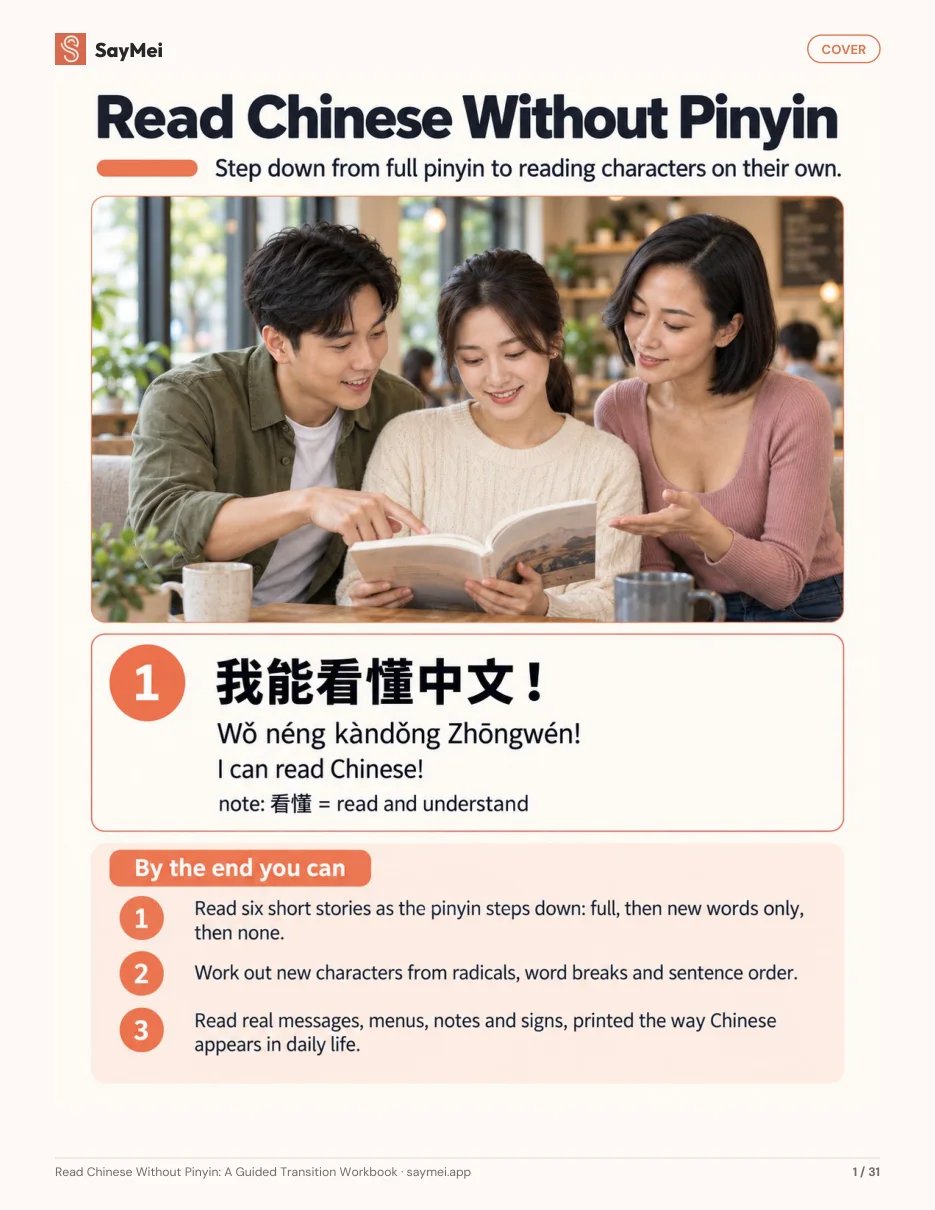
我能看懂中文! · Wǒ néng kàndǒng Zhōngwén! · I can read Chinese!
By the end you can
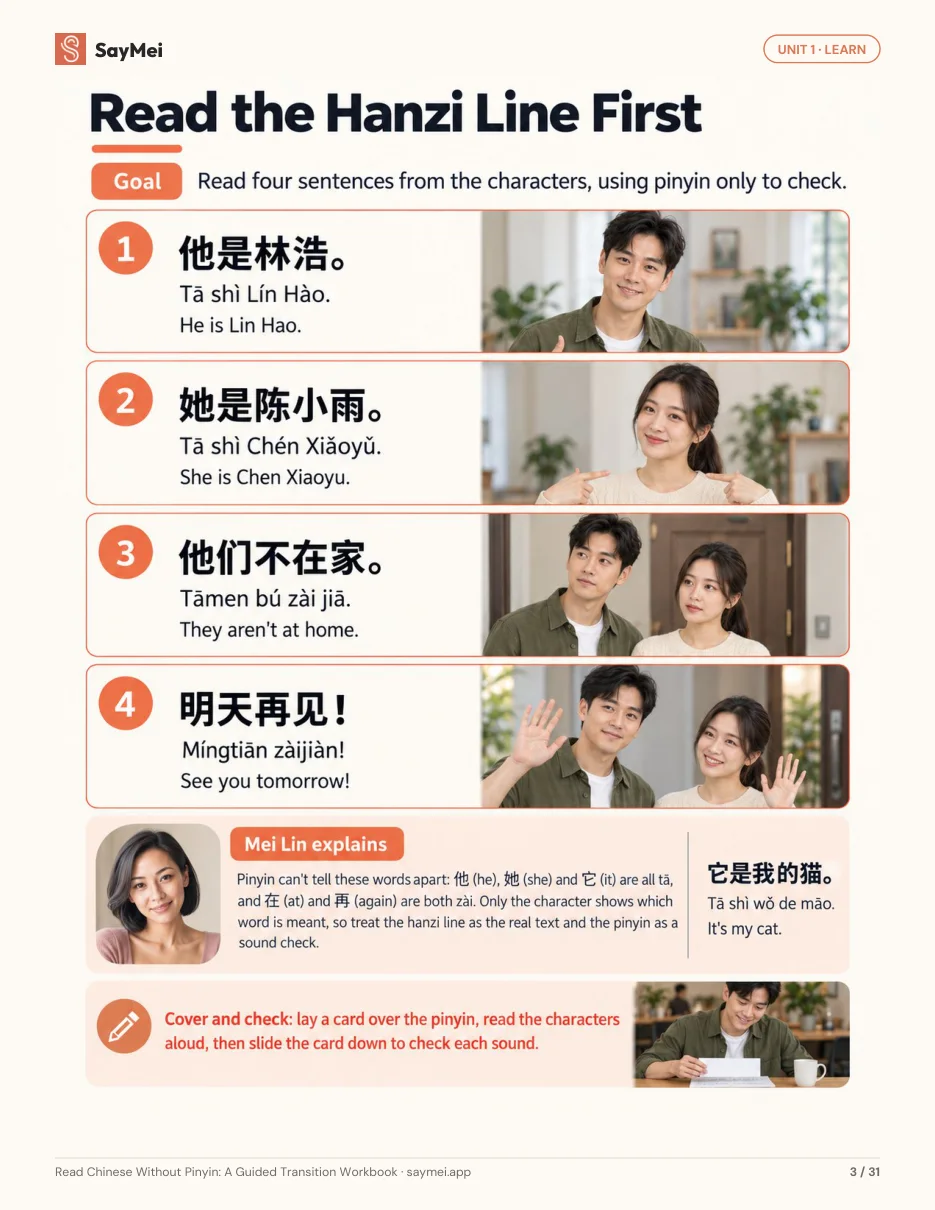
- Read the characters first and use pinyin only to check. Pinyin can't tell 他, 她 and 它 apart: all three are tā. Treat the hanzi line as the real text and the pinyin as a sound check under a card.
她是陈小雨。 · Tā shì Chén Xiǎoyǔ. · She is Chen Xiaoyu. - Recognise the ten characters in almost every text. 的, 一, 是, 不, 了, 在, 人, 有, 我 and 他 top the frequency lists, and 的 alone is roughly one character in every 25. Spot them first and the gaps are the words left to work out.
我的老师是中国人。 · Wǒ de lǎoshī shì Zhōngguórén. · My teacher is Chinese. - Use radicals and word breaks to work out a line. A radical gives you the topic, so a new character with 氵 is probably something wet. Chinese prints no spaces, so split a line into words before you read it aloud.
我想喝汤。 · Wǒ xiǎng hē tāng. · I'd like some soup. - Say the tone changes the characters never show. 不 and 一 change tone before other syllables, and two third tones in a row change too. Glance at the next syllable, and read the last character to tell a question from a suggestion.
不要咖啡,我要一杯茶。 · Bú yào kāfēi, wǒ yào yì bēi chá. · No coffee, I'd like a cup of tea. - Read dates, times and prices in Chinese order. Chinese writes time from big to small: month, day, weekday, part of day, hour. Read the whole time chunk before you translate it, and know that 28元 is said 二十八块.
三月八号上午十点 · sānyuè bā hào shàngwǔ shí diǎn · 10 a.m. on March 8th - Follow long phrases and predict the next word. Find the noun after 的 to read long describing phrases, and use the fixed order of time, person, place and action to guess what comes next. Tell apart look-alikes that differ by one stroke or dot.
- Read past a character you don't know. Put a dot under it, finish the sentence, then guess from its slot and radical. Two or three unfamiliar characters before 说 or 老师 are usually a name.
我喝了一壶茶。 · Wǒ hēle yì hú chá. · I drank a pot of tea. - Read signs, messages, menus and notes with no pinyin. Nine signs from doors, stations and shops, then six short stories as the pinyin steps down to none: a self-introduction, a message, a noodle-shop scene, a teacher's note, a diary and a postcard.
我在门口等你。 · Wǒ zài ménkǒu děng nǐ. · I'll wait for you at the door.
What’s inside
- Unit 1: Learn: Read the Hanzi Line First
- Reference: Ten Characters in Every Text
- Story 1: Lin Hao's Reading Goal
- Unit 1: Practice: Hanzi First, Pinyin Second
- Unit 2: Learn: Radicals Hint at Meaning · Learn: No Spaces: Find the Words
- Story 2: A Message from Xiaoyu
- Unit 2: Practice: Radicals and Word Breaks
- Unit 3: Learn: Tone Changes Characters Hide · Learn: Read the Last Character First
- Story 3: Dinner at the Noodle Shop
- Unit 3: Practice: Tones, Endings and Menus
- Reference: Look-Alike Characters
- Unit 4: Learn: Read Dates, Times and Prices
- Story 4: A Note from the Teacher
- Unit 4: Practice: Look-Alikes, Dates and Notes
- Unit 5: Learn: Describers Come Before the Noun · Learn: Time, Person, Place, Action
- Story 5: Xiaoyu's Saturday
- Unit 5: Practice: Nouns, Word Order and Story 5
- Reference: Signs You Can Read Today
- Unit 6: Learn: Skip, Guess, Keep Reading
- Story 6: A Postcard from Mei Lin
- Unit 6: Practice: Guess, Check and Read Signs
- Cards: Cut-Out Character Cards
- Review: Read It All Without Pinyin
How to use this book
Six units in three stages: full pinyin, then pinyin for new words only, then none. Read every text twice: first with a card over the pinyin, saying each character aloud, then lift the card and check.
- Units 1–2: Full pinyin. Read the hanzi line first, learn the ten everyday characters, then use radicals and word breaks. Stories 1 and 2 still print every syllable in pinyin.
- Units 3–4: Pinyin for new words only. Hidden tone changes, sentence endings, look-alikes, dates, times and prices, with Stories 3 and 4.
- Units 5–6: No pinyin. Long phrases, word order, everyday signs and how to read past a new character. Stories 5 and 6 are characters only.
- Every story: Dot, read on, guess. Meet a new character? Dot it, read on to the full stop and guess. Check the word box under the story only after that.
- Cards: Quiz yourself. Cut out the eight character cards. Check your answers in the key at the back and copy every character you missed onto a card like them.
- Review: Read it all without pinyin. Read a dialogue in characters only, answer in Chinese, then plan a reading date with a partner from characters alone.
Who it’s for
Beginners who can say basic sentences and recognise some characters but still lean on pinyin to read, and want to read Chinese the way it appears on menus, signs and phones.
Before you start: You should read pinyin comfortably and know basic words like 我, 是 and 不. The book starts with full pinyin and takes it away step by step.
Frequently asked questions
How fast does the pinyin disappear?
In three stages. Units 1 and 2 print full pinyin, Units 3 and 4 give pinyin only for new words, and Units 5 and 6 give none. The review dialogue is in characters only.
What do I do when I meet a character I don't know?
Keep going. The book teaches you to dot it, read to the full stop, and guess from its place in the sentence and its radical, then check the word box under the story.
How many characters do I need to know first?
Not many. The texts are built from beginner words, and the book starts with full pinyin so you can check every syllable while you get used to reading the characters.
Is this workbook free?
Yes. The whole 32-page PDF is free, and you can look through its pages here before you download. There's no card and nothing to pay.
Do I need a SayMei account?
Yes, to download the PDF, and the account is free: sign up with Google, Apple or your email address. With it we email you a copy of the workbook, keep every workbook you download on your account on all your devices, save your place in the free online practice, and you can practise speaking with Mei Lin, SayMei's AI tutor.
How do I print it?
The PDF is US Letter size. On A4 paper, choose "Fit to page" (or "Scale to fit") in the print dialog so nothing is cut off. Print the whole workbook or only the pages you need; colour looks best, and black and white works too.
Can I print copies for my class?
Yes. Print as many copies as you like for your own class or family. To share it, send this page: everyone can download their own copy.
Keep going
Weather & Seasons: Read Forecasts and Make Plans · Guess the Sound: Chinese Phonetic Components in Practice · Elementary Chinese Short Stories with Pinyin: 8 Everyday Stories · Read Chinese News: Headlines, Summaries & Fact–Opinion Practice · Browse all 294 workbooks
Version 2026-10 · Updated Oct 8, 2026 · Report a correction