Traditional Chinese legend, retold in simple Mandarin
The Eight Immortals Cross the Sea
八仙过海
The Eight Immortals Cross the Sea (八仙过海, Bā xiān guò hǎi) is a Chinese legend, retold in simple Mandarin as a 5-chapter story with audio for learners at about HSK 2 (Elementary).
Retold from the Chinese legend of the Eight Immortals: eight friends cross the Eastern Sea on their own magic treasures, until the Dragon King's spoiled son decides one of those treasures should be his.
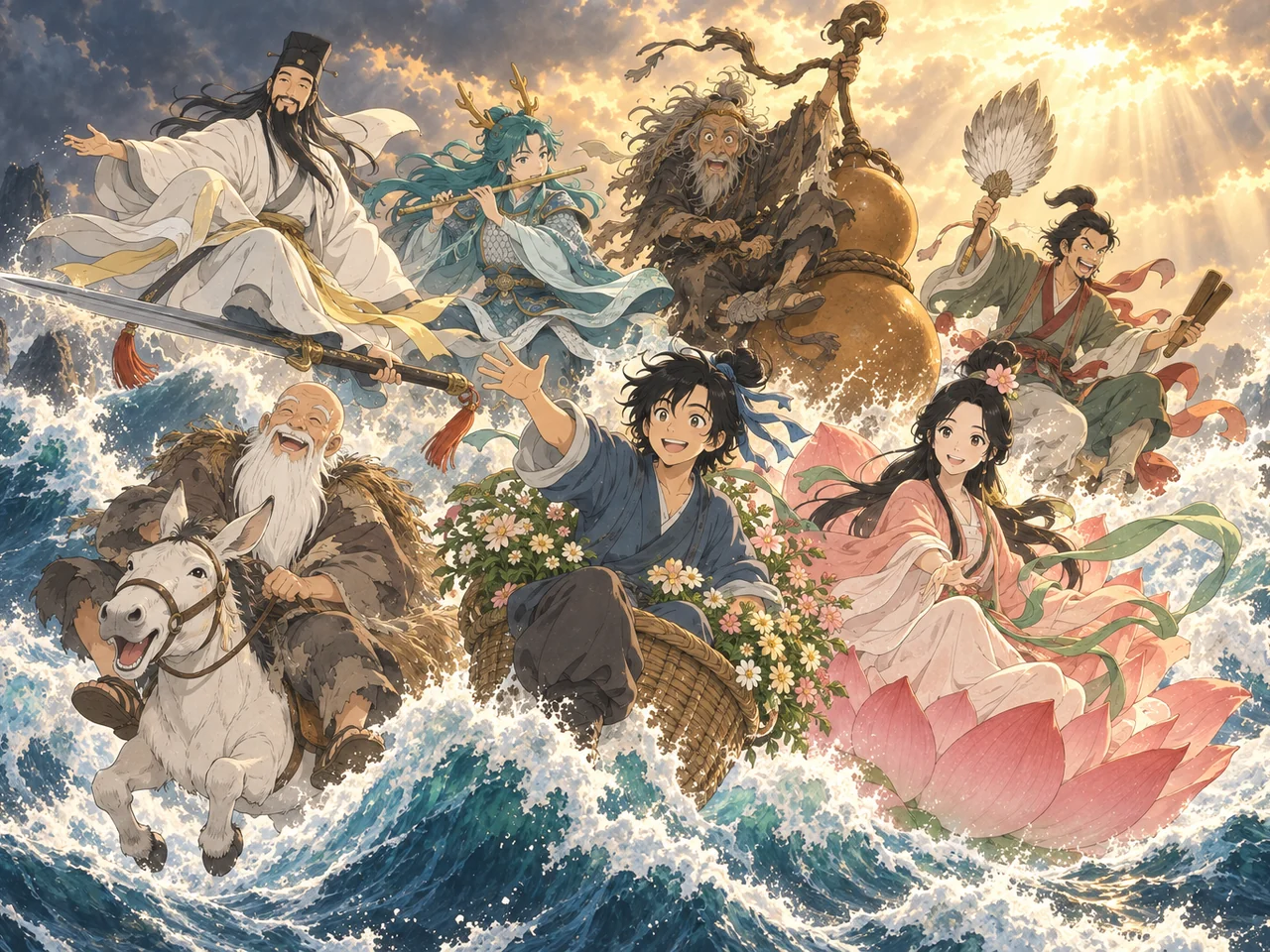
Meet the voices
- Narrator · 旁白 — An old storyteller who tells how eight immortals crossed the Eastern Sea, the way grandparents all over China tell it.
- Lü Dongbin · 吕洞宾 — A dashing swordsman-immortal who loves wine, a good dare and a good fight, and who dreams up the crossing.
- Zhang Guolao · 张果老 — The oldest of the eight, who calls himself Old Zhang and rides his paper donkey backwards, so he never sees where he's going.
- Lan Caihe · 蓝采和 — The youngest of the eight: a cheerful singer with one bare foot, who says everything twice and carries a flower basket that never runs out of flowers.
- He Xiangu · 何仙姑 — The only woman of the eight: calm, kind and careful, and always the one counting her friends.
- Li Tieguai · 铁拐李 — A lame old beggar with an iron crutch and a gourd: grumpy, but afraid of nothing.
- Han Zhongli · 汉钟离 — A big-bellied, jolly immortal whose palm-leaf fan can raise a storm.
- Han Xiangzi · 韩湘子 — A dreamy young immortal whose flute can make anyone dance.
- Cao Guojiu · 曹国舅 — An emperor's uncle who became an immortal: very proper and polite, with a pair of jade clappers.
- The Dragon Prince · 龙太子 — The Dragon King's spoiled son, who has never seen a flower and is used to getting whatever he wants.
- The Dragon King · 龙王 — The mighty, hot-tempered ruler of the Eastern Sea, who believes every word his son says.
- Guanyin · 观音菩萨 — The gentle goddess of mercy from the South Sea, who can stop a wave with one hand.
5 chapters, one journey
Chapter 1: Eight Treasures
八个宝贝
At a party on Penglai, Lü Dongbin dares his friends to cross the Eastern Sea on their own magic treasures. But deep under the sea, someone is watching.
Free to read
Chapter 2: The Dragon Prince
龙太子
Halfway across the sea, a boy with golden horns rises from the waves beside Lan Caihe's basket. He has never seen a flower, and he wants the whole basket.
SayMei Stories
Chapter 3: A Song Under the Sea
海里的歌
Deep in the Dragon Palace, the prince shows off two new treasures to his father, while seven worried immortals search the dark sea for their missing friend.
SayMei Stories
Chapter 4: The Battle of Treasures
各显神通
Shrimp soldiers and crab generals pour out of the Dragon Palace, and the immortals answer with a fan, a flute, a pair of clappers, a thirsty gourd and a sword.
SayMei Stories
Chapter 5: Flowers for the Sea
海里有花了
A wall of water from all four seas rushes at the immortals, until a white cloud floats in from the South Sea and someone tells everyone to stop.
SayMei Stories
Key words in The Eight Immortals Cross the Sea
Behind the story
The Eight Immortals (八仙) are the best-loved band of immortals in Chinese folk religion and folk art: an old man on a donkey, a swordsman, a lame beggar, a young woman with a lotus and four more. Their trip across the Eastern Sea was told in an old zaju opera, 争玉板八仙过沧海, and in the Ming-dynasty novel 东游记 (Journey to the East) by Wu Yuantai. Storytellers have always told it their own way, changing the party, the treasures and even who dared the others to cross.
The story gave the Chinese language a saying, 八仙过海,各显神通: “the Eight Immortals cross the sea, each showing their own magic.” People use it for any group where everyone reaches the same goal in their own way, from a team at work to students before an exam. In the oldest tellings, the treasure the Dragon King's son takes is Lan Caihe's jade clappers; in this retelling he takes the flower basket that Lan Caihe carries in most pictures today.
Did you know?
- Penglai (蓬莱), on the coast of Shandong, is said to be where the Eight Immortals set off across the sea, and in 2008 its legends of the Eight Immortals were added to China's national list of intangible cultural heritage.
- A big square table that seats eight people, two on each side, is called an Eight Immortals table (八仙桌), and many Chinese families still eat around one.
- Tales from the Tang dynasty say Zhang Guolao's white donkey could run a huge distance in a day, and that when he stopped, he folded it up as thin as paper and put it away. To ride again, he sprayed it with a mouthful of water.