Busuu review for Chinese: what you get, and what Premium Plus leaves out
Our Busuu review for Mandarin: how far the Chinese course goes, what Premium Plus leaves out, its certificates and every plan's price, checked November 2026.


Busuu sells Premium Plus "for speaking fluency". Its own help centre lists the speaking tools behind that promise for five courses, and Chinese isn't one of them.
This review is for you if you're learning Mandarin and wondering whether Busuu deserves your time, and which plan to buy. We read Busuu's own pages, its help centre, its price lists and its store listings on 5 November 2026. We also coded 58 recent store reviews about learning Chinese on Busuu.
Key takeaways
- It's a beginner course with a long label. Busuu says A1 to B2, but learners say the course falls apart once you leave A1.
- The community is the best reason to use it. Native speakers correct the sentences and recordings you post, on every plan.
- Premium Plus's speaking tools skip Chinese. AI Conversations, pronunciation feedback and Mistake Repair are listed for other courses only.
- Certificates stop at A1 in Chinese. That's what Busuu's help centre says, even though its Chinese page promises A1 to B2.
- There's no placement test or grammar review for Chinese. Busuu's help centre lists both tools for other courses only.
- If you pay, pay yearly. On Busuu's website, a year of Premium costs about half of paying month by month.
Is Busuu good for learning Chinese?
For a beginner who wants structure and a human check on their sentences, yes. For anyone past the first level, or anyone who mainly wants to talk, it does much less. We read what Busuu says about each part, and what learners report, then scored them:
What you need · Verdict · What Busuu gives you
A gentle start from zero
Strong
Short A1 lessons with pinyin and native-speaker audio
Feedback from native speakers
Strong
Community corrections on what you write and record, free
A course past beginner level
Partly
A2 to B2 lessons, which learners say rush you
Learning to read characters
Partly
Simplified characters with pinyin, plus a separate Characters course
Pronunciation and tones
Partly
Recordings for the community; no pronunciation feedback listed for Chinese
Conversation practice
Missing
AI Conversations aren't offered for Chinese
A path to the HSK exam
Missing
Built on the European CEFR scale; certificates at A1 only
Sources: Busuu's Chinese course page, help centre and price lists, and store reviews, all read 5 November 2026. Each row is explained below.
So we'd use Busuu for a few weeks of structured basics on the free plan, with real people checking your work. Plan your next tool before you reach A2.
Chinese gets far fewer lessons than Japanese
Busuu's Chinese course page says Complete Chinese takes you from beginner to upper intermediate in 210+ lessons. Its Japanese course claims the same range in 570+.
Lessons are short, so the count tells you how much ground there is. Busuu's help centre puts each lesson at three to five minutes. Here's how the Chinese course compares with Busuu's other courses that run from A1 to B2:
Source: the course pages on busuu.com, checked 5 November 2026. We left out English and Spanish, whose pages count lessons up to C1, and Korean, which stops at A2.
Chinese sits in the lower half of the list, far below Japanese. Older reviews also found the Chinese course thinning as it went up: about 20 units at A1, and around a dozen at B2. Busuu has restructured its lessons since, so treat that as history.
We'd take the lesson: a level label on Busuu doesn't tell you how much a course holds. In Chinese, the same four levels hold far less than in Japanese or Italian.
Busuu follows the CEFR, not the HSK
Chinese learners often ask how far Busuu goes on the HSK, China's proficiency exam. Busuu's answer, on its own Chinese page, is that the course is built around the CEFR, the European scale it uses for all 14 languages.
That matters, because a CEFR level in Chinese is hard to pin down. China's exam board has published no CEFR table for the new HSK, and Busuu publishes no word list we could check. What we can show is how big each level would be, by the yardstick Chinese teachers in German-speaking countries proposed:
A1
- Busuu says you can…
- Introduce yourself and order food
- Words, by the teachers' yardstick
- About 500
- New HSK level of that size
- HSK 2: 500 words
A2
- Busuu says you can…
- Make plans and describe your family
- Words, by the teachers' yardstick
- About 1,000
- New HSK level of that size
- HSK 3: 1,000 words
B1
- Busuu says you can…
- Give reasons and begin to follow TV
- Words, by the teachers' yardstick
- About 2,000
- New HSK level of that size
- HSK 4: 2,000 words
B2
- Busuu says you can…
- Discuss issues and follow the news
- Words, by the teachers' yardstick
- Not given; they rated the old HSK 6 B2
- New HSK level of that size
- HSK 6: 5,400 words
Sources: Busuu's level descriptions; the Fachverband Chinesisch's 2010 statement and the 2025 HSK syllabus, as set out in our HSK 3.0 guide. This compares sizes, not an official equivalence.
We'd be surprised if 210 short lessons taught that much. At Busuu's three to five minutes a lesson, the whole course comes to under 20 hours of lessons.
The same teachers estimated that upper-intermediate Chinese takes 1,200 to 1,600 hours of teaching, plus private study.
One learner on Google Play asked in January whether the course follows HSK 3.0 or the old exam. Busuu doesn't say either way.
If you're working towards an HSK exam, use the exam's own word lists next to Busuu, whatever level you reach.
Short lessons, with pinyin on almost everything
Each lesson covers one everyday topic, such as introducing yourself. Busuu says its lessons mix videos of real people, audio, dialogues and quizzes, and its Chinese page promises videos of Chinese speakers. One older review found no videos in the Chinese course, and grainier audio than in other courses, so expect more audio than video.
Lessons are grouped into chapters, and each chapter ends with a checkpoint quiz.
Here's what else you get in Chinese, by Busuu's own pages:
- Three courses. Complete Chinese, Chinese for Travel, and Chinese Characters, which Busuu says teaches you to read and write characters.
- Simplified characters. Busuu's Chinese page says it primarily teaches Simplified Chinese, the script of mainland China, and we found no Traditional option.
- A strict order on the free plan. Free learners unlock lessons in sequence or pass a checkpoint; Premium lets you jump around.
- No placement test. Busuu's placement test covers eight languages, not Chinese, so you start at A1 or pick a level by hand.
- No live classes, unless your employer pays. Busuu's live lessons with teachers are sold only through Busuu for Business.
Pinyin, the spelling of Chinese sounds in Roman letters, is on almost everything, learners say. Nine of the store reviews we coded are about pinyin and characters. Some say you can't turn the pinyin off, though older reviews described a switch for it, and some want more teaching of the characters themselves.
That's fine on day one, when a word like hello, 你好, is easier to say with its pinyin above it. It becomes a crutch later, because reading Chinese means reading the characters without help. Our guide to learning to read Chinese shows how to wean yourself off pinyin.
The Characters course is meant to fill that gap, and one Android learner works through it alongside Complete Chinese. They also reported a bug: after switching between the two, the character lessons vanished from the main course.
To type answers in characters, you'll need a Simplified Chinese keyboard on your phone or computer. Busuu's help centre explains how to add one.
Review works differently by course. Chinese gets Vocabulary Review, a Premium tool that rates your words weak, medium or strong and brings back the weak ones. Grammar Review covers seven courses, and Chinese isn't one of them.
Premium Plus's speaking tools skip Chinese
Busuu builds Premium Plus around three tools: AI Conversations, pronunciation feedback and Mistake Repair, which turns your grammar slips into practice. On 5 November 2026, Busuu's own help pages listed none of them for Chinese.
Here are Busuu's main tools, their plan, and whether Busuu lists each one for the Chinese course:
Feature · In the Chinese course · Plan
Community corrections
Yes
Free
Vocabulary Review
Yes
Premium
Grammar Review
No
Premium
Certificates
A1 only
Premium
AI Conversations
No
Premium Plus
Speaking practice with pronunciation feedback
No
Premium Plus
Mistake Repair
No
Premium Plus
Sources: Busuu's help articles on Conversations, speaking practice, Mistake Repair, Grammar Review and certificates, updated between 8 October and 2 November 2026, and its Chinese course page.
The settings Busuu's website loads for visitors say the same. They name five learning languages for its AI role-plays and its speaking practice: English, Spanish, French, German and Italian. Mistake Repair is narrower still, on iPhone only and for English, Spanish and French.
Busuu added these tools between June 2024 and October 2025, going by when their help articles first appeared. None of them has reached Chinese since.
You may not hear when one does. Busuu, part of the US education company Chegg since January 2022, updates its iPhone app almost every week. Every release note since April is the same boilerplate: "Improved learning experience. New content. Bug fixes."
Busuu's store pages lead with these tools anyway. This App Store image sells AI Conversations with an English example:
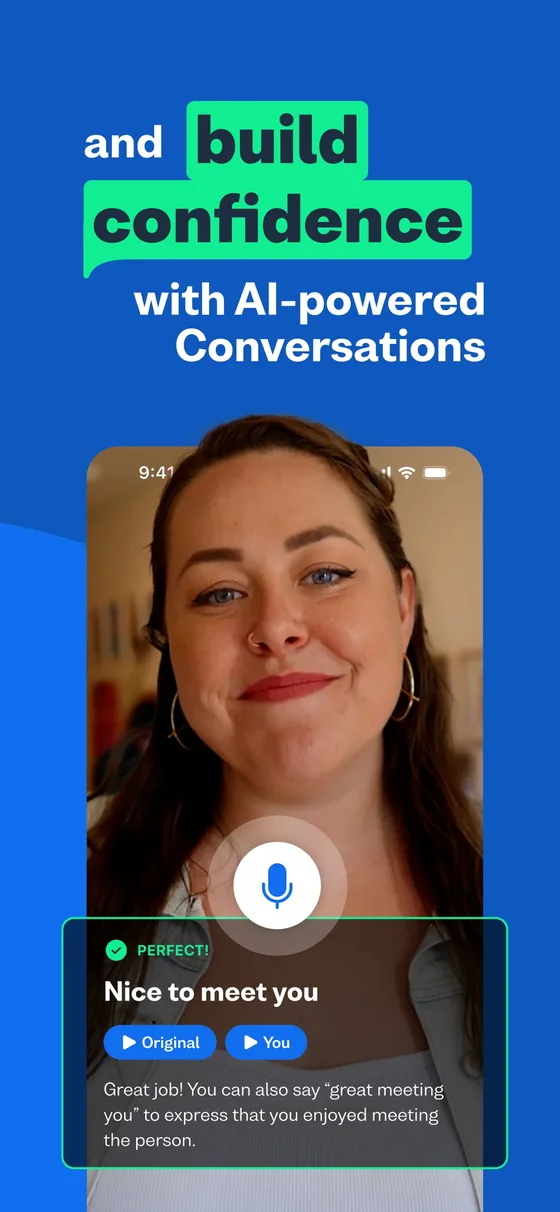
None of Busuu's 16 App Store and Google Play images shows a Chinese lesson. The lessons in them are in Spanish, French and English.
For a Chinese learner, what's left in Premium Plus is streak protection, plus study plans and "exclusive content" for courses Busuu doesn't name. Before you upgrade, check the app's Speak tab and your lesson list while you're learning Chinese. If conversations aren't there, they haven't reached Chinese yet.
Speaking means recording yourself for other learners
Busuu's Chinese course does ask you to speak. At the end of a lesson, you can record an answer and send it to the community. Busuu's help centre also mentions speech-recognition exercises, without saying which courses have them or how they mark you.
What Busuu doesn't list for Chinese is automatic feedback on how you sounded. Busuu's speaking practice marks mispronounced words in red only in English, Spanish, French and German. Its more detailed feedback is in English and Spanish only.
Here's what that practice looks like, in Busuu's French course:
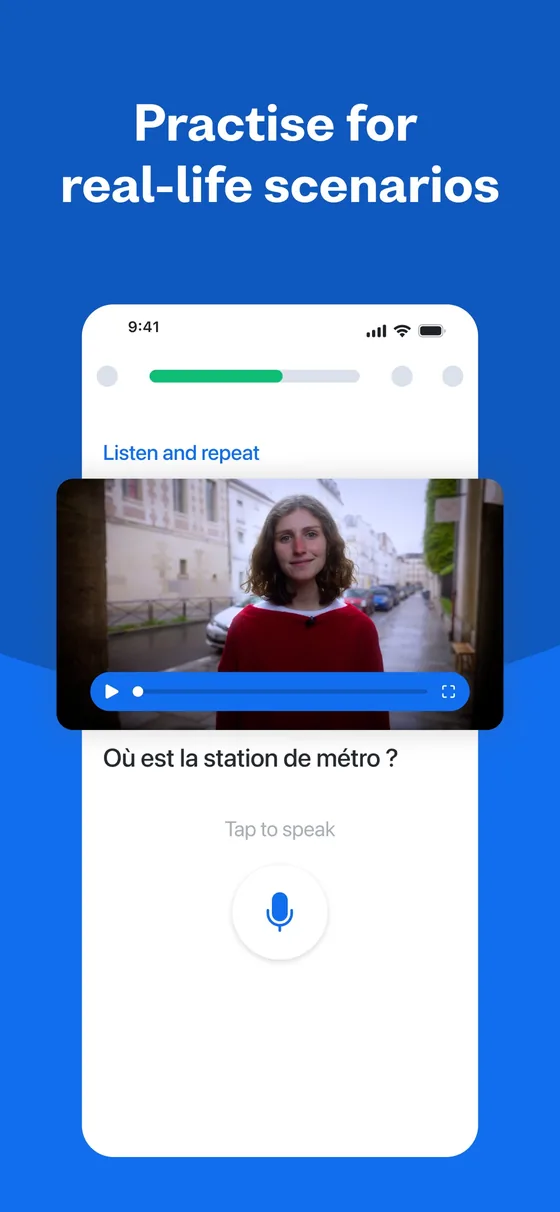
In Chinese, that gap matters more than in most languages. A wrong tone can change the word. To buy, 买, and to sell, 卖, differ only in pitch. So the feedback that matters most is the kind Busuu doesn't list for Chinese.
Machines find pitch hard, too. A review of 15 studies of English learners found that speech-recognition practice improved learners' individual sounds a lot, but their rhythm and pitch only a little. So even a tool that marks words in red might miss a tone.
Busuu does teach tones. A beginner on Australia's App Store noted that the course introduces all four early, and Busuu's Chinese page promises videos of native speakers to copy. Checking your own tones is the part Busuu leaves to the community.
The community can fill part of the gap. A native speaker who hears your recording can tell you a tone was off. But you wait for a volunteer, and you can't ask them to drill the same pair with you.
We'd use Busuu's recordings as a check now and then, and train your tones elsewhere. Our guide to learning tones shows how to train your ear and your voice.
The community is the best reason to use Busuu
Busuu's community is the feature that sets it apart from other course apps. You write or record an answer, and people who speak Chinese correct it. That works on every plan, including the free one.
Here's how it works, from Busuu's help pages:
- You post from the end of a lesson, typing your answer or recording it, or you pick an exercise in the Community tab.
- Speakers of the language correct it. They edit your text, with changes shown in green, and add a comment.
- An exercise usually stays open until it gets at least five corrections or reaches enough learners. A Correction Bot may answer while you wait.
- You thank the best one. You can reply, give a thumbs up or down, and award a Best Correction.
Busuu's own App Store image shows the Community tab:
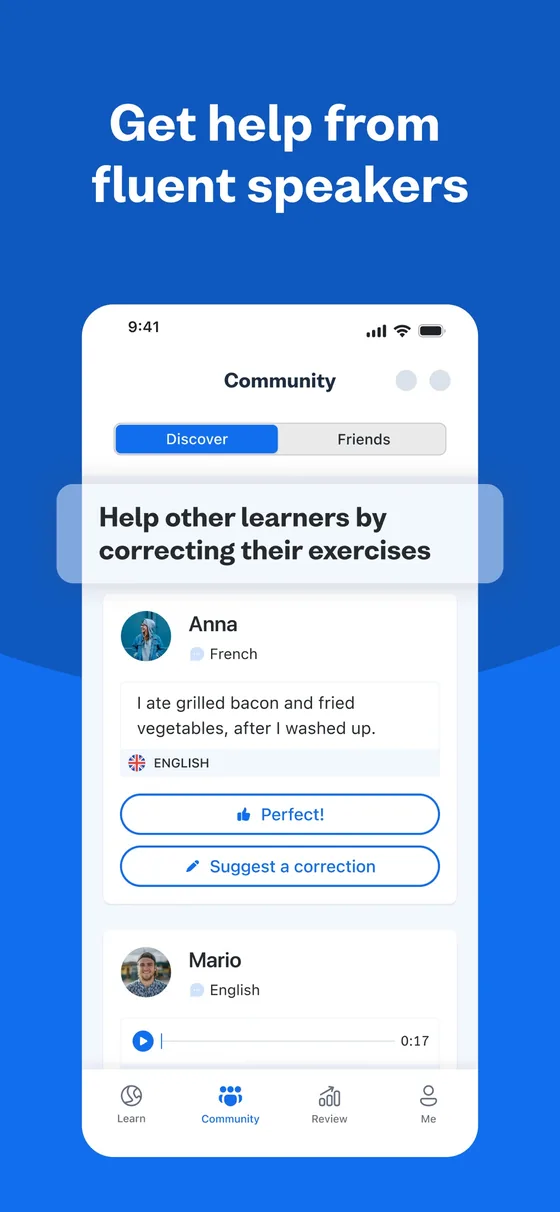
Here's the kind of slip a native speaker catches and a multiple-choice quiz can't. A beginner writes 我吃饭在饭馆, putting the place after the verb, the English way. The correction, "I eat at a restaurant", is 我在饭馆吃饭, with the place before the verb.
Learners rate this part highly. Seven of the 58 recent store reviews we coded praise it, and in September a learner on the US App Store liked that "actual native speakers can correct you".
Two caveats. Correctors are volunteers, so quality and speed vary. And Busuu's help centre says every exercise you post is public, so keep personal details out of it.
We'd use it after every lesson, even on the free plan. It's the part of Busuu most worth your time.
Learners say the course thins out after A1
Busuu is popular. In November 2026 it averaged 4.7 stars from about 101,000 ratings on the US App Store.
On Google Play it averaged 4.6 stars from 1.25 million ratings. Those ratings cover all of Busuu's languages, though: fewer than one in a hundred of the newest reviews there mention Chinese.
In the 500 latest US App Store reviews we read, one in seven mentions Duolingo, and nine in ten of those give Busuu four or five stars.
So we searched the latest reviews from nine English-speaking App Stores and from Google Play in the US for ones about learning Chinese on Busuu. Since January 2025 we found 58, and here's what they say:
Source: our coding of App Store reviews from Apple's public feed for nine countries and the 6,000 newest US Google Play reviews, read 5 November 2026. Method below.
Much of the praise is from beginners, and it's real. They like the clear explanations and the cultural notes. They like hearing male and female native voices, and the way each lesson breaks a sentence down. Several had switched from Duolingo and preferred Busuu.
The complaints come later. Six of the 16 critical reviews say the course falls apart after A1, and so does one four-star review.
In October 2025, a learner on the UK App Store who paid for a year to reach A2 titled their review "For mandarin learners - look elsewhere".
In May 2026, a learner on Google Play in the US put it more bluntly: "The A1 course is great, you actually learn things. A2 is gibberish."
Reddit threads say the same. A post on r/ChineseLanguage titled "Busuu Chinese Warning" praised the first level, then said that from A2 on, dozens of new words arrive with no grammar or context. A commenter this summer advised stopping after A1.
Learners have also caught mistakes in the course. One found the display stand 展台 taught as "to stand"; to stand up is 站起来.
Another, learning through Spanish, asked about "it", 它, which a lesson called the pronoun for non-binary people. Commenters replied that the word is for animals and things, and impolite for a person. We couldn't check either lesson ourselves.
We found no research on the Chinese course to weigh against this. Busuu's best-known claim, that 22 hours of Premium equal a college semester, comes from a 2016 study of learners of Spanish.
Budget for A1 on Busuu, then switch tools or add one.
Certificates stop at A1 for Chinese
Busuu gives a certificate when you pass a level's completion test, on Premium or Premium Plus. For Chinese, its two main pages disagree about how far that goes.
Busuu's help centre, updated in November, lists Chinese certificates for A1 only. Busuu's Chinese course page says its Chinese certificates run from A1 to B2.
Other courses go further. Japanese certificates reach B1, and Spanish ones C1.
We'd go by the help centre, which lists every course's certificate levels. Either way, the certificate shows your name, your CEFR level, your grade, the date and a summary of the skills you showed. If you fail the test, you can retake it after 14 days.
It's Busuu's own certificate, not an exam result. If a university, a scholarship or an employer asks for proof of Chinese, they'll usually want an exam result, such as the HSK. Our HSK exam guide explains the new levels, dates and fees.
Premium is the only plan worth buying for Chinese
Busuu has three plans. For a Chinese learner, Premium buys most of what's useful, and Premium Plus adds little. Here's what each adds, at the US prices on Busuu's website:
Free
- What it adds for Chinese learners
- The whole course, with an ad before each lesson, and community corrections
- US price on busuu.com
- $0
Premium
- What it adds for Chinese learners
- No ads, Vocabulary Review, offline lessons, skipping ahead, an A1 certificate
- US price on busuu.com
- $12.49 a month or $72.99 a year
Premium Plus
- What it adds for Chinese learners
- Premium, plus streak protection; its speaking tools skip Chinese
- US price on busuu.com
- $14.90 a month or $87.90 a year
Source: Busuu's pricing page and the price lists it loads, and Busuu's plan comparison, checked 5 November 2026.
If you'll stay a while, pay for the year. Here's what each plan costs a month, by how you pay:
Source: busuu.com/products, US. The yearly rows are $72.99 and $87.90 divided by 12.
Your price may differ: Busuu appears to be testing Premium Plus prices. Its pricing page also loads a second US list, with Premium Plus at $16.99 a month and $100.99 a year. Premium is the same on both.
Here's what a year on Busuu's website costs in four countries:
| Country | Premium, a year | Premium Plus, a year |
|---|---|---|
| United States | $72.99 | $87.90 |
| United Kingdom | £49.99 | £58.99 |
| Canada | C$118.99 | C$142.99 |
| Australia | A$129.99 | A$159.99 |
Source: the price lists busuu.com loads for each country, 5 November 2026.
The app stores charge differently. Busuu's US App Store list shows a year's subscription anywhere from $70.00 to $139.99, under names that don't always say which plan.
Its monthly items on the App Store run from $6.99 to $23.49.
Google Play lists items up to $169.99. The price your app shows you at checkout is the one that counts.
Older reviews quote older prices. Four of the top results we read for "busuu review" still give the 2021–2023 price of $83.40 a year. None of the reviews we read said that Premium Plus's speaking tools skip Chinese.
Before you pay, know the terms:
- Free has limits. You watch an ad before each lesson, unlock lessons in order, and get no review tools or offline lessons.
- Trials depend on where you buy. Busuu's website price lists carry no free trial. The US App Store lists a "14 Day Trial - Premium Plus" item.
- Refunds are narrow. Busuu offers a 14-day money-back guarantee on your first payment only, not on renewals. If you paid through Apple, ask Apple.
- Cancel where you paid, at least a day before renewal. On Android you can't move from Premium Plus down to Premium; you can only cancel.
- There's no lifetime or family plan. Busuu's price lists offer one month or one year, and its help centre says accounts are for one person.
Low-star reviews complain about ads more than about billing. Among the US App Store's one- and two-star reviews since July, nearly a third mention ads, and about a fifth billing, cancelling or refunds. Those reviews cover every language.
Our advice: start free for a few weeks, and buy a year of Premium only if you're still using it. Compare the price in the app with the website's before you pay.
How to get the most from Busuu's free plan
The free plan is the best way to use Busuu for Chinese. It holds the whole course, and the community costs nothing. Here's how we'd use it, drawing on Busuu's own help pages:
- Speak your end-of-lesson answer. Record it rather than typing it, so the person correcting you can hear your tones.
- Add Chinese-speaking friends. Busuu's help pages suggest friends who speak Chinese and are learning English, so you can notify them when you post.
- Correct English learners in return. It's the trade the community runs on, and it's how you'll find those friends.
- Skip what you know with checkpoints. On the free plan, passing a chapter's checkpoint unlocks its lessons, so you don't have to crawl through greetings you already know.
- Keep your own word list. Vocabulary Review is Premium, so save new words in a flashcard app as you go.
- Decide at the end of A1. That's where learners say the course changes, so it's the natural point to add a second tool or move on.
The ads are the price of all this. Busuu shows one before each lesson, and several store reviewers say they're hard to close. If they drive you away, a year of Premium removes them.
Busuu or Duolingo for Chinese?
They suit different beginners. Busuu explains more and puts real people on your mistakes. Duolingo is free from start to finish and, by our count, about 6,000 words deep. HelloChinese, a third option, is built for Chinese alone.
Here's how the three compare for a Chinese learner:
Course size
- Busuu
- 210+ lessons, A1 to B2 claimed
- Duolingo
- About 6,000 words, by our count
- HelloChinese
- 2,500+ words
Speaking in Chinese
- Busuu
- Recordings for the community to correct
- Duolingo
- Read-aloud lines you can skip; no tone drill we found
- HelloChinese
- Set lines, each character marked right or wrong
Native-speaker corrections
- Busuu
- Yes, free
- Duolingo
- No
- HelloChinese
- No
Pinyin and characters
- Busuu
- Simplified; learners say pinyin is on almost everything
- Duolingo
- Pinyin over new words only, if you choose
- HelloChinese
- Simplified or Traditional, with handwriting
A year, US
- Busuu
- $72.99 for Premium on the website
- Duolingo
- Free; Super Duolingo is optional
- HelloChinese
- $69.99 for Premium
Sources: Busuu's pages and US price list; our reviews of Duolingo for Chinese and HelloChinese; the US App Store, 5 November 2026.
Pick Busuu if you want people to check your sentences, and Duolingo if you want a free daily habit. Pick HelloChinese if you want an app built for Chinese alone, with handwriting and graded stories. Whichever you choose, add speaking practice that answers back.
Who should use Busuu for Chinese, and who shouldn't
We'd pick Busuu if:
- You're starting from zero. The A1 lessons are short, clear and well liked.
- You want people to check your Chinese. Community corrections are free, and rare in a course app.
- You're learning another language too. One account covers 14 courses.
- You study on more than one device. Busuu runs on iPhone, Android and in a web browser, and keeps your progress in step.
- You want to start free. The whole course is open on the free plan, ads included.
We'd skip it, or pair it with something else, if:
- You're past beginner level. Learners say A2 and above rush you.
- You want to practise talking. Its AI conversations and pronunciation feedback don't cover Chinese.
- You're preparing for the HSK. The course follows the CEFR and stops certifying at A1.
- You want Traditional characters. Busuu teaches Simplified; our Simplified vs Traditional guide helps you choose.
The best alternatives for each goal
If Busuu isn't the right fit, here's what we'd pick for each goal:
A longer Chinese-only course
- Pick
 HelloChinese
- Price
- $11.99 a month or $69.99 a year
- Why
- A course past the new HSK 4 list, with handwriting and graded stories
A course that scores what you say
- Pick
 SuperChinese
- Price
- $11.99 a month or $59.99 a year
- Why
- Speaking checked on every line, to about HSK 5
A free daily habit
- Pick
 Duolingo
- Price
- Free
- Why
- The whole course is free, though light on tones
Native speakers to chat with
- Pick
 HelloTalk
- Price
- Free, or VIP at $12.99 a month
- Why
- A language exchange: you help with English, they help with Chinese
Spoken practice that answers back
- Pick
 SayMei
- Price
- $5.99 a month for 200 minutes
- Why
- Mei Lin replies and corrects your tones
A human ear for your tones
- Pick
 An italki tutor
- Price
- About $20 an hour
- Why
- The median of 783 Chinese teachers we read
Source: each app's US App Store listing, 5 November 2026; SayMei's pricing page; italki from our tutors guide.
For a closer look at the two Chinese course apps, read our HelloChinese review and SuperChinese review. If Duolingo is your other option, read Is Duolingo good for Chinese?
Where SayMei fits, and where it doesn't
SayMei is built for the part Busuu leaves out in Chinese: talking out loud and getting feedback straight away. In a lesson, Mei Lin, your AI teacher, asks you questions out loud, waits for your answer and corrects your tones and grammar as you go.
SayMei Premium is $5.99 a month for 200 minutes with her, plus unlimited flashcard reviews. Our HSK workbooks are free with a SayMei account.
We'll be plain about where SayMei loses to Busuu:
- No human corrections. Busuu's community puts real native speakers on your sentences, and SayMei has nothing like it.
- No app. SayMei runs in a web browser, with no offline lessons.
- No certificate. SayMei gives no certificate of any kind.
- One language. Busuu covers 14, so it suits you better if you're learning two.
Many learners would do best with both: Busuu's free A1 course and community for structure, and someone to talk to every day.
What to do next
- Start on the free plan. A few weeks of A1 will show you whether Busuu's style suits you.
- Post an exercise after every lesson. Corrections from native speakers are the most useful thing Busuu gives you.
- Skip Premium Plus. Its speaking tools don't cover Chinese, so the extra buys you little.
- Plan your move after A1. Line up a longer course or a reader before the jump to A2.
- Train your tones somewhere that answers back. Repeating words into a recorder won't tell you which tone you said.
If you want a longer Chinese course, start with our HelloChinese review.
FAQ
Is Busuu free for learning Chinese?
Mostly. The free plan opens the whole Complete Chinese course, but you watch a brief ad before each lesson, unlock lessons in order and get no review tools or offline lessons.
Community corrections are free on every plan. Premium, which removes the ads, costs $12.49 a month or $72.99 a year on Busuu's US website.
Is Busuu Premium Plus worth it for Chinese?
Not for Chinese, as of November 2026. Premium Plus is sold on AI Conversations, pronunciation feedback and Mistake Repair, and Busuu's help centre lists none of them for the Chinese course.
That leaves streak protection, plus study plans and extra courses Busuu doesn't list by language. Premium, at $72.99 a year on the US website, covers what Chinese learners use.
Does Busuu give a certificate for Chinese?
Yes, but only at A1, according to Busuu's help centre. Busuu's Chinese course page says its Chinese certificates run from A1 to B2, so its pages disagree.
You need Premium or Premium Plus, and you earn it by passing a level test. It's Busuu's own certificate, so for university or work you'd take an exam such as the HSK instead.
Is Busuu better than Duolingo for Chinese?
For beginners who want explanations and native speakers checking their work, often yes. Nine of the 58 Chinese store reviews we coded compare the two, and eight of them say Busuu is better.
Duolingo's Chinese course is free, though, and by our count about 6,000 words deep. It also lets you show pinyin over new words only. Neither app trains your tones well.
Does Busuu teach Chinese characters?
Yes. Busuu teaches Simplified characters, and it has a separate Chinese Characters course next to Complete Chinese.
Learners say pinyin appears on almost everything, though, and several can't find a way to hide it or want more teaching of the characters. For handwriting and reading practice, you'd add a dedicated characters app or workbook.
What HSK level does Busuu's Chinese course reach?
Busuu doesn't say. It maps the course to the European CEFR scale, A1 to B2, and publishes no word list we could compare with the HSK.
By the size teachers expect at each CEFR level, B2 would mean roughly the new HSK 6 list. Learners say the course thins out after A1, well before that.
Can you learn Traditional Chinese or Cantonese on Busuu?
No. Busuu's Chinese course teaches Mandarin in Simplified characters, the standard in mainland China, and we found no Traditional or Cantonese option.
If you'll live in Taiwan, choose an app that teaches Traditional characters; HelloChinese, for example, teaches both scripts. For Hong Kong, our Mandarin vs Cantonese guide helps you decide which to learn.
Does Busuu have a lifetime plan?
No. Busuu's price lists offer monthly and yearly plans only, and its help centre says there's no family plan either.
Over time, a yearly plan is the cheaper way to pay: Premium costs $72.99 a year on Busuu's US website and £49.99 in the UK. App Store and Google Play prices can differ.
Sources
Checked 5 November 2026 unless noted. No accounts were created and nothing was bought.
Busuu
- Learn Mandarin Chinese online, Busuu's Chinese course page: courses, lesson count, levels, its answers on HSK, certificates and Simplified characters
- Busuu's course pages for Japanese and its other 12 languages: lesson counts
- How our language courses work: what each level means
- Busuu Premium pricing and the price lists it loads for the US, UK, Canada and Australia
- Busuu help centre: What is Premium?; How many languages can I learn?; Certificates; Retaking the level test; Busuu Conversations; Speaking practice; Mistake Repair; Grammar Review; Vocabulary Review; Placement Test; Learning for free; Changing levels; Sending exercises to the Community; Correcting others; Refunds; Cancelling; Upgrading and downgrading; Family plans; Live Lessons
- Busuu's terms: renewal, cancellation and the 14-day right
- About Busuu: owned by Chegg since January 2022
- Busuu's 2016 study: 144 learners of Spanish
- Busuu on the App Store: rating, purchases, version history and listing images
- Busuu on Google Play: rating, downloads, purchases and listing images
Learners
- App Store reviews from Apple's public feed for the US, UK, Canada, Australia, New Zealand, Ireland, Singapore, India and the Philippines, and the 6,000 newest US Google Play reviews
- r/ChineseLanguage: Busuu Chinese Warning (September 2024); 展台 as "to stand" (July 2023); 它 as a pronoun (November 2024); a beginner's thread (comment, July 2026); Is Busuu worth it? (July 2020)
Other apps
- HelloChinese, SuperChinese, Duolingo and HelloTalk on the US App Store
- SayMei: pricing
- italki's median tutor price: online Chinese tutors compared (October 2026)
Other reviews
- Older reviews of the Chinese course: All Language Resources (2017, reposted on r/ChineseLanguage), Flexi Classes (2020, updated 2023) and FluentU (2023, updated June 2025): unit counts, videos and the pinyin switch
- Reviews still quoting $83.40 a year: Langoly (2021), SmarterLanguage (2023), Learnopoly (undated) and FluentU
Research
- Ngo, T. T.-N., Chen, H. H.-J. & Lai, K. K.-W. (2024). The effectiveness of automatic speech recognition in ESL/EFL pronunciation: a meta-analysis. ReCALL 36(1). doi:10.1017/s0958344023000113
HSK and CEFR
- The 2025 HSK syllabus and the Fachverband Chinesisch's 2010 statement, as set out in our HSK 3.0 guide
Methods
We read Busuu's Chinese course page, its course pages for all 14 languages, its pricing page and the price lists it loads, its terms and all 99 articles in its English help centre on 5 November 2026. We didn't subscribe, sign in or take lessons, so a feature is either what Busuu says or what learners report, and we say which.
- Features by course come from Busuu's help articles, which name the courses each tool covers, and from the settings Busuu's website loads for visitors. Where Busuu's pages disagree, as on certificates, we say so.
- Lesson counts are the figures on each course page, which also names the levels they cover; the chart shows every course whose page says A1 to B2. Lessons may differ in length between courses.
- Prices are from Busuu's US, UK, Canadian and Australian price lists for its website, and the US App Store and Google Play listings. The pricing page loads two lists, and its settings name a Premium Plus price experiment; our tables use the list it showed us. Sales and other countries can differ.
- The review count covers 3,036 App Store reviews from nine countries and the 6,000 newest US Google Play reviews. We read every 2025–2026 review that mentions Chinese, Mandarin, pinyin, hanzi or the HSK: 64 in all. We set aside 6 that weren't about learning Chinese, and coded the other 58 by hand; one review can carry several themes. Apple's feed gives each country's latest 500 reviews at most, so the sample reaches back further in some countries than others: in the US, only to July 2026.
- The US review figures for Duolingo, ads and billing come from keyword searches of the 500 most recent US App Store reviews, all languages, checked by hand.
- Reddit blocks automated readers, so we read its threads through the public Arctic Shift archive.
- The HSK table compares list sizes using the teachers' yardstick, and isn't an official equivalence.
- The screenshots are Busuu's own App Store images, shown unedited for review.
- The Mandarin examples were checked against the CC-CEDICT dictionary.
If you spot a mistake, tell us: we fix errors.