Lingopie review: is it good for learning Chinese?
Our Lingopie review for Mandarin learners: its Chinese shows and subtitles, the pinyin and speaking gaps, prices since 2021 and 420 App Store reviews.


Lingopie's Chinese page promises "countless titles" from China. It never says how many, and its help centre adds a catch: Chinese comes in Simplified characters only.
This review is for you if you're learning Mandarin and wondering whether Lingopie is worth a trial, a year or a lifetime plan. We checked its website, help centre, pricing and store listings on 6 November 2026, and read all 420 written reviews in Apple's US feed.
Key takeaways
- It's built for listening. Two subtitle lines, a tap-to-translate dictionary and slowed playback help you follow real Chinese at your own pace.
- Real shows assume an intermediate level. By our count of their subtitles, modern Chinese series turn watchable around HSK 3.
- The Chinese catalog is a black box. Lingopie doesn't publish how many Chinese titles it has, and its biggest libraries are European.
- Chinese gets fewer extras. There are no Traditional characters and no private lessons, and reviewers say the phone app lacks pinyin.
- Billing is the top complaint. A third of the past year's written App Store reviews describe a trial, renewal or refund problem.
- Pay yearly if you stay. The yearly plan works out at $6.99 a month, half the quarterly price, and covers every language.
Good for listening, weak for beginners and speaking
Lingopie does one job well: it turns real Chinese TV into listening practice you can follow. We read its help centre, blog, pricing page and store listings, then scored each part against what a Mandarin learner needs:
What you need · Verdict · What Lingopie gives you
Real Chinese to listen to
Strong
Dramas, films and shorts from China, with Chinese and English subtitles
Help following each line
Strong
Tap a word for its meaning, loop a line, slow it to 0.65x
Remembering new words
Strong
Video flashcards with spaced repetition, quizzes and games
Shows at your level
Partly
Beginner, intermediate and advanced filters, but no HSK levels
Pinyin and characters
Partly
Simplified only; reviewers say the phone app lacks pinyin
Speaking practice
Partly
Say It scores lines you repeat; group classes cost extra
A course from zero
Missing
None: you choose the shows yourself
Source: Lingopie's help centre, blog and pricing page, its US App Store listing and Apple's public reviews, checked 6 November 2026.
If you can already follow simple Chinese, that's a strong kit for listening. If you're starting out, the gaps sit exactly where beginners need help: levels, pinyin and a path to follow.
How many Chinese shows does Lingopie have?
Lingopie doesn't say. Its Chinese page promises "countless titles" from China and other Chinese-speaking regions. Its plans list 5,000+ shows and films, but that's across all 17 languages.
Lingopie's own guide says Spanish, French and Italian have the biggest libraries. Chinese isn't one of them. When a learner asked in r/Lingopie what Chinese content there is, we found no reply.
What we can see is what Lingopie names. Its 2026 blog posts list eight Chinese dramas as available, among them You Are My Glory and Are You Safe? None of the six it describes is a palace or martial-arts epic, which matters for your level, as the next section shows.
Here's what a Chinese learner gets across Lingopie's products:
Main catalog: web, phones, TV
- Chinese?
- Yes
- What you get
- Dramas, films and shorts; count not published
Lingopie Kids
- Chinese?
- Yes
- What you get
- Children's shows in a separate section
Chrome extension
- Chinese?
- Yes
- What you get
- Its tools on select Netflix and Disney+ titles you pay for
DramaRizz, an iPhone app
- Chinese?
- Yes
- What you get
- 20 micro-dramas in 1,562 one-minute episodes
Live group classes
- Chinese?
- Yes
- What you get
- First class free, then a monthly or quarterly fee
Private lessons
- Chinese?
- No
- What you get
- Six other languages only
Music, news and short stories
- Chinese?
- Not listed
- What you get
- Lingopie's guide names other languages
Source: Lingopie's help centre on Kids, group classes, private lessons and DramaRizz; its platform guide of January 2026 and extension page; our count of DramaRizz's website, 6 November 2026.
So Chinese gets the core of Lingopie: shows, subtitles and flashcards. Most of the extras built for the big European languages haven't reached it yet.
If songs are how you like to learn, Lingopie's music section is one of those extras. Its guide lists eight languages for it, and Chinese isn't among them.
Real dramas assume you know 1,000 words
Real Chinese TV is hard below an intermediate level, whatever app you watch it in. Lingopie says as much: its guide says it works best once you know basic pronunciation and "a few hundred common words".
For Chinese, our own count says you need more. For our Chinese dramas guide, we measured the dialogue of 40 modern mainland series and 50 costume films against the new HSK word lists.
Modern series turn watchable at HSK 3, when you know the first 1,000 words. Costume films, full of court titles and idioms, need about two levels more.
Here's the share of words you'd know in a typical title, by the HSK level you've learned:
Modern series turn watchable at HSK 3; costume films at HSK 5
Median share of running words you'd know, by the new HSK levels learned
- 80% watchable, 95% comfortable
| Your level | Costume films | Modern TV series |
|---|---|---|
| HSK 1 | 53.5% | 61.0% |
| HSK 2 | 63.7% | 72.0% |
| HSK 3 | 71.0% | 81.0% |
| HSK 4 | 78.6% | 88.1% |
| HSK 5 | 82.8% | 92.1% |
| HSK 6 | 87.2% | 94.9% |
| HSK 7–9 | 92.9% | 97.8% |
Source: our count of the CPED research dialogue for 40 modern series and of OpenSubtitles files for 50 costume films, published in our dramas guide on 11 October 2026. In a 2024 study, viewers understood a video well enough once they knew about 80% of its words.
Below HSK 3, even an easy modern drama leaves you guessing at about one word in four. Subtitles and slow speeds carry you, and progress feels slow.
That's what one learner found. A year into Mandarin, they started a Lingopie trial, set it to beginner and wrote in r/ChineseLanguage in February 2025 that they "hardly understood a thing". Slowing it down, they said, blurred the speech.
Lingopie added a Beginner Zone to its apps in October 2026. We couldn't see inside it without an account, so we can't say how easy it starts.
The tools help you follow every line
Lingopie's player is where it earns its price. You watch with Chinese and English subtitles together, tap any word for its meaning, and save it with the scene it came from.
Here's the player in Lingopie's own App Store image. The shows in its listing's images are all Spanish; none is Chinese:
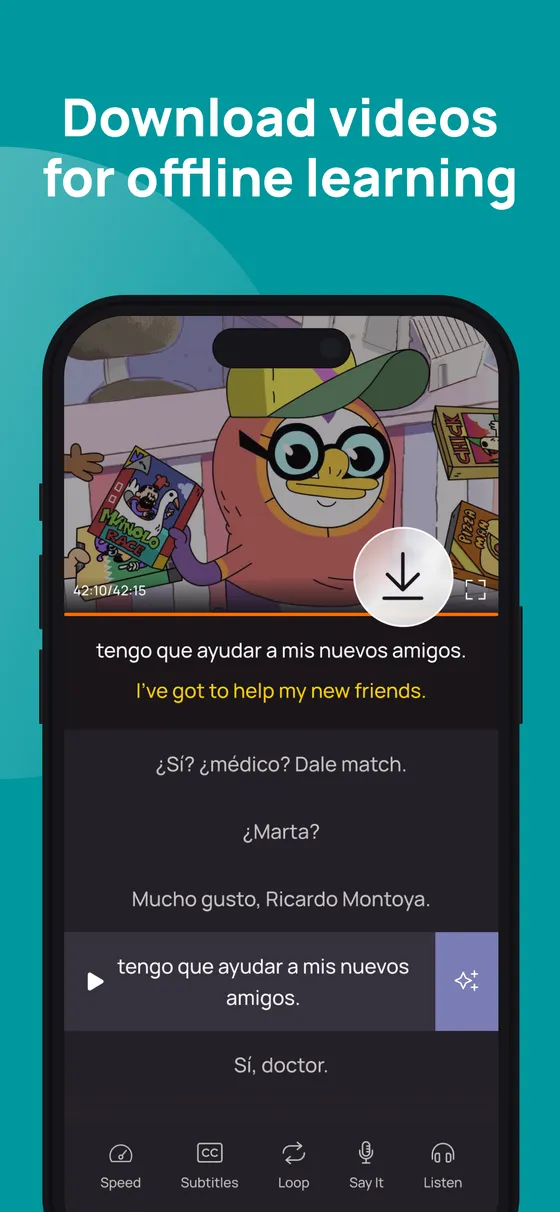
The buttons under each video do the heavy lifting:
- Speed. Four settings, from 0.65x to full speed. A beginner account starts slowed, so a 45-minute episode takes about 69 minutes.
- Loop. One line plays again and again until you catch it.
- Transcript. The whole script scrolls with the video, so you can read ahead or back.
- Flashcards. Saved words come back with their clip, on a spaced-repetition schedule since April 2025.
- Games. Word Master, Pop Quiz and Sentence Wizard reuse the lines you saved.
There's grammar help too. Lingopie says its Grammar Coach is AI-driven and checked by its language team, and its Grammar Index colours each word by part of speech. It doesn't colour tones, which one Chinese learner asked for in October.
You can watch on the web, on iPhone and Android, and on Google TV, Fire TV, Roku and Apple TV. The phone app can download episodes, though one reviewer said in August that it wouldn't open offline.
Used actively, these tools turn a drama into a lesson. Watched passively, Lingopie is a smaller Netflix with better subtitles.
Simplified only, and pinyin is patchy
Lingopie's help centre is plain about the script: it offers Simplified Chinese only. If you're learning Traditional characters for Taiwan or Hong Kong, that rules it out.
One App Store reviewer looked for a switch to Traditional in 2024 and found none. There's no Cantonese either: Lingopie's Chinese is Mandarin.
Pinyin is murkier. Lingopie's roundup of Chinese apps lists pinyin among its own subtitle settings. Chinese learners on the App Store tell a different story, and they've told it for nearly two years.
In January 2025, one said the app shows no pinyin at all. In October 2025, another said the app's flashcards lack it while the desktop's have it. And in October 2026, a five-star reviewer added: "Waiting for pinyin support but otherwise this app is great."
We couldn't see the player without an account, so we can't settle it. If you rely on pinyin, open the subtitle menu on day one of the trial.
Tap-to-translate has a second weak spot in Chinese: one word alone can mislead. Take a line you'll hear in plenty of dramas:
- 你到底想怎么样? Nǐ dàodǐ xiǎng zěnmeyàng? What on earth do you want?
Tap 到底 on its own, and a dictionary offers "finally" or "in the end". In this line it means "on earth", so read the line's translation, not just the word's.
Lingopie says native speakers check its subtitles. Still, 11 of the past year's 107 written App Store reviews complained of translation errors, in several languages.
Speaking is an add-on
Lingopie is built for listening, and its speaking tool is small. Say It plays a line, records you saying it and gives you a score.
For Chinese, the reports aren't good. Two App Store reviewers, one a fluent speaker, wrote in December 2024 and January 2025 that Say It scored their Chinese zero on every line. The first put it simply: "It doesn't work for Chinese. It continues to return 0/100 for every word and phrase."
Lingopie's guide admits Say It is "not perfect", and we found no later report on Chinese either way. We found nothing on its pages that says it checks tones.
For real conversation, Lingopie runs live group classes in Chinese. Your first class is free; after that you pay monthly or quarterly, at a price its public pages don't show.
The classes suit learners at A2 to B1, Lingopie says, and you can't join if you pay through Apple or Google. Private lessons aren't offered in Chinese at all.
If speaking is your goal, treat Lingopie as input, and get your speaking practice somewhere that answers back.
DramaRizz adds Chinese micro-dramas, sold separately
In August 2026 Lingopie launched DramaRizz, an iPhone app of vertical micro-dramas, 短剧. These are soap operas told in episodes about a minute long.
Its website lists 20 Chinese shows with 1,562 episodes between them, with titles such as From Rags to Rank One and Stop Faking It, My Lord! The first ten episodes of every show are free, and so is tapping a word for its meaning.
After that, it's $14.99 a month or $59.99 a year on the App Store. DramaRizz has its own account and subscription, so a Lingopie plan doesn't cover it.
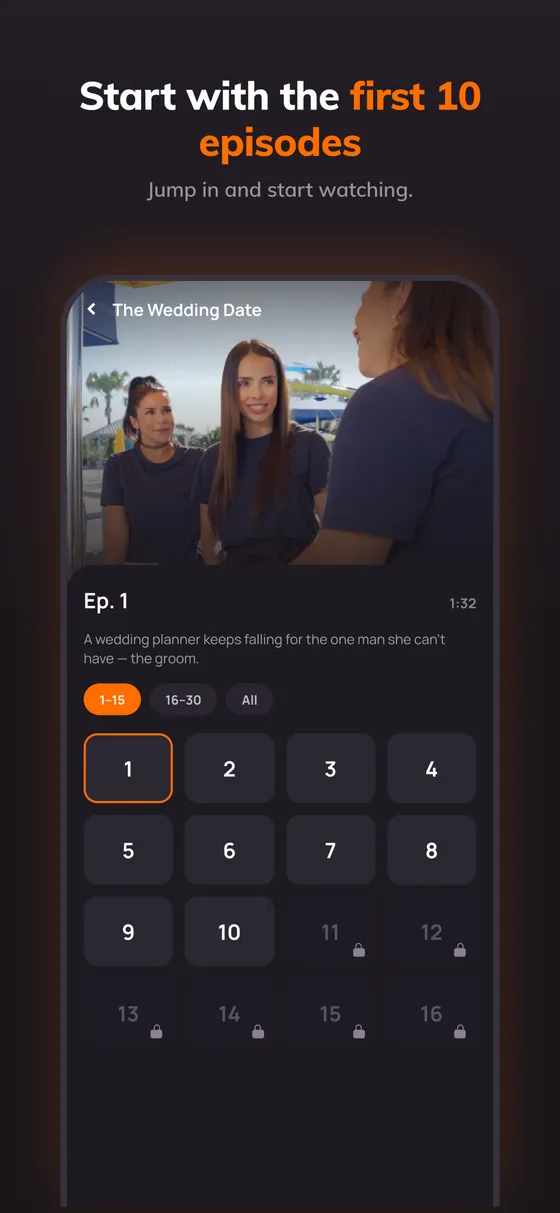
For a Chinese learner, the short episodes are a real plus: you can replay one in a minute. The catch is level again. Micro-dramas are written for native viewers, and several of these are set at court, the setting our count found hardest.
Stars are high; written reviews split
Lingopie's ratings look healthy in every store. Here's where they stood on 6 November:
| Where | Rating | Ratings | Note |
|---|---|---|---|
| App Store, US | 4.4 | 2,200 | Listed since February 2021 |
| Google Play | 4.4 | 6,836 | 500K+ downloads |
| Trustpilot | 4.6 | 3,881 | Lingopie invites reviews |
Sources: Lingopie's US App Store and Google Play listings and its Trustpilot profile, read 6 November 2026. Apple's data gives the App Store rating as 4.36, rounded here; Trustpilot's figure is its TrustScore.
The written reviews tell a different story. We read every one in Apple's US feed, 420 since February 2021, and counted the share giving one or two stars each year:
Source: our count of Apple's public review feed for the US, to 1 November 2026.
Unhappy people write more than happy ones, so written reviews run below the stars almost everywhere. What stands out here is how steady it is: roughly half, year after year.
Then we read the past year's 107 reviews and noted what each one raises:
Source: our hand count of all 107 written reviews in Apple's US feed for those dates. A review can raise several themes. Ten more asked for a language or feature, four found it too hard as beginners and two said the free version was too short. How we counted.
Of the 56 one- and two-star reviews, 35 describe a billing, trial or cancellation problem. That's the risk to plan around, and the next section shows how.
Chinese learners are a quiet voice here. Only five of the 420 reviews come from people learning Chinese on Lingopie, and their complaints match what we found: pinyin, speech scoring and no Traditional characters.
On Reddit, Chinese learners rarely discuss it. A December 2025 thread in r/ChineseLanguage asking for opinions drew no replies that we could find.
The trial needs a card, and billing tops the complaints
Every Lingopie plan on the web starts with a 7-day free trial, and every trial needs a card. When it ends, the plan you picked begins and you're charged, unless you cancel first.
The rules are spread across Lingopie's help centre. Here's what matters:
- Cancel on the website. A trial can't be cancelled in the app, and cancelling ends your access at once.
- Expect a hold. Lingopie mentions a small verification charge; several reviewers saw $41 to $45 held or charged at sign-up.
- The app trial is narrower. In the apps, only US users on a yearly plan who pay by card get one. Apple and Google payments don't include a trial.
- Refunds are rare. Lingopie may refund billing errors, or a charge after a cancelled trial, if you email within 14 days. It doesn't refund unused time.
- Lifetime can't be cancelled. It's one payment, so there's nothing to stop later.
- Google Play buyers get a week. Lingopie's terms give a full refund within seven days of your first Google Play payment.
In the billing complaints, the same stories repeat: a charge after a cancelled trial, a renewal with no reminder, a refund refused. Lingopie's renewals are automatic, and its help pages don't promise a reminder email.
If you try it, here's how we'd start:
- Pick the 3-month plan for the trial. A missed cancellation then costs a quarter, not a year.
- Set a reminder two days before the trial ends.
- Cancel at lingopie.com, under Settings and Plan, and screenshot the confirmation.
- Check your card a few days later for holds or charges.
A year costs $83.88, whatever the banner says
Lingopie's pricing page carries a sale banner, and the prices under it don't seem to move. Here's what it showed on 6 November:

Those prices don't look temporary. StoryLearning found the same three on 19 September, and the App Store has charged $83.99 a year since June 2025.
On 6 November, Lingopie's blog carried a different banner: a Black Friday year for $60. We couldn't find that price on its pricing page that day.
Here's what each plan costs a month in the US:
Source: Lingopie's pricing page and US App Store listing, 6 November 2026. We spread lifetime over three years for comparison; it beats the yearly plan after about 2.7 years. Google Play lists purchases from $1.00 to $83.99.
A few things the table doesn't show:
- The 3-month plan covers one language. The yearly and lifetime plans cover all 17.
- The monthly plan lives only in the apps, and it has no trial.
- The free version is tiny. Lingopie's App Store listing gives you 8 minutes of learning a week on your phone.
- A family add-on covers up to three more people on a yearly plan. Support quotes its price.
- Your library may pay. Lingopie's libraries page says patrons of libraries that subscribe can use it free with their card.
If you'll watch for a year, the yearly plan is the one to buy. Lifetime only pays off if you're still watching in three years.
Prices have risen twice since 2021
Lingopie's App Store prices have gone up twice since 2021. We read eleven copies of its US listing saved by the Internet Archive, plus today's:
The App Store's yearly price went from $64.99 to $83.99
Lingopie's top-listed monthly and yearly subscriptions on the US App Store, in US$
| When | Monthly | Yearly |
|---|---|---|
| October 2021 | 11.99 | 64.99 |
| October 2022 | 11.99 | 71.99 |
| April 2025 | 11.99 | 71.99 |
| June 2025 | 13.99 | 83.99 |
| November 2026 | 13.99 | 83.99 |
Source: Lingopie's US App Store listing, archived on 16 October 2021, 28 October 2022, 24 April 2025 and 16 June 2025, and read live on 6 November 2026. Copies in between show the same prices. The listing still keeps older purchases at $11.99, $71.99, $59.99 and $34.99.
Web prices moved the same way. Reviews from 2021 to 2024 quoted $199 for lifetime access; it's $229 now.
So if a review quotes $12 a month or $72 a year, it's out of date.
What changed in the last 18 months
Lingopie ships often, so older reviews miss things. Its release notes, blog and app listings since April 2025 add up to this:
- Spaced repetition for saved words, April 2025.
- Short Stories on Apple devices, August 2025, though its guide lists them for four European languages.
- Sentence Wizard, a word-order game built from lines you saved, late 2025.
- An Apple TV app, May 2026, next to Google TV, Fire TV and Roku.
- DramaRizz, the micro-drama app, August 2026.
- One-minute news and a Beginner Zone, October 2026.
Only DramaRizz clearly adds Chinese content. The Chinese gaps above were still open in everything we could see: pinyin, Traditional characters and speaking.
Who should use Lingopie
We'd pick Lingopie if:
- You're around HSK 3 or above. You'll follow modern dramas with the subtitles' help.
- You learn by watching. It turns a drama habit into listening practice with flashcards.
- You read Simplified characters. That's the only script it offers.
- You learn more than one language. A yearly plan covers all 17.
We'd skip it, or pair it with something else, if:
- You're a beginner. Build vocabulary with graded stories or a course first.
- You need Traditional characters or Cantonese. Neither is offered.
- Speaking is your goal. Say It and paid group classes are thin practice for Chinese.
- You rely on pinyin. Check the subtitle menu during the trial before you pay.
- You want a course. There's no path from zero; you choose shows yourself.
The best alternatives for each goal
No single app does all of this. If Lingopie isn't the right fit, here's what we'd pick for each goal:
Chinese subtitles on Netflix or YouTube
- Pick
 Language Reactor
- Price
- Free, with paid extras
- Why
- Two subtitle lines and a pop-up dictionary, in Chrome
Free Chinese dramas
- Pick
 Rakuten Viki
- Price
- Free with ads, or from $7.99 a month
- Why
- A big drama library with volunteer subtitles
Stories below HSK 3
- Pick
 SayMei Stories
- Price
- $2.99 a month
- Why
- 169 books read aloud, with pinyin over every word
Graded reading to advanced
- Pick
 Du Chinese
- Price
- $14.99 a month or $119.99 a year
- Why
- Thousands of stories and articles with audio
A course from zero
- Pick
 HelloChinese
- Price
- $11.99 a month or $69.99 a year
- Why
- Pinyin, characters and grammar, step by step
Speaking with tone feedback
- Pick
- SayMei
- Price
- $5.99 a month for 200 minutes
- Why
- Mei Lin talks with you at your HSK level
Sources: the US App Store listings of Viki, Du Chinese and HelloChinese, Language Reactor's Chrome Web Store page and SayMei's pricing page, checked 6 November 2026. What Viki shows free varies by country.
Our Du Chinese review and HelloChinese review go deeper on those two.
Where SayMei fits, and where it doesn't
SayMei is our app, and it's built only for Mandarin. It runs in the browser on any phone or computer. It has no TV shows or films; its listening and reading are graded by HSK level, and its tutor talks with you.
SayMei Stories has 169 graded books, read aloud with pinyin over every character and English for every line, for $2.99 a month. Dialogues gives you 3,500+ short conversations from HSK 1 to 6, and the 175 songs of SayMei Music are free.
SayMei Premium is $5.99 a month: 200 minutes with Mei Lin, your AI teacher, plus every story and unlimited dialogue practice. She talks with you at your HSK level and corrects your tones as you go.
We'll be plain about where it loses to Lingopie:
- No real TV. Lingopie's dramas are what native speakers watch; nothing on SayMei is.
- Less listening time. A drama gives you hours of native-speed Chinese a week, while our dialogues run about a minute each.
- One language. Lingopie's yearly plan covers 17.
- No offline viewing. SayMei needs a connection, while Lingopie's app can download episodes.
SayMei's free week also needs a card, and it also becomes a paid plan unless you cancel. We email you the day before it ends.
If you want real Chinese TV with learning tools, Lingopie does that, and we don't. If you're below HSK 3, or you want to speak, that's where we fit.
What to do next
- Check your level first. Below HSK 3, build words with graded stories before you pay for dramas.
- Start the trial on the 3-month plan. A missed cancellation then costs a quarter, not a year.
- Test the Chinese basics on day one. Look for pinyin in the subtitle menu, and try Say It on a line.
- Cancel on the website, and keep proof. Trials can't be cancelled in the app.
- Ask your library. Some libraries give their patrons Lingopie for free.
To find a drama that fits your level, on Lingopie or anywhere else, use our Chinese dramas guide.
FAQ
Is Lingopie good for learning Chinese?
For listening, yes, once you're around HSK 3. Its dual subtitles, tap-to-translate, slowed playback and video flashcards make real Chinese dramas usable as study material.
It's weaker for beginners and for speaking. The shows assume an intermediate vocabulary, there's no course, and two reviewers reported its speech scoring giving their Chinese zero. Pair it with graded stories or a course if you're new.
Does Lingopie have pinyin?
Lingopie says so: its roundup of Chinese apps lists pinyin among its subtitle settings. Reviewers on the App Store say the phone app doesn't show it, and one said in October 2025 that only the desktop flashcards had it.
We couldn't see the player without an account. If you rely on pinyin, check the subtitle menu on the first day of the trial.
Does Lingopie have Traditional Chinese or Cantonese?
No. Lingopie's help centre says it offers Simplified Chinese only, and its Chinese is Mandarin. Cantonese isn't one of its 17 languages.
A 2025 Lingopie blog post mentions Traditional characters, but the help centre's newer answer says Simplified only. If you're learning for Taiwan or Hong Kong, look elsewhere.
Is Lingopie free?
Not really. On phones, a free preview gives you 8 minutes of learning a week, its App Store listing says. Otherwise there's a 7-day trial that needs a card and becomes a paid plan unless you cancel on the website.
DramaRizz, its micro-drama app, gives away the first ten episodes of each show. Some public libraries also offer Lingopie free to their patrons.
How much does Lingopie cost?
In the US, Lingopie's website charges $41.97 for three months of one language, $83.88 a year or $229 once for lifetime access, checked 6 November 2026. In the apps, a monthly plan costs $13.99 and a year $83.99.
The website shows these prices under a sale banner, and StoryLearning found the same prices in September. Lingopie's blog also advertised a Black Friday year for $60, a price we couldn't find on its pricing page. Prices vary by country.
Is Lingopie legit, or a scam?
It's a real product from Lingopie Inc, on the App Store since 2021, rated 4.4 from 2,200 US ratings and 4.6 on Trustpilot. Plenty of learners like it.
The angriest reviews are about money. In the past year, 35 of 56 one- and two-star App Store reviews describe a billing, trial or cancellation problem. Read the trial rules, and cancel on the website.
How do I cancel Lingopie and get a refund?
Cancel where you paid. Web subscriptions and trials cancel in your account at lingopie.com, under Settings and Plan; trials can't be cancelled in the app. App Store and Google Play subscriptions cancel in your store settings.
Lingopie may refund a billing error if you email support within 14 days, but not unused time. Google Play buyers get a full refund within seven days of the first payment.
Is Lingopie better than Netflix with Language Reactor for Chinese?
They do different jobs. Language Reactor is a Chrome extension that adds two subtitle lines and a pop-up dictionary to Netflix and YouTube, with paid extras; you supply the shows.
Lingopie brings its own Chinese catalog, with flashcards, games and slowed speeds on phones and TVs too. Its own Chrome extension also works on select Netflix and Disney+ titles.
Sources
Checked 6 November 2026 unless noted. We didn't create an account, start a trial or buy anything.
Lingopie
- Learn Chinese page and pricing page: the Chinese pitch, plans and prices
- Help centre: languages (16 October 2026), dialects and scripts, plans, free trial, cancelling a trial, cancelling and refunds, playback speed, language level, group classes, private lessons, Kids, TV apps, DramaRizz and the family plan
- Terms of service (June 2025): refunds and cancellation
- Blog: what is Lingopie (January 2026), is Lingopie worth it, best Chinese TV shows (May 2026), Lingopie languages, best apps to learn Chinese, the grammar feature and the Chrome extension
- Lingopie for Libraries
- Lingopie on the App Store: description, prices, version history, ratings and listing images; Apple's public review feed for the US
- The App Store listing archived by the Internet Archive on 16 October 2021, 28 October 2022, 24 April 2025 and 16 June 2025, with seven more copies from 2023 to July 2026
- Lingopie on Google Play and on Trustpilot
- DramaRizz on the App Store and its website
Learner reports
- Apple's public US review feed: all 420 written reviews, 23 February 2021 to 1 November 2026
- r/ChineseLanguage: listening comprehension feels impossible (February 2025); opinions on Lingopie (December 2025); Lingopie for Chinese, has anyone tried it? (February 2024)
- r/Lingopie: what content is available in Chinese (August 2025)
- StoryLearning's Lingopie review (prices checked 19 September 2026)
Other apps and our guides
- US App Store listings of Viki, Du Chinese and HelloChinese; Language Reactor on the Chrome Web Store
- SayMei: pricing, Stories, Music and Dialogues
- Chinese dramas for learning Chinese (October 2026): words known by HSK level for 40 series and 335 films
Research
- Durbahn, M., Rodgers, M. P. H., Macis, M. & Peters, E. (2024). Lexical coverage in L1 and L2 viewing comprehension. Studies in Second Language Acquisition 46(4), 1045–1068. doi:10.1017/S0272263124000391
Methods
We read Lingopie's website, help centre, terms, blog and store listings on 6 November 2026. We didn't subscribe, sign in or start a trial, so a feature is either what Lingopie says or what learners report, and we say which.
- Prices are US prices from Lingopie's pricing page, opened in a browser, and from the US App Store. Other countries, sales and in-app offers can differ.
- The price history comes from eleven copies of the US App Store listing saved by the Internet Archive, from October 2021 to July 2026. We charted the first monthly and yearly subscriptions each copy lists; the older purchases it keeps are noted under the chart.
- The review count covers every written review in Apple's public US feed for Lingopie: 420, from February 2021 to 1 November 2026. The yearly chart counts them all.
- The theme chart is our reading of the 107 written reviews from 2 November 2025 to 1 November 2026. We gave each review every theme it raised, from a list of ten.
- Chinese learners' reviews were found by searching all 420 for Chinese, Mandarin and pinyin, then reading each match.
- The catalog isn't public. We name only the Chinese titles Lingopie's own 2026 blog posts list as available, and we counted DramaRizz's Chinese shows on its public website.
- The level chart reuses the medians from our dramas guide: the CPED dialogue for 40 modern series and OpenSubtitles files for 50 costume films, scored against the 2025 HSK syllabus.
- Where Lingopie contradicts itself, we follow its help centre and pricing page. A 2025 blog post mentions Traditional characters, one blog table gives every plan all languages, and its Chinese page lists short stories that its platform guide doesn't.
- Reddit threads were read through the Arctic Shift archive of public posts.
- The screenshots are Lingopie's and DramaRizz's own App Store images and Lingopie's pricing page, shown unedited for review.
- The Mandarin example was checked against the CC-CEDICT dictionary.
If you spot a mistake, tell us: we fix errors.