SayMei vs Duolingo for Chinese: Habit Builder vs AI Mandarin Tutor
Compare SayMei and Duolingo for learning Mandarin across speaking practice, tones, HSK 3.0 alignment, characters, and free vs paid pricing.


Duolingo and SayMei optimize for opposite outcomes when you study Mandarin. Duolingo excels at keeping a zero-cost daily habit alive with streaks, leaderboards, and short tile-matching sessions across its entire Simplified Chinese course. SayMei is ours, and it treats speaking Mandarin aloud with an AI tutor (Mei Lin), hearing and distinguishing tones, and preparing for the HSK 3.0 syllabus as the main event.
Many Chinese learners start on Duolingo for three months and realize they can match character tiles quickly while freezing in a two-sentence voice conversation. Here is how SayMei and Duolingo compare across the six areas that decide real Mandarin progress.
Side-by-side comparison: SayMei vs Duolingo
A quick breakdown of where Duolingo's free course beats paid alternatives—and where Mandarin-specific design gives SayMei a clear edge.
Dimension · Winner ·  SayMei ·
 Duolingo
Speaking & AI tutor feedback
SayMei
Open spoken video lessons with Mei Lin + inline grammar notes
Skippable repeat-aloud lines; Video Call rolling into Super on iOS (Chinese Android unconfirmed)
Curriculum & HSK 3.0 scope
SayMei
Mapped directly to Nov 2025 HSK 3.0 (1–9 vocab lists; HSK 1–6 lessons & dialogues)
Mapped to CEFR B2 (~5,960 words, 82% HSK 4 match; 1 in 4 words off-HSK)
Pricing & free access
Split
Generous free daily tier + 437 PDFs; Premium $5.99/mo (200 live min)
Entire Chinese course free with ads + Energy limit; Super $9.99–$119.99 SKUs
Graded stories, flashcards & PDFs
SayMei
169 audio books to HSK 3; FSRS cards; 3,500+ dialogues; 437 PDF workbooks
Short in-path stories on mobile; no standalone graded reader shelf or printable PDFs
Pronunciation & tone depth
SayMei
On-device Tone Checker (80% across 984 clips), Tone Pair Trainer & Sandhi tool
Basic Pinyin tab for tones/initials; no visible tone drill or pitch chart in lessons
Character practice vs live speech
Split
Dedicated Characters tool (1,200 writing / 1,940 reading) + 6 HSK 田字格 PDFs
Hanzi tab + Oct 2026 Component Sessions (reading parts only, zero handwriting)
Speech recognition, tones, and AI tutor conversational feedback
SayMei builds its entire core loop around open spoken conversation with Mei Lin, whereas Duolingo builds 80%+ of its Chinese exercises around reading recognition, listening taps, and tile assembly. In captured Duolingo lessons documented in our course audit, 21 of 25 exercise items relied on picking an option or arranging word tiles rather than speaking, and tapping "Can't speak now" skips spoken drills for 15 minutes without blocking course completion.
In a live SayMei conversation, Mei Lin speaks Mandarin at an approachable pace, prompts open replies from the learner, and highlights natural phrasing or grammar fixes directly below the live transcript. Pinyin and English translation can stay visible in week one and toggle off as confidence grows.
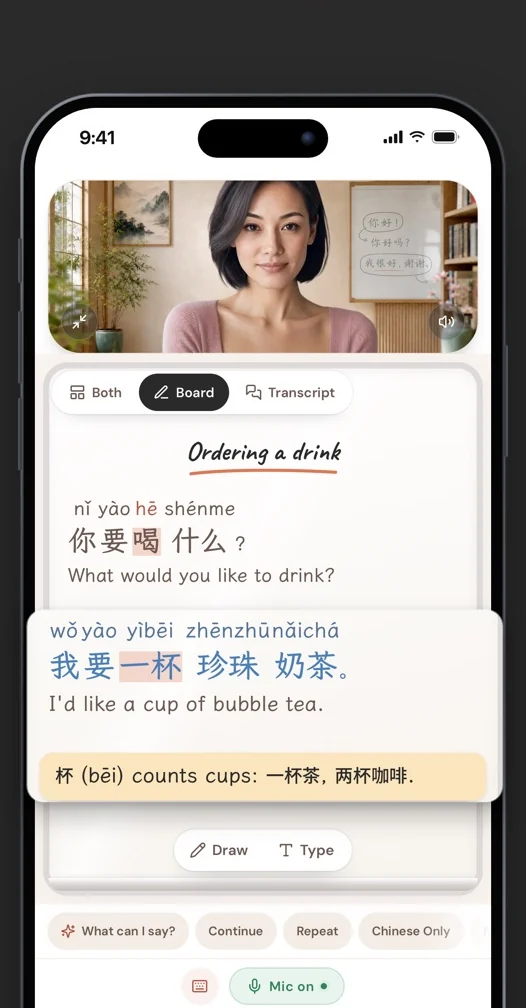
Duolingo has moved aggressively on conversational AI in late 2026: its Q3 November 2026 shareholder letter confirmed it is retiring the separate Duolingo Max tier and bringing unlimited AI Video Call to Super subscribers on iOS by year-end. However, Duolingo's Video Call rollout on Android for Mandarin remains unconfirmed in public help notes, calls cost a paid Super subscription, and standard free lessons still leave conversational production out of reach for beginners.
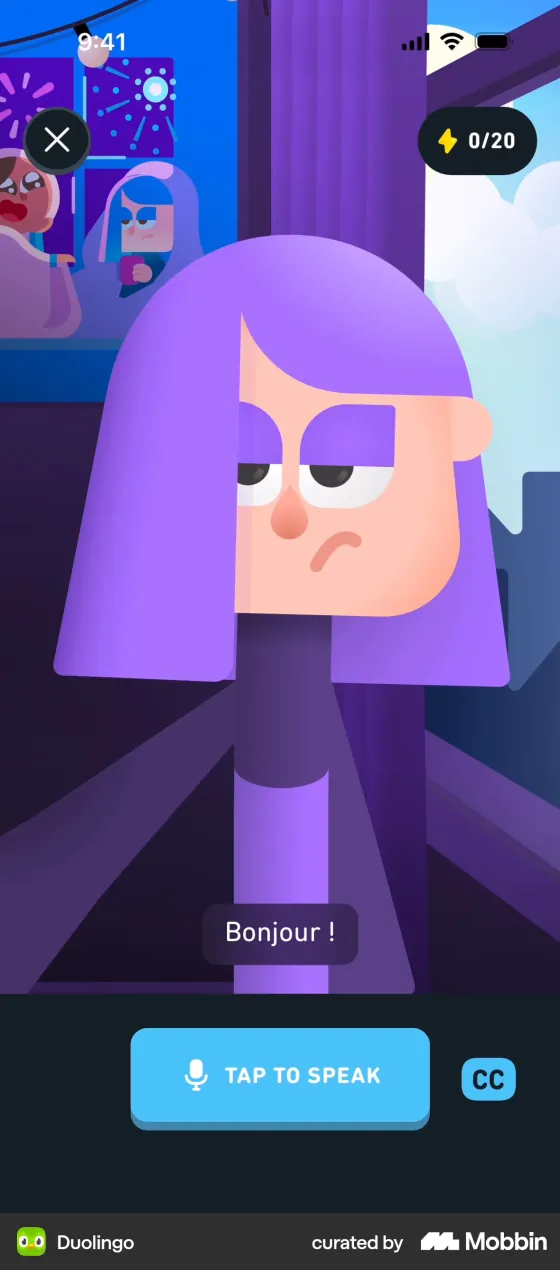
For learners who freeze whenever someone speaks Chinese back without multiple-choice tiles, SayMei closes the exact speaking gap Duolingo leaves open. On the other hand, if you commute on crowded trains and prefer silent tile exercises you can finish in three minutes before bed, Duolingo's design stays effortlessly light.
Structured curriculum and HSK 1–6 / HSK 3.0 coverage
SayMei aligns explicitly to China's November 2025 HSK 3.0 syllabus, while Duolingo maps Mandarin onto CEFR stages (targeting CEFR Score 129, labeled B2) designed across all of Duolingo's global languages. Matching Duolingo's 5,960-word course list from duome.eu against the official 2025 HSK 3.0 list shows real breadth—covering 82% of HSK 4 vocabulary and 85% across HSK 1–4—yet roughly a quarter of taught vocabulary sits outside HSK syllabi, and Duolingo's HSK 6 coverage drops to 48%.
What separates the two is Mandarin pedagogy rather than raw vocabulary count. Duolingo teaches Simplified characters only, starts beginners on isolated food/drink phrases tailored for tile matching, and explains almost no Chinese grammar inside standard free exercises. SayMei connects HSK 1–9 vocabulary lists, 1,800+ lessons (with its 2026 rewrite concentrated on HSK 1–4 across 1,183 spoken prompts), over 3,500 topical HSK 1–6 dialogues, and explicit grammar notes inside Grammar Checker. Note two honest caveats: SayMei concentrates on Mandarin in Simplified script for lessons (offering Traditional script toggle inside Stories and reading tools), and its HSK 5–6 live lessons run in the pre-2026 lesson format while HSK 1–4 have the newest prompt set.
Syllabus structure
- SayMei
- Aligned to Nov 2025 HSK 3.0 (HSK 1–9 vocab; HSK 1–6 lessons & dialogues)
- Duolingo
- CEFR B2 sequence (~310 skills, ~5,960 course words; no HSK mode)
Traditional character support
- SayMei
- Toggle Simplified/Traditional in Stories and reading tools
- Duolingo
- Simplified script only in Mandarin course
Grammar explanations
- SayMei
- Inline explanations during Mei Lin calls + dedicated Grammar Checker
- Duolingo
- Very brief Guidebook tips; deep "Explain My Answer" historically paywalled behind Max
Cross-platform sync
- SayMei
- Web browser, iPhone, Android (App Store excludes EU/CN/MA/AF; use web there)
- Duolingo
- Web browser, iPhone, Android globally
Pricing and what is genuinely free vs. paid
Duolingo wins if your absolute requirement is unlocking an entire multi-year Chinese course tree for $0—provided you tolerate ads and the Energy refill system that replaced Hearts. SayMei costs $5.99 a month on Premium for unlimited core content plus 200 live Mei Lin speaking minutes, undercutting Duolingo Super's US App Store lineup ($9.99 to $119.99 across monthly, yearly, and family SKUs).
Monthly effective price in USD: SayMei vs Duolingo (Nov 2026)
Duolingo core path stays $0 with ads/Energy; Super SKUs span monthly to annual family options on US App Store.
| Plan | US$ a month | Plan details |
|---|---|---|
| Duolingo Free | 0 | Full course path with ads and 25-bar Energy limits |
| SayMei Stories Unlimited | 2.99 | Standalone graded reader ($0 7-day trial) |
| SayMei Premium | 5.99 | 200 live min/mo (roll over), Stories, FSRS cards, all test prep |
| Duolingo Super | 9.99–19.99 | Removes ads/Energy; US App Store SKUs range $9.99–$119.99 (adds Video Call by end-2026) |
Look closely at what stays free on each platform before picking one:
- Free on Duolingo: The entire Simplified Chinese path (Sections through CEFR B2), the Pinyin tone/initial reference tab, and the Hanzi component sessions stay open without a subscription, interrupted by video ads and refilled via an Energy meter (25 max, refilled via gems, watching ads, or small free top-ups).
- Free on SayMei: Your first 10-minute live Mei Lin lesson needs no signup or card in most countries (a second lesson unlocks with a free account; elsewhere a 7-day 100-minute trial starts first). A free account also gives daily access to 1 dialogue speaking turn, 10 new flashcards, 10 practice reviews, Tone Checker, Tone Pair & Sandhi tools, Characters and Radicals drills, 8 full Stories books plus chapters 1–2/3 of every title, SayMei TV, HSK 1–9 vocab lists, and all 437 printable PDF workbooks.
SayMei is also an app for iPhone and Android: get the app.
Graded audio stories, flashcards, dialogues, and printable PDF workbooks
SayMei delivers an entire Chinese reading, listening, and offline printable library that Duolingo simply does not build. Duolingo weaves short dialogue-like story moments into its unit path, yet offers no graded book shelf, no user-controlled FSRS flashcard deck, and no printable PDF packs. SayMei includes 169 illustrated audio stories across 1,161 chapters up to HSK 3 (plus one free HSK 4 title), FSRS spaced-repetition flashcards targeting 90% recall by default, over 3,500 graded HSK 1–6 dialogues with 0.75× and 0.5× pitch-preserved playback, and 437 printable PDF workbooks.
Because SayMei lets learners tap any word in a dialogue, story, or SayMei TV video clip to save it straight to an FSRS review queue, vocabulary connects directly to listening and speaking context. Duolingo repeats words on its own opaque algorithm and mixes non-HSK filler words into early units without exporting cards for outside review. Where SayMei falls short is story ceiling: SayMei Stories stops at HSK 3, whereas upper-intermediate readers aiming for HSK 5–6 will need The Chairman's Bao or Du Chinese once past HSK 3.
Pronunciation and tone feedback depth
This is Duolingo's single sharpest blind spot in Mandarin, and SayMei's clear strength. Duolingo includes a dedicated Pinyin tab teaching tones (mā, má, mǎ, mà, ma) and initials (b, p, m, f...) separately, yet inside normal Chinese exercises, pronunciation feedback stays invisible—mistakes get swept into generic translations, and tone pairs or third-tone sandhi rules receive minimal systematic drilling.
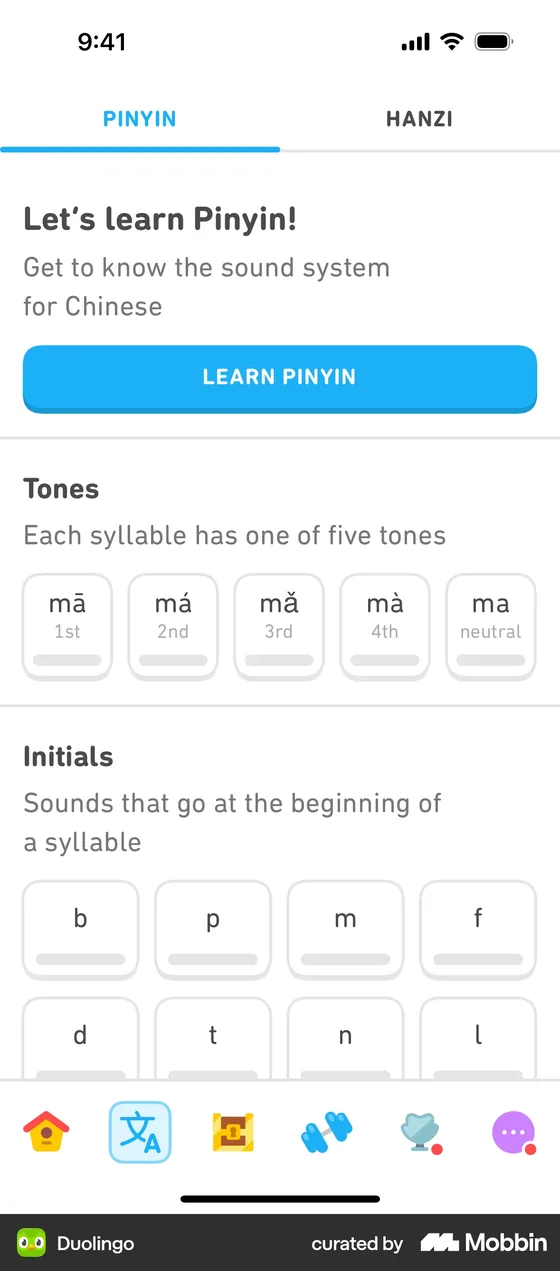
SayMei approaches tones as both acoustic perception and physical pitch habits. On the browser and app side, learners get three targeted pronunciation instruments:
- Tone Checker: Records your voice locally in the browser, draws your fundamental pitch contour against a native model, and detects tones accurately 80% of the time across 984 reference clips.
- Tone Pair Trainer & SayMei Tones: Drills two-syllable pairs (1–2, 2–3, 3–4, etc.) where most real English-speaker tone mistakes occur.
- Tone Sandhi Checker: Checks shifting tones for 不, 一, and double third-tone sequences.
Combine those drills with slow-speed audio (0.75× and 0.5× pitch-preserved) across Dialogues and Mei Lin's live replies, and beginners catch muddy tones early instead of fossilizing bad habits over a 300-day Duolingo streak. Still, note SayMei's honest caveat: during live Mei Lin calls, you get inline coaching rather than a 0–100 phonetic score, and live lesson tone feedback itself lacks an external clip-level accuracy benchmark.
Character writing practice vs. live speaking practice
Neither app is built as a standalone calligraphy tutor like Skritter, yet SayMei covers actual handwriting meaningfully better than Duolingo while prioritizing live speech. Duolingo introduced Component Sessions in October 2026 to help learners spot shared radicals and sound components inside characters, which boosts reading recognition nicely; even so, Duolingo offers zero stroke-order tracing or Chinese handwriting anywhere in its Chinese course.
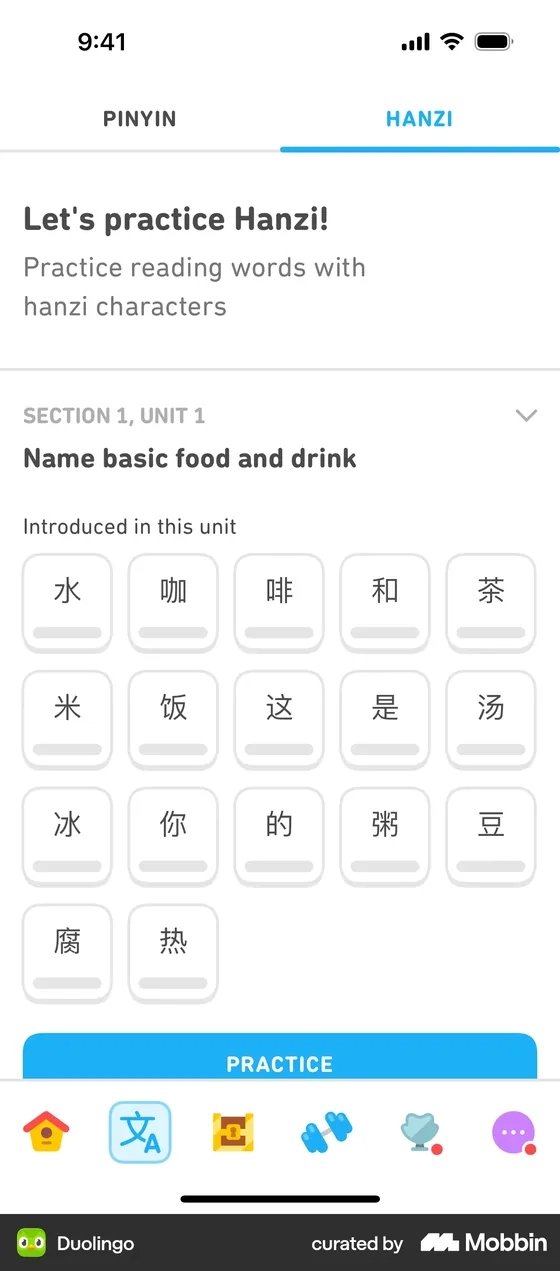
SayMei keeps live lesson minutes focused on speaking out loud rather than tracing screens, then handles character writing in two dedicated ways: an interactive Characters web tool covering 1,200 HSK 3.0 writing characters (and 1,940 reading characters) with spaced-repetition intervals, plus six direct printable HSK 1–6 田字格 writing workbooks if you want pen-on-paper muscle memory.
Choose Duolingo if...
Choose Duolingo if keeping an effortless daily habit for $0 matters more right now than speaking accuracy or HSK prep.
- You want the full course path completely free: If paying even $5.99/mo is off the table, Duolingo unlocks hundreds of Simplified units to CEFR B2 at $0 with ads.
- Gamified streaks keep you showing up: XP leagues, streak freezes, and sub-5-minute tap quizzes reduce procrastination when motivation dips.
- You want reading recognition only: October 2026 Component Sessions plus Hanzi practice cards help beginners memorize character shapes without learning handwriting or speaking aloud.
- You study multiple languages on one app: Duolingo covers 40+ languages alongside Chinese under a single account.
Choose SayMei if...
Choose SayMei if you want to actually hold Mandarin conversations, build solid tones early, and align with the November 2025 HSK 3.0 standard.
- Speaking out loud is your bottleneck: Mei Lin conducts adaptive spoken video dialogues with real-time phrasing and grammar guidance instead of repetitive matching tiles.
- You want systematic tone tools, not guesswork: Tone Checker (80% across 984 clips), Tone Pair Trainer, and Tone Sandhi Checker drill pitch explicitly alongside slow dialogue audio.
- You want HSK 3.0 alignment and printable resources: Access Nov 2025 HSK 1–9 word lists, 1,200/1,940 Characters tools, HSK Test Prep, and 437 printable PDF workbooks free with an account.
- You want better speaking value per dollar: SayMei Premium runs $5.99/mo (with 7-day trial, rolling minutes, and $2.99 extra 100-min Boosts), beating Duolingo Super's pricing while bundling 169 audio books and FSRS flashcards.
Check full trial and rollover terms on SayMei pricing, or start with a free 10-minute session on your first lesson.
FAQ
Is Duolingo enough to become conversational in Chinese?
Duolingo alone rarely makes learners conversational in Mandarin. Its course teaches broad Simplified vocabulary (~5,960 words to CEFR B2), yet 21 of 25 captured lesson items in our audit were selection or tile drills rather than open speech, and speaking exercises can be skipped with one tap. Pair Duolingo with an AI tutor like SayMei or human speaking practice to turn passive recognition into spoken recall.
Does Duolingo teach Chinese tones properly?
Duolingo introduces the five tones (four contours plus neutral) inside a separate Pinyin tab, yet standard lessons do not drill tone discrimination systematically or display pitch feedback when you speak. Learners often glide through matching exercises using context clues while mispronouncing tones aloud. SayMei adds a pitch-plotting Tone Checker, Tone Pair Trainer, and Sandhi tools to isolate tones directly.
Why is SayMei better for speaking than Duolingo?
SayMei centres its core lesson around live voice dialogue with Mei Lin, requiring you to recall words and answer follow-up questions in real time with inline grammar notes. Duolingo relies mostly on recognition tiles, has minimal speaking inside free lessons, and only adds AI Video Call on paid Super subscriptions (rolling out on iOS by late 2026, with Android Mandarin unconfirmed).
Is Duolingo Chinese free forever, and what does SayMei cost?
Duolingo's entire Simplified Chinese tree can be completed free with ads and Energy limits, while ad-free Duolingo Super ranges from $9.99 to $119.99 on US App Store plans. SayMei offers your first 10-minute Mei Lin lesson free without a card in most countries plus generous daily free dialogues, tone tools, and 437 printable PDFs; SayMei Premium costs $5.99/mo for 200 rolling live minutes.
Does Duolingo or SayMei align with HSK 3.0?
SayMei aligns directly to the November 2025 HSK 3.0 syllabus across HSK 1–9 vocabulary lists, character writing/reading tools, and HSK prep. Duolingo maps its Chinese course to CEFR levels rather than HSK: while its vocabulary matches 82% of new HSK 4 words, around a quarter of its words fall outside HSK syllabi and HSK 6 coverage drops to 48%.
Can you learn Chinese writing on Duolingo or SayMei?
Duolingo teaches reading character components via its October 2026 Hanzi Component Sessions, with no stroke-order handwriting practice anywhere in Mandarin. SayMei separates writing from speaking: its free Characters web tool covers 1,200 writing characters (and 1,940 reading characters) aligned to HSK 3.0 alongside six direct HSK 1–6 printable 田字格 writing workbooks.
Which app works better for busy schedules across phone and laptop?
Both SayMei and Duolingo sync across web browsers, iPhone, and Android on one account (note SayMei's iOS app is excluded in the EU, mainland China, Morocco, and Afghanistan, where learners use the web app). Duolingo works best in tiny 3-minute silent bursts anywhere, while SayMei's 6–7 minute spoken lessons require a quiet minute with microphone access, supplemented offline by due flashcards and printed PDFs.
Should I quit Duolingo if I switch to SayMei?
Not necessarily. Many learners keep a quick daily Duolingo habit strictly for passive character exposure during silent commutes while using SayMei for daily spoken output with Mei Lin, tone-pair diagnosis, FSRS flashcards, and printable HSK workbooks. Once Duolingo tiles feel too easy and repetitive, shifting more time to live speaking and graded audio stories speeds up real fluency.
Sources
Checked and verified 27 November 2026 from product modules, public filings, app stores, and vocabulary syllabus comparisons.
SayMei
- SayMei pricing and free limits, first Mei Lin lesson, Tone Checker, and printable workbooks
- SayMei iPhone and Android pages
Duolingo
- Duolingo Chinese course overview, Duolingo Energy update, and Component Sessions post
- Duolingo Q3 FY26 Shareholder Letter (Nov 2026 Video Call & Max sunsetting)
- Vocabulary coverage audit: duome.eu Chinese word list matched against the Nov 2025 HSK 3.0 syllabus PDF
- SayMei guides: Is Duolingo Good for Chinese?, Duolingo vs HelloChinese, and Best AI Apps to Learn Chinese
Methods
- Editorial disclosure: SayMei is our product. Plan limits, trial allowances, audiobook counts (169 books, 1,161 chapters), workbook totals (437 PDFs), and Tone Checker clip accuracy (80% across 984 recordings) reflect verified production configuration and published benchmarks.
- Competitor audit: Duolingo observations draw on captured Mobbin iOS/web exercise sequences (25 items analyzed), duome.eu's 5,960-word course dump, official Duolingo blog posts, and its Q3 2026 SEC shareholder letter rather than inside Duolingo telemetry.
- Balance policy: We credit Duolingo openly where it wins—zero-dollar full course completion, addictive streak psychology, and character component recognition—while documenting real gaps in speaking volume, tone training, and HSK 3.0 mapping.
- Corrections: Duolingo frequently A/B-tests Energy, Video Call availability, and Super pricing across accounts and regions. If any pricing or platform rollout changed, tell us and we will update this page.
Duolingo is a trademark of Duolingo, Inc.; SayMei is not affiliated with or endorsed by Duolingo.