SayMei vs LingoDeer for Chinese: Live AI Speaking vs Grammar-First Lessons
Compare SayMei and LingoDeer for Mandarin across AI speaking, HSK 3.0 vs CEFR B1 curriculum, Learning Tips, handwriting, stories, and 2026 pricing.


LingoDeer and SayMei take almost opposite paths into Mandarin. LingoDeer won a loyal following among English speakers with calm, textbook-grade grammar notes (Learning Tips), clean sentence-tile construction across Chinese I and II, and one multi-language subscription covering 19 languages. SayMei is ours, and it is engineered exclusively for Mandarin: centred on live spoken video lessons with Mei Lin, pitch-visualized tone diagnostics, HSK 3.0 prep, 169 audio books, and 437 PDFs at $5.99 a month.
If you want to learn how Mandarin sentences fit together on paper before speaking, LingoDeer shines early on—yet paying $14.99/month or $95.99/year without open spoken conversation or HSK 3.0 depth leaves many learners searching for a speaking partner by month three.
Side-by-side comparison: SayMei vs LingoDeer
Compare both platforms across all six areas that determine how fast English speakers build spoken and reading fluency in Chinese.
Dimension · Winner ·  SayMei ·
 LingoDeer
Speaking & AI tutor feedback
SayMei
Open spoken video dialogues with Mei Lin + inline grammar notes
Scripted read-aloud & Story-Speaking drills; zero open back-and-forth AI chat
Curriculum & HSK 3.0 depth
SayMei
HSK 1–6 lessons/dialogues (2026 rewrite 1–4); Nov 2025 HSK 3.0 lists 1–9
94 units / 259 lessons (CEFR B1); topic-first (~185/300 HSK 1 exact words)
Pricing & free access
SayMei
$5.99/mo Premium (200 rolling live min); free PDFs, tones & dialogues
Single tier: $14.99/mo or $95.99/yr (multi-year web SKUs; Lifetime ended)
Graded stories, flashcards & PDFs
SayMei
169 audio books (HSK 1–3), FSRS cards, 3,500+ dialogues, 437 PDFs
Nov 2026 Booster drills & SRS reviews; no graded storybook catalog or PDFs
Pronunciation & tone depth
SayMei
On-device Tone Checker (80% across 984 clips), Tone Pair & Sandhi tools
5-unit Tone Training (beta on Android only Sep 2025; tone accuracy unverified)
Character writing vs live speech
LingoDeer
Characters web tool (1,200 writing / 1,940 reading) + 6 田字格 PDFs; live speech first
Built-in 3-mode stroke tracing inside Chinese lessons (Oct 2025 update)
Speech recognition, tones, and AI tutor conversational feedback
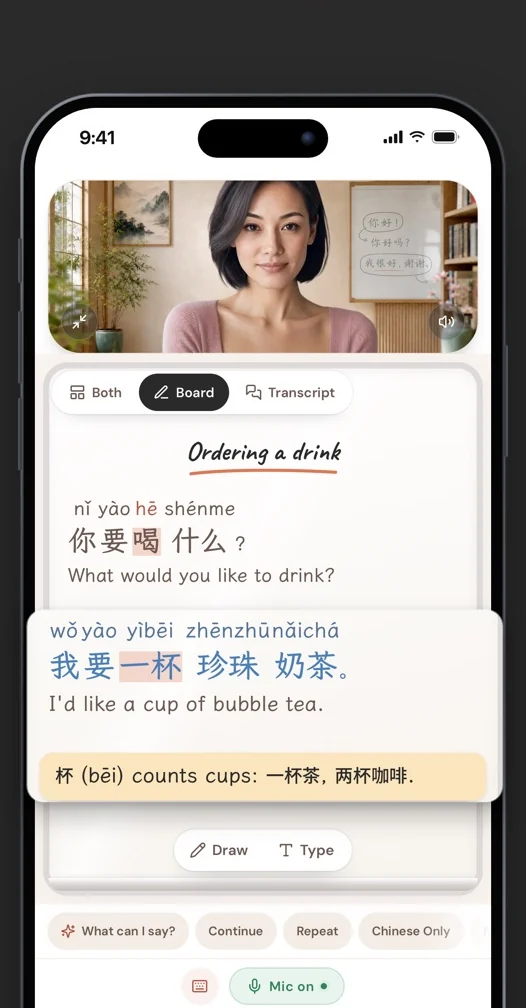
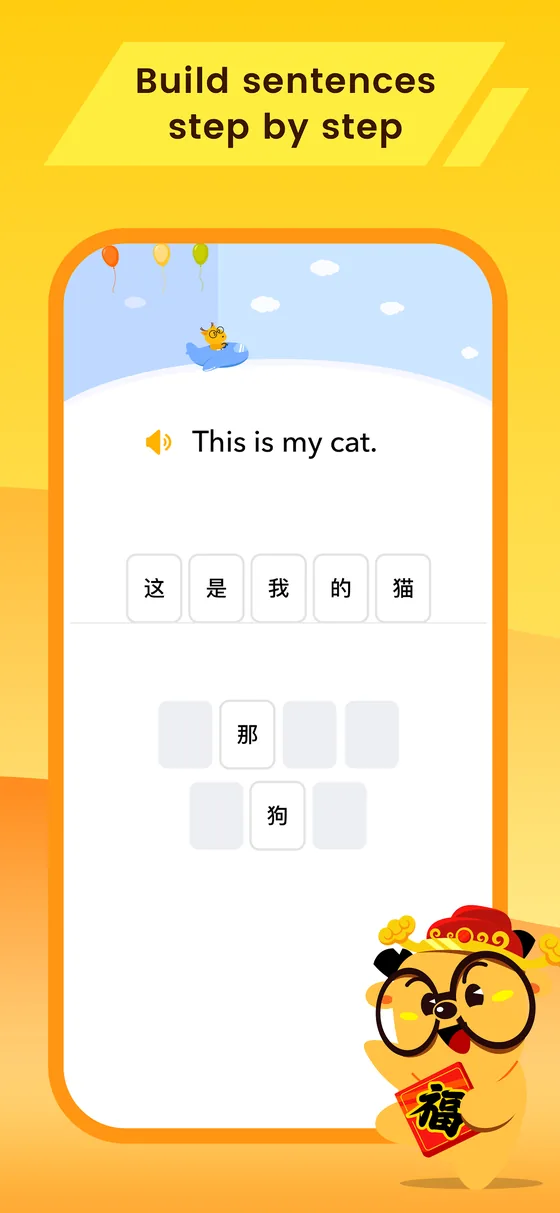
SayMei centres learning on dynamic two-way speaking with Mei Lin, whereas LingoDeer treats speaking as scripted read-aloud checkpoints inside a puzzle course. LingoDeer introduced toggleable generative-AI features (Tell Me Why mistake explanations and alternate answer grading) in late 2025 and June 2026—helpful when asking why a sentence drill failed—yet LingoDeer still does not let learners hold open, unscripted spoken conversations.
During a SayMei lesson, Mei Lin leads real spoken scenarios where your reply determines the follow-up turn, keeps optional pinyin/English lines available while you build recall speed, and drops targeted grammar feedback cards into the live transcript whenever word order or measure words drift.
If speaking anxiety makes live conversation feel intimidating in week one, LingoDeer's structured tile assembly and calm Story-Speaking read-aloud screens feel reassuring—no live dialogue turn awaits your answer. Conversely, if speaking aloud without freezing is why you downloaded an app, LingoDeer's read-aloud scoring leaves conversational reflex untrained. Note SayMei's own honest boundary too: Mei Lin responds conversationally with qualitative feedback rather than giving a single numerical 0–100 score per sentence.
Structured curriculum and HSK 1–6 / HSK 3.0 coverage
SayMei covers far deeper Mandarin territory and aligns explicitly with the November 2025 HSK 3.0 syllabus, while LingoDeer builds a compact, topic-oriented beginner-to-low-intermediate path capped at CEFR B1. Auditing LingoDeer's public map shows 94 units and 259 lessons split across Chinese I (45 units / 160 lessons) and Chinese II (49 units / 99 lessons), naming 1,048 distinct headline words. Matching those headline words against November 2025 HSK 3.0 reveals only 799 appear on any HSK list—including just 185 of 300 exact HSK 1 words—because LingoDeer prioritizes everyday conversation topics and multi-language syllabus uniformity over exam coverage.
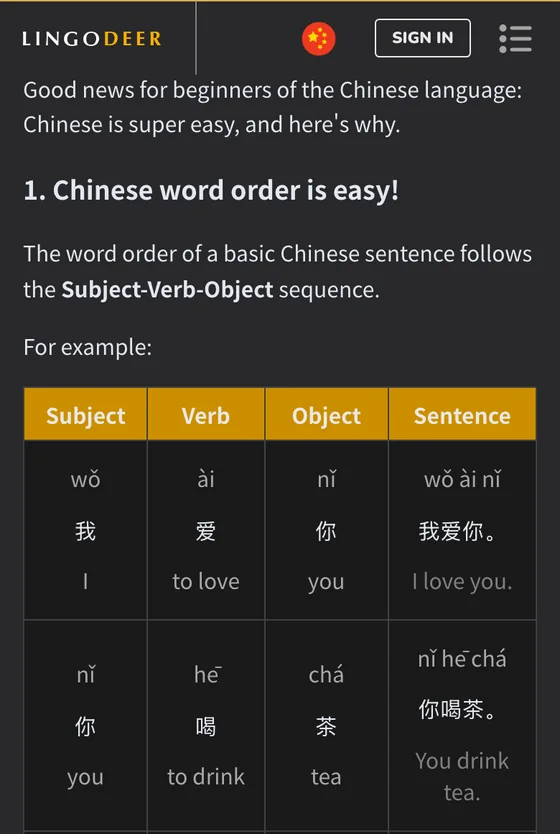
Where LingoDeer stands out genuinely is written grammatical clarity for beginners: its pre-lesson Learning Tips explain Chinese word order, aspects, and measure-word logic cleanly in plain English, backed up in November 2026 by the new Booster tab (word, collocation, grammar, and comprehension drills) and Knowledge Cards.
SayMei maps directly onto HSK 3.0 ahead of the December 13, 2026 rollout where HSK 3+ speaking becomes compulsory: HSK 1–9 word lists, 1,800+ lessons (with its 2026 prompt refresh focused on HSK 1–4 across 1,183 spoken turns), over 3,500 topical dialogues across HSK 1–6, and Chinese Grammar Checker. Honest boundaries: SayMei's HSK 5–6 live lessons run on an older prompt format compared with HSK 1–4, SayMei teaches Mandarin only (whereas LingoDeer unlocks 19 languages under one roof), and LingoDeer's Traditional character support in help docs remains unconfirmed (Simplified-first) while SayMei lets Stories and reading learners switch Simplified and Traditional cleanly.
Pricing and what is genuinely free vs. paid
SayMei wins sharply on price for anyone studying only Chinese, while LingoDeer justifies its higher rate mainly if you plan to bounce across Korean, Japanese, or European courses on the same account. Since discontinuing Lifetime plans by December 2025, LingoDeer charges a single multi-language rate: $14.99 a month, $34.99/3 mo on iOS ($39.99 web), or $95.99 a year ($8.00/mo), with longer web-only 3-year ($189.99, $119.99 Black Friday) and 6-year ($239.99) options plus a 7-day iOS trial tied to the $95.99 annual plan. SayMei Premium runs $5.99 a month (200 rolling live minutes), after a 7-day trial ($0 today, 100 live minutes) or free opening Mei Lin session in eligible countries.
US monthly cost range: SayMei vs LingoDeer (Nov 2026)
LingoDeer includes 19 languages (range reflects $95.99/yr vs $14.99/mo); SayMei includes live Mandarin AI tutoring.
| Plan | US$ a month | Plan scope |
|---|---|---|
| SayMei Stories Unlimited | 2.99 | Audio storybooks only (included in Premium) |
| SayMei Premium | 5.99 | Live Mei Lin tutoring (200 min/mo), Stories, FSRS cards, HSK prep |
| LingoDeer Membership | 8.00–14.99 | Annual ($95.99/yr) to monthly ($14.99/mo); unlocks 19 languages; web multi-yr lower |
Free tiers split cleanly too:
- Free on LingoDeer: Pinyin/Alphabet foundations, Basics 1 (Unit 1), Test Outs, and the 658-item Travel Phrasebook stay free, while Chinese I Unit 2 onward—and LingoDeer Plus review mini-games—require paid access.
- Free on SayMei: Your first 10-minute Mei Lin lesson starts without signup or card in most countries (2nd with free account; 7-day trial elsewhere). A free account permanently keeps daily 1-session dialogue speaking, 10 daily flashcards/reviews, Stage 1 of SayMei Tones, Tone Checker, Grammar Checker, HSK 1–9 lists, Characters (1,200 writing / 1,940 reading), 8 full Stories plus early chapters of all 169 books, and 437 printable PDFs.
Note web parity differences too: LingoDeer runs a clean web app at lingodeer.com, though offline downloads and Fluency Builder stay mobile-only; SayMei syncs browser, iPhone, and Android identically (except EU, mainland China, Morocco, and Afghanistan iOS App Store exclusions, where web fills in seamlessly).
SayMei is also an app for iPhone and Android: get the app.
Graded audio stories, flashcards, dialogues, and printable PDF workbooks
SayMei provides a complete audio story shelf, FSRS flashcard scheduler, dialogue library, and PDF catalog that LingoDeer lacks outside unit quizzes. LingoDeer offers built-in SRS vocabulary reviews tied cleanly to completed units plus its November 2026 Booster comprehension cards, yet publishes zero graded storybook library and zero downloadable PDF packs.
SayMei includes 169 multi-chapter graded books (1,161 chapters) for HSK 1–3 plus one free HSK 4 story with synchronized audio, Simplified/Traditional switching, and one-tap card capture fed into FSRS scheduling (90% default target). Over 3,500 topical dialogues spanning HSK 1–6 add slow pitch-preserved audio (0.75× and 0.5×), backed offline by 437 free printable PDF workbooks (431 illustrated study books and 6 HSK writing volumes). The fair caveat on SayMei is ceiling: Stories tops out at HSK 3, and live calls and Stories need internet access (only due flashcards and paper PDFs work offline).
Pronunciation and tone feedback depth
SayMei offers substantially deeper Mandarin tone tools across all devices, whereas LingoDeer's dedicated tone feature arrived as an Android-only beta with unproven accuracy. In September 2025, LingoDeer added a 5-unit Chinese Tone Training module scoring tone, initial, and final on Android phones, alongside standard lesson read-aloud scoring, yet LingoDeer does not verify accuracy on a published clip set or surface visual pitch graphs—and iPhone learners do not get the same tone beta.
SayMei puts its acoustic tools in any browser or phone: the on-device Tone Checker plots your live pitch trace directly beside a native speaker (80% accurate across 984 reference recordings), paired with the 16-pattern Tone Pair Trainer and the Tone Sandhi Checker for 不, 一, and double third tones. While Mei Lin's live conversations do not hand out numeric 0–100 percentages during dialogue turns, those companion tools pinpoint pitch drift that scripted scores often gloss over.
Character writing practice vs. live speaking practice
LingoDeer offers better built-in mobile handwriting inside lessons (added in October 2025 with three guided tracing modes), whereas SayMei prioritizes conversational speaking minutes first and separates character drilling cleanly. Learners who enjoy learning stroke order alongside each new word directly on a smartphone screen will appreciate LingoDeer's three writing modes without leaving the lesson tree.
SayMei takes the position that tracing strokes during live tutoring burns conversational momentum, so handwriting lives inside its free Characters tool (1,200 writing / 1,940 reading characters on HSK 3.0 with SRS) and six printable 田字格 HSK writing workbooks for dedicated paper sessions.
Choose LingoDeer if...
Choose LingoDeer if multi-language study, upfront written English grammar lessons, and calm puzzle drills matter more than real-time speaking or HSK 3.0 exam scope.
- You are learning multiple Asian or European languages: One $95.99/yr ($14.99/mo) subscription unlocks Korean, Japanese, Vietnamese, and 15+ additional languages alongside Chinese.
- You want calm, written-first
Learning Tips: Beginners who prefer detailed English grammar breakdowns before answering drills love LingoDeer's pre-lesson explanations andTell Me Whynotes. - In-lesson stroke tracing on mobile fits your commute: October 2025 3-mode handwriting sits smoothly inside structured lessons without printing PDFs.
- You only want to build up to CEFR B1 passively: Chinese I and II give clear low-stress structure without live speaking pressure.
Choose SayMei if...
Choose SayMei if Mandarin is your focus and you want live conversational fluency, explicit HSK 3.0 prep, audio stories, and visual tone training at less than half the monthly cost.
- You want live spoken conversation with an AI tutor: Mei Lin engages in back-and-forth Mandarin dialogues with real-time phrasing notes instead of static sentence tiles.
- You care about HSK 3.0 coverage and December 2026 spoken exams: HSK 1–9 word lists, 3,500+ dialogues, Characters tools, and HSK prep target Mandarin exams directly rather than CEFR generalizations.
- You want stories, FSRS flashcards, Tone Checker, and 437 PDFs: Every tool connects across web and mobile without charging $14.99/mo.
- You study strictly Chinese and want lower monthly cost: At $5.99/mo (with rolling minutes and 7-day trial), SayMei saves ~$24/yr compared to LingoDeer annual or ~$108/yr compared to LingoDeer monthly while adding live AI tutoring.
See full rollover terms and trial allowance on SayMei pricing.
FAQ
Is LingoDeer or SayMei better for Chinese grammar?
LingoDeer writes famously clear pre-lesson English Learning Tips and Nov 2026 Booster collocation drills alongside toggleable Tell Me Why explanations inside puzzles. SayMei teaches grammar through live conversational correction with Mei Lin plus a free Grammar Checker tool that fixes sentences with plain-English notes. Pick LingoDeer for textbook-style reading notes before puzzles; pick SayMei to apply grammar aloud in speech.
Does LingoDeer have an AI tutor like SayMei's Mei Lin?
No. LingoDeer added generative-AI explanations (Tell Me Why for wrong answers and alternate valid translations) in late 2025/2026, yet learners cannot hold open, adaptive spoken conversations with an AI partner inside LingoDeer. SayMei includes live two-way voice dialogues with Mei Lin across HSK 1–6 inside its $5.99 monthly Premium plan.
How far does LingoDeer's Chinese course go compared to SayMei?
LingoDeer's Chinese I and II cover 94 units and 259 lessons totaling 1,048 headline words up to roughly CEFR B1 (~HSK 3–4 depth), missing about 115 exact HSK 1 words due to topic sequencing. SayMei follows the November 2025 HSK 3.0 syllabus across HSK 1–9 word lists, 3,500+ HSK 1–6 dialogues, and 1,800+ lessons (with 2026 prompt refreshes on HSK 1–4).
Which app is cheaper for studying Chinese in 2026?
SayMei costs noticeably less for Mandarin learners: SayMei Premium is $5.99/mo ($71.88 across 12 months, pause anytime) and bundles AI speaking, 169 audio books, FSRS cards, and HSK prep. LingoDeer charges $14.99/mo or $95.99/yr ($8.00/mo)—only cheaper per language if you actively study several of its 19 languages under one plan.
Does LingoDeer or SayMei teach Chinese tones better?
SayMei handles Mandarin tones more reliably across all devices with its on-device Tone Checker (80% across 984 clips), Tone Pair Trainer (all 16 combinations plus neutral tones), and Tone Sandhi Checker. LingoDeer includes scripted read-aloud scoring plus an Android-only 5-unit Tone Training beta without published accuracy benchmarks or visual pitch plots.
Which app supports Traditional Chinese characters?
SayMei supports switching between Simplified and Traditional script across its 169 graded audio stories and reading tools, plus Traditional output in the worksheet generator (lessons and the 437 pre-built PDFs remain Simplified). LingoDeer's Chinese course is Simplified-first, with Traditional script toggles unconfirmed in its public help documentation.
Can you write Chinese characters in LingoDeer and SayMei?
Yes, in different ways. LingoDeer embeds guided 3-mode stroke tracing inside its mobile Chinese lessons (launched October 2025). SayMei excludes stroke tracing from live speaking calls to keep conversation fast, providing interactive stroke practice via its free Characters tool (1,200 HSK 3.0 writing characters) and six printable 田字格 HSK writing workbooks.
Can you pair LingoDeer and SayMei together?
Yes, though many learners eventually outgrow LingoDeer's fixed path once basics click. Beginners often start with LingoDeer's free Unit 1 Learning Tips or one year of grammar puzzles while opening SayMei on the side for Mei Lin speaking sessions, Tone Checker checks, HSK 3.0 vocab lists, and graded HSK 1–3 audio books.
Sources
Checked and verified 27 November 2026 from LingoDeer's public course maps, dev logs, pricing pages, and SayMei configs.
SayMei
- SayMei pricing and free limits, first Mei Lin lesson, Grammar Checker, and printable workbooks
- SayMei iPhone and Android platform pages
LingoDeer
- LingoDeer website, pricing, and help center pricing/trial notes
- Chinese I and Chinese II public syllabus pages matched against the Nov 2025 HSK 3.0 syllabus PDF
- September 2025 Tone Training dev log, October 2025 handwriting log, December 2025 AI update, and November 2026 Booster log
- SayMei guides: LingoDeer Chinese Review, HelloChinese vs LingoDeer, and Best AI Apps to Learn Chinese
Methods
- Editorial disclosure: SayMei is our product. Plan limits, rolling live minutes, book counts (169 books, 1,161 chapters), workbook counts (437 PDFs), and Tone Checker clip accuracy come directly from SayMei configuration and test records.
- Competitor audit: LingoDeer counts (94 units, 259 lessons, 1,048 headline words, 799 HSK-matched words, 185 exact HSK 1 matches) and screenshots come directly from public logged-out reads of lingodeer.com course maps, Google Play/App Store feeds, support articles, and dev logs rather than paid accounts.
- Objectivity: We highlight LingoDeer's real advantages—calm pre-lesson grammar guides, Booster drills, 3-mode mobile stroke tracing, and 19-language bundling—alongside SayMei's own boundaries on HSK 5–6 live formats, HSK 3 story cap, and online call requirement.
- Corrections: LingoDeer's multi-year discounts and iOS/Android Booster parity shift periodically. If any detail needs updating, tell us and we will correct it.
LingoDeer is a trademark of LingoDeer; SayMei is not affiliated with or endorsed by LingoDeer.