LingoDeer review: is it good for learning Chinese?
Our LingoDeer review for Mandarin: the Chinese course against the new HSK, its speaking and tone practice, the new AI features and every plan's price.

LingoDeer is best known for Korean and Japanese, and most reviews of it say little about Chinese. So we went through its Chinese course map lesson by lesson and counted 500 recent App Store reviews.
This review is for you if you're learning Mandarin and deciding whether LingoDeer is worth paying for, and which plan to buy. We checked its course pages, store listings, help centre and developer logs on 5 November 2026.
Key takeaways
- The Chinese course is bigger than most reviews say. Its two levels hold 259 lessons, from pinyin to complements and other intermediate grammar.
- It follows topics and grammar, not the HSK. Its course pages name only part of the HSK 1 list, while its finance units teach HSK 6 words.
- The grammar explanations are the reason to pay. Notes before each unit and a "Tell Me Why" button after mistakes explain what drills can't.
- Speaking means repeating set lines. You record yourself and some lines get a score, but nothing asks you to say sentences of your own.
- LingoDeer now uses AI, and you can switch it off. Since December 2025, generative AI explains your mistakes and accepts other right answers.
- Pay for a year or longer, never six months. A yearly plan costs about half of paying monthly; the App Store's six-month plan saves almost nothing.
Strong on grammar, thin on conversation
LingoDeer does a beginner's structured jobs well and leaves out the hardest one: talking freely. We read its course pages, help centre, developer logs and store listings, then scored each part:
What you need · Verdict · What LingoDeer gives you
A start from zero
Strong
A pinyin course, then short lessons in a fixed order
Grammar you understand
Strong
Notes before each unit, and explanations when you're wrong
Pinyin and characters
Strong
Pinyin you can hide, and handwriting practice for each lesson
Tones and pronunciation
Partly
Record and compare, some scored lines, and Tone Training on Android
Listening
Partly
Native-speaker audio you can slow down, and longer dialogues
An HSK path
Missing
Topic units that don't follow the HSK lists
Real conversation
Missing
Nothing that answers back
Sources: LingoDeer's course pages, help centre, developer logs and store listings, read 5 November 2026. Each row is explained below.
If you want a course that explains why Chinese works the way it does, LingoDeer is one of the clearest we've read. If you want to talk, or to pass an HSK exam, plan on a second tool from the start.
Two levels take you from pinyin to intermediate
LingoDeer launched on the App Store in 2017 and says more than 20 million people learn with it. Its makers, with offices in Singapore and Beijing, also make ChineseSkill, a Chinese-only app.
It teaches Chinese in two levels, Chinese I and Chinese II, after an Alphabet section that teaches pinyin. LingoDeer says the two together take "a complete beginner to an intermediate level", the A1 to B1 range of the European CEFR scale.
It also claims the course covers 90% of the grammar in beginner textbooks such as Integrated Chinese. We can't check that claim, but we could count what's there. Here's what the app holds for Chinese today:
Alphabet
- What it is
- Pinyin: initials, finals and tones
- Size
- One section
Chinese I
- What it is
- Topic units, each ending in a short story
- Size
- 45 units, 160 lessons
Chinese II
- What it is
- Shorter units, many named after a grammar point
- Size
- 49 units, 99 lessons
Fluency Builder
- What it is
- Longer dialogues with speaking and writing drills
- Size
- Not published
Travel Phrasebook
- What it is
- Words and phrases by topic, to hear and repeat
- Size
- 12 topics, 658 entries
Tone Training
- What it is
- Listening drills, scored recordings and a final test, on Android
- Size
- 5 units
Booster
- What it is
- Word, phrase, grammar and comprehension drills
- Size
- New in November
Source: LingoDeer's public course pages and Travel Phrasebook, its help centre and its developer logs, 5 November 2026. Fluency Builder was called Fluent until November.
Lessons mix the usual app exercises: matching words to pictures, building sentences from tiles, typing, listening and speaking. LingoDeer pitches them as five-minute lessons, and a Test Out lets you skip ahead if you already know the material.
There's a game layer too, much like Duolingo's: XP, a daily streak with shields, weekly rankings and achievements. The App Store even sells gems, at $4.99 for 1,200.
Chinese I does most of the teaching. Its units run from two to eight lessons, and each ends with a story to read and then read aloud. Chinese II runs about two lessons per unit, and its unit names read like a grammar book's contents: complements, directions, erhua, tone changes.
LingoDeer doesn't say how many hours the course takes, or how many words it teaches. Its own advice is that no app alone gets you past intermediate, which we think is honest.
It follows topics and grammar, not the HSK
LingoDeer builds its units around topics and grammar, so its vocabulary doesn't line up with the HSK, China's official Mandarin exam. Its public course pages list the main words each lesson teaches, and we matched those words to the 2025 HSK syllabus. About three in four are on the exam's lists.
The rest are names, foods and animals the lists leave out, or compounds such as Monday, 星期一. Here's where the listed words fall:
Source: our count of the words LingoDeer's public Chinese I and Chinese II course pages name for each lesson, 5 November 2026, matched to the 2025 HSK syllabus. Another 249 named words aren't on the lists. How we counted.
That spread comes from the topics. The finance unit in Chinese I teaches bankruptcy, 破产, an HSK 6 word, and mortgage, 抵押, from the top band. Meanwhile, only 170 of the 300 words on the HSK 1 list are among the words the pages name.
One caveat: these are the words the pages name for each lesson, not every word in its sentences. Some HSK 1 words, such as the question word 吗, turn up only inside grammar patterns, so LingoDeer teaches more than our count shows. It doesn't publish a full word list, though, so you can't see what you've covered.
If you're aiming at an HSK exam, use LingoDeer for the grammar and track the exam's own word list for your level. What changed in the new HSK explains why the level numbers moved.
The grammar explanations are the reason to pay
LingoDeer's grammar teaching is its best part. Its notes explain why a sentence is built the way it is, and reviews that mention grammar average 4.6 stars.
Grammar reaches you in three places:
- Learning Tips before each unit. LingoDeer asks you to read them first, so you meet the unit's key patterns before any exercise tests you.
- Help inside lessons. Tap a word to see what it means, and use the hints when a sentence won't come.
- Tell Me Why after a mistake. Since late 2025, a button explains what went wrong and shows more example sentences.
Here's how the notes look, from the Learning Tips for Chinese Unit 1, which anyone can read on LingoDeer's website:
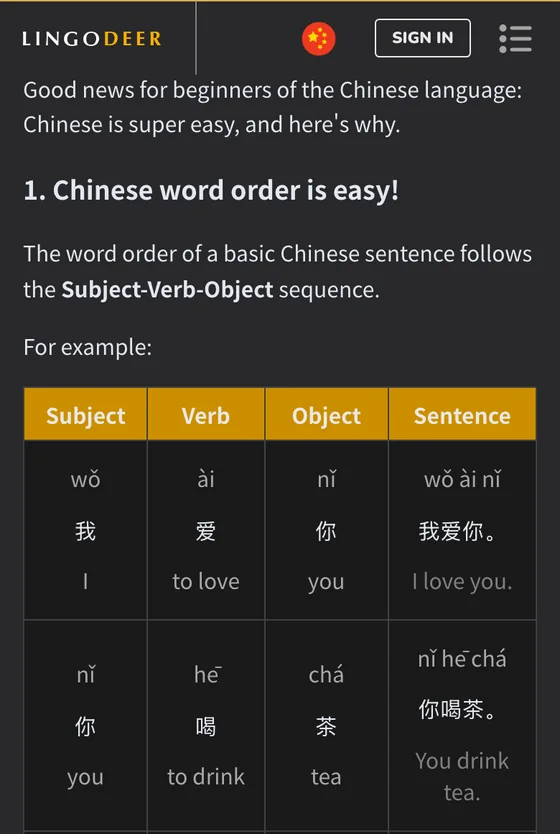
Chinese II is where the grammar gets serious. Whole units cover complements, the words after a verb that add a result, a direction or whether it's possible. One unit teaches the pair can see, 看得见, and can't see, 看不见.
Two things to know. Translations are semi-literal on purpose, LingoDeer says, so the English can sound stiff. And one July 2025 reviewer wished they could move back and forth inside a lesson.
If you've used Duolingo and wondered why 了 goes where it does, this is what you'd be paying for.
Pinyin you can hide, characters you can write
LingoDeer starts Chinese with pinyin, the spelling of Chinese sounds in Roman letters. Its Alphabet section walks through the initials, finals and tones, and a pinyin chart sits beside the course.
From there you choose what each lesson shows: characters, pinyin, or both. LingoDeer's own advice is to do each lesson twice, first with characters off to learn the sounds, then with them on to match sound to character.
Exercises build sentences from tiles, like this one from LingoDeer's Google Play listing:
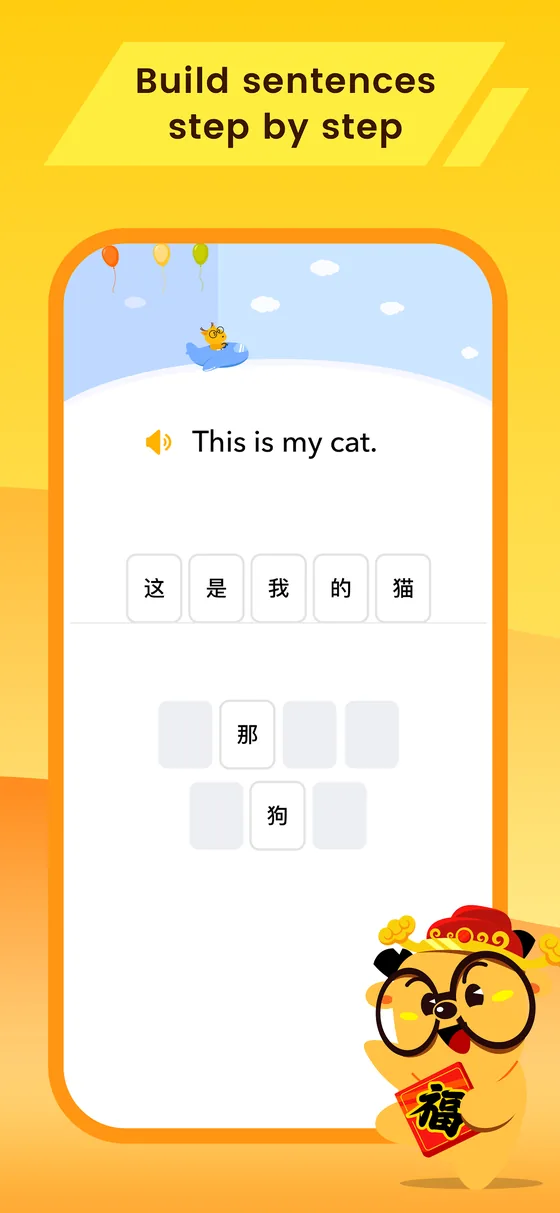
Characters get real practice too. In October 2025 LingoDeer added handwriting practice for every character in a lesson, in three modes: with stroke hints, without them, and freehand. It started on Android; the iPhone app has handwriting exercises too, which you can now skip.
The course teaches Simplified characters, the script of mainland China. One 2025 review describes a setting that switches it to Traditional, the script of Taiwan and Hong Kong, but LingoDeer's help pages don't mention one. If you want Taiwan Mandarin, ChineseSkill, LingoDeer's sister app, sells a separate Traditional course.
We'd count reading and writing as a strength. You'll be able to read what you've learned as well as hear it. Simplified vs Traditional helps if you're still choosing.
LingoDeer uses AI to explain mistakes, not to talk
LingoDeer added generative AI in two places, and both can be switched off. We found no AI tutor or chatbot to talk to.
The first is the Tell Me Why button. The second accepts answers worded differently from the lesson's, as long as the meaning holds. LingoDeer's December 2025 developer log launched both for Chinese and Japanese, in beta, and said plainly that they use generative AI.
By January the features reached six languages, and the iPhone app's release notes list them from June 2026. To turn them off, go to Me, then Settings, then AI features.
The timing matters to some learners. Several reviewers say they left Duolingo over its use of AI, and LingoDeer's listing still stresses lessons "created by language teachers" and studio-recorded native speakers.
Reactions to the change are mixed. Some reviewers like the explanations, while one, otherwise happy, wrote:
"The only big flaw is the AI they use for explaining when you get an answer wrong." (App Store, September 2026)
In a September 2026 r/ChineseLanguage thread asking for apps without AI, one learner said LingoDeer had pivoted to it, and another, who uses it, disagreed. Both have a point: LingoDeer says teachers write its lessons, but its Tell Me Why explanations come from AI unless you switch them off.
If AI is a dealbreaker, turn both switches off on day one. LingoDeer's help centre also warns Lifetime members that some later AI features "may follow a different access model". We read that as a hint they could cost extra.
Speaking means repeating set lines, now with scores
LingoDeer gives you plenty of chances to speak, but always someone else's words. Nothing in the app lets you say something of your own and get a reply.
Speaking happens in four places:
- New words in lessons. You hear a native speaker, record yourself and play the two back to compare, LingoDeer explains.
- Speaking practice. Some exercises score your recording, as LingoDeer's store images show.
- Story-Speaking and Fluency Builder. You read a unit's story or a longer dialogue aloud, line by line, and can share your story recordings.
- Tone Training, on Android. Five units of listening drills, the rules for tone changes, a final test and scores for your recordings.
Here's LingoDeer's own picture of a scored line, from its Korean course:
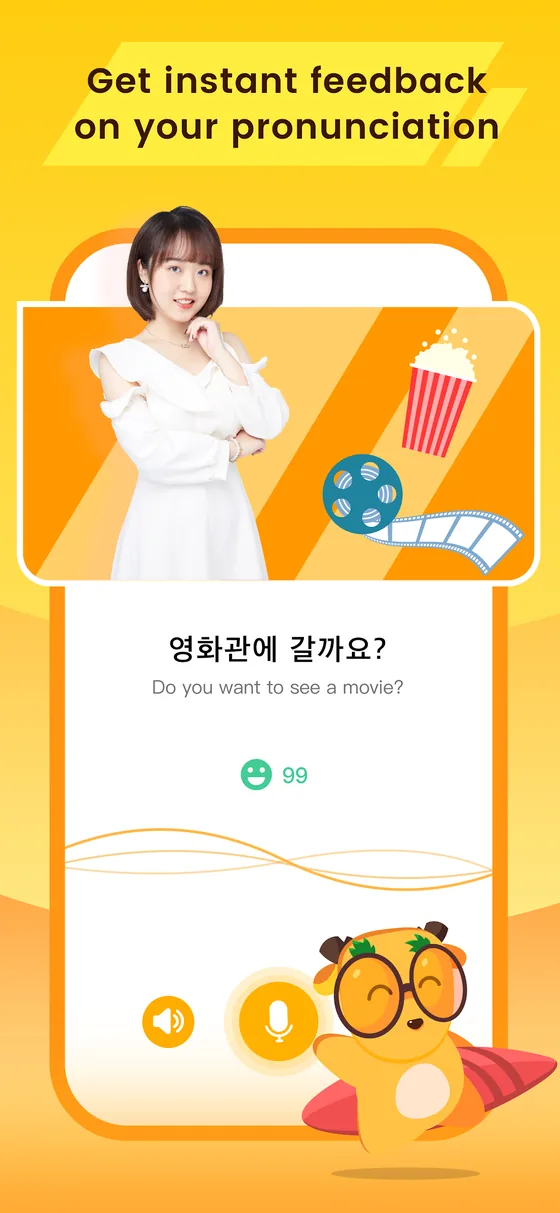
Two Mandarin learners in our sample of App Store reviews say the app grades their pronunciation, and one says that matters for a tonal language. We found no public test of how well the scoring judges tones, though.
Tone Training is the most interesting part. LingoDeer launched it in beta on Android in September 2025, with a pronunciation assessment that breaks a recording into tones, initials and finals. Its iPhone release notes don't mention it yet.
Why does checking tones matter so much? In one LingoDeer lesson you learn buy, 买, and sell, 卖, together. Only the tone tells them apart, and a speech recognizer that guesses from context can let the wrong one pass.
A review of 15 studies of English learners found that speech-recognition practice improves individual sounds a lot, but stress, rhythm and intonation only a little. Tones are pitch, like intonation, so we'd treat any app's tone score as a hint, not a verdict.
Our advice: use LingoDeer's drills to tune your sounds, and find a conversation elsewhere. Our guide to learning tones shows how to train your ear.
Listening is native audio at your own pace
Every word and sentence in LingoDeer's Chinese course is voiced by native speakers, its Chinese page says, with no computer voices. Courses with more than one voice let you pick a male or female one, or mix the two. LingoDeer's developer logs suggest Chinese is one of them.
The controls are generous:
- Speed in small steps. Audio in a lesson runs slower or faster in 10% steps, and new words can play at 0.8 times speed.
- Dialogues at two speeds. Fluency Builder plays each conversation slowly or at native pace, and can show each word's meaning as it's spoken.
- Listening without English. The new Booster tab has comprehension drills with no translations at all.
What's missing is length. Most listening is a word, a sentence or a short dialogue. LingoDeer has added native-speaker videos to its Japanese and Korean lessons, but its developer logs haven't announced them for Chinese.
Once the course feels easy, we'd add one longer listening source, such as graded audio stories or a beginner podcast.
Review is built in, and it's real spaced repetition
LingoDeer's Review tab does more than some reviews give it credit for. Its spaced-repetition system, SRS, schedules each word and character by how well you know it, and a January 2026 update added new ways to review.
Its help centre describes the whole system. You rate each card on four buttons, each showing when you'll see it again, and cards move from fading to mastered. On a phone you can review by flashcard, mixed exercises, listening, speaking or spelling.
You can also move a review earlier or later, hide cards you don't need and add your own notes. Beside them, the Review tab holds Knowledge Cards, which LingoDeer's App Store listing calls printable grammar flashcards.
The limit is scope. SRS holds only what the lessons taught you, so it can't drill an HSK list you haven't met in the course. Free users get flashcard reviews for the free units only.
Learners praise the grammar and resent the paywall
We checked both stores on 5 November.
LingoDeer was rated 4.7 stars on the US App Store and 4.4 on Google Play, from about half a million ratings, most of them on Android.
We read the 500 most recent written reviews on the US App Store, going back to June 2025, and sorted them by theme with simple keyword rules. Here's what came up most:
Source: Apple's public review feed for LingoDeer, US store, read 5 November 2026. A review can count under several themes. Our rules. Store ratings that day: 4.74 from 28,103 on the App Store, and 4.45 from 454,633 on Google Play.
The pattern is clear. Of the 109 reviews with three stars or fewer, three in four mention price, and most of those complain that the free part ends almost at once:
"you get ONE lesson before being required to pay" (App Store, April 2026)
Grammar runs the other way: those reviews average 4.6 stars. And one review in four names Duolingo, usually in a five-star review.
Only 26 reviews mention Chinese, but they're the happiest of any language, averaging 4.9 stars. One reviewer, comparing LingoDeer's courses, put it simply:
"their Chinese one is huge and covers everything" (App Store, August 2026)
The Chinese reviewers' wishes are telling. They want more upper-intermediate content, conversation practice and easier vocabulary review. One recommends adding Pleco, Du Chinese and Skritter, which says a lot about what LingoDeer leaves out.
How much does LingoDeer cost?
LingoDeer Premium costs $14.99 a month, or $95.99 a year, in the US. One membership unlocks every course it teaches, so a second language costs nothing extra.
What you pay per month depends far more on the plan than on the store. Here's every plan we found:
Source: LingoDeer's pricing page and its US App Store listing, 5 November 2026. The App Store also lists a $109.99 yearly purchase we couldn't place. Google Play shows only a range, $0.99 to $299.99 per item.
Two things stand out. The App Store's quarterly plan is $5 cheaper than the website's. And the long plans exist only on the website, where you pay by card through Stripe or by PayPal.
LingoDeer no longer sells Lifetime memberships. Its long plans replaced them: you pay once for three or six years, with no renewal.
Old lifetime purchases still appear on the App Store listing, from $119.99 to $299.99, but LingoDeer says it has stopped selling them.
LingoDeer's help centre says it runs sales at product launches and on some holidays. For Black Friday 2026, it cut the three-year plan to $119.99.
How does that compare? Month to month, LingoDeer is the dearest Chinese course app, but its six-year plan costs less a month than any rival's yearly plan:
LingoDeer costs most monthly; its six-year plan undercuts rivals' yearly plans
Premium per month in each app. Left end: its longest fixed-term plan; right end: paying monthly. Lifetime plans left out. US prices, 5 November 2026.
| App and plan | US$ a month | Longest plan |
|---|---|---|
 LingoDeer Premium | 3.33–14.99 | 6 years, $239.99 |
 SuperChinese PLUS | 5.00–11.99 | 1 year, $59.99 |
 ChineseSkill Premium | 5.00–11.99 | 1 year, $59.99 |
 HelloChinese Premium | 5.83–11.99 | 1 year, $69.99 |
 SayMei Premium | 5.99 | Monthly only |
Source: each app's US App Store listing, LingoDeer's pricing page and SayMei's pricing page, 5 November 2026. SuperChinese also sells PLUS for life at $139.99, less than LingoDeer's six-year plan. SayMei's price buys 200 minutes with Mei Lin a month.
So the plan you pick matters more with LingoDeer than with its rivals.
What's free, and what the trial costs
The free part is small. LingoDeer's help centre lists it:
- The Alphabet section, which for Chinese is the pinyin course.
- All of Unit 1, Basics 1, with its three lessons and review.
- The Test Outs, though passing one won't unlock the next unit unless you pay.
- The whole Travel Phrasebook, and the first lesson of Fluency Builder's two beginner levels.
Offline lessons and syncing between devices need Premium. A determined learner will reach the paywall on day one, which is what the one-star reviews are about.
The free trial lasts a week, once per account, and only starts inside the app. It's tied to the yearly plan, so cancel at least a day before it ends or you'll pay $95.99.
Cancelling and refunds
Subscriptions renew on their own, and LingoDeer doesn't refund renewals or unused time. Deleting your account doesn't cancel your subscription either.
The exception is the website. Its yearly plan and its long plans come with a 7-day money-back guarantee, once per person. Buy in the app, and Apple's or Google's refund rules apply instead.
If you're sure about Chinese for two years or more, the website's long plans are the cheapest way in. If you're not, use the trial, then buy one year.
LingoDeer Plus is a separate app and bill
LingoDeer Plus is a companion app of short vocabulary and grammar games, and a LingoDeer membership doesn't include it. Chinese is one of its six languages, with about 3,000 words each, up to the B1 level.
Its levels aren't linked to the main course, and there's no web version. On the US App Store it costs $8.99 a month, and its iPhone app was last updated in March 2024.
We'd skip it. The new Booster tab, on Android first, puts similar word, phrase and grammar drills inside LingoDeer itself, at no extra cost.
Most reviews predate LingoDeer's biggest changes
LingoDeer has changed more since mid-2025 than any review we found describes. We dated each change from its developer logs and iPhone release notes:
August 2025
- What changed
- A new design, and speaking practice for every language
September 2025
- What changed
- Chinese Tone Training, with a pronunciation score, on Android
October 2025
- What changed
- Handwriting practice for every character in a lesson
December 2025
- What changed
- AI explanations of mistakes for Chinese, on Android first
By December 2025
- What changed
- Lifetime plans no longer sold
January 2026
- What changed
- AI features reach six languages, and reviews get new modes
November 2026
- What changed
- A Booster tab of drills; Fluent renamed Fluency Builder
Source: LingoDeer's developer logs, its App Store version history and its help centre. LingoDeer doesn't say when Lifetime ended; App Store reviews from late December 2025 say it was gone.
We read the top Google results for "LingoDeer review" and "LingoDeer Chinese review": eleven pages, dated from 2021 to March 2026. Only two were mainly about Chinese, and none mentioned Tone Training, the AI features or the new plans.
Several still quote $79.99 a year and a $159.99 lifetime plan, prices you can't buy today. One says LingoDeer has no speech recognition and no real spaced repetition; its own pages now describe both.
Who should use LingoDeer
We'd pick LingoDeer for Chinese if:
- You want grammar explained. Its grammar notes are among the clearest we've read in a Chinese app.
- You're starting from zero. The pinyin course and fixed lesson order make the first months easy to follow.
- You learn more than one language. One membership covers every course.
- You'll study for years. The six-year plan makes it one of the cheapest structured courses per month.
We'd skip it, or pair it with something else, if:
- You want to speak soon. Repeating lines won't prepare you for questions you didn't expect.
- You're preparing for an HSK exam. The course doesn't track the exam's word lists, so add them yourself, plus mock tests.
- You're already past intermediate. The course ends at about B1.
- You want to stay free. The free part ends after one unit.
The best alternatives for each goal
No single app does everything. If LingoDeer isn't the right fit, here's what we'd pick for each goal:
A Chinese-only course from the same team
- Pick
- ChineseSkill
- Price
- $11.99 a month or $59.99 a year
- Why
- Simplified, Taiwan and Cantonese courses, with speech recognition
More reading as you go
- Pick
- HelloChinese
- Price
- $11.99 a month or $69.99 a year
- Why
- A course of 2,500+ words; the full story library needs Premium+
A longer course with scored speaking
- Pick
- SuperChinese
- Price
- $11.99 a month or $59.99 a year
- Why
- A course to about HSK 5 that scores what you say
A free daily habit
- Pick
 Duolingo
- Price
- Free
- Why
- The whole course is free, though light on grammar notes
Speaking practice that answers back
- Pick
- SayMei
- Price
- $5.99 a month for 200 minutes
- Why
- Mei Lin asks questions and corrects your tones
A human ear for your tones
- Pick
 An italki tutor
- Price
- About $20 an hour
- Why
- The median of 783 Chinese tutors
Source: each app's US App Store listing, 5 November 2026; SayMei's pricing page; italki's median from our tutors guide, October 2026. ChineseSkill's seller is Yiyan Technology, named with LingoDeer on LingoDeer's own website.
ChineseSkill is the surprise on this list. LingoDeer calls it its "oldest child" and the place it tests Chinese-specific features. If you only want Chinese, compare the two before you pay.
For closer looks, read our HelloChinese review, our SuperChinese review and Is Duolingo good for Chinese? For the wider field, see the best apps to learn Chinese.
Where SayMei fits, and where it doesn't
SayMei is built for the part LingoDeer leaves out: talking. In a lesson, Mei Lin, your AI teacher, asks you questions out loud, waits for your answer and corrects your tones and grammar as you go.
SayMei Premium is $5.99 a month for 200 minutes with her. It also includes unlimited flashcard reviews for the HSK 1 to 6 word lists, which help with the HSK gap in LingoDeer's course.
We'll be plain about where SayMei loses:
- No native app. SayMei runs in a web browser, with no offline mode.
- No grammar course. Mei Lin corrects your grammar as you talk, but there's no unit-by-unit grammar path like LingoDeer's.
- Less handwriting. Character writing comes as printable worksheets, not exercises in the app.
- Capped minutes. 200 minutes a month is about six and a half minutes a day.
- One language. SayMei teaches only Mandarin.
If you want a course that explains Chinese grammar step by step, LingoDeer does that better. Many learners would do best with both: a course for structure, and someone to talk to.
What to do next
- Start with the free unit. A few days with Basics 1 will show you whether the pace suits you.
- Read the Learning Tips first. They're the best part of the app, so don't skip them.
- Buy a year, or wait for a sale. Monthly plans add up fast, and the six-month plan barely saves.
- Decide about AI on day one. Leave the explanations on, or switch them off in Settings.
- Practise talking somewhere else. Repeating lines won't prepare you for a real reply.
If you're choosing between LingoDeer and its closest rivals, start with our HelloChinese review.
FAQ
Is LingoDeer free?
Only at the start. LingoDeer is free to download, and its pinyin course, its first unit, the Test Outs and the Travel Phrasebook are free. Everything after the first unit needs Premium, from $14.99 a month or $95.99 a year in the US. There's a week-long free trial in the app, tied to the yearly plan, so cancel a day early if you don't want it.
Is LingoDeer worth it for Chinese?
For a beginner who wants grammar explained, we think so, especially on a yearly or longer plan. A year costs $95.99, about $8 a month, for the whole course, with grammar notes, pinyin options and handwriting practice. It's poor value if you mainly want to speak, since its speaking practice means repeating set lines. If you'll study for years, the website's long plans cost even less per month.
What HSK level does LingoDeer reach?
LingoDeer doesn't follow the HSK, so there's no exact answer. It says its course reaches an intermediate level, B1 on the European scale. We matched the words its course pages name to the new HSK syllabus. They spread across every level, and fewer than six in ten HSK 1 words were among them. If you're taking an exam, study its word lists alongside LingoDeer.
Does LingoDeer correct your tones?
Partly. In lessons you record yourself and compare your voice with a native speaker's, and some speaking exercises now give your recording a score. On Android, a Tone Training section launched in 2025 scores your tones, initials and finals. We found no public test of how accurately it judges tones, and nothing in the app asks you to speak freely, so add a tutor or a conversation partner.
Does LingoDeer use AI?
Yes, in two features. Since December 2025, generative AI explains your mistakes through the Tell Me Why button and accepts answers worded differently from the lesson's. LingoDeer says its lessons are written by teachers and its audio recorded by native speakers. You can switch both AI features off under Me, then Settings, then AI features. We found no AI tutor or chatbot to talk to.
Is LingoDeer better than HelloChinese?
For grammar, we think LingoDeer explains more. HelloChinese is built only for Chinese and has more to read: a course of 2,500+ words, and the full library of graded stories on its pricier Premium+ plan.
Its Premium plan is also cheaper, at $69.99 a year against LingoDeer's $95.99. Neither gives you real conversation practice. If you also learn Korean or Japanese, LingoDeer's one membership covers them.
Does LingoDeer have a lifetime plan?
Not anymore. LingoDeer's help centre says it stopped selling Lifetime memberships, though people who bought one keep their access. Instead, its website sells plans you pay for once, for three or six years, with no renewal. The six-year plan costs $239.99, about $3.33 a month, which is less than a quarter of paying month by month.
Can you use LingoDeer on a computer?
Yes. LingoDeer has a web version at lingodeer.com for Mac and PC. With Premium, your progress syncs with the iPhone and Android apps if you sign in the same way. The web version does less, though. LingoDeer's help centre says Fluency Builder, offline lessons and some practice modes are only in the apps, so plan to do most of your study on a phone or tablet.
Sources
Checked 5 November 2026 unless noted. No accounts were created and nothing was bought.
LingoDeer
- LingoDeer on the App Store: description, in-app purchases, version history, ratings and listing images
- LingoDeer on Google Play: ratings, downloads, What's new and listing images
- lingodeer.com: its Chinese page, the pricing page, the Black Friday 2026 page, the public Chinese I and Chinese II course pages, and the Travel Phrasebook
- LingoDeer's help centre, including what level you'll reach, what's free, the free trial, refunds, renewals, long-term plans, LingoDeer Plus, Learning Tips, lesson hints, pinyin and display options, translations and spaced repetition
- LingoDeer's developer logs, June 2025 to November 2026, including Tone Training, handwriting, AI features, January 2026 and ChineseSkill
- LingoDeer Plus on the App Store and on Google Play
- LingoDeer's terms
Other apps
- ChineseSkill, HelloChinese, SuperChinese and Duolingo on the US App Store
- SayMei: pricing
- italki's median tutor price: online Chinese tutors compared (October 2026)
HSK word lists
- 2025 HSK syllabus, counted in our HSK 3.0 guide
Research
- Ngo, T. T.-N., Chen, H. H.-J. & Lai, K. K.-W. (2024). The effectiveness of automatic speech recognition in ESL/EFL pronunciation: a meta-analysis. ReCALL 36(1). doi:10.1017/s0958344023000113
Learners
- The 500 most recent written reviews of LingoDeer in Apple's public US review feed, 25 June 2025 to 3 November 2026
- Reviews on LingoDeer's Google Play page
- "Recommendations for non-AI Chinese learning apps?", r/ChineseLanguage, September 2026 (read 6 October 2026)
- Eleven top Google results for "LingoDeer review" and "LingoDeer Chinese review", read 5 November 2026
Methods
We read LingoDeer's website, help centre, developer logs, store listings and terms on 5 November 2026, logged out. We didn't subscribe, sign in or take lessons, so a feature is either what LingoDeer says or what learners report, and we say which.
- Prices are US prices on LingoDeer's website and the US App Store. Other countries, and in-app offers, can differ.
- The course table counts the units and lessons on LingoDeer's public course maps for Chinese I and II.
- The HSK chart comes from reading LingoDeer's public course pages for Chinese I and II, which list the main new words of each lesson. We split each lesson's line into words and set aside grammar patterns, such as the comparison pattern A 比 B. Then we matched every distinct word to its lowest level on the 2025 HSK syllabus. A single character takes the lowest level of any listed word containing it, because the pages often split compounds. Of 1,048 named words, 799 are on the lists; the others are compounds of listed words, names, foods, animals and set phrases. The HSK 1 count takes exact matches only. We publish only these counts.
- The review themes come from Apple's public review feed: the 500 most recent US reviews, sorted by keyword rules. Price means words such as price, paywall, subscription, premium or free; grammar means grammar, explain or tips. A review can count under several themes.
- The scorecard is our judgment from those sources, not a test of the app.
- The screenshots are LingoDeer's own store images, shown unedited for review, and our capture of its public Learning Tips page for Chinese Unit 1, read logged out and cropped to the notes.
- The Mandarin examples were checked against the CC-CEDICT dictionary.
If you spot a mistake, tell us: we fix errors.