HelloChinese vs LingoDeer for Chinese: depth, grammar, stories and price
HelloChinese vs LingoDeer for Mandarin in 2026: 2,500+ words vs 259 lessons, grammar tips, graded stories, real US prices, lifetime status and 400 reviews.


Most learners try Duolingo first, then switch to HelloChinese or LingoDeer. Both apps changed fast through late 2026, making older reviews wrong on price, depth and lifetime plans.
We checked each price, help page, course map and four hundred US App Store reviews on 25 November 2026 so you can choose cleanly.
Key takeaways
- HelloChinese runs deeper in Mainland Mandarin. Its August 2026 update took Main Course 2.0 past 2,500 words and 430 grammar points.
- LingoDeer teaches Chinese grammar with far more depth. Nearly one in four recent store reviews praises its grammar notes, against under one in twenty on HelloChinese.
- HelloChinese owns graded reading. Its library holds over a thousand audio stories, unlocked in full on Premium+ at $149.99 a year.
- LingoDeer wins laptop study and extra languages. One plan unlocks twenty courses across nineteen languages plus a synced web app.
- Neither app sells a lifetime pass now. LingoDeer ended Lifetime by December 2025 for multi-year web passes, while HelloChinese has none.
- Both lock fast and skip real talk. Paywalls hit in week one, mic drills repeat set lines, and neither proves how well it checks tones.
Which app wins each beginner job?
We scored both apps across the eight jobs beginners buy a Mandarin course app to do:
Job · Winner · HelloChinese · LingoDeer
Grammar notes
LingoDeer
Short Teacher Talks and English-trap drills
Pre-unit Learning Tips, Knowledge Cards, Booster drills and switchable AI notes
Course depth and HSK
HelloChinese
2,500+ words, 430+ grammar points; 2021 HSK standard
94 units, 259 lessons to B1; topic-led, not HSK-aligned
Graded stories and reading
HelloChinese
1,000+ graded audio stories and immersion on Premium+
Unit-end short stories and Fluency Builder dialogues; no story library
Speaking and tone drills
Tie
Set-line green/red drills in every pit stop; unproven tones
Scored speaking, Fluency Builder and Android 5-unit Tone Training; unproven tones
Character writing
Tie
Stroke-by-stroke tracing in lessons; Characters course on Premium+
Stroke tracing in every lesson since October 2025, in three modes
Traditional characters
HelloChinese
Officially supported across lessons and graded stories
Simplified-first in web docs and SRS; Traditional toggle unconfirmed in help centre
Web and extra languages
LingoDeer
Mandarin only; mobile and Apple M1+ Mac only, no web app
Synced web app plus 20 courses across 19 languages on one bill
Price and long-term value
Tie
Lower 1-year fee ($69.99 vs $95.99); no multi-year or lifetime
Lower 2-to-6-year web fee ($189.99/3 yr, $239.99/6 yr; $119.99 Black Friday 2026)
Source: HelloChinese and LingoDeer US App Store listings, websites, help centres and course maps, checked 25 November 2026.
Pick your top goal, study span and sale mode below. Our picker names the winner and compares real US totals across HelloChinese, LingoDeer, SuperChinese and SayMei:
HelloChinese vs LingoDeer matchup picker and cost comparator
Pick what matters most to you, how long you plan to study and whether to include seasonal sales: you get the priority winner and exact US totals against SuperChinese and SayMei.
Your top priority
How long you'll study
Pricing mode
For Grammar explanations (1 year): LingoDeer
LingoDeer wins with pre-unit Learning Tips, Chinese II grammar units, printable Knowledge Cards, instructor-written Booster drills and optional Tell Me Why AI explanations (praised in 23% of recent US App Store reviews vs 4.5% on HelloChinese).
Over 1 year, HelloChinese Premium ($69.99) undercuts LingoDeer ($95.99) by $26.
Cheapest way to buy HelloChinese vs LingoDeer for 1 year
- HelloChinese Premium · Yearly (US App Store), once$69.99About $5.83/mo over 1 year. Lowest standard 1-year rate ($5.83/mo); no lifetime plan
- LingoDeer Premium · Annual (web or App Store), once$95.99About $8/mo over 1 year. $8.00/mo; web annual carries a 7-day money-back guarantee
- HelloChinese Premium+ · Yearly (US App Store), once$149.99About $12.50/mo over 1 year. $12.50/mo; costs more than Du Chinese ($119.99/yr) alone
HelloChinese vs LingoDeer and rivals over 1 year
- Total (1 year)
- $69.99
- Grammar explanations
- Partly
- Cheapest path & key catch
- Yearly (US App Store) (once). 2,500+ words, Traditional script, mobile + M1 Mac only; full story library needs Premium+
- Total (1 year)
- $149.99
- Grammar explanations
- Partly
- Cheapest path & key catch
- Yearly (US App Store) (once). Adds 1,000+ graded stories, Characters course & immersion; no web app or lifetime plan
- Total (1 year)
- $95.99
- Grammar explanations
- Strong
- Cheapest path & key catch
- Annual (web or App Store) (once). 259 lessons, deep grammar notes, web app & 20 courses; not HSK-aligned, no story library
- Total (1 year)
- $59.99
- Grammar explanations
- Partly
- Cheapest path & key catch
- PLUS Yearly (US App Store) (once). HSK 1–5 path, scored lines & $139.99 Lifetime iOS; CHAO AI tutor costs extra ($109.99/yr)
- Total (1 year)
- $71.88
- Grammar explanations
- Partly
- Cheapest path & key catch
- Monthly ($5.99) (12 times). 200 live Mei Lin speaking min/mo + 169 Stories, TV, Tones & offline FSRS; live talk needs internet
Prices checked 25 November 2026 in US dollars on Apple's US App Store, lingodeer.com/pricing, lingodeer.com/activity/blackfriday-2026.html and saymei.app/pricing. A multi-year plan longer than your window counts in full.
Sources: HelloChinese US App Store (id1001507516), LingoDeer US App Store (id1261193709), lingodeer.com/pricing, lingodeer.com/activity/blackfriday-2026.html, SuperChinese US App Store (id1462500984) and saymei.app/pricing, checked 25 November 2026.
If your goals split evenly, pick by study feel first. HelloChinese feels warm and story-led, while LingoDeer feels like a crisp textbook.
HelloChinese wins year one; LingoDeer wins multi-year value
Older blogs still quote prices you cannot buy today, such as LingoDeer's old yearly and lifetime fees. We checked HelloChinese's US App Store page, LingoDeer's pricing page, its Black Friday sale page and its US App Store list on 25 November 2026.
Here is how monthly costs line up from each app's longest fixed plan up to monthly billing:
HelloChinese costs less for one year; LingoDeer wins over multi-year spans
Left end: lowest standard fixed-term rate divided by months. Right end: monthly billing. US prices, 25 November 2026.
| Plan | US$ a month | How you can pay |
|---|---|---|
| LingoDeer Premium | 3.33–14.99 | $239.99/6 yr web, $189.99/3 yr web, $95.99/yr, $34.99/3 mo iOS, $14.99/mo |
| SuperChinese PLUS | 5.00–11.99 | $59.99/yr iOS, $11.99/mo, or $139.99 lifetime iOS |
| ChineseSkill Premium | 5.00–11.99 | $59.99/yr, $24.99/3 mo web, $11.99/mo |
| HelloChinese Premium | 5.83–11.99 | $69.99/yr or $48.99 sale, $25.99/3 mo, $11.99/mo |
| SayMei Premium | 5.99 | $5.99/mo for 200 live minutes + full app; $71.88/yr |
| HelloChinese Premium+ | 12.50–19.99 | $149.99/yr or $104.99 sale, $89.99/6 mo, $19.99/mo |
Source: US App Store listings, LingoDeer web pricing, ChineseSkill web pricing and SayMei pricing, checked 25 November 2026.
Notice the crossover point. For one year, HelloChinese Premium saves twenty-six dollars over LingoDeer at list price. Past year one, LingoDeer's web multi-year deals flip the lead.
We also found sharp splits between web checkouts and app stores, laid out in full here:
Monthly rate
- HelloChinese
- $11.99 Premium; $19.99 Premium+
- LingoDeer
- $14.99 (all 20 courses; no single-language plan)
Quarterly or 6-month rate
- HelloChinese
- $25.99/3 mo Premium; $89.99/6 mo Premium+
- LingoDeer
- $34.99/3 mo iOS vs $39.99 web; $83.99/6 mo iOS trap
Annual rate
- HelloChinese
- $69.99 Premium; $149.99 Premium+
- LingoDeer
- $95.99 web and iOS (App Store also lists $109.99 SKU)
Sale tiers
- HelloChinese
- 30%-off iOS SKUs: $48.99/yr, $62.99/6 mo, $104.99/yr
- LingoDeer
- Black Friday 2026 web 3-Year: $119.99 once until 28 Nov 2026
Multi-year or lifetime
- HelloChinese
- None offered anywhere
- LingoDeer
- Lifetime discontinued; web 3-Year $189.99, 6-Year $239.99 once
Free trial
- HelloChinese
- None listed on store page
- LingoDeer
- 7-day in-app trial linked to $95.99 annual plan; cancel 24h early
Direct web refund window
- HelloChinese
- 30 days on annual website or support buys; monthly final
- LingoDeer
- 7-day money-back on first web Annual, 3-Year or 6-Year buy
Apple and Google refunds
- HelloChinese
- Final per HelloChinese Terms §7
- LingoDeer
- Handled by Apple or Google (Google generally 48 hours)
Source: HelloChinese US App Store and Terms §7; LingoDeer pricing page, Black Friday 2026 page, Help Centre and US App Store, checked 25 November 2026.
Watch out for four billing traps before you pay. First, skip LingoDeer's six-month App Store plan at $83.99. It saves less than a dollar a month over monthly billing, while two iPhone three-month packs cost $69.98.
Second, buy quarterly LingoDeer in the US App Store, not on the web. Apple charges five dollars less than LingoDeer's own site for the same three months.
Third, stop hunting for a LingoDeer Lifetime button. LingoDeer's help centre confirms Lifetime sales ended because one-off plans did not scale, though stale rows still show on Apple's list. Past buyers keep access, yet LingoDeer notes later AI tools may use a separate fee model.
Fourth, skip LingoDeer Plus as an extra bill. It is a separate games app excluded from LingoDeer Premium. Its iPhone build has not updated since March 2024, and LingoDeer's new Booster tab puts drill games inside the main plan.
What each HelloChinese tier unlocks matters too. Per FluentU's review, whose prices match Apple's live list, Premium opens the main course, Teacher Talks, short videos and games. Premium+ adds the full story library, Characters course and immersion tracks.
For Mandarin alone over one year, HelloChinese Premium wins on price. For two years or more, or for adding Japanese or Korean, LingoDeer's web pass gives far more for your cash.
Neither free tier lasts past week one
Both apps are free to download, yet both lock up fast. That surprise drives half of all low store scores on both platforms.
On HelloChinese, learners on r/ChineseLanguage hit a lock after roughly two units or four lessons on Main Course 2.0. A September 2026 reviewer also noted that reviewing words you already learned now sits behind a paid plan.
We found one free workaround on HelloChinese. Switching to old Course 1.0 in settings unlocks old HSK 1 free, plus a few sample stories. That buys you extra weeks without paying, though it skips the August 2026 growth.
LingoDeer lists its free slice clearly in its help centre. You get the pinyin Alphabet track, all of Unit 1 with its three lessons and SRS flashcards, plus Test Outs that check your level without opening locked units.
You also get the whole Travel Phrasebook of 658 items across twelve topics and the first lesson of Fluency Builder Beginner I and II. Offline packs and sync across devices still require Premium.
Watch the trial catch on LingoDeer. Its seven-day free trial starts in the phone app only and bills $95.99 automatically unless you cancel a day early.
We call free tiers a tie. LingoDeer hands out a handy travel guide upfront, while HelloChinese's legacy course opens more guided lessons. For a truly free path, pair Duolingo with Pleco and our free HSK word lists.
HelloChinese goes further on HSK; LingoDeer teaches by topic
The two courses aim at different targets. HelloChinese builds one Mainland Mandarin ladder tied to HSK milestones, while LingoDeer builds a topic and grammar path to CEFR B1.
In August 2026, HelloChinese grew its main course with new Upper Intermediate units. The course now lists over 2,500 words and more than four hundred grammar points.
That jump matters for exam prep. The last regular HSK 2.0 test passed on 7 November 2026.
The first regular HSK 3.0 exam runs on 13 December 2026. Computer sign-ups stay open until 3 December 2026.
By sheer size, HelloChinese passes the new HSK 4 target of two thousand words and matches old HSK 5. It still sits short of new HSK 5, which asks for 3,600 words.
One caveat applies for test takers. HelloChinese's team said the new course follows the 2021 teaching standard, putting five hundred words in HSK 1 instead of the exam's three hundred. Because it hides its full word list, treat the HSK tags as rough guides.
LingoDeer skips the HSK altogether. Its public course maps show forty-five units in Chinese I and forty-nine units in Chinese II, making 259 lessons in all. LingoDeer says those lessons reach CEFR B1 and cover ninety percent of beginner textbook grammar like Integrated Chinese, with no word total listed.
We checked how LingoDeer's words line up with the real test. Across more than a thousand distinct headline words named on its public Chinese pages, 799 matched the November 2025 HSK 3.0 syllabus, and half sat at HSK 4 or above:
Source: SayMei count of headline words on LingoDeer's public Chinese I and Chinese II pages matched to the November 2025 HSK 3.0 syllabus (249 other named words are compounds, foods, animals or names). Full lesson sentences contain additional words beyond headline lines.
Topic units explain that spread. LingoDeer's finance unit teaches bankruptcy, 破产, an HSK 6 word, and mortgage, 抵押, from HSK 7 to 9. Meanwhile, only 170 of HSK 1's 300 words match cleanly as headline lines, since core words like the question mark 吗 sit inside grammar notes.
For an HSK exam, HelloChinese gives you a much cleaner word climb, though neither app has timed mocks so add free HSK practice tests. For practical grammar over exam checklists, LingoDeer's 259 lessons hold strong through early intermediate.
LingoDeer explains grammar deeper than HelloChinese
Ask buyers why they pay extra for LingoDeer, and one word comes up first: grammar. In our four-hundred-review US App Store audit, nearly a quarter of LingoDeer reviewers praised its grammar notes, against under five percent on HelloChinese.
LingoDeer puts grammar front and centre in four places:
- Pre-unit Learning Tips. Before you drill a unit, LingoDeer urges you to read clear notes with tables showing word order and small particles.
- Chinese II grammar units. While Chinese I covers daily topics, Chinese II builds whole units round complements, such as can see, 看得见, versus cannot see, 看不见, plus erhua and tone shifts.
- Knowledge Cards and Booster drills. In November 2026, LingoDeer shipped its Booster tab on Android and iOS v4.0, adding grammar drills with notes written by teachers.
- Switchable Tell Me Why AI notes. Since December 2025 on Android and June 2026 on iOS, generative AI explains your slips and accepts other valid wording. You can turn both switches off in Settings.
HelloChinese keeps notes shorter and lighter. Its Teacher Talks focus on common English traps, like dropping 的 for close family so my mum is 我妈妈 instead of 我的妈妈.
It also drills why Chinese uses to be at, 在, instead of to be, 是, for places. That light touch keeps new learners moving without textbook weight.
LingoDeer's semi-literal English glosses can sound stiff, which LingoDeer says is on purpose so Chinese order stays plain. If Duolingo left you guessing where 了 belongs, LingoDeer fixes that fast.
HelloChinese wins graded reading by a wide margin
Graded reading is HelloChinese's biggest win over LingoDeer. Short stories built from words you know turn reading into a simple daily habit.
HelloChinese lists over a thousand graded audio stories. Its team says humans write, check, voice and translate every story without AI. An August 2026 reader on r/ChineseLanguage counted roughly nine hundred stories across seventy series from HSK 1 to HSK 5.
Look at HelloChinese's own US App Store story screen for Beijing's weather, 北京的天气, showing live text highlights, pinyin and speed controls:
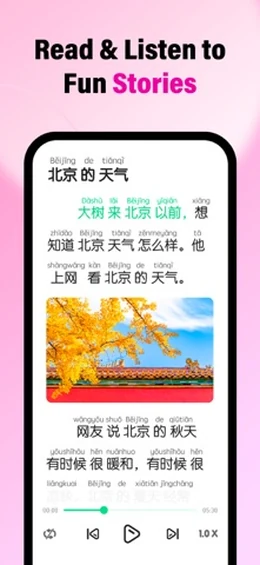
Two touches make HelloChinese reading work well early on:
- Pit-stop chapters. Every review unit ends with one episode of a running story built strictly from the words you just learned.
- Tone marks over hanzi. You can hide pinyin letters while keeping tone marks above characters so your eyes learn shapes without guessing pitch.
HelloChinese Premium+ also opens podcast-style Immersion lessons, on top of two thousand short native clips inside the main path. Learners note those short clips last just a few seconds and can sound noisy, so story audio works better for listening.
LingoDeer has no story library. Each Chinese I unit closes with a brief story to read aloud, and the Booster tab holds Fluency Builder dialogues and translation-free listening drills. Its native-speaker lesson videos have launched only for Japanese and Korean so far.
Check the price before buying HelloChinese Premium+ for stories alone. At $149.99 a year regularly, it costs more than Du Chinese, a dedicated reader with thousands of voiced readings for $119.99 a year. See every option in our Chinese graded readers guide.
Audio, speaking and tones: both stick to set lines
Both apps avoid flat robot audio for Mandarin. LingoDeer's Chinese page confirms native studio voices on every word and line, with speed tweaks in ten-percent steps and male or female packs. HelloChinese pairs studio audio with its story voices and native video clips.
When you speak, though, both apps still keep you on rails. Neither lets you build your own replies in an open chat.
HelloChinese checks speech on set lines and added a speaking drill to every pit stop in October 2025. Each character lights up green or red, and you replay your voice next to the model. Its store screen headlines AI speaking, yet shows the same read-aloud line for When are you going to Beijing, 你什么时候去北京 nǐ shénme shíhou qù Běijīng, with 去 marked red:
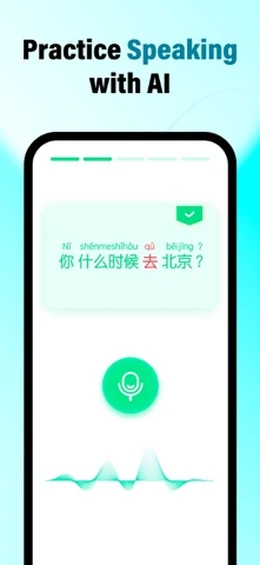
One user on r/ChineseLanguage saw skippable AI chats in the opening unit, and an October 2026 store critic got stuck on a screen named Chat with wang fai. Even so, a July 2026 Premium+ thread still called HelloChinese speaking mostly scripted shadowing.
LingoDeer's speaking tools split by phone. Both iPhone and Android offer record-and-compare, scored speaking prompts, Story-Speaking and Fluency Builder read-alouds.
Android users also get LingoDeer's five-unit Chinese Tone Training module, launched in beta in September 2025. It drills tone-sandhi rules and splits scores into tones, initials and finals. Through November 2026, iPhone release notes still do not list it.
Our main warning fits both apps. Neither publishes proof of how well it checks Mandarin tones. Speech tools lean on context to guess words.
Say buy, 买, with a falling tone and you say sell, 卖. Say sugar, 糖, flat and you say soup, 汤.
A review of fifteen studies found speech drills help individual sounds a lot, yet move pitch and stress only a little. Mandarin tones are pitch.
Use either mic to get comfy talking aloud, not as a final judge. Build your ear with our guide to Chinese tones, drill pairs in our free Tone Pair Trainer and test pitch on-device in our free Tone Checker, which checks against 984 clips at 80% tone accuracy.
Handwriting ties, yet HelloChinese wins Traditional script
Both apps beat Duolingo on writing by placing stroke tracing right inside lessons. That habit pays off. A study of adult learners found writing by hand builds memory for shape and meaning, while typing pinyin builds sound links only.
HelloChinese built stroke tracing in early and adds a component-based Characters course on Premium+. LingoDeer caught up in October 2025, adding handwriting for every lesson character in three modes: stroke hints, no hints and freehand.
Both apps also let you drop pinyin crutches cleanly. Look at LingoDeer's Google Play screen for This is my cat, 这是我的猫, showing its pinyin-off tile builder:
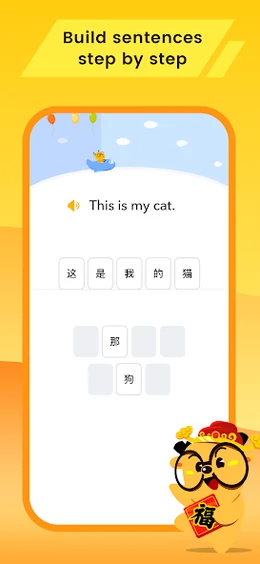
Where the two split is Traditional characters, the script used in Taiwan and Hong Kong.
HelloChinese supports both Simplified and Traditional script across its main path and graded stories. Note that its words and audio still stay Mainland Mandarin, with no zhuyin.
LingoDeer stays Simplified-first across its site, course maps and SRS help docs, which list Chinese modes only as Pinyin, Character or Both. One 2025 blog mentions a script toggle in settings, which we could not confirm in LingoDeer's help centre in November 2026.
If Taiwan Mandarin with zhuyin comes first, try ChineseSkill. It comes from Yiyan Technology, LingoDeer's own maker, and builds separate paths for Taiwan Mandarin, Hong Kong Cantonese and Hokkien. Still picking scripts? Read Simplified vs Traditional Chinese.
Review tools, AI policy, laptop use and offline study
Four daily details decide whether an app sticks past month two.
Spaced review. Both apps bake SRS into study, yet LingoDeer documents finer controls. LingoDeer's Review tab gives phone users five review modes plus four rating buttons with clear gaps, letting you move or hide cards. HelloChinese runs SRS through pit stops and review tabs, though free users lost open word review in 2026. Neither lets you import custom HSK decks.
AI rules and trust. Both teams say human teachers write lessons and native speakers voice audio, yet buyers reacted differently to their AI updates in 2026. LingoDeer limits generative AI to Tell Me Why mistake notes and alternate answers, disclosed in its dev logs with an off switch in Settings. HelloChinese admitted using AI for some Course 2.0 drawings and promotes AI speaking on store screens without a help page, drawing heat from reviewers who disliked AI art.
Offline and desktop study. Both apps download units offline on mobile once you pay for Premium, though AI checks still need internet. On laptops, LingoDeer wins clearly for Windows and Chromebook users.
LingoDeer's web app at lingodeer.com syncs across Mac, PC, Chromebook, iPhone and Android on Premium, while Fluency Builder and offline downloads stay mobile-only. HelloChinese has no web course at all, running on desktop only as a mobile app on Apple M1 or newer Macs.
What 400 recent US App Store reviews reveal
To check real learner pain points, we pulled two hundred recent US App Store reviews per app on 25 November 2026 across matched three-month windows. Both hold top store scores, yet their gripes diverge sharply:
| Store metric | HelloChinese | LingoDeer |
|---|---|---|
| US App Store overall rating | 4.87 stars, 24,131 ratings | 4.74 stars, 28,206 ratings |
| Google Play rating and installs | 4.8 stars, 416K reviews, 10M+ | 4.4 stars, 455K reviews, 10M+ |
| Aligned 200-review window | 30 Jul – 25 Oct 2026 | 26 Aug – 24 Nov 2026 |
| Sample mean rating (n = 200) | 4.73 stars | 4.59 stars |
| Positive 4–5 star share | 94% (188 of 200) | 91% (181 of 200) |
| Critical 1–3 star share | 6% (12 of 200) | 10% (19 of 200) |
| Grammar/explanation mentions (all 200) | 5% (9 of 200; 4.56 avg) | 23% (46 of 200; 4.63 avg) |
Source: Apple iTunes Lookup, Google Play US and Apple public US App Store RSS feeds audited 25 November 2026 (n = 200 per app).
We read every one- to three-star review by hand across both groups. Paywalls cause half of all low scores on both apps, while second gripes split cleanly:
Source: SayMei hand audit of all 12 critical HelloChinese reviews (30 Jul – 25 Oct 2026) and all 19 critical LingoDeer reviews (26 Aug – 24 Nov 2026). Reviews may mention more than one theme.
Look at the AI split first. Four of HelloChinese's twelve low ratings called out AI images or a stuck chat lesson, against just one of LingoDeer's nineteen low ratings.
LingoDeer's Chinese learners stood out too. Seventeen reviews in our LingoDeer sample named Chinese or Mandarin and averaged 4.94 stars with zero low scores. Still, a September 2026 five-star user urged adding Pleco, Du Chinese and Skritter to fill the gaps.
Both apps win fans fleeing Duolingo. Thirty-three positive HelloChinese reviews and thirty-eight positive LingoDeer reviews praised the app directly over Duolingo.
Why 2024 and early 2025 reviews are out of date
Many search posts still say LingoDeer lacks writing drills and speech scoring while selling a cheap lifetime pass, and call HelloChinese a short HSK 3 course. Both apps shipped major updates through late 2026:
April 2025
- App
 HelloChinese
- What changed
- Main Course 2.0 reaches English learners on the 2021 HSK standard
September 2025
- App
 LingoDeer
- What changed
- Chinese Tone Training (5 units, tone/initial/final scores) launches beta on Android
October 2025
- App
- HelloChinese
- What changed
- Speaking drills added to every pit stop in Main Course 2.0
October 2025
- App
- LingoDeer
- What changed
- Stroke-by-stroke handwriting launches for every character in Chinese lessons
December 2025
- App
- LingoDeer
- What changed
- Generative-AI Tell Me Why and alternative answers launch; Lifetime plans retired
June 2026
- App
- LingoDeer
- What changed
- AI mistake explanations reach iPhone (v3.1.14)
August 2026
- App
- HelloChinese
- What changed
- Upper Intermediate units expand Main Course 2.0 past 2,500 words and 430 grammar points
November 2026
- App
- LingoDeer
- What changed
- Booster tab (word, collocation, grammar, comprehension drills) ships on Android and iOS v4.0
Source: US App Store release histories, Android notes and LingoDeer developer logs, checked 25 November 2026.
Reviews from before August 2026 miss roughly a thousand HelloChinese words. Reviews from before December 2025 pitch LingoDeer lifetime passes you can no longer buy.
Who should pick HelloChinese, and who should pick LingoDeer?
Both apps build a stronger Mandarin base than Duolingo. Your best pick rests on four plain choices.
We would pick HelloChinese if:
- Mandarin is your sole goal. Every tip, drill and story targets Chinese learners directly.
- You want stories inside one app. Premium+ opens over a thousand audio stories from HSK 1 to HSK 5.
- You need Traditional script. Both scripts work cleanly across lessons and stories.
- You want a longer HSK path and lower year-one cost. Premium runs $69.99 a year and crosses 2,500 words.
We would pick LingoDeer if:
- You want deep grammar notes. Learning Tips, Chinese II units, Knowledge Cards and Booster drills explain every rule.
- You study on Windows or a Chromebook. The synced web app lets you type on a real keyboard.
- You study Japanese or Korean too. One plan unlocks all twenty courses.
- You want lower multi-year costs. Three-year and six-year web passes beat yearly renewals from year two on.
Want other options? SuperChinese costs $59.99 a year on iPhone, still sells a $139.99 lifetime pass and scores every spoken line. See HelloChinese vs SuperChinese or our best apps to learn Chinese guide.
Where SayMei fits, and where it doesn't
HelloChinese and LingoDeer teach words and rules through fixed lessons. Neither app holds a live spoken chat that answers what you actually say.
SayMei fills that exact gap. In our live lessons, Mei Lin talks with you aloud across twenty-five levels mapped to HSK 1 through HSK 6. She fixes your tones and grammar as you speak, with live hanzi, pinyin or both.
SayMei Premium costs $5.99 a month for 200 live minutes after a seven-day trial with a card, and unused minutes roll over while active.
Active members can also add a $2.99 Boost pack of one hundred minutes that never expire.
One account syncs across saymei.app, iPhone and Android. SayMei is also an app for iPhone and Android: get the app.
We also cover three extra beginner jobs inside the same account:
- Stories and real TV: SayMei Stories holds 169 books in 1,161 short chapters for HSK 1 to HSK 3 in Simplified or Traditional script, inside Premium or alone for $2.99 a month. Free SayMei TV pairs real shows and YouTube videos with tappable words.
- Tones and writing: SayMei Tones drills all four tones in quick rounds. Our free Tone Checker tests pitch on-device against 984 clips, and SayMei Characters traces all 1,200 November 2025 HSK 3.0 writing characters free with an account beside SayMei Radicals.
- Dialogues, lists and PDFs: We include 3,500+ dialogues, free HSK 1 to 9 word lists and 402 printable PDF workbooks free with an account.
We want to be plain about where HelloChinese and LingoDeer beat us. Live chats with Mei Lin need internet, though due flashcards work offline on mobile and PDFs work on paper. We skip multi-language packs and textbook Learning Tips, and our stories stop at HSK 3 where HelloChinese goes higher.
SayMei is not an offline dictionary like Pleco and does not book human tutors or mark exams. Our iPhone app is also not yet on the App Store in the EU, mainland China, Morocco or Afghanistan, where learners use the web.
Pairing one drill app with SayMei gives you structure plus live speech. Compare speaking tools in our best AI apps to learn Chinese guide.
What to do next
- Try both free starts over one weekend. Run HelloChinese's opening units plus LingoDeer's Basics 1 and Learning Tips to test the pace.
- Match the app to your laptop and goals. Pick LingoDeer for web study or extra languages; pick HelloChinese for Mandarin depth or Traditional script.
- Check web and store fees first. Skip LingoDeer's six-month App Store trap and check HelloChinese sale tiers.
- Pay monthly before locking in. Build a five-day weekly habit before buying a yearly or multi-year pass.
- Add tone checks and live speech early. Pair course drills with pitch checks and real spoken chats.
When you are ready to turn course words into real speech, try a spoken lesson with Mei Lin.
FAQ
Is HelloChinese or LingoDeer better for complete beginners in 2026?
Both are strong starter apps for Mandarin in 2026, and your pick comes down to study style. HelloChinese feels warmer and gentler for Mainland Mandarin, pairing short Teacher Talks with pit-stop stories. LingoDeer feels closer to a crisp textbook, giving thorough pre-unit Learning Tips and clear grammar rules before every quiz.
How much do HelloChinese and LingoDeer cost in 2026?
On regular US rates in 2026, HelloChinese Premium costs $11.99 a month or $69.99 a year, while Premium+ with stories runs $149.99 a year. LingoDeer costs $14.99 a month or $95.99 a year, plus cheaper web three-year and six-year one-time passes.
Does LingoDeer or HelloChinese still offer a lifetime plan in 2026?
No. Neither app sells a lifetime pass in November 2026. HelloChinese never offered one, and LingoDeer ended Lifetime sales by December 2025 despite old rows staying on Apple's list. LingoDeer replaced Lifetime with web-only three-year and six-year passes, while SuperChinese PLUS still sells a lifetime pass on Apple's store.
Which app reaches a higher HSK level: HelloChinese or LingoDeer?
HelloChinese gives a longer, clearer HSK climb. Its August 2026 expansion pushed the main course past 2,500 words, clearing the new HSK 4 target of two thousand words. LingoDeer's topic lessons aim at CEFR B1 rather than HSK, skipping many HSK 1 words while teaching HSK 6 terms.
Does LingoDeer have graded stories like HelloChinese?
No. Graded reading is HelloChinese's clearest lead in 2026, with over a thousand human-written graded audio stories from HSK 1 to HSK 5 unlocked on Premium+. LingoDeer includes short end-of-unit stories in Chinese I, Fluency Builder dialogues and Booster listening drills, with no standalone story library. Add Du Chinese or SayMei Stories for reading.
Which is better for Traditional characters: HelloChinese or LingoDeer?
HelloChinese wins clearly for Traditional characters in 2026. It officially supports both Simplified and Traditional script across its main course and graded stories, though words and audio stay Mainland Mandarin. LingoDeer stays Simplified-first across its website and official help centre docs. For Taiwan Mandarin with zhuyin, try LingoDeer's sister app ChineseSkill.
Can you use HelloChinese or LingoDeer on a computer and offline?
Both apps download lessons for offline phone study with Premium in 2026, while AI features need internet. On a laptop, only LingoDeer offers a synced web app at lingodeer.com for Windows, Mac and Chromebooks, though Fluency Builder stays mobile-only. HelloChinese has no web app and runs on desktop solely on Apple M1 or newer Macs.
Which app is better for Mandarin speaking and tones in 2026?
Neither app holds live conversation or proves how well it checks tones in 2026, making speaking a narrow tie. HelloChinese puts green-and-red speech drills in every pit stop across iPhone and Android. LingoDeer scores set lines on both platforms and adds five-unit Chinese Tone Training on Android, not yet listed for iOS.
Sources
Checked 25 November 2026. No accounts were created, no free trials were started and nothing was purchased.
HelloChinese
- HelloChinese on the US App Store and Google Play: ratings, installs, v7.6–v7.7 release notes, compatibility, prices and listing images
- hellochinese.cc and Terms of Use: user claims, mobile-only availability and refund policy (§7)
- HelloChinese team comments on Reddit: 2021 HSK standard, human-written stories and AI image disclosure
- FluentU HelloChinese review (updated 21 January 2025): Premium vs Premium+ tier breakdown
LingoDeer
- LingoDeer on the US App Store, Google Play and LingoDeer Plus on the US App Store: ratings, v4.0 Booster release notes, in-app prices and listing images
- lingodeer.com, Chinese page, pricing page, Black Friday 2026 page, Chinese I and Chinese II course maps, and Travel Phrasebook
- LingoDeer Help Centre: free content, course level, long-term plans & Lifetime sunset, refunds, Learning Tips, translations, SRS review and multi-device web access
- LingoDeer developer logs: Chinese Tone Training (19 September 2025), handwriting (17 October 2025), AI mistake explanations (26 December 2025), Booster tab (4 November 2026) and ChineseSkill sister-app note
Reviews, HSK, research and alternatives
- Apple public US App Store RSS feeds for HelloChinese and LingoDeer (200 reviews per app, audited 25 November 2026)
- r/ChineseLanguage threads: full-course HelloChinese review (August 2026), speaking exercises (July 2026), free lessons (May 2026) and non-AI Chinese apps (September 2026)
- November 2025 HSK 3.0 syllabus and CTI 2009 HSK 2.0 table
- Ngo, Chen & Lai (2024) (ReCALL 36:1, 15-study ASR meta-analysis) and Guan et al. (2011) (Journal of Educational Psychology 103:3)
- SuperChinese US App Store, ChineseSkill pricing, Du Chinese pricing and SayMei pricing
Methods
This comparison relies solely on public primary sources checked on 25 November 2026: official websites, pricing pages, help centres, terms of use, developer logs, US App Store and Google Play listings and public learner reviews. We did not create paid accounts or run paid trials; every feature is attributed to official vendor documentation or labelled learner reports.
- Prices: All prices are US dollars from Apple's US App Store and each company's live US website on 25 November 2026. Regional prices and seasonal sales can vary.
- 400-review US App Store audit: We collected two hundred recent reviews per app from Apple's public US App Store RSS feed on 25 November 2026 (HelloChinese: 30 July – 25 October 2026; LingoDeer: 26 August – 24 November 2026) and classified every one- to three-star review by hand; reviews raising multiple themes count in each.
- HSK benchmarks: Cumulative exam word totals come from CTI's 2009 HSK 2.0 table and the November 2025 HSK 3.0 syllabus. LingoDeer's headline-word spread comes from matching the 1,048 distinct words named on its public Chinese I and II lesson maps against the November 2025 HSK 3.0 syllabus (full lesson sentences include additional words beyond headline entries).
- Screenshots and Mandarin examples: All three screenshots are official US App Store or Google Play vendor images verified visually for review. Hanzi and tone-marked pinyin examples were checked against standard dictionaries.
If you spot an error or a price update, tell us: we fix mistakes promptly.