Kids · Kids workbook
Chinese Clothes Worksheets for Kids: Printable Pack
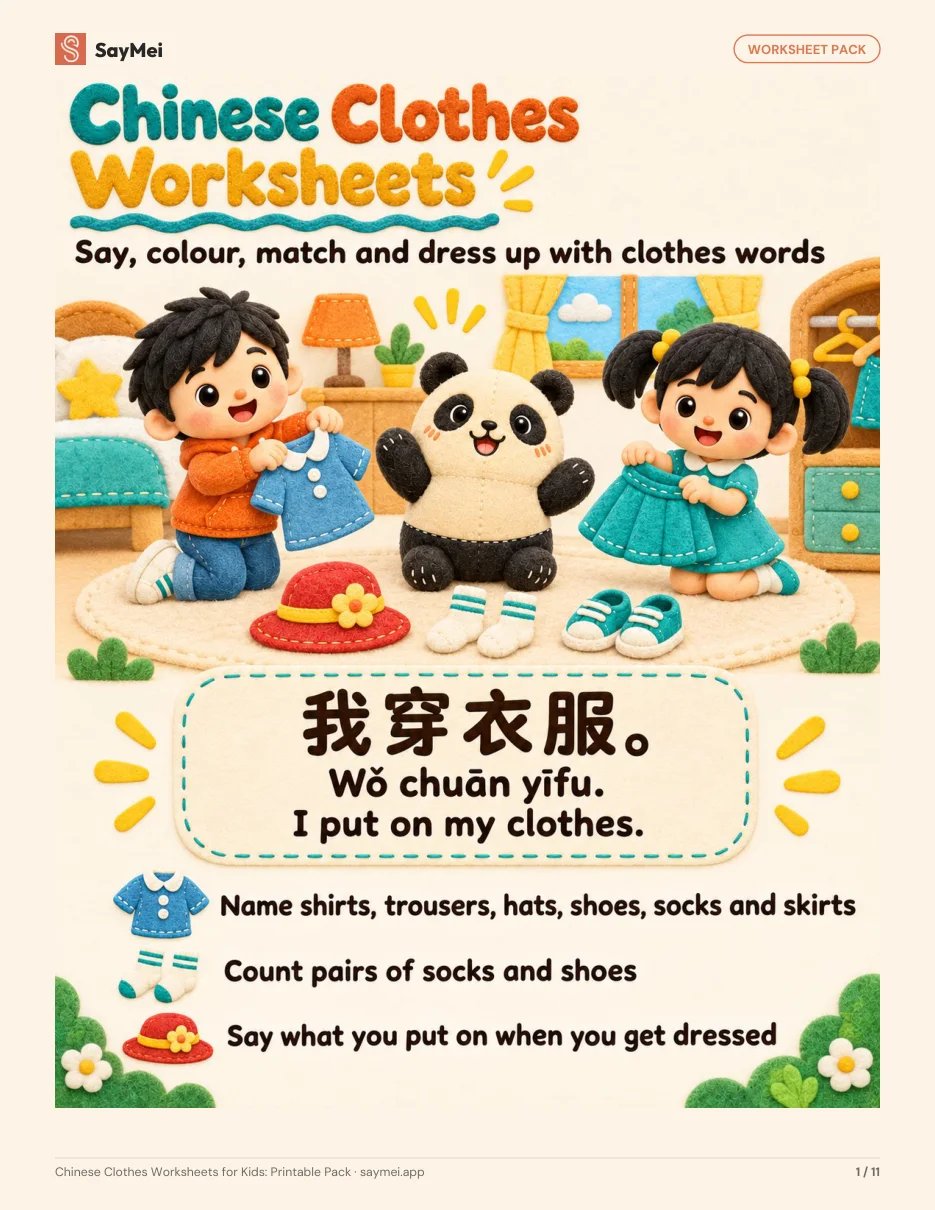
You and your child name a hat, socks and a skirt, count pairs of shoes with 双 and say 我穿鞋子 while getting dressed. For ages 3 to 7, with pinyin for every word.
- Level:
- Kids 3–7
- Format:
- Worksheet pack · PDF · 12 pages · US Letter (prints on A4)
- Price:
- Free · free with a saymei account · updated Nov 12, 2026
Download the free PDF: create a free SayMei account on this page, and we'll email you a copy too.
我穿衣服。 · Wǒ chuān yīfu. · I put on my clothes.
By the end you can
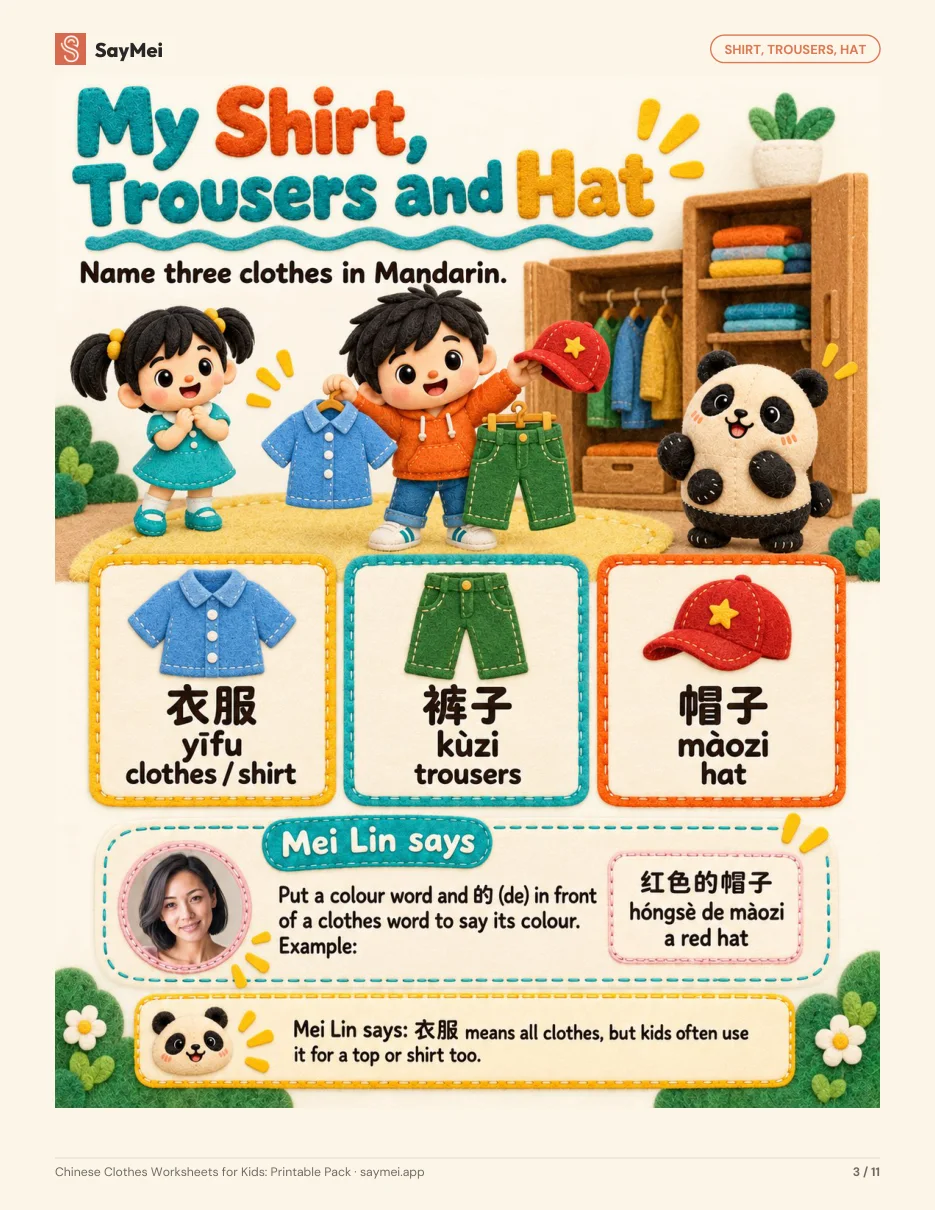
- Name a shirt, trousers and a hat. 衣服, 裤子 and 帽子. 衣服 means all clothes, but children often use it for a top or shirt too. Your child traces the words and matches each one to its meaning.
帽子 · màozi · hat - Say what colour the clothes are. A colour word and 的 (de) go in front of the clothes word: 红色的帽子 is a red hat. Your child colours Lele's and Duoduo's clothes from the Chinese.
红色的帽子 · hóngsè de màozi · a red hat - Name shoes, socks and a skirt. 鞋子, 袜子 and 裙子 all end in a soft 子 (zi). Your child circles the clothes that go on your feet, then points to their own feet and names what they're wearing.
裙子 · qúnzi · skirt - Count pairs with 双. Shoes and socks come in pairs, so they're counted with 双 (shuāng), which means a pair. Your child counts the pairs of socks on a washing line.
一双袜子 · yì shuāng wàzi · a pair of socks - Say what you put on with 穿 and 戴. Chinese has two words for wear: 穿 (chuān) for clothes your body goes into, and 戴 (dài) for a hat. Your child fills the gaps with 穿 or 戴 and draws Bao in his clothes.
我戴帽子。 · Wǒ dài màozi. · I put on my hat. - Play Bao's dress-up party. Lele and Duoduo play a game that mixes body, clothes and colour words. Your child finishes two sentences, then tells you what colour their shirt is.
我穿红色的衣服。 · Wǒ chuān hóngsè de yīfu. · I'm wearing a red shirt. - Name eight things to wear. The clothes cards add 外套 (coat) and 手套 (gloves), each with a short phrase to say, such as 戴手套 or 一双鞋子.
外套 · wàitào · coat
What’s inside
- Shirt, trousers, hat: My Shirt, Trousers and Hat · Shirt, Trousers and Hat
- Shoes, socks, skirt: My Shoes, Socks and Skirt · Shoes, Socks and Skirt
- Getting dressed: Getting Dressed · Dress Bao Up
- Dress-up party: Bao's Dress-Up Party
- Clothes cards: Clothes
The pages come from Body Parts and Clothes in Chinese for Kids (Ages 4–6) · Chinese Flashcards for Kids: 96 Picture Cards to Print (Ages 3–7).
How to use this book
About ten minutes a day is plenty. Read each Chinese line aloud with its pinyin, let your child say it back and point, then do one exercise together. Getting dressed in the morning is a good time to say the words again.
- Day 1: Shirt, trousers and hat. Pages 3 and 4. Say the three clothes, trace 衣服 and 裤子, colour Lele's clothes and name the colour of your child's own top.
- Day 2: Shoes, socks and skirt. Pages 5 and 6. Say the three words, count pairs of socks with 双 and colour Duoduo's skirt and shoes.
- Day 3: Getting dressed. Pages 7 and 8. Learn 穿 and 戴, fill the gaps and draw Bao's outfit, then say each thing as your child gets dressed.
- Day 4: Dress-up party. Page 9. Read the game as Lele and Duoduo, play it with a hat, and finish the two sentences.
- Day 5: Clothes cards. Page 10. Cut out the eight cards, hold them up one at a time and say each one together. The answers are on page 11.
Who it’s for
Children aged 3 to 7 learning their first clothes words in Chinese, with a parent at home or a teacher in class.
Before you start: Nothing. Every word has pinyin and English, so you don't need to speak Chinese yourself. Colour words like 红色 and 蓝色 come up on several pages. You'll need crayons, a pencil, and scissors for the cards.
Frequently asked questions
What's inside this pack?
Eight worksheets on pages 3 to 10, taken from SayMei's kids workbooks: a shirt, trousers and a hat, then shoes, socks and a skirt, getting dressed with 穿 and 戴, Bao's dress-up party game and eight clothes cards to cut out. The answer key is on page 11.
Why does Chinese have two words for wear?
穿 (chuān) is for clothes your body goes into, such as 衣服, 裤子, 袜子 and 鞋子. 戴 (dài) is for a hat, and the cards use it for gloves too (戴手套). Page 8 has your child choose 穿 or 戴 to fill each gap.
What age is it for?
Ages 3 to 7. Younger children can point, colour and play the dress-up game while you read the Chinese aloud. Older children can also trace the clothes words and fill the 穿 or 戴 gaps on page 8.
Does the party game use words the pack doesn't teach?
Two: 头 (head) and 鼻子 (nose), from the body pages of the same book. Page 9 prints them with pinyin and English, so you can read them out as you play.
Is there audio?
No, this pack has no audio. Every Chinese line has pinyin and English, so you can read it aloud yourself, and short tips explain words in plain English, such as the soft 子 at the end of 鞋子, 袜子 and 裙子.
What can we use after this pack?
Most pages come from Body Parts and Clothes in Chinese for Kids (Ages 4–6), which also teaches the body words used in the party game. The cards are from Chinese Flashcards for Kids: 96 Picture Cards to Print (Ages 3–7).
Do I need a SayMei account?
Yes, to download the PDF, and the account is free: sign up with Google, Apple or your email address. With it we email you a copy of the workbook, keep every workbook you download on your account on all your devices, save your place in the free online practice, and you can practise speaking with Mei Lin, SayMei's AI tutor.
How do I print it?
The PDF is US Letter size. On A4 paper, choose "Fit to page" (or "Scale to fit") in the print dialog so nothing is cut off. Print the whole workbook or only the pages you need; colour looks best, and black and white works too.
Keep going
Chinese Flashcards for Kids: 96 Picture Cards to Print (Ages 3–7) · Chinese Colors Worksheets for Kids: Printable Pack with Pinyin · Chinese Body Parts Worksheets for Kids: Printable Pack · Chinese Greetings Worksheets for Kids: Printable Pack · Browse all 340 workbooks
Version 2026-11 · Updated Nov 12, 2026 · Report a correction