Kids · Kids workbook
Chinese Greetings Worksheets for Kids: Printable Pack
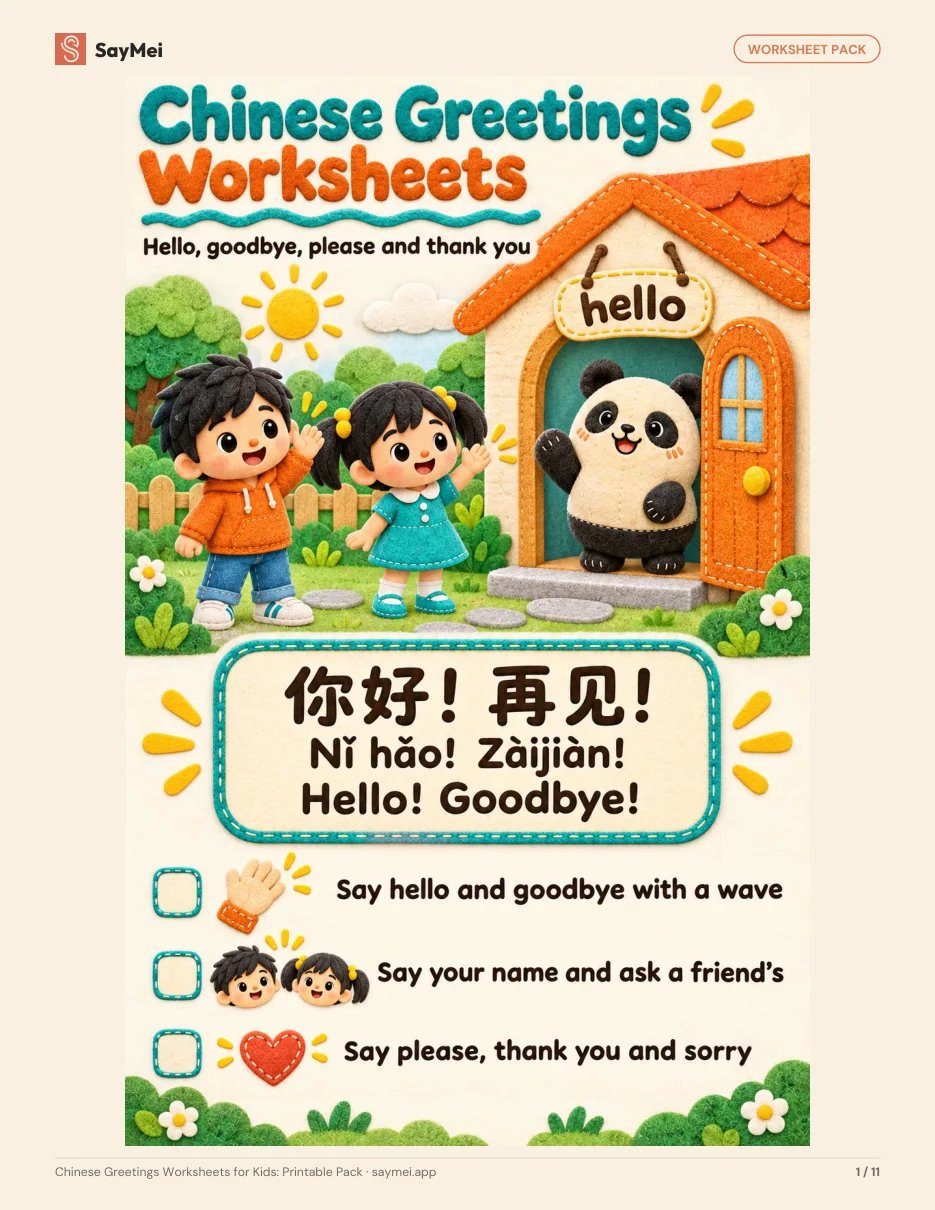
Your child waves hello and goodbye, greets everyone with 大家好, says their name with 我叫 and learns what to say back to 谢谢 and 对不起. For ages 3 to 7, with pinyin for every word.
- Level:
- Kids 3–7
- Format:
- Worksheet pack · PDF · 12 pages · US Letter (prints on A4)
- Price:
- Free · free with a saymei account · updated Nov 12, 2026
Download the free PDF: create a free SayMei account on this page, and we'll email you a copy too.
你好!再见! · Nǐ hǎo! Zàijiàn! · Hello! Goodbye!
By the end you can
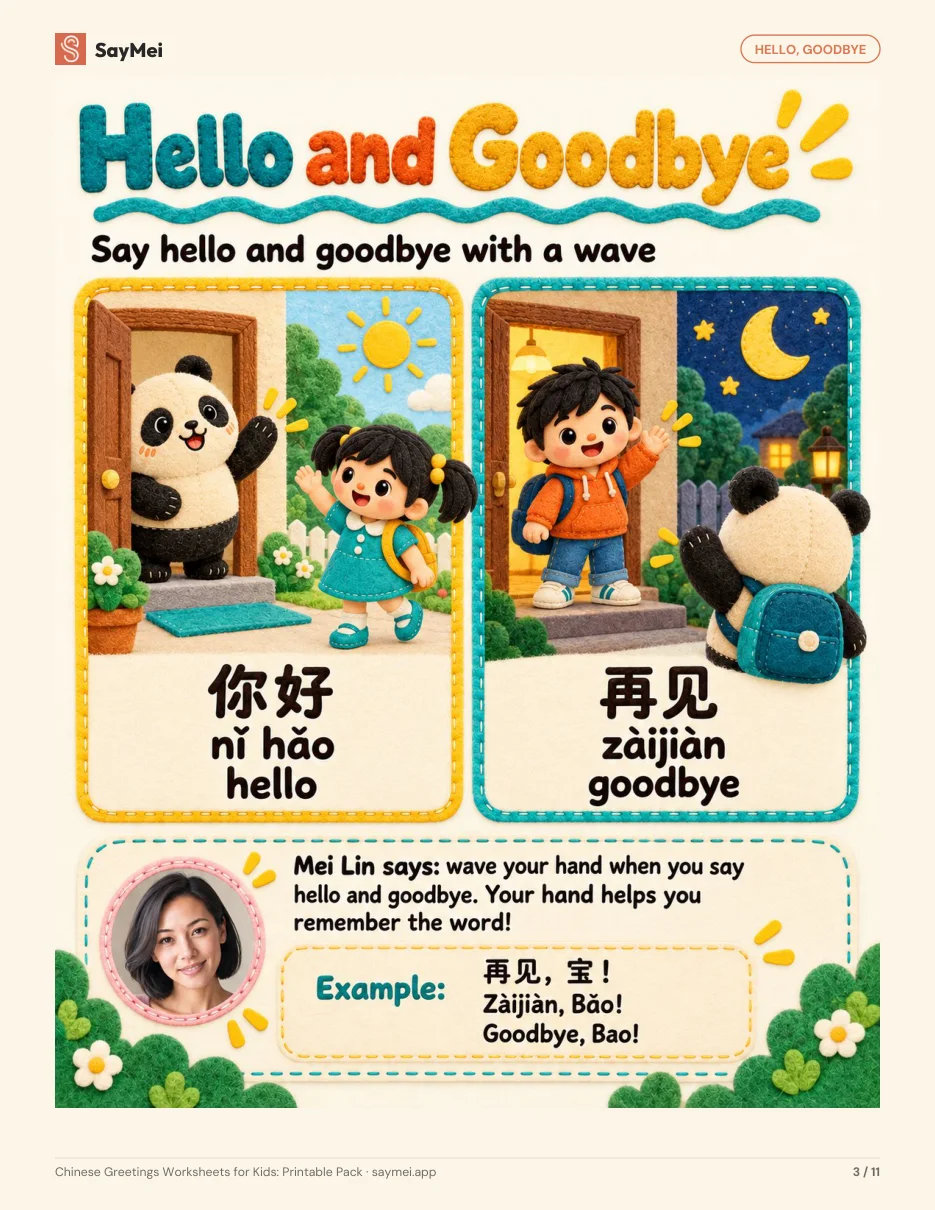
- Say hello and goodbye with a wave. 你好 and 再见, with a wave for each so the hand helps the word stick. Your child matches pictures to hello or goodbye and traces Bao's path to his friend's door.
再见,宝! · Zàijiàn, Bǎo! · Goodbye, Bao! - Greet a whole group, then each person. 大家好 greets everyone at once, and 你好 plus a name greets one person. Your child claps once on each word of 大家好, then says hello to each person by name.
大家好! · Dàjiā hǎo! · Hello, everyone! - Say your name and ask a friend's. Start with 我叫 and add the name. The answer uses the question's words: 你叫 becomes 我叫. Swap 我 for 他 to talk about a boy.
你叫什么名字? · Nǐ jiào shénme míngzi? · What is your name? - Trace 我 and match names. Your child traces 我 and 叫, circles 名字 (name), matches badges to Lele, Duoduo and Bao, then tells Bao their own name.
我叫乐乐。 · Wǒ jiào Lèle. · My name is Lele. - Ask with please and answer thank you. 请 goes at the very start, before what you want. 谢谢 is thank you and 不客气 is the reply. The page suggests playing shop with toy fruit.
请给我苹果。 · Qǐng gěi wǒ píngguǒ. · Please give me an apple. - Say sorry and it's OK. 对不起 is sorry and 没关系 is the kind reply. Adding 我帮你 (I'll help you) makes a sorry kinder, and a note for grown-ups helps when a child isn't ready to say sorry.
对不起,我帮你。 · Duìbuqǐ, wǒ bāng nǐ. · Sorry, I'll help you.
What’s inside
- Hello, goodbye: Hello and Goodbye · Wave Hello, Wave Goodbye
- Hello, everyone: Hello, Everyone · Wave and Clap Hello
- My name is: My Name Is ... · Who Am I?
- Please, thank you: Please and Thank You
- Sorry: Sorry and It's OK
The pages come from Mandarin for Preschoolers: First Words Activity Book · Mandarin Circle Time for Preschoolers: Immersion-Style Routines to Do at Home · Mandarin for Kids: My Family & Me · Feelings and Manners in Chinese for Kids: Happy, Sad, Please and Thank You (Ages 3–6).
How to use this book
About ten minutes a day is plenty. Read each Chinese line aloud with its pinyin, let your child say it back and point, then do one exercise together. Use the greetings for real at the door, at meals and at bedtime.
- Day 1: Hello and goodbye. Pages 3 and 4. Wave and say 你好 and 再见, match the pictures, and trace Bao's path to his friend's door.
- Day 2: Hello, everyone. Pages 5 and 6. Greet the whole family with 大家好, clap its three words, then greet each person by name.
- Day 3: My name is. Pages 7 and 8. Ask 你叫什么名字, answer with 我叫, trace 我 and 叫, and match the name badges.
- Day 4: Please and thank you. Page 9. Play shop with toy fruit: your child asks with 请给我 and you answer 给你 (here you are).
- Day 5: Sorry and it's OK. Page 10. Say 对不起 and 没关系 together, and add 我帮你 when someone needs a hand. The answers are on page 11.
Who it’s for
Children aged 3 to 7 learning their first greetings and polite words in Chinese, with a parent at home or a teacher in class.
Before you start: Nothing. Every word has pinyin and English, so you don't need to speak Chinese yourself. You'll need a pencil, and toy fruit for the shop game on page 9.
Frequently asked questions
What's inside this pack?
Eight worksheets on pages 3 to 10, taken from SayMei's kids workbooks: hello and goodbye, greeting everyone in a circle, saying your name and asking a friend's, then please and thank you, and sorry and it's OK, each with its reply. The answer key is on page 11.
What's the difference between 你好 and 大家好?
你好 greets one person, and you can add their name: 你好,乐乐! 大家好 greets a whole group at once, such as a class or a circle of children. Page 6 has your child clap once on each of its three words.
Does it teach the replies as well?
Yes. 谢谢 (thank you) is answered with 不客气 (you're welcome), and 对不起 (sorry) with 没关系 (it's OK). The name page teaches your child to answer 你叫什么名字 with 我叫 and their name.
What age is it for?
Ages 3 to 7. Most pages are about saying and doing: waving, clapping, pointing and playing shop. Older children can also trace 我 and 叫 and match the name badges on page 8.
Is there audio?
No, this pack has no audio. Every Chinese line has pinyin and English, so you can read it aloud yourself, and short tips explain how to use each greeting, such as where 请 goes in a sentence.
What can we use after this pack?
Pages 9 and 10 come from Feelings and Manners in Chinese for Kids: Happy, Sad, Please and Thank You (Ages 3–6), which goes on to feelings, sharing and taking turns, with free audio on its page. The name pages are from Mandarin for Kids: My Family & Me.
Do I need a SayMei account?
Yes, to download the PDF, and the account is free: sign up with Google, Apple or your email address. With it we email you a copy of the workbook, keep every workbook you download on your account on all your devices, save your place in the free online practice, and you can practise speaking with Mei Lin, SayMei's AI tutor.
How do I print it?
The PDF is US Letter size. On A4 paper, choose "Fit to page" (or "Scale to fit") in the print dialog so nothing is cut off. Print the whole workbook or only the pages you need; colour looks best, and black and white works too.
Keep going
Chinese Flashcards for Kids: 96 Picture Cards to Print (Ages 3–7) · Chinese Colors Worksheets for Kids: Printable Pack with Pinyin · Chinese Body Parts Worksheets for Kids: Printable Pack · Chinese Clothes Worksheets for Kids: Printable Pack · Browse all 340 workbooks
Version 2026-11 · Updated Nov 12, 2026 · Report a correction