Conversation · Beginner
Family Members in Chinese: Family Tree Chart and What to Call Every Relative
You'll tell 伯伯 from 叔叔, 堂 cousins from 表 cousins and your dad's parents from your mum's, then greet everyone at a birthday dinner. For beginners meeting a partner's family and heritage learners getting relatives right.
- Level:
- Beginner · HSK 1
- Format:
- Workbook · PDF · 32 pages · US Letter (prints on A4)
- Price:
- Free · free with a saymei account · updated Oct 27, 2026
Download the free PDF: create a free SayMei account on this page, and we'll email you a copy too.
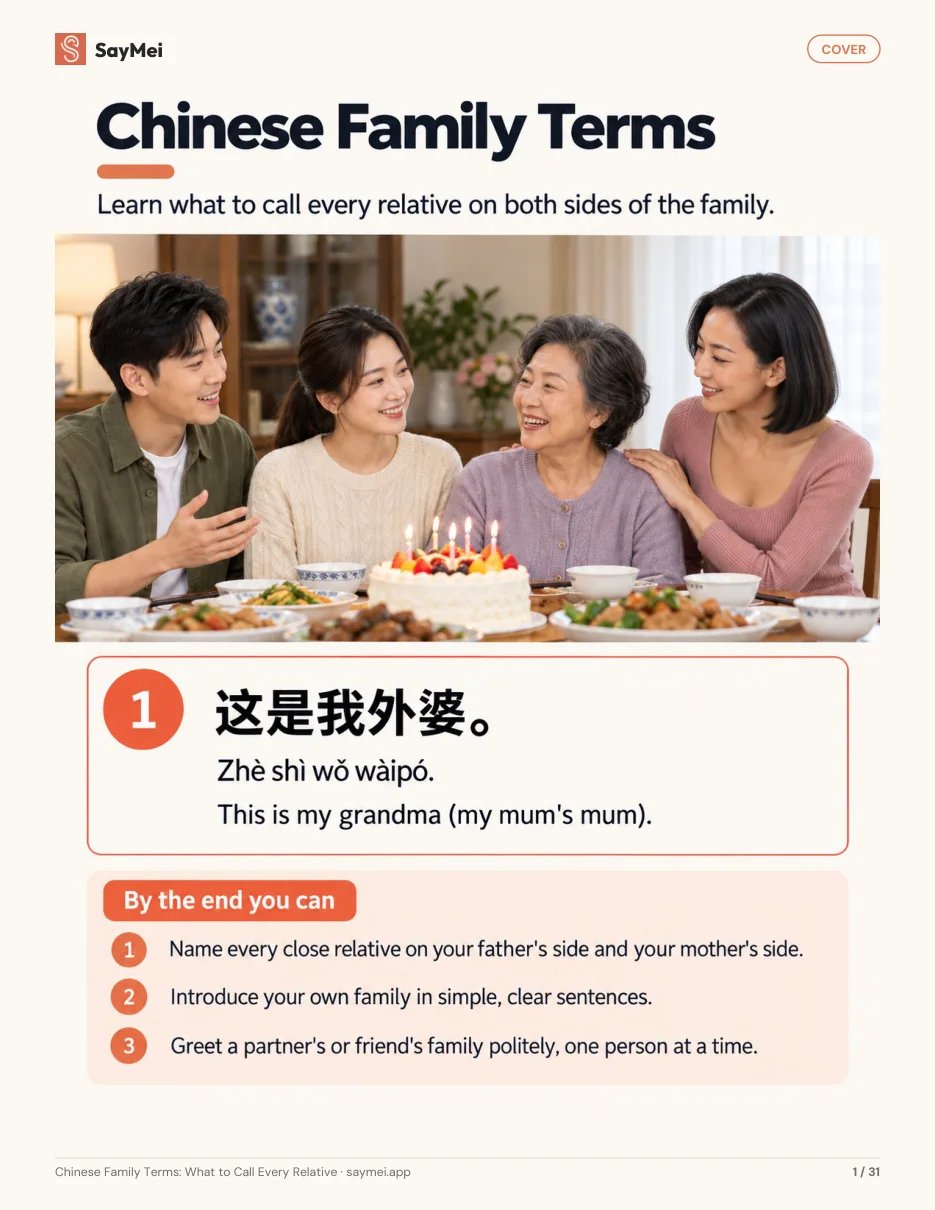
这是我外婆。 · Zhè shì wǒ wàipó. · This is my grandma (my mum's mum).
By the end you can
- Learn the two rules behind most family words. Which side of the family a person is on (外 marks your mother's side), and whether they are older or younger than you or your parent.
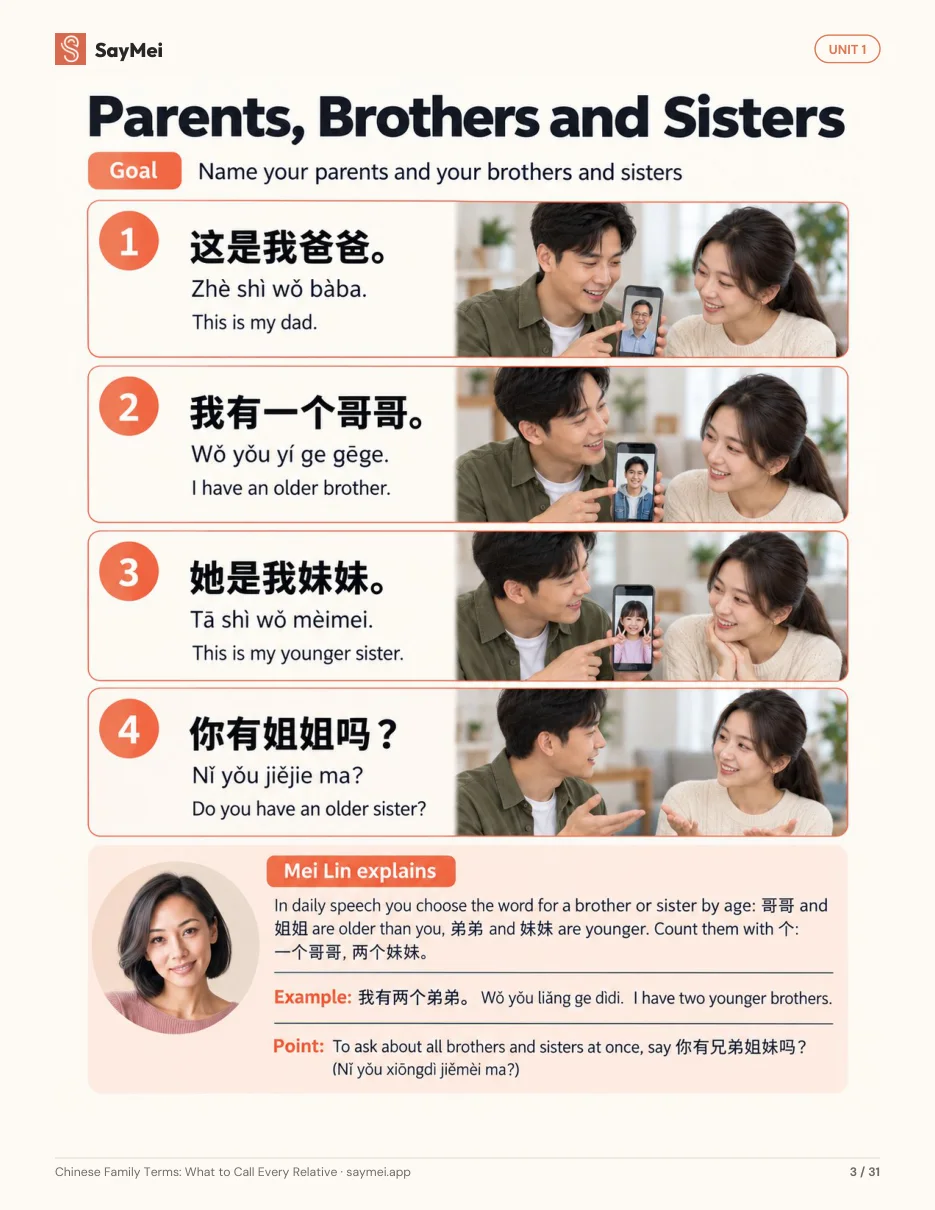
外公 · wàigōng · mum's father - Name parents, brothers and sisters by age. Choose 哥哥 or 弟弟, 姐姐 or 妹妹 by age, and count siblings with 个.
我有一个哥哥。 · Wǒ yǒu yí ge gēge. · I have an older brother. - Tell your father's parents from your mother's. 爷爷 and 奶奶 on your dad's side, 外公 and 外婆 on your mum's, with the 姥爷 and 姥姥 many northern families use, and 您 to greet them.
外婆,您好! · Wàipó, nín hǎo! · Hello, Grandma! (to your mum's mum) - Name every uncle and aunt on both sides. On your dad's side, 伯伯 is older than your dad and 叔叔 is younger. On your mum's side, every brother is 舅舅. Family-tree charts show how to greet each one.
他是我叔叔。 · Tā shì wǒ shūshu. · He is my uncle (my dad's younger brother). - Tell 堂 cousins from 表 cousins. 堂 cousins are your dad's brothers' children and usually share your surname. Every other cousin is 表. Then add 哥, 姐, 弟 or 妹 for age.
她是我表妹。 · Tā shì wǒ biǎomèi. · She is my younger cousin. - Talk about partners and in-laws. Formal 丈夫 and 妻子, warm everyday 老公 and 老婆, the words for each set of in-laws, and the 爸 and 妈 many people say to a partner's parents.
这是我丈夫。 · Zhè shì wǒ zhàngfu. · This is my husband. - Name children, grandchildren, nieces and nephews. 外 marks the line through a daughter or a sister, so a daughter's son is 外孙 and a sister's daughter is 外甥女.
这是我孙女。 · Zhè shì wǒ sūnnǚ. · This is my granddaughter (my son's daughter). - Use family words with people who aren't family. Call a friend's parents 叔叔 and 阿姨, an older stranger 爷爷 or 奶奶, and someone a little older than you 哥 or 姐 after their surname.
叔叔好!阿姨好! · Shūshu hǎo! Āyí hǎo! · Hello! (to a friend's dad and mum) - Introduce your own family. Count your family with 口, and explain any relative with a chain of 的 when you forget the special word.
他是我妈妈的哥哥。 · Tā shì wǒ māma de gēge. · He is my mum's older brother.
What’s inside
- Unit 1: Parents, Brothers and Sisters · Practice: Parents and Siblings
- Unit 2: Grandparents on Both Sides · Practice: Grandparents
- Unit 3: Your Father's Side · Practice: Father's Side
- Unit 4: Your Mother's Side · Practice: Mother's Side
- Family Tree: Family Tree: Father's Side · Family Tree: Mother's Side
- Unit 5: Cousins: 堂 or 表 · Practice: Cousins
- Unit 6: Partners and In-Laws · Practice: Partners and In-Laws
- Unit 7: The Next Generation · Practice: The Next Generation
- Unit 8: Family Words for Everyone · Practice: Words for Everyone
- Unit 9: Introduce Your Family · Practice: Introduce Your Family
- Story: Lin Hao at the Birthday Dinner · Who Is Who at the Dinner
- Review: Meet the Whole Family
- Cards: Most-Confused Pairs
How to use this book
Nine units, each a learn page and a practice page, then a story, a review and a page of the most-confused pairs. Say every phrase out loud, then do the exercises without looking back.
- Day 1: The two rules. Read page 2 on side and age, then do Units 1 and 2: parents, siblings and both sets of grandparents.
- Days 2–3: Uncles and aunts. Units 3 and 4, then check yourself against the family-tree charts on pages 11 and 12.
- Days 4–5: Cousins, in-laws and children. Units 5 to 7: 堂 or 表 cousins, partners and in-laws, then children, grandchildren, nieces and nephews.
- Day 6: Outside the family. Units 8 and 9: polite family words for friends and strangers, and introducing your own family.
- Day 7: The birthday dinner. Read Lin Hao's story, answer the questions, then greet each of Xiaoyu's relatives in turn on page 25. Keep the confused-pairs cards on page 26 for review.
Who it’s for
Beginners who need to address a Chinese family: partners meeting the in-laws, heritage learners who want to get relatives right, and anyone going to a family dinner or wedding.
Before you start: A few words of Chinese help. The family words are the topic, and the sentences around them use simple new HSK 1 and 2 words, all with pinyin and English.
Frequently asked questions
What's in the book?
Nine units, each a learn page and a practice page: parents and siblings, grandparents, your father's side, your mother's side, cousins, partners and in-laws, the next generation, family words for people who aren't family, and introducing your own family. Two family-tree charts follow the uncles and aunts, and the book ends with a birthday-dinner story, a review and a page of the most-confused pairs.
Why does Chinese have so many words for relatives?
Most family words tell you two things English leaves out: which side of the family the person is on, and whether they are older or younger. Once you know those two rules, the words follow a pattern.
Is it 外婆 or 姥姥 for my mum's mum?
Both are correct. Many northern families say 姥姥 and 姥爷, and many others say 外婆 and 外公. Use the words your family uses.
What should I call my partner's parents?
Unit 6 covers the formal words for in-laws and what people actually say to them: many people call a partner's parents 爸 and 妈. The story and review then walk through greeting a whole family at dinner.
Do I need to know any Chinese first?
A few words help. The family words are the topic, and the sentences around them use simple new HSK 1 and 2 words, all with pinyin and English.
How long does it take?
About a week in the book's plan: the two rules and the grandparents on day 1, uncles and aunts on days 2 and 3, cousins, in-laws and children on days 4 and 5, words for friends and strangers on day 6, and the birthday dinner on day 7.
Do I need a SayMei account?
Yes, to download the PDF, and the account is free: sign up with Google, Apple or your email address. With it we email you a copy of the workbook, keep every workbook you download on your account on all your devices, save your place in the free online practice, and you can practise speaking with Mei Lin, SayMei's AI tutor.
How do I print it?
The PDF is US Letter size. On A4 paper, choose "Fit to page" (or "Scale to fit") in the print dialog so nothing is cut off. Print the whole workbook or only the pages you need; colour looks best, and black and white works too.
Keep going
Keep a Mandarin Conversation Going · Talk About Your Day: Mandarin Daily Routines Workbook · Hobbies in Chinese: Sports, Free Time and Invitations · Spoken Mandarin Days 15–30: Your Next Two Weeks of Speaking · Browse all 294 workbooks
Version 2026-10 · Updated Oct 27, 2026 · Report a correction