Culture · Intermediate
100 Chinese Proverbs and Sayings with Pinyin, Meanings and Audio
One hundred Chinese proverbs, sayings and quotes people still use, in ten themes, each with pinyin, its meaning, what it says word for word and when people say it. Free audio reads every one.
- Level:
- Intermediate · HSK 3
- Format:
- Reference guide · PDF · 21 pages · US Letter (prints on A4)
- Price:
- Free · free with a saymei account · updated Nov 11, 2026
Listening audio: play every track free, no account needed.
Download the free PDF: create a free SayMei account on this page, and we'll email you a copy too.
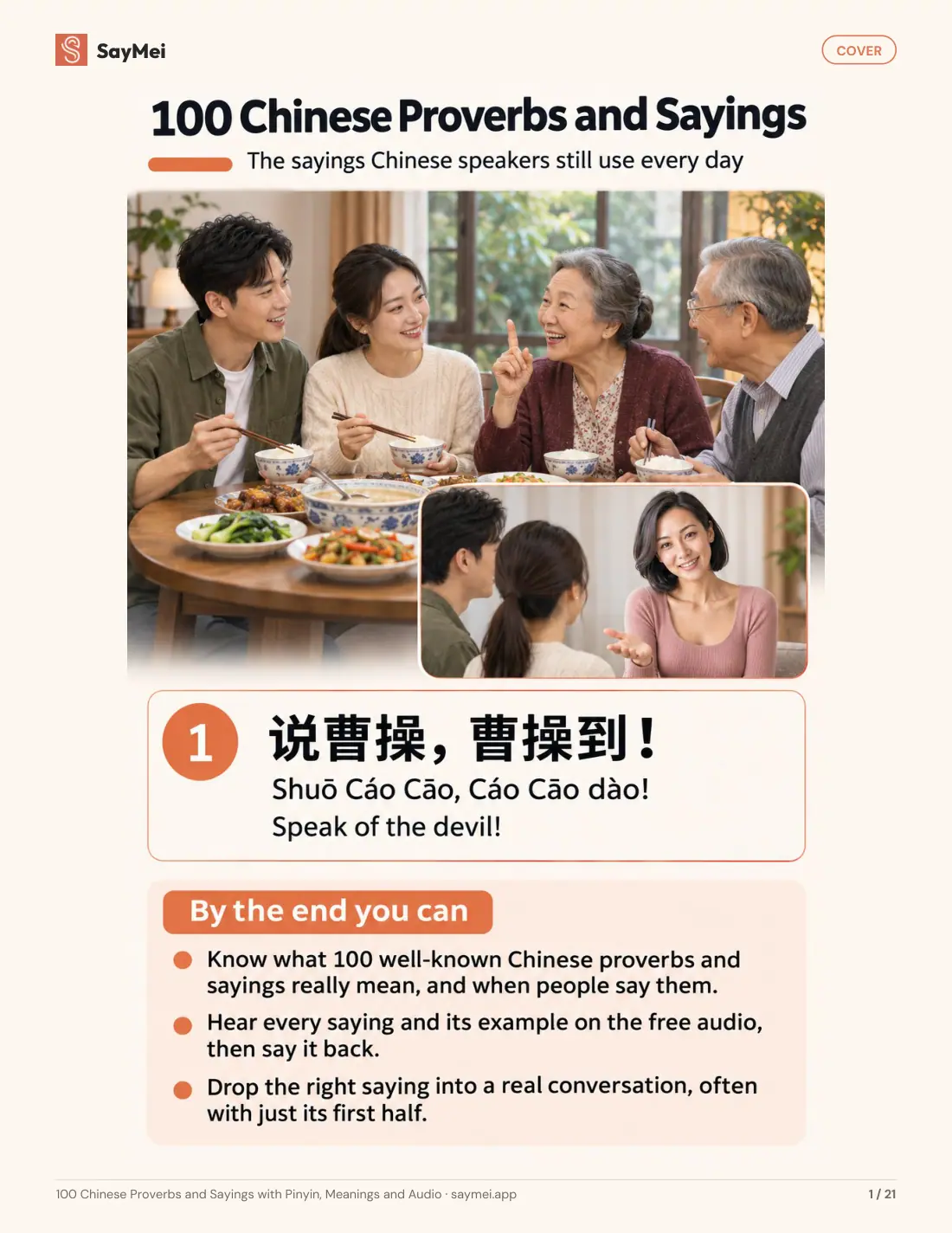
说曹操,曹操到! · Shuō Cáo Cāo, Cáo Cāo dào! · Speak of the devil!
By the end you can
- Know what 100 well-known Chinese proverbs really mean. From 活到老,学到老 to 车到山前必有路, each saying comes with a plain English meaning and what it says word for word.
车到山前必有路 · chē dào shān qián bì yǒu lù · things will work out - Know when people say each one. Every row has a "Said" line: when someone older starts something new, at a farewell, after a setback, or when a friend walks in just as you mention her.
说曹操,曹操到 · shuō Cáo Cāo, Cáo Cāo dào · speak of the devil - Hear every saying and its example on the free audio. The audio reads each saying, then its example sentence, theme by theme, with a pause after each so you can say it back.
百闻不如一见 · bǎi wén bù rú yī jiàn · seeing for yourself beats hearing about it - Find sayings by theme, from learning to luck. Ten themes of ten: learning, effort, time and planning, people, friends and family, words and manners, money and work, luck, wisdom, and food and health.
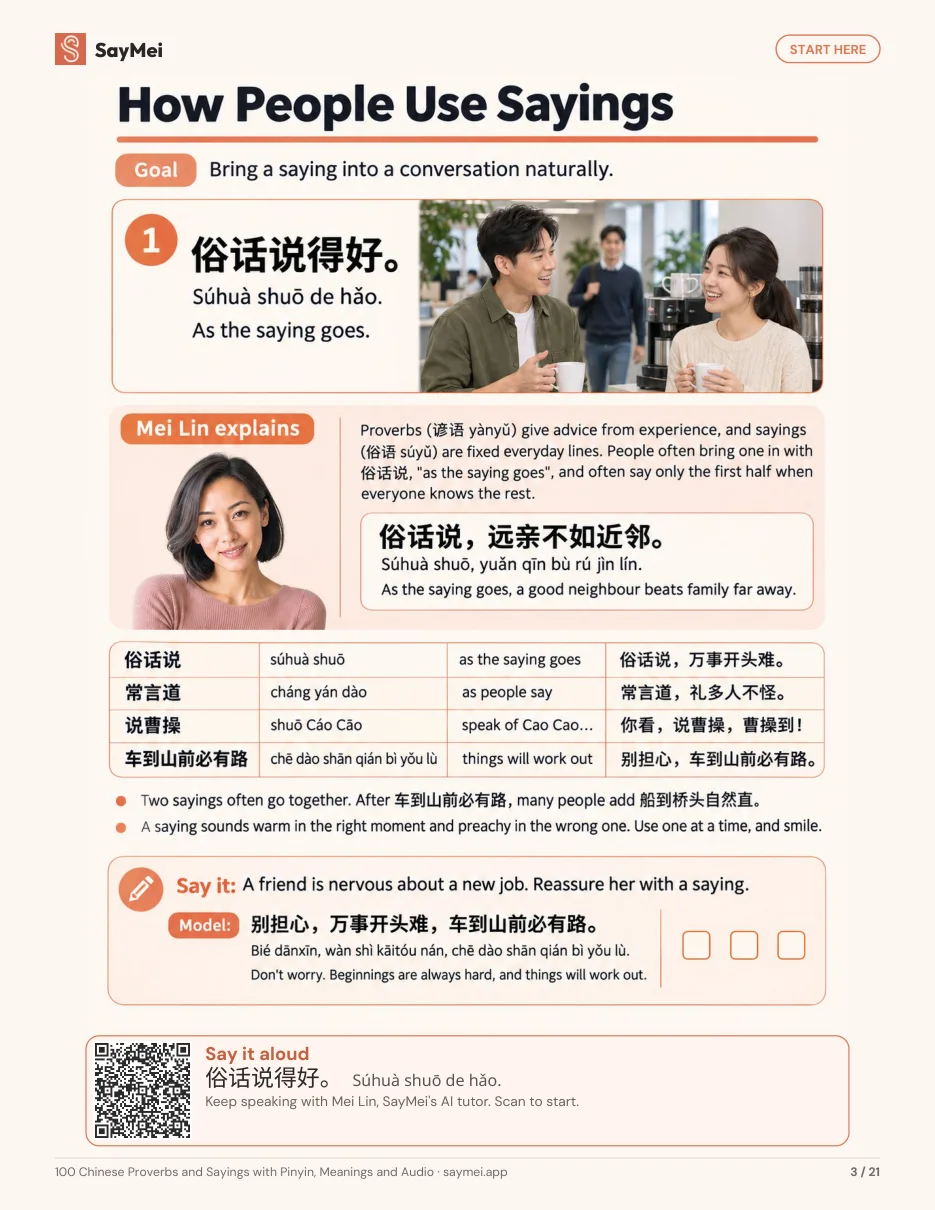
远亲不如近邻 · yuǎn qīn bù rú jìn lín · a good neighbour beats family far away - Bring a saying into a conversation naturally. Start with 俗话说, "as the saying goes", or say only the first half when everyone knows the rest, as people often do.
俗话说,远亲不如近邻。 · Súhuà shuō, yuǎn qīn bù rú jìn lín. · As the saying goes, a good neighbour beats family far away. - Comfort, encourage and warn with the right line. Say 失败是成功之母 after a failure, 吃一堑,长一智 after a mistake, and 不怕一万,就怕万一 before a trip.
吃一堑,长一智 · chī yī qiàn, zhǎng yī zhì · you learn from your mistakes - Check yourself on the practice page. Pick the saying for four everyday moments and finish four famous sayings from their first half. The answers are at the back.
千里之行,始于足下 · qiān lǐ zhī xíng, shǐ yú zú xià · every big thing starts with a first step
What’s inside
- Start Here: How People Use Sayings · Pick the Saying
- Proverbs: 100 Proverbs and Sayings
How to use this book
Read the two Start Here pages, then take one theme a day with the free audio. Listen, say each saying and its example in the pause, and keep the ones you like for the next time the moment comes up.
- Day 1: Start Here. Pages 3 and 4: how people bring a saying into a conversation, then the practice page. Check your answers at the back.
- Days 2–11: One theme a day. Play the theme's audio track, say each saying back, then read its "Said" line and example aloud.
- Each week: Use one for real. Pick a saying that fits your week and use it with a friend or Mei Lin, with 俗话说 in front.
- Any time: Test the first halves. Cover the list, read the first half of a saying and say the rest.
Who it’s for
Intermediate learners who want the Chinese proverbs and sayings people still use, with what they mean and when to say them, and anyone looking for a printable list of Chinese proverbs with pinyin.
Before you start: Every saying and example has pinyin and English, so you can follow along from HSK 3 or so. The free audio lets you hear each one before you say it.
Frequently asked questions
What's the difference between a proverb, a saying and a chengyu?
Proverbs (谚语) give advice from experience, and sayings (俗语) are fixed everyday lines; both are usually longer than four characters. Chengyu (成语) are four-character idioms, and they have their own book: 100 Common Chinese Idioms (Chengyu). For a shorter start, Chinese Sayings for Beginners has 40 everyday expressions with audio.
Where is the audio?
On this book's page on saymei.app: scan the code on the how-to page. There is one track per theme, and each reads the saying and its example with a pause to say it back.
Do Chinese people really still use these?
Yes. Each saying was chosen because it is in everyday use, and every meaning was checked against at least two dictionaries. Each row tells you when people say it, and some are said half joking.
Is the pinyin marked with tone changes?
No. Pinyin shows each character's own tone, as dictionaries do, so 一 is yī and 不 is bù. In speech they often change tone before other syllables, and the audio says them as people do.
Do I need a SayMei account?
Yes, to download the PDF, and the account is free: sign up with Google, Apple or your email address. With it we email you a copy of the workbook, keep every workbook you download on your account on all your devices, save your place in the free online practice, and you can practise speaking with Mei Lin, SayMei's AI tutor.
How do I print it?
The PDF is US Letter size. On A4 paper, choose "Fit to page" (or "Scale to fit") in the print dialog so nothing is cut off. Print the whole workbook or only the pages you need; colour looks best, and black and white works too.
Keep going
Everyday Chengyu: Meaning, Context & Misuse Practice · 100 Common Chinese Idioms (Chengyu): Printable List with Pinyin, Meanings and Examples · Chinese New Year 2027 Workbook: Year of the Goat Greetings & Customs · Learn Chinese with C-Dramas: 100 Phrases You Hear in Every Drama · Browse all 340 workbooks
Version 2026-11 · Updated Nov 11, 2026 · Report a correction