Characters · Beginner
Chinese Radicals Chart: Common Radicals and Their Changing Forms
A Chinese radicals chart of 36 everyday radicals: you see 人 turn into 亻 and 水 into 氵 on the left, find 艹 and 灬 above and below, and tell 氵 from 冫. For beginners who know a few characters.
- Level:
- Beginner · HSK 1
- Format:
- Reference guide · PDF · 7 pages · US Letter (prints on A4)
- Price:
- Free · free with a saymei account · updated Oct 8, 2026
Download the free PDF: create a free SayMei account on this page, and we'll email you a copy too.
这个字的部首是什么? · Zhège zì de bùshǒu shì shénme? · What is the radical of this character?
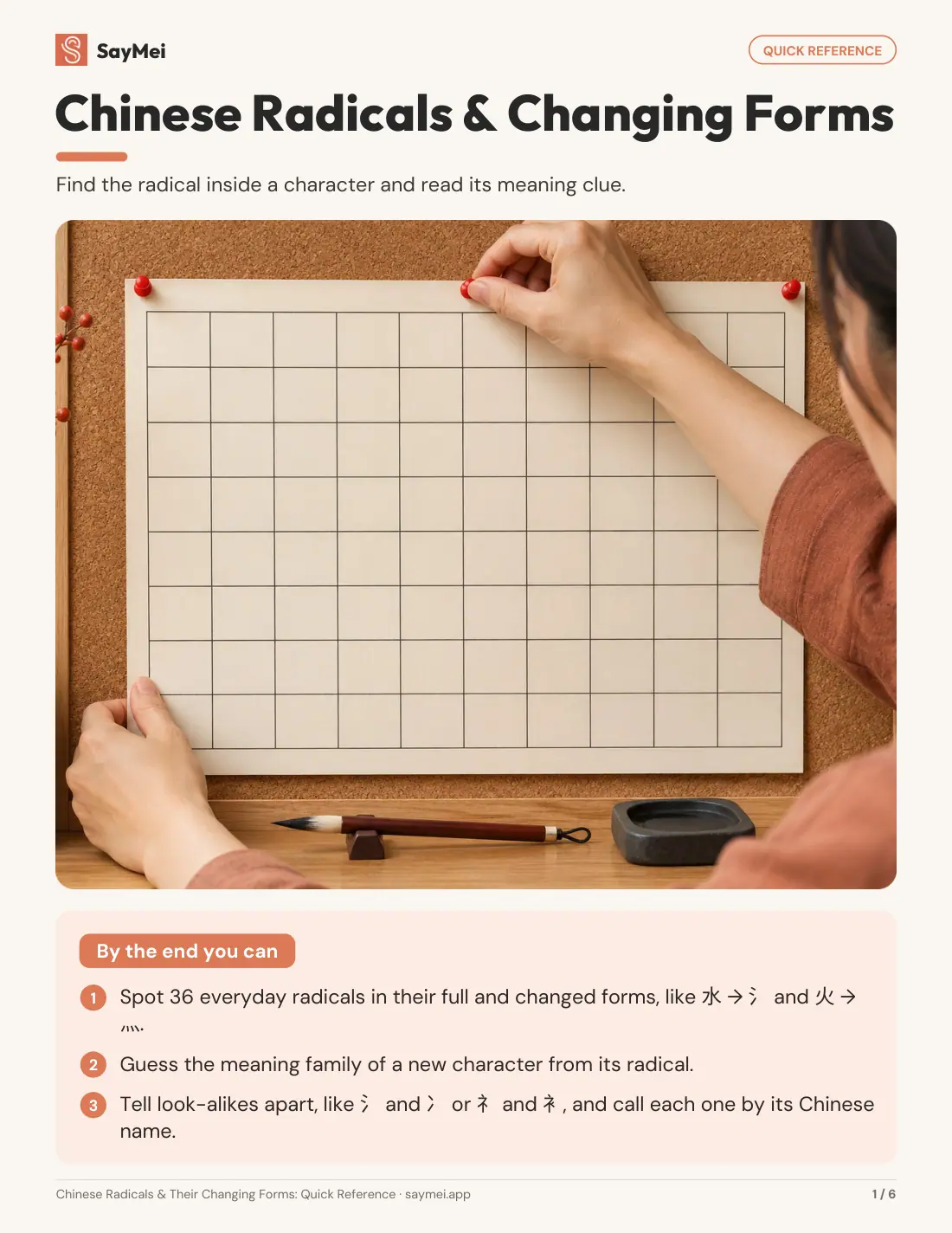
By the end you can
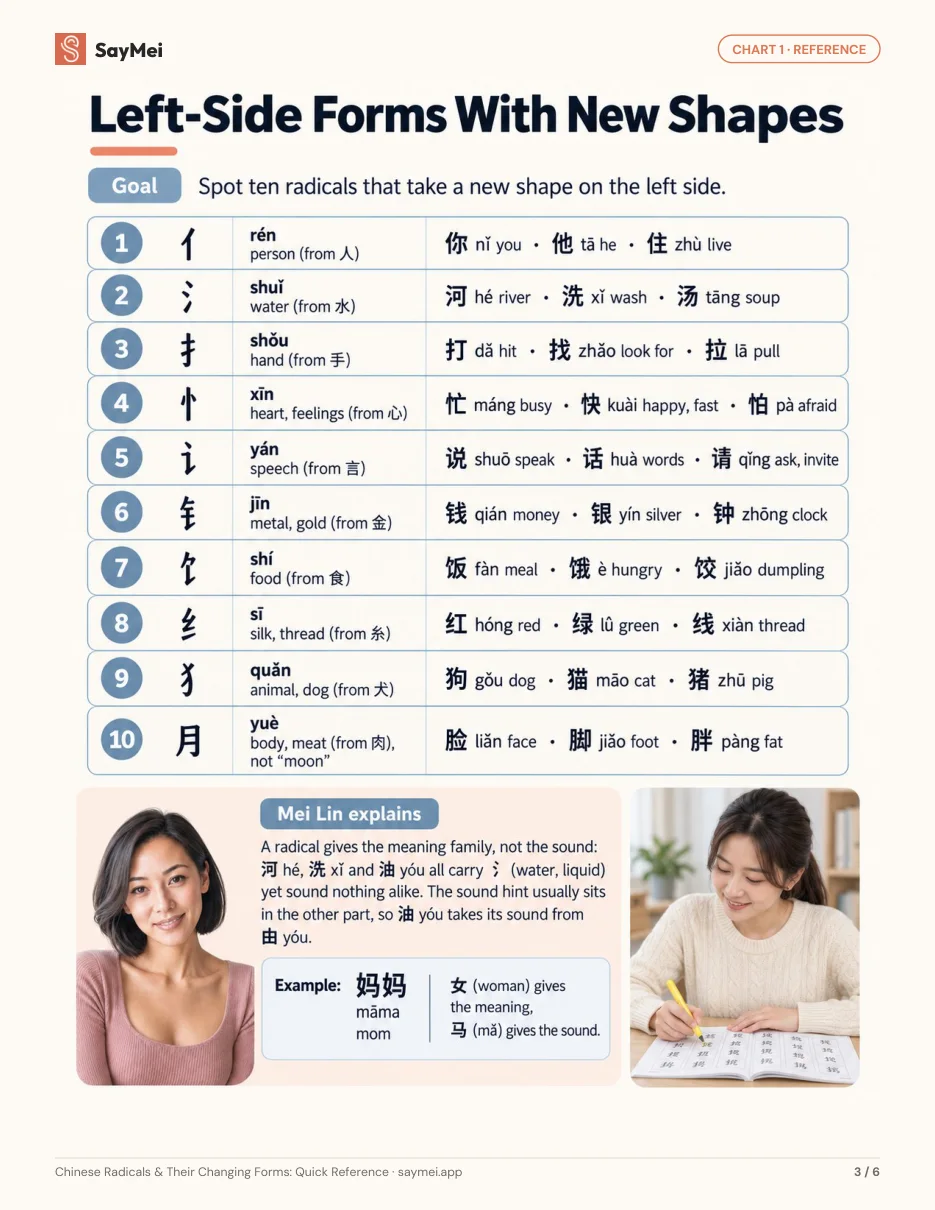
- Read a radical chart row at a glance. Each row gives the radical as it looks inside characters, its pinyin and meaning, the full form it comes from, and three everyday characters that use it.
洗 · xǐ · wash - Spot ten radicals that take a new shape on the left. 人 becomes 亻, 水 becomes 氵, 手 becomes 扌, 言 becomes 讠, and six more, from 钅 for metal to 犭 for animals and 月 for the body.
说 · shuō · speak - Know the forms radicals take on the top, bottom and right. Ten more, like 艹 for plants, 宀 for roofs, 灬 for fire and 辶 for walking. One radical can change by position: 心 stands whole under 想 but becomes 忄 on the left.
你想喝热茶吗? · Nǐ xiǎng hē rè chá ma? · Would you like some hot tea? - Notice the small changes when a radical moves left. Ten radicals slim down on the left side: the last stroke of 木 becomes a dot, 土 and 王 end in a rising stroke, and 口 shrinks and sits high.
林 · Lín · Lin, Lin Hao's surname - Tell look-alikes apart and call each one by its Chinese name. Five pairs side by side: 氵 and 冫, 亻 and 彳, 礻 and 衤, 阝 on the left and right, 广 and 疒, each with the name people use to spell characters aloud.
三点水 · sāndiǎnshuǐ · three-dot water - Guess the meaning family of a new character. Find the radical, usually on the left or top, guess what the character is about, then check a dictionary. The radical gives the meaning family, not the sound.
这个字的部首是什么? · Zhège zì de bùshǒu shì shénme? · What is the radical of this character?
What’s inside
- Chart 1: Reference: Left-Side Forms With New Shapes
- Chart 2: Reference: Top, Bottom and Right-Side Forms
- Chart 3: Reference: Left-Side Forms That Slim Down
- Chart 4: Reference: Look-Alikes and Their Names
How to use this book
A six-page chart to keep beside you while you read. Take one chart at a sitting, then come back to it whenever a new character turns up.
- First sitting: Charts 1 and 2. The radicals that change shape: ten on the left, ten on the top, bottom or right. Read each row aloud with its example characters.
- Second sitting: Charts 3 and 4. The small stroke changes on the left, then the look-alike pairs and their Chinese names.
- Test yourself: Cover the meaning column. Read the three example characters in a row and guess what they have in common, then uncover and check.
- Any new character: Find the radical first. Look for it on the left or top, guess the meaning family, then check a dictionary.
Who it’s for
Beginners who know some characters and want to see the patterns inside them, and anyone who keeps meeting 氵 or 扌 without knowing what they mean.
Before you start: Knowing a few characters helps you spot the radicals. Every example character comes with pinyin and an English meaning.
Frequently asked questions
How many radicals does it cover?
36 everyday radicals across four charts: ten that take a new shape on the left, ten on the top, bottom or right, ten that slim down on the left, and five look-alike pairs with their Chinese names. Each row gives the form, its pinyin and meaning, the full form it comes from and three everyday characters.
Does the radical tell me how to say a character?
No. The radical gives the meaning family. The sound usually sits in the other part, so in 妈, 女 gives the meaning and 马 gives the sound.
Why does one radical have two shapes?
A radical can change with its position. 心 stands whole under 想 but becomes 忄 on the left, and the last stroke of 木 turns into a dot when it moves to the left side. The charts show each change next to the full form.
Can I use it with a paper dictionary?
Yes. The book shows how: count the radical's strokes (氵 is 3), find it in the dictionary's radical index, then count the strokes in the rest of the character.
How should I use it?
Take one chart at a sitting and read each row aloud with its example characters. To test yourself, cover the meaning column and guess what the three characters in a row have in common. After that, find the radical first whenever a new character turns up.
How is it different from the radicals workbook?
This is a short chart for looking up forms. Chinese Radicals Workbook: 50 Radicals to Read New Characters teaches 50 radicals in groups with a practice page after each, and Chinese Radicals Flashcards: 48 Common Radicals to Print and Cut puts 48 of them on cards.
Do I need a SayMei account?
Yes, to download the PDF, and the account is free: sign up with Google, Apple or your email address. With it we email you a copy of the workbook, keep every workbook you download on your account on all your devices, save your place in the free online practice, and you can practise speaking with Mei Lin, SayMei's AI tutor.
How do I print it?
The PDF is US Letter size. On A4 paper, choose "Fit to page" (or "Scale to fit") in the print dialog so nothing is cut off. Print the whole workbook or only the pages you need; colour looks best, and black and white works too.
Keep going
All 214 Chinese Radicals: Printable List and Chart with Pinyin and Meanings · Chinese Radicals Workbook: 50 Radicals to Read New Characters · The 1,000 Most Common Chinese Characters: Printable List with Pinyin and Audio · The SayMei Chinese Characters Practice Book · Learn radicals online in SayMei Radicals · Browse all 379 workbooks
In these collections: Chinese Cheat Sheets and Charts · Chinese Character and Writing Workbooks · HSK 1 Chinese Workbooks
Version 2026-10 · Updated Oct 8, 2026 · Report a correction