Reading · Total beginner to pre-intermediate
Chinese Short Stories with Pinyin: 23 Graded Stories for Beginners
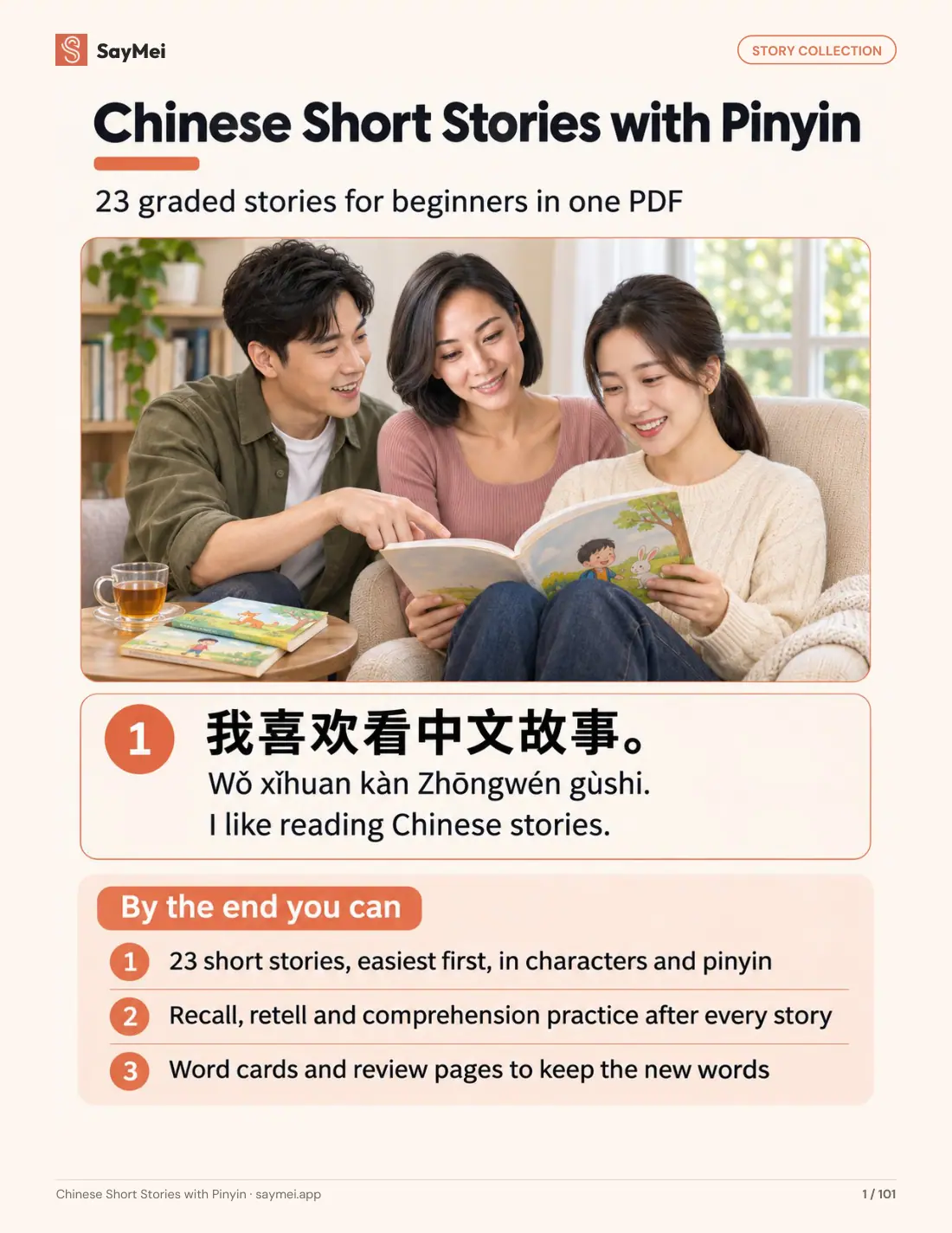
You read 23 short Chinese stories with pinyin, from coffee that's too hot to a phone left in a taxi, easiest first, and retell each one. For beginners who want their first real reading.
- Level:
- Total beginner · HSK 1
- Format:
- Practice book · PDF · 101 pages · US Letter (prints on A4)
- Price:
- Free · free with a saymei account · updated Nov 17, 2026
Download the free PDF: create a free SayMei account on this page, and we'll email you a copy too.
我喜欢看中文故事。 · Wǒ xǐhuan kàn Zhōngwén gùshi. · I like reading Chinese stories.
By the end you can
- Read five six-line stories from one shared word bank. Book 1: five very short stories about Lin Hao and Xiaoyu, with the core words previewed first.
门口有一只小猫。 · Ménkǒu yǒu yì zhī xiǎomāo. · There's a kitten at the door. - Say something is too much with 太…了. Each story leans on one pattern, practised straight after the story.
咖啡太热了。 · Kāfēi tài rè le. · The coffee is too hot. - Read ten more stories and retell each with one change. Book 2: a wrong bus, ten yuan short and a late train, with a review after every five stories.
林浩在车站等车。 · Lín Hào zài chēzhàn děng chē. · Lin Hao waits for the bus at the bus stop. - Ask someone to choose with 还是. Short patterns from the stories that you can use in your own sentences.
去饭馆,还是在家吃? · Qù fànguǎn, háishi zài jiā chī? · Go to a restaurant, or eat at home? - Follow longer two-part stories with linking words. Book 3: eight two-part stories with a plot, comprehension questions and retelling.
他很累,所以很早就睡觉了。 · Tā hěn lèi, suǒyǐ hěn zǎo jiù shuìjiào le. · He was tired, so he went to bed early. - Keep the new words with word cards and reviews. Each book ends with word cards or word lists and a review, so the words from the stories stay with you.
你还记得那些水果吗? · Nǐ hái jìde nàxiē shuǐguǒ ma? · Do you remember that fruit?
What’s inside
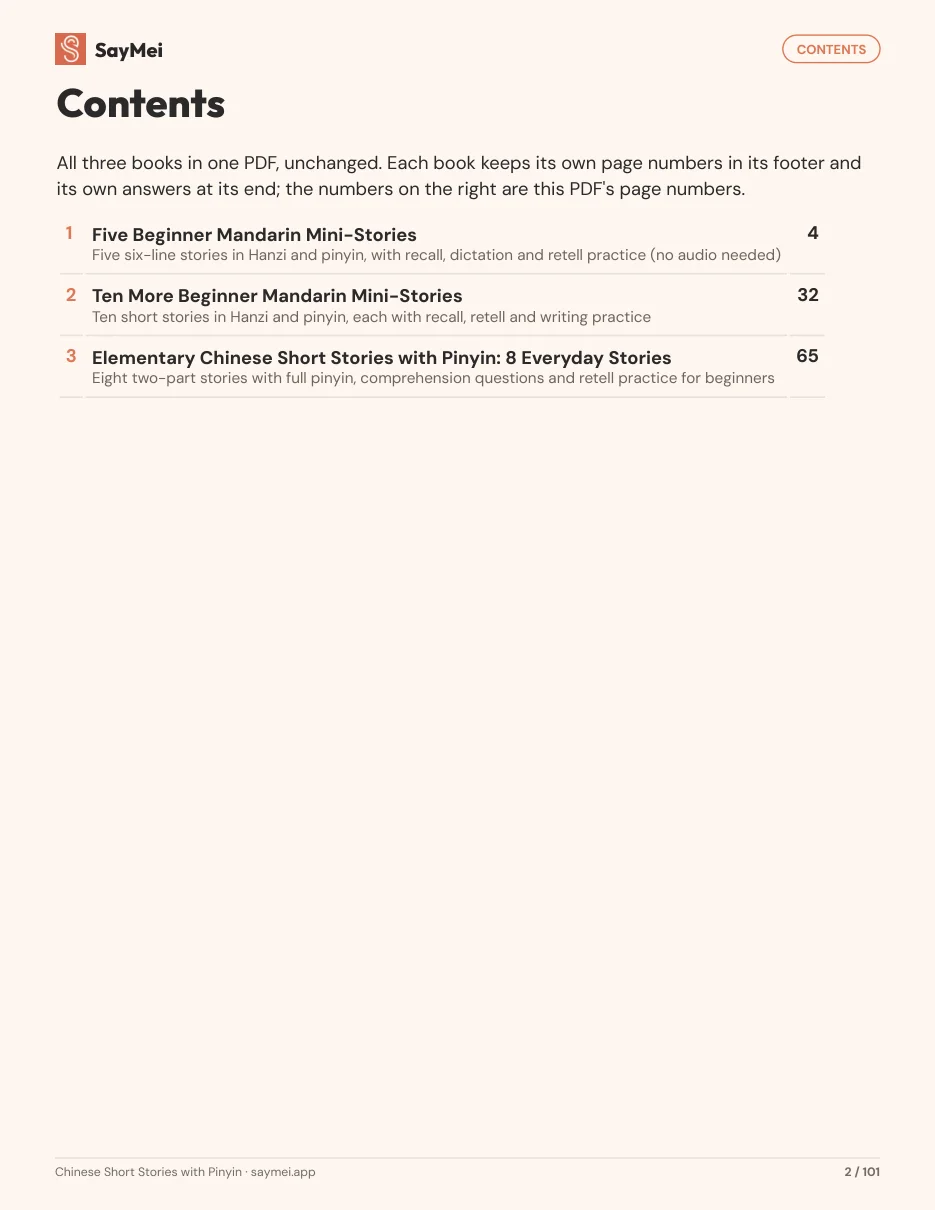
- Book 1: Five Beginner Mandarin Mini-Stories: five six-line stories with recall, dictation and retell practice. Five Beginner Mandarin Mini-Stories
- Book 2: Ten More Beginner Mandarin Mini-Stories: ten short stories with recall, retell and writing practice. Ten More Beginner Mandarin Mini-Stories
- Book 3: Elementary Chinese Short Stories with Pinyin: eight two-part stories with questions and retelling. Elementary Chinese Short Stories with Pinyin: 8 Everyday Stories
How to use this book
One story at a time, in order. Read it for the gist, read it aloud, do its practice page, and read it again the next day.
- Each story: Read, then read aloud. Read once for the gist with the pinyin, then aloud, line by line.
- Straight after: Practice page. Do the story's recall, retell or question page, then check the answers at the back of that book.
- The next day: Read it again. Cover the pinyin and see how much the characters alone tell you.
- After each book: Review. Use the word cards or word lists to keep the new words before you start the next book.
Who it’s for
Total beginners who want to read their first connected stories in Chinese, and beginners who can read simple sentences with pinyin and want stories with a plot.
Before you start: Knowing pinyin helps. Every story has pinyin with the characters, and the core words are previewed before the first story.
Frequently asked questions
Do all the stories have pinyin?
Yes. All 23 stories have pinyin with the characters. SayMei's intermediate story book, without pinyin, is not part of this collection.
How hard are the stories?
They start at total beginner level with six-line stories and finish with two-part elementary stories, so the reading gets longer and richer as you go.
Is there audio?
No. The stories are made to read on paper and say aloud; the practice pages use recall, retelling and questions rather than listening.
Is this the same as the three separate books?
Yes. It puts Five Beginner Mandarin Mini-Stories, Ten More Beginner Mandarin Mini-Stories and Elementary Chinese Short Stories with Pinyin into one PDF, unchanged, with a cover, a contents page and a page on how to use it.
Do I need a SayMei account?
Yes, to download the PDF, and the account is free: sign up with Google, Apple or your email address. With it we email you a copy of the workbook, keep every workbook you download on your account on all your devices, save your place in the free online practice, and you can practise speaking with Mei Lin, SayMei's AI tutor.
How do I print it?
The PDF is US Letter size. On A4 paper, choose "Fit to page" (or "Scale to fit") in the print dialog so nothing is cut off. Print the whole workbook or only the pages you need; colour looks best, and black and white works too.
Keep going
Ten More Beginner Mandarin Mini-Stories · Free Mandarin Textbook for Beginners: The SayMei Practice Book · Elementary Chinese Short Stories with Pinyin: 8 Everyday Stories · Spoken Mandarin in 60 Days: The Complete Speaking Course · Browse all 367 workbooks
In these collections: Free Chinese Textbooks and Course Books (PDF) · Intermediate Chinese Workbooks · Chinese Reading Workbooks · Chinese Workbooks for Complete Beginners
Version 2026-11 · Updated Nov 17, 2026 · Report a correction