Kids · Kids workbook
Chinese Tones Worksheets for Kids: Printable Pack
Your child says mā, má, mǎ and mà with hand signals, colours tone marks like little hats and finds out why 你好 is said ní hǎo. For ages 5 to 8, and you don't need any Chinese to help.
- Level:
- Kids 5–8
- Format:
- Worksheet pack · PDF · 15 pages · US Letter (prints on A4)
- Price:
- Free · free with a saymei account · updated Nov 12, 2026
Download the free PDF: create a free SayMei account on this page, and we'll email you a copy too.
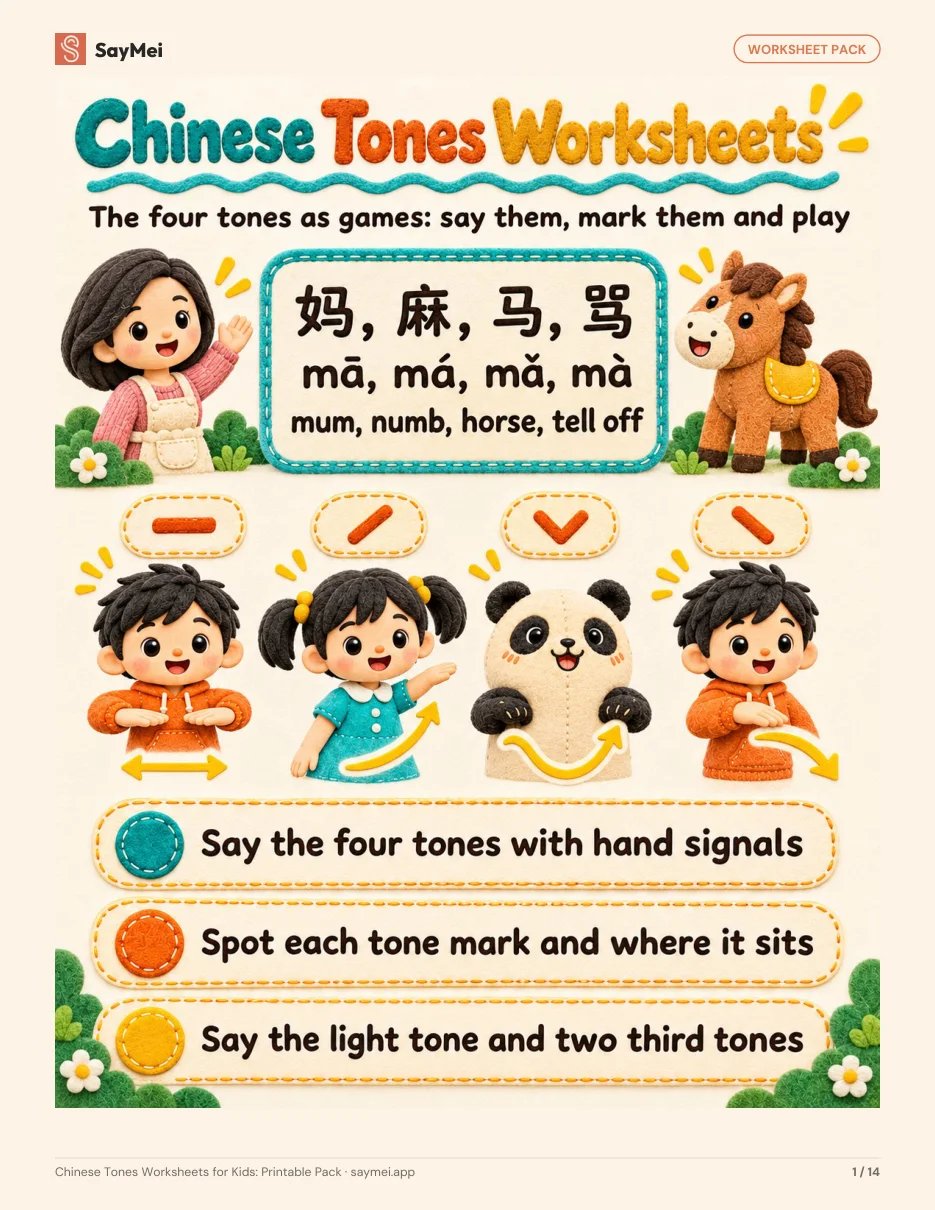
妈,麻,马,骂 · mā, má, mǎ, mà · mum, numb, horse, tell off
By the end you can
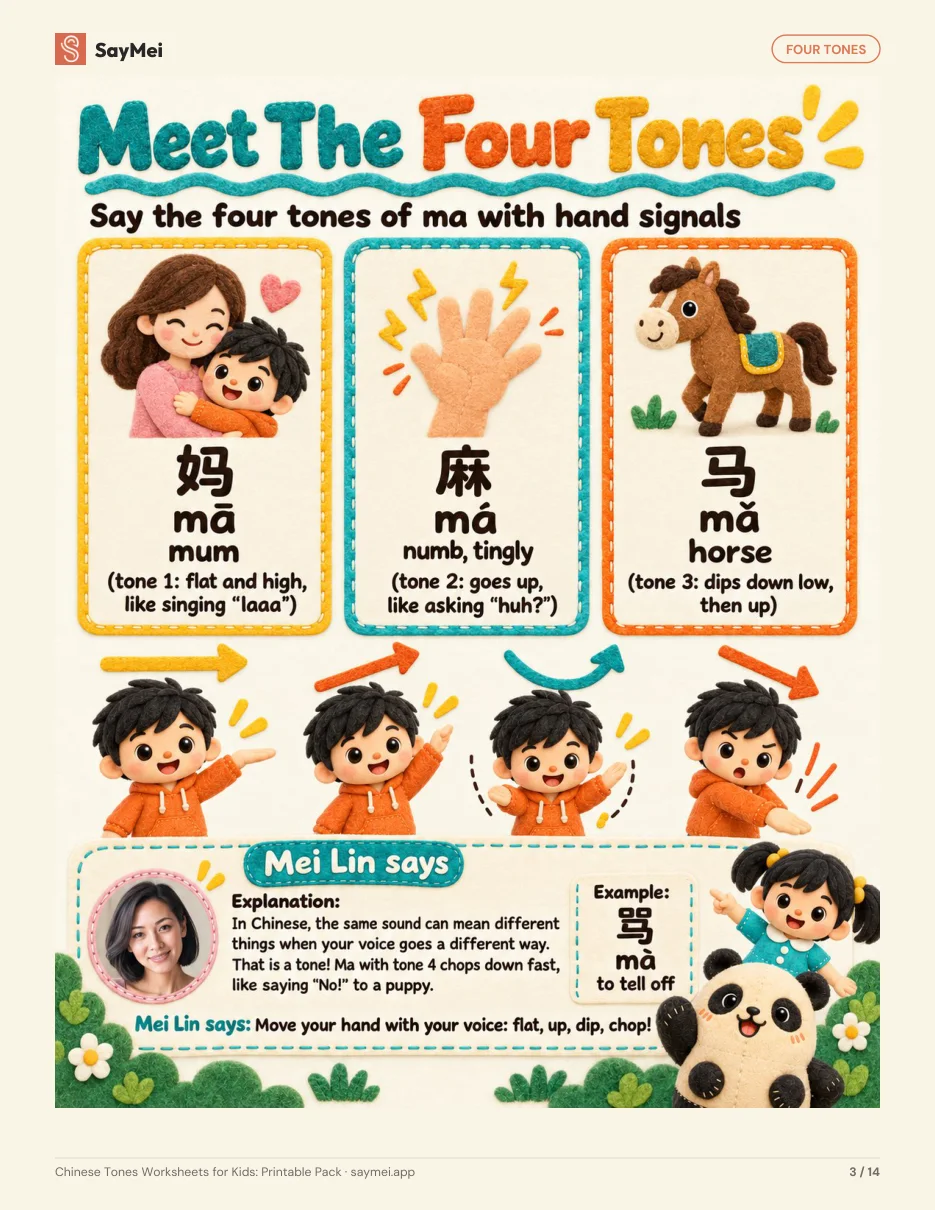
- Say the four tones of ma with hand signals. Flat and high, going up, dipping down then up, and a chop. mā is mum, má is numb, mǎ is horse and mà is to tell off. Your child matches each word to its hand signal.
妈,麻,马,骂 · mā, má, mǎ, mà · mum, numb, horse, tell off - Spot tone marks and the vowel they sit on. A tone mark is a little hat on a vowel, and if a word has a or e, the hat goes there. Your child colours each hat in its tone's colour and copies mā má mǎ mà.
好 · hǎo · good - Say the light, sleepy tone. A syllable with no mark is said short and soft, like a tiny yawn, as in bàba and māma. Your child circles the sleepy syllable in family words and names people in a family photo.
这是妈妈。 · Zhè shì māma. · This is Mum. - Say two third tones in a row. When two dipping tones sit side by side, the first one climbs like tone 2. 你好 is written nǐ hǎo but said ní hǎo. Your child circles the pairs that climb and writes the tone they say.
很好 · hěn hǎo · very good - Put the tone mark on the right vowel. The mark sits on a if there is one, and if not, on o or e. In iu and ui it sits on the second letter. Your child writes hǎo, liù and shuǐ with the mark in the right place.
水 · shuǐ · water - Hear the difference between two tones. Your child circles mǎi or mài and táng or tāng while you read the pairs from the audio script in the answer key. 买 is buy and 汤 is soup.
汤 · tāng · soup
What’s inside
- Four tones: Meet The Four Tones · Tone Hand Dance
- Tone marks: Tone Marks Are Little Hats · Colour The Hats
- Sleepy tone: The Sleepy Tone · Wake Up Or Sleep
- Two dips: Two Dips Make A Climb · Climb Or Dip
- Where marks sit: Where the Tone Mark Sits · Read, Circle and Check: Tones
The pages come from Pinyin & Tones Fun for Kids · Pinyin Reading Practice for Kids 2: Blend, Read and Check (Ages 6–8).
How to use this book
About ten minutes a day is plenty. Say each word with its hand signal, let your child copy your voice and your hand, then do one exercise together. Two pages a day, in order: each page builds on the one before.
- Day 1: The four tones. Pages 3 and 4. Say mā, má, mǎ and mà with the hand signals: flat, up, dip, chop. Then match each word to its signal.
- Day 2: Tone marks. Pages 5 and 6. Spot the little hats, colour them in four colours and copy mā má mǎ mà with each hat in place.
- Day 3: The sleepy tone. Pages 7 and 8. Say family words like bàba and gēge, find the syllable with no hat, and name people in a family photo.
- Day 4: Two third tones. Pages 9 and 10. Say 你好, 很好 and 水果 with the first word climbing, then greet three toys.
- Day 5: Where the mark sits. Pages 11 and 12. Put marks on hao, liu and shui. For the listening exercise, read the pairs from the audio script in the answer key, on pages 13 and 14.
Who it’s for
Children aged 5 to 8 learning the four tones of Mandarin and how pinyin shows them, with a parent at home or a teacher in class.
Before you start: Nothing. Every word has pinyin and English, so you don't need to speak Chinese yourself. You'll need a pencil and red, green, blue and purple crayons for the tone hats on page 6.
Frequently asked questions
What's inside this pack?
Ten worksheets on pages 3 to 12, taken from SayMei's kids workbooks: the four tones of ma, tone marks as little hats, the light sleepy tone, two third tones in a row, and where the tone mark sits. The answer key is on pages 13 and 14.
I find the tones hard to hear. Can I still help?
Yes. Each tone has a hand signal (flat, up, dip and chop) and a plain-English description, such as tone 2 going up like asking huh. Move your hand with your voice and your child copies you.
Why is 你好 said ní hǎo?
When two third tones sit side by side, the first one climbs up like tone 2. Pinyin still writes nǐ hǎo, but you say ní hǎo, and 很好 is said hén hǎo. Pages 9 and 10 practise this with 你好, 很好 and 水果.
Is there audio for the listening exercise?
This pack has no audio. Page 12 asks your child to listen and circle the tone they hear, such as mǎi or mài, and the answer key prints the words as an audio script for you to read aloud.
What can we use after this pack?
Pages 3 to 10 come from Pinyin & Tones Fun for Kids, which also covers the pinyin sounds. Pages 11 and 12 are from Pinyin Reading Practice for Kids 2: Blend, Read and Check (Ages 6–8), which has free audio on its page.
Do I need a SayMei account?
Yes, to download the PDF, and the account is free: sign up with Google, Apple or your email address. With it we email you a copy of the workbook, keep every workbook you download on your account on all your devices, save your place in the free online practice, and you can practise speaking with Mei Lin, SayMei's AI tutor.
How do I print it?
The PDF is US Letter size. On A4 paper, choose "Fit to page" (or "Scale to fit") in the print dialog so nothing is cut off. Print the whole workbook or only the pages you need; colour looks best, and black and white works too.
Keep going
Chinese Numbers 1–100 for Kids: Count, Trace and Play (Ages 5–8) · Dragon Boat Festival for Kids: Boats, Zongzi and the Story of Qu Yuan · Pinyin Worksheets for Kids: Printable Pack · Chinese Stroke Order Worksheets for Kids: Printable Pack · Browse all 340 workbooks
Version 2026-11 · Updated Nov 12, 2026 · Report a correction