Kids · Kids workbook
Pinyin Worksheets for Kids: Printable Pack
Your child says the fish-lips ü, holds a tissue to tell b from p and blends b + à into bà. For ages 5 to 8, and you don't need to speak Chinese to help.
- Level:
- Kids 5–8
- Format:
- Worksheet pack · PDF · 15 pages · US Letter (prints on A4)
- Price:
- Free · free with a saymei account · updated Nov 12, 2026
Download the free PDF: create a free SayMei account on this page, and we'll email you a copy too.
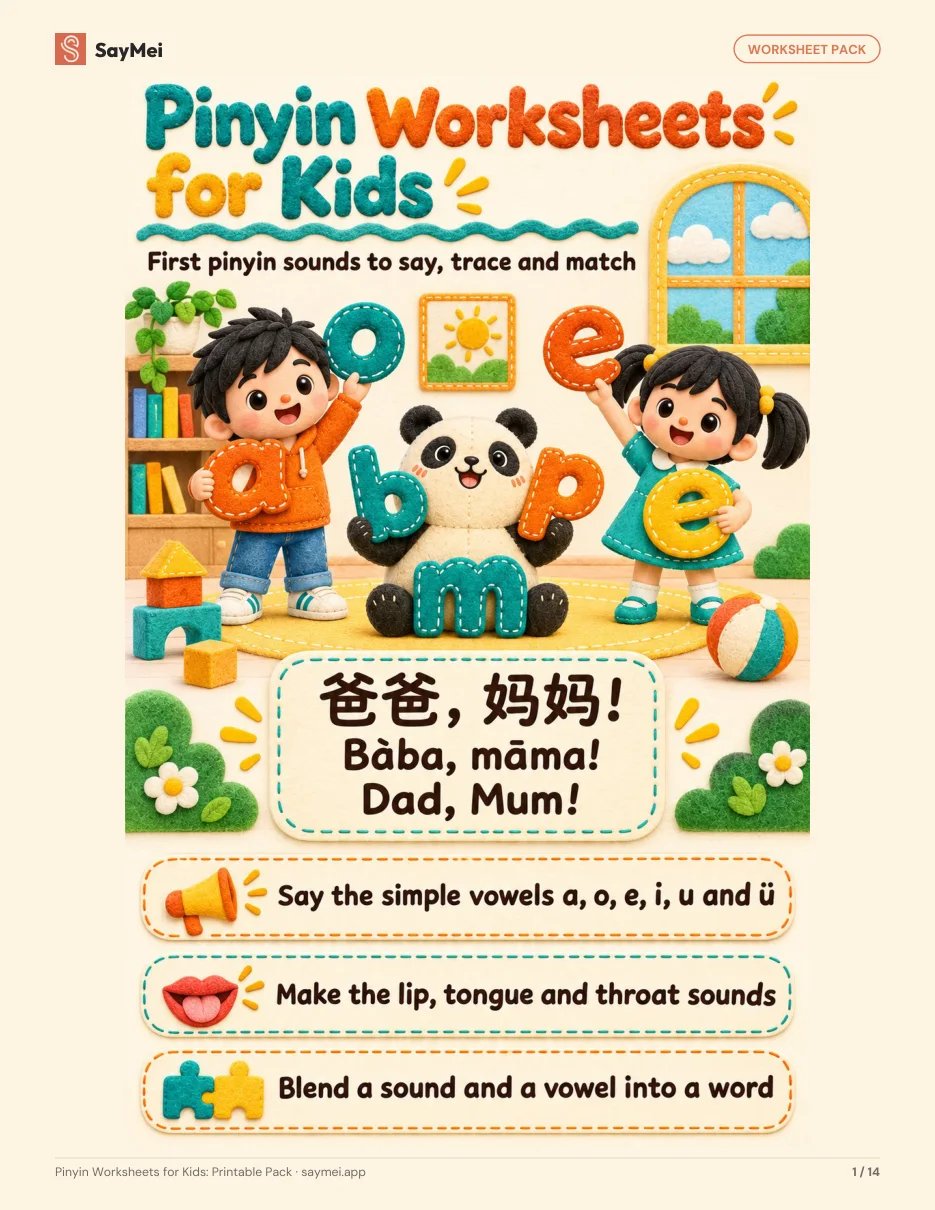
爸爸,妈妈! · Bàba, māma! · Dad, Mum!
By the end you can
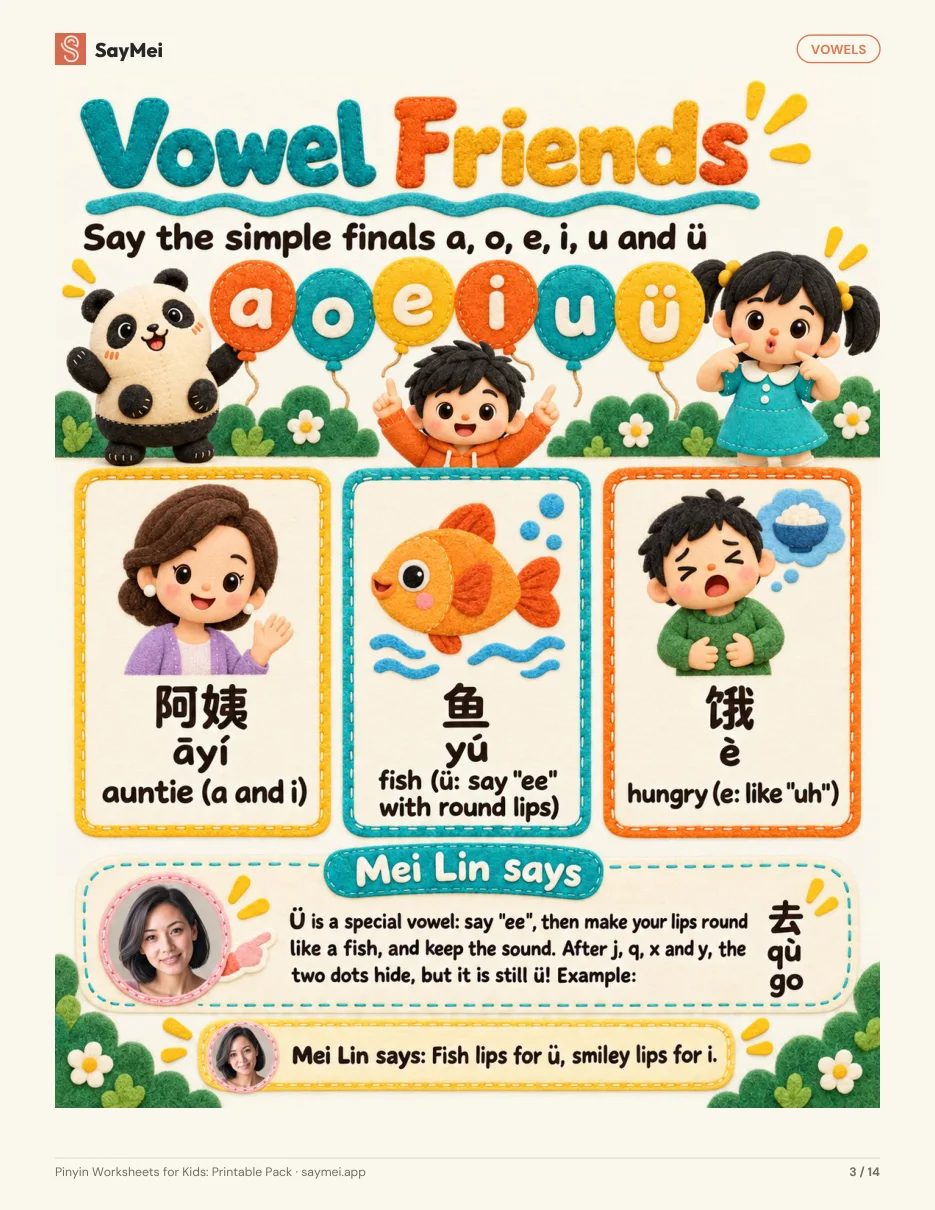
- Say the simple vowels, with fish lips for ü. a, o, e, i, u and ü. For ü, say ee, then round your lips like a fish. Your child circles the words with ü, such as yú and lǜ, and colours the vowel that wears the tone mark.
鱼 · yú · fish - Tell b from p with a tissue. B and p both start with closed lips, and p lets out a puff of air that makes a tissue wiggle. Your child circles b or p for words like pǎo and bā, then traces b, p, m and f.
爸爸 · bàba · dad - Tap the tongue for d, t, n and l. All four start with the tongue tip behind the top teeth, and t has a puff like p. Your child counts the tongue letters in nǐ hǎo and lǎoshī and picks the word that starts with t.
他 · tā · he - Make the throat sounds g, k and h. G, k and h live at the back of the mouth, and Chinese h is scratchier than English h. Your child matches gǒu, hē and hǎo to their meanings and circles the tone number of each word.
喝 · hē · drink - Blend a first sound and a vowel into a word. Say the first sound short and quick, then slide straight into the vowel in one beat: b + à = bà. Your child blends bà, pá and mǎ and meets 福 (fú) for good luck.
马 · mǎ · horse - Read pinyin and check it against a picture. Your child circles the sound they hear in pairs like bā / pā and bí / pí, then ticks or crosses pinyin words against pictures, such as mǎ beside a picture of a mum.
爸爸! · Bàba! · Dad!
What’s inside
- Vowels: Vowel Friends · Fish Lips Or Smile
- b p m f: Lip Letters B P M F · Tissue Puff Game
- d t n l: Tongue Letters D T N L · Tongue Tap Count
- g k h: Throat Letters G K H · Back Of The Mouth
- Blend and read: Lip Sounds Meet Vowels · Read, Circle and Check: b p m f
The pages come from Pinyin & Tones Fun for Kids · Pinyin Reading Practice for Kids 2: Blend, Read and Check (Ages 6–8).
How to use this book
About ten minutes a day is plenty. Read each word aloud with your child, let them copy the mouth shape and say it back, then do one exercise together. A tissue and a mirror help with the lip sounds.
- Day 1: The simple vowels. Pages 3 and 4. Say a, o, e, i, u and ü, practise fish lips and smiley lips, and circle the words with ü.
- Day 2: b, p, m, f. Pages 5 and 6. Hold a tissue in front of your mouths: still for b, wiggly for p. Then trace the four lip letters.
- Day 3: d, t, n, l. Pages 7 and 8. Tap the tongue behind the top teeth, count the tongue letters and say 你好 to Bao.
- Day 4: g, k, h. Pages 9 and 10. Fog a pretend window for h, match the words and circle each tone number.
- Day 5: Blend and read. Pages 11 and 12. Blend the lip sounds with a vowel. For the listening exercise, read the pairs aloud from the audio script in the answer key, on pages 13 and 14.
Who it’s for
Children aged 5 to 8 starting to read pinyin, the letters that show how Chinese words sound, with a parent at home or a teacher in class.
Before you start: Nothing. Every word has pinyin and English, so you don't need to speak Chinese yourself. Page 10 asks for tone numbers 1 to 4, so it helps to know that pinyin has four tones. You'll need a pencil and crayons.
Frequently asked questions
What's inside this pack?
Ten worksheets on pages 3 to 12, taken from SayMei's kids workbooks: the simple vowels, the lip sounds b, p, m and f, the tongue sounds d, t, n and l, the throat sounds g, k and h, and two pages on blending a sound and a vowel into a word. The answer key is on pages 13 and 14.
How do I help with sounds I can't make myself?
Each sound comes with something to see or feel: round fish lips for ü, a tissue that stays still for b and wiggles for p, a tongue tap behind the top teeth for d and t, and warm air like fogging a window for h. You can copy these together.
Does it teach the tones?
Only a little. Every word has its tone mark, and page 10 asks your child to circle the tone number of words like gǒu and kàn. The four tones themselves are in Chinese Tones Worksheets for Kids: Printable Pack.
Is there audio for the listening exercise?
This pack has no audio. Page 12 asks your child to listen and circle the sound they hear, such as bā or pā, and the answer key prints what to say as an audio script for you to read aloud.
What can we use after this pack?
Pages 3 to 10 come from Pinyin & Tones Fun for Kids, which also teaches the four tones. Pages 11 and 12 are from Pinyin Reading Practice for Kids 2: Blend, Read and Check (Ages 6–8), which goes on blending and reading and has free audio on its page.
Do I need a SayMei account?
Yes, to download the PDF, and the account is free: sign up with Google, Apple or your email address. With it we email you a copy of the workbook, keep every workbook you download on your account on all your devices, save your place in the free online practice, and you can practise speaking with Mei Lin, SayMei's AI tutor.
How do I print it?
The PDF is US Letter size. On A4 paper, choose "Fit to page" (or "Scale to fit") in the print dialog so nothing is cut off. Print the whole workbook or only the pages you need; colour looks best, and black and white works too.
Keep going
Chinese Numbers 1–100 for Kids: Count, Trace and Play (Ages 5–8) · Dragon Boat Festival for Kids: Boats, Zongzi and the Story of Qu Yuan · Chinese Tones Worksheets for Kids: Printable Pack · Chinese Stroke Order Worksheets for Kids: Printable Pack · Browse all 340 workbooks
Version 2026-11 · Updated Nov 12, 2026 · Report a correction