Characters · Beginner literacy
100 Common Chinese Characters, Learned by Component
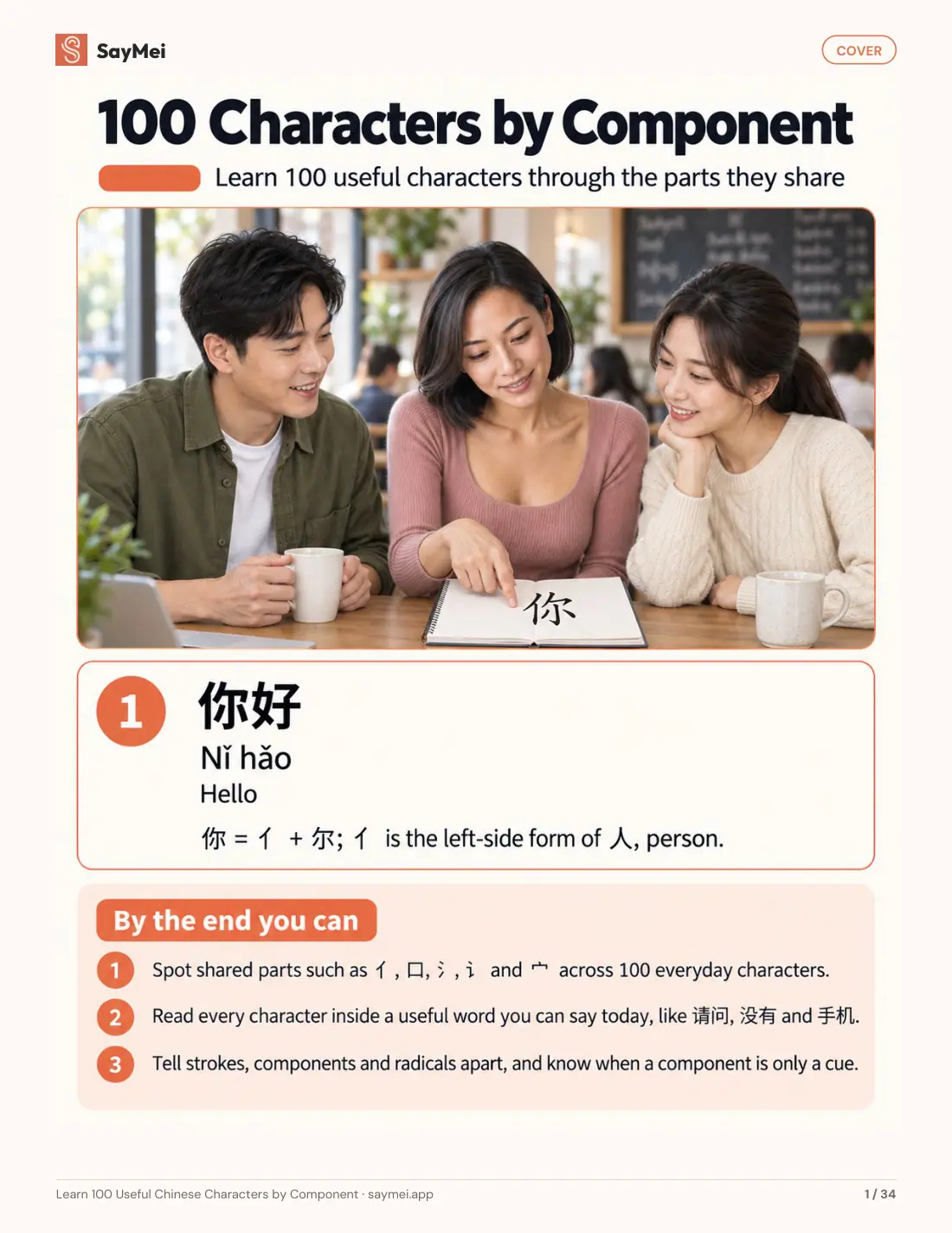
You sort the characters into 15 families by the part they share, like 亻 for a person, and learn each one inside a word you can say today. For beginners who speak some Mandarin and want to start reading.
- Level:
- Beginner · HSK 1
- Format:
- Workbook · PDF · 35 pages · US Letter (prints on A4)
- Price:
- Free · free with a saymei account · updated Oct 8, 2026
Download the free PDF: create a free SayMei account on this page, and we'll email you a copy too.
你好 · Nǐ hǎo · Hello
By the end you can
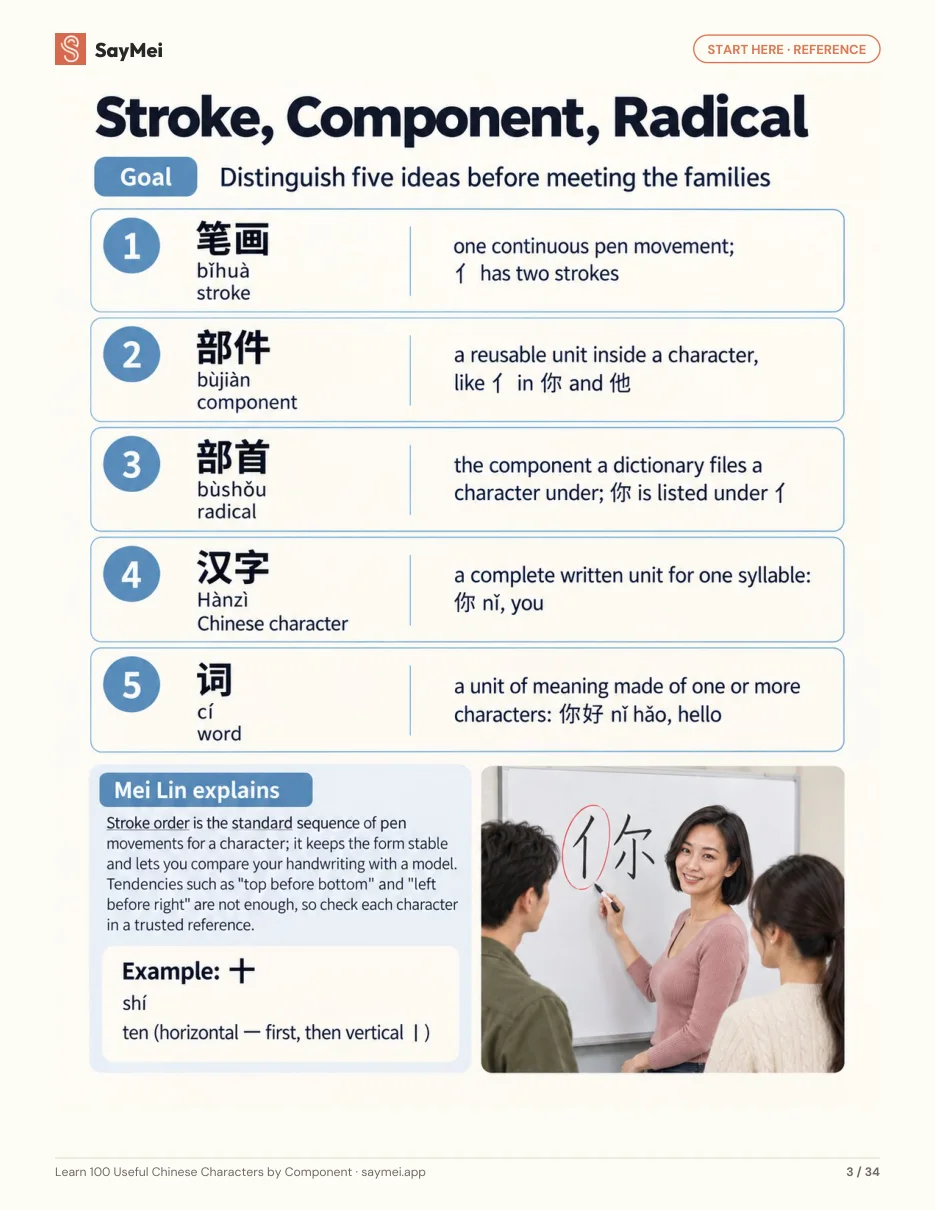
- Tell strokes, components, radicals, characters and words apart. A Start Here page defines five ideas with one example each: 亻 has two strokes, 你 is filed under the radical 亻, and 你好 is a word made of two characters.
部件 · bùjiàn · component - Spot the person and mouth components. See 人 narrow to 亻 on the left in 你, 他 and 们, and spread into a roof on top in 会 and 个. Then find 口 alone and as a part in everyday speech words.
你好 · nǐ hǎo · hello - Recognise side forms by their position. Learn 女, 日, 木, the three-dot water form 氵, and hand and heart, which shrink to 扌 and 忄 on the left but keep their full shape at the bottom, as in 拿 and 想.
我想打电话。 · Wǒ xiǎng dǎ diànhuà. · I'd like to make a phone call. - Read speech, roof and movement families. Find 讠 in talking words, 宀 on top, and three movement families, 辶, 走 and 足, in travel words like 走路 and 路口. Tell 进 from 近 by the part inside.
我家很近。 · Wǒ jiā hěn jìn. · My home is very close. - Write numbers in characters and say 一 right. Learn one to ten, then build hundreds and thousands like 三百五十, and say 一 as yì before tones 1, 2 and 3 and yí before a fourth tone.
三百五十 · sānbǎi wǔshí · three hundred and fifty - Learn the whole forms too useful to skip. Eight independent forms such as 我, 不, 有, 很 and 的, door and enclosure forms, and ten essentials for time, place and action: 天, 年, 来, 去, 上 and 下.
不忙 · bù máng · not busy - Read every character inside a useful word. Each of the 100 characters comes with a word you can say today, like 手机, 打电话, 明天 and 早上, so you learn the character and a real word at once.
手机 · shǒujī · mobile phone - Read a story and a dialogue built from your 100 characters. Read Lin Hao's Day, find components in it, then read an after-class dialogue that uses characters from many families.
明天是我的生日。 · Míngtiān shì wǒ de shēngrì. · Tomorrow is my birthday. - Tell look-alike characters apart. Cut-out cards pair characters that share parts or sounds, such as 他 and 她, 问 and 间, 木 and 本, and 十 and 千, with the one difference to look for.
What’s inside
- Start Here: Reference: Stroke, Component, Radical
- Family 1: Reference: People: 人 and 亻
- Family 2: Reference: The Mouth Component: 口
- Families 1–2: Practice: Practice: People and Mouth
- Family 3: Reference: The 女 Component
- Family 4: Reference: Day and Time: 日
- Families 3–4: Practice: Practice: 女 and 日
- Families 5–6: Reference: Wood 木 and Water 氵
- Families 7–8: Reference: Hand 扌 and Heart 忄
- Families 5–8: Practice: Practice: Four Side Forms
- Families 9–10: Reference: Speech 讠 and Roof 宀
- Family 11: Reference: Movement: 辶, 走, and 足
- Families 9–11: Practice: Practice: Speech, Roof, Movement
- Family 12: Reference: Numbers One to Ten · Learn: Hundreds, Thousands, and 一 · Practice: Practice: Numbers
- Family 13: Reference: Eight Independent Forms
- Family 14: Reference: Door and Enclosure Forms
- Families 13–14: Practice: Practice: 不, 的, and Enclosures
- Family 15: Reference: Ten Essential Characters · Practice: Practice: Time, Place, Action
- Story 1: Lin Hao's Day · Practice: Practice: Lin Hao's Day
- Cards: Look-Alike Characters
- Check: Practice: Check the Component Map
- Review: Review: After Class
- Planner: My Character Map
How to use this book
Fifteen families, each on a reference page, with a practice page after every two or so. Take one or two families a sitting, then finish with the story, the cards and your character map.
- Start here: Five ideas first. Read the Stroke, Component, Radical page so the family pages make sense. It also shows why stroke order matters.
- Families 1–4: People, mouth, 女 and 日. Read each character with its word aloud, then do the practice pages: sort, complete and build words.
- Families 5–11: Side forms and movement. Wood, water, hand, heart, speech, roof and movement. Say where each component sits before you say the word.
- Families 12–15: Numbers and whole forms. Numbers and the tone of 一, eight independent forms, enclosures and ten essentials, with 不 or 没 and 的 phrases in practice.
- Last sittings: Story, cards and check. Read Lin Hao's Day and the after-class dialogue, sort the look-alike cards, retrieve the component map, then choose eight characters to review.
Who it’s for
Beginners who can say some Mandarin and want to start reading characters, and learners who find character lists hard to remember without a pattern.
Before you start: Pinyin helps, since every character comes with its pinyin, meaning and a word. You don't need to know any characters before you start.
Frequently asked questions
What's inside?
Fifteen component families, each on a reference page, with a practice page after every two or so. You start with people and mouth, 女 and 日, then wood, water, hand, heart, speech, roof and movement, then numbers, eight whole forms like 我, 不 and 的, and ten essentials such as 天, 来 and 上. The book ends with Lin Hao's Day, an after-class dialogue, look-alike cards and your own character map.
What's the difference between a component and a radical?
A component is any reusable part inside a character, like 亻 in 你 and 他. A radical is the one component a dictionary files a character under. The book also shows when a component is only a cue to meaning or sound, not a rule.
Do I need to know any characters first?
No. Every character comes with its pinyin, its meaning and a word you can say, like 手机 or 明天, so reading pinyin helps. The book suits beginners who can already say some Mandarin and want to start reading it.
How long does it take?
There's no fixed schedule. The book suggests one or two families a sitting, then a few last sittings for the story, the look-alike cards and your character map, where you choose eight characters to review.
Does it teach stroke order?
It explains what stroke order is and why it helps, with 十 as the example, but it's a reading book built around components and words. For writing by hand, Chinese Stroke Order Chart and Rules teaches the eight rules.
What comes after these 100?
Learn 100 More Useful Chinese Characters by Component carries on with the next 100 everyday characters, and its review dialogue mixes characters from both books.
Do I need a SayMei account?
Yes, to download the PDF, and the account is free: sign up with Google, Apple or your email address. With it we email you a copy of the workbook, keep every workbook you download on your account on all your devices, save your place in the free online practice, and you can practise speaking with Mei Lin, SayMei's AI tutor.
How do I print it?
The PDF is US Letter size. On A4 paper, choose "Fit to page" (or "Scale to fit") in the print dialog so nothing is cut off. Print the whole workbook or only the pages you need; colour looks best, and black and white works too.
Keep going
Learn 100 More Useful Chinese Characters by Component · Chinese Radicals Workbook: 50 Radicals to Read New Characters · Look-Alike Chinese Characters: Spot the Difference · Chinese Radicals Chart: Common Radicals and Their Changing Forms · Browse all 294 workbooks
Version 2026-10 · Updated Oct 8, 2026 · Report a correction