Characters · Beginner
How Chinese Characters Work: Radicals, Components and Stroke Order Basics
A beginner's workbook on how Chinese characters work: the six ways they are formed, sound and meaning parts, radicals and components, stroke order basics, and how to look up and remember new characters, with audio.
- Level:
- Beginner · HSK 1
- Format:
- Workbook · PDF · 35 pages · US Letter (prints on A4)
- Price:
- Free · free with a saymei account · updated Nov 12, 2026
Listening audio: play every track free, no account needed.
Download the free PDF: create a free SayMei account on this page, and we'll email you a copy too.
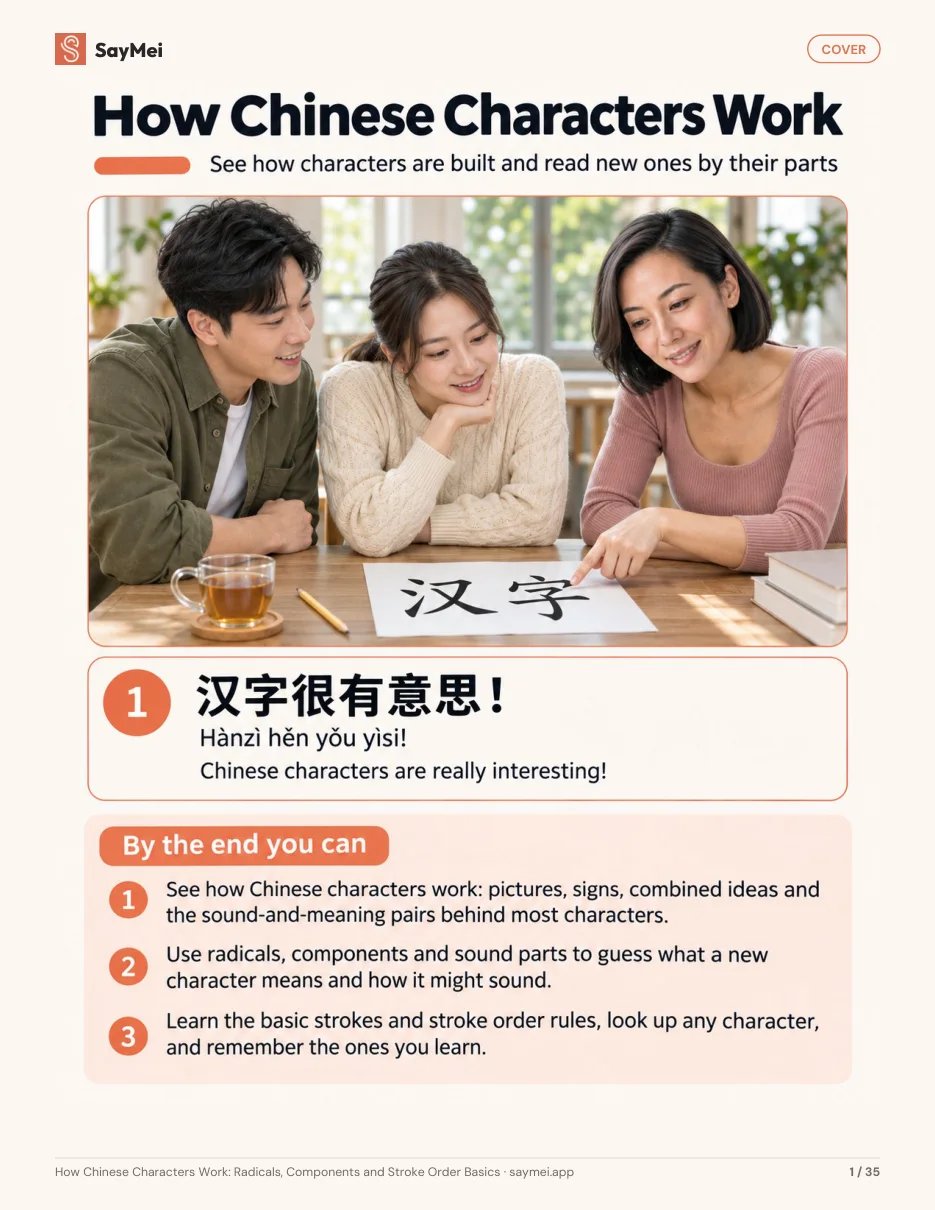
汉字很有意思! · Hànzì hěn yǒu yìsi! · Chinese characters are really interesting!
By the end you can
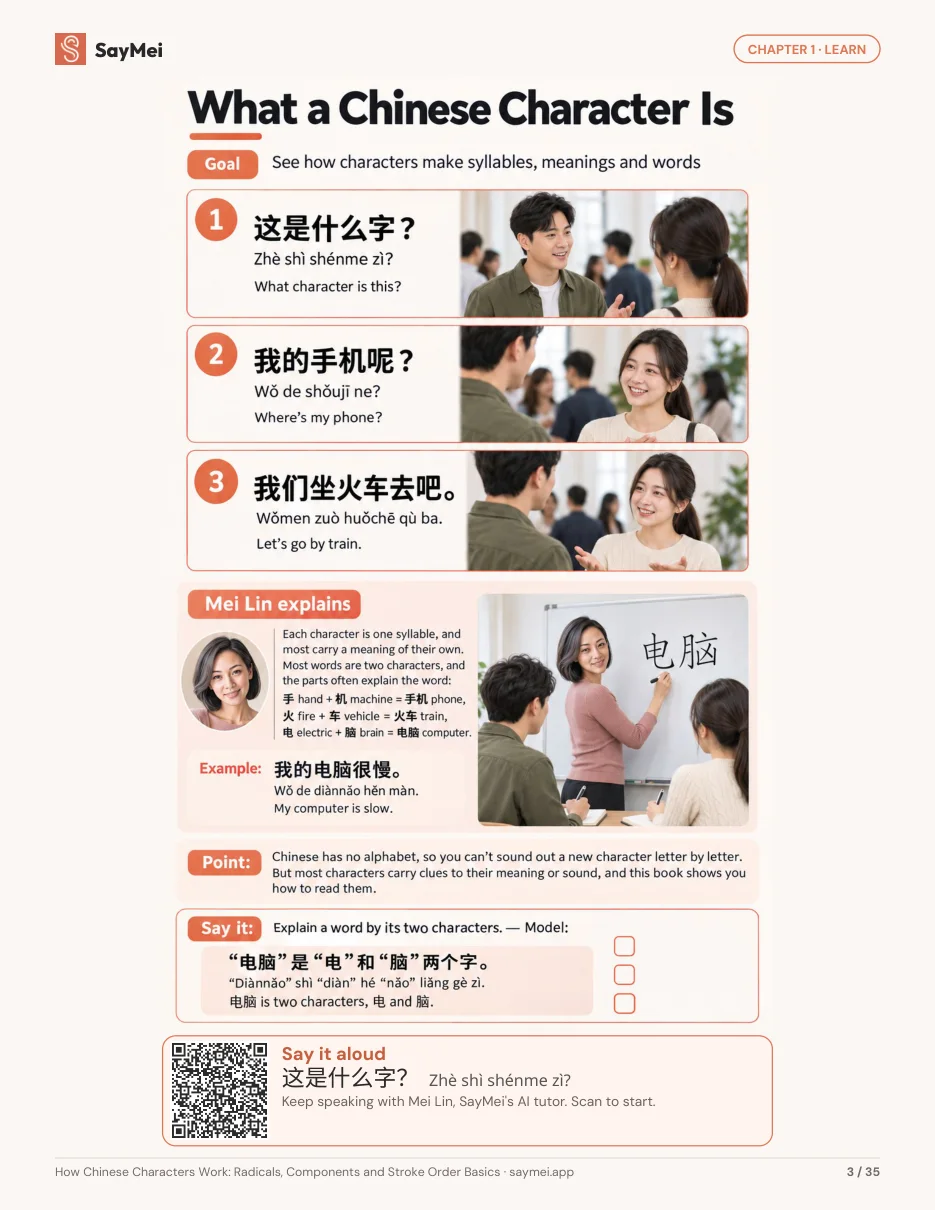
- See what a Chinese character is and how many there are. One syllable with a meaning, built into words like 手机 and 电脑. Then the real numbers: about 47,000 in the Kangxi Dictionary, 8,105 in China's 2013 list, and 1,000 that cover over nine in ten of everyday text.
汉字一共有多少个? · Hànzì yígòng yǒu duōshao gè? · How many Chinese characters are there? - Name the six ways characters are formed. Pictures like 日 and 山, signs like 本 and 末, combined ideas like 休 and 看, borrowed characters like 来 and 北, and the sound-and-meaning pairs behind most characters.
我们休息一下吧。 · Wǒmen xiūxi yíxià ba. · Let's take a break. - Split a character into a meaning part and a sound part. 洗 is 氵 water plus 先 for the sound; 包 sounds through 饱, 抱, 跑 and 泡. You also see how often the sound part is exact (about a third of the time) and where it has drifted, as in 海.
请问,洗手间在哪儿? · Qǐngwèn, xǐshǒujiān zài nǎr? · Excuse me, where's the restroom? - Use radicals to guess what a new character means. Ten radicals by the names people say, like 三点水, 提手旁 and 草字头, where they sit, and the two look-alikes that fool learners: 月 for moon or body, and 阝 for hill or town.
这个字跟水有关系吗? · Zhège zì gēn shuǐ yǒu guānxi ma? · Does this character have to do with water? - Take characters apart and say them by their parts. Name a character's shape (left-right, top-bottom or wrap-around), then spell it the way people spell surnames: 弓长张, 木子李, 双木林 and seven more.
我姓林,双木林。 · Wǒ xìng Lín, shuāng mù Lín. · My surname is Lin, the Lin with two trees. - Learn the basic strokes and the stroke order rules. The eight basic strokes and the core rules, with why they exist and worked examples in 干, 八, 川, 回, 小 and 犬, then practice ordering and counting strokes.
这个字先写哪一笔? · Zhège zì xiān xiě nǎ yì bǐ? · Which stroke of this character comes first? - Read both scripts, look up any character and remember it. How simplified and traditional differ (说 and 說, 门 and 門), four ways to look a character up, and how to make it stick with parts, families, memory stories and spaced review.
这是繁体字吗? · Zhè shì fántǐzì ma? · Is this a traditional character?
What’s inside
- Chapter 1: What a character is: one syllable with a meaning, how characters build words, and how many characters there are. Learn: What a Chinese Character Is · Reference: How Many Characters Are There? · Practice: Characters, Syllables and Words
- Chapter 2: The six ways characters are formed: pictures, signs, combined ideas and borrowed characters, with how common each one is. Reference: Six Ways Characters Are Formed · Learn: Pictures That Became Characters · Learn: Signs and Combined Ideas · Learn: Borrowed Characters · Practice: Pictures, Signs and Borrowings
- Chapter 3: Sound and meaning together: the meaning part, the sound part, four sound families, and when the sound part has drifted. Learn: Sound and Meaning Together · Reference: Sound Families · Learn: When the Sound Part Drifts · Practice: Find the Sound Part
- Chapter 4: Radicals as the meaning clue: what a radical is, ten radicals that change shape, and guessing meanings from them. Learn: Radicals: the Meaning Clue · Reference: Radicals That Change Shape · Practice: Guess the Meaning From the Radical
- Chapter 5: Components and shapes: left-right, top-bottom and wrap-around characters, and spelling surnames by their parts. Learn: Components and Character Shapes · Reference: Say a Character by Its Parts · Practice: Take Characters Apart
- Chapter 6: Strokes and stroke order basics: the eight strokes, the core rules and why they exist, with practice. Learn: Strokes and Stroke Order Basics · Practice: Order the Strokes
- Chapter 7: Simplified and traditional characters, and four ways to look up a character you can't read. Learn: Simplified and Traditional · Learn: Four Ways to Look Up a Character · Practice: Two Scripts and Four Lookups
- Chapter 8: How to remember characters: parts, families, words, memory stories and a review plan. Learn: How to Remember Characters · Practice: Make Characters Stick
- Review: Read a menu by its parts, take apart eight new characters, and tick off what you can do now. Reading a Menu by Its Parts · Practice: Take Apart Eight Characters · Checklist: What You Can Do Now
How to use this book
Work through one or two chapters a sitting, in order, and play the audio as you go. Say each line aloud, then check the practice pages against the answers at the back.
- Day 1: What characters are. Chapter 1: one syllable, one meaning, words built from characters, and the numbers on page 4.
- Days 2–3: How characters are built. Chapters 2 and 3: the six ways, then the meaning part and the sound part. Say the sound families on page 12 aloud.
- Days 4–5: Radicals and components. Chapters 4 and 5: guess meanings from radicals and spell your own surname, or a friend's, by its parts.
- Days 6–7: Strokes, scripts and lookup. Chapters 6 and 7: the stroke order rules, simplified and traditional, and the four ways to look a character up.
- Day 8: Make it stick. Chapter 8 and the review: write your own memory stories, take apart eight new characters and tick the checklist.
- Every new character: Take it apart first. Find the meaning part and the sound part, name the shape, then review it after one day, three days and a week.
Who it’s for
Adult beginners who want to understand Chinese characters instead of memorising shapes: learners starting to read, anyone who keeps meeting 氵 and 扌 and wonders why, and teachers who want a clear explanation with practice.
Before you start: No characters needed. Every example has pinyin and English, the sentences use beginner words, and the free audio reads every Chinese line.
Frequently asked questions
How many Chinese characters are there?
Big dictionaries list tens of thousands: the Kangxi Dictionary of 1716 has about 47,000, most of them rare or old forms. China's 2013 standard list has 8,105 for general use, with 3,500 common ones in its first tier. The most common 2,500 make up about 98% of everyday text, and the top 1,000 over nine in ten. Page 4 sets out the numbers.
Does a radical always tell you the meaning?
No. A radical points to a meaning family, and clearly so only a bit over half the time: 江 and 湖 have the water radical, but so does 法, method. The book shows when to trust it and the two look-alikes that fool most learners, 月 and 阝.
How often does the sound part give the right sound?
Exactly, tone included, only about a third of the time, though the rhyme or the first sound often still matches. Chapter 3 shows families that work well, like 包 in 饱, 抱, 跑 and 泡, and ones that have drifted, like 每 in 海.
Does the book teach stroke order?
Yes, in one chapter: the eight basic strokes, the core rules with worked examples and why they exist, and a practice page. For every rule with its own practice pages, see Chinese Stroke Order Chart and Rules.
Does it use simplified or traditional characters?
Simplified, as mainland China and Singapore do. Chapter 7 shows how traditional characters differ and how one simplified radical, like 讠 for 言, covers a whole family of characters.
Do I need a SayMei account?
Yes, to download the PDF, and the account is free: sign up with Google, Apple or your email address. With it we email you a copy of the workbook, keep every workbook you download on your account on all your devices, save your place in the free online practice, and you can practise speaking with Mei Lin, SayMei's AI tutor.
How do I print it?
The PDF is US Letter size. On A4 paper, choose "Fit to page" (or "Scale to fit") in the print dialog so nothing is cut off. Print the whole workbook or only the pages you need; colour looks best, and black and white works too.
Keep going
Chinese Radicals Chart: Common Radicals and Their Changing Forms · Chinese Radicals Workbook: 50 Radicals to Read New Characters · The SayMei Chinese Characters Practice Book · Chinese Radicals Flashcards: 48 Common Radicals to Print and Cut · Browse all 340 workbooks
Version 2026-11 · Updated Nov 12, 2026 · Report a correction