Conversation · Beginner
Mandarin for Couples: Talk with Your Partner and Meet Their Family
You greet your partner's parents as 叔叔 and 阿姨 on the first video call, bring the right gift and turn down more food with 我吃饱了. For adult beginners with a Chinese-speaking partner, starting from zero.
- Level:
- Beginner · HSK 1
- Format:
- Workbook · PDF · 28 pages · US Letter (prints on A4)
- Price:
- Free · free with a saymei account · updated Nov 4, 2026
Listening audio: play every track free, no account needed.
Download the free PDF: create a free SayMei account on this page, and we'll email you a copy too.
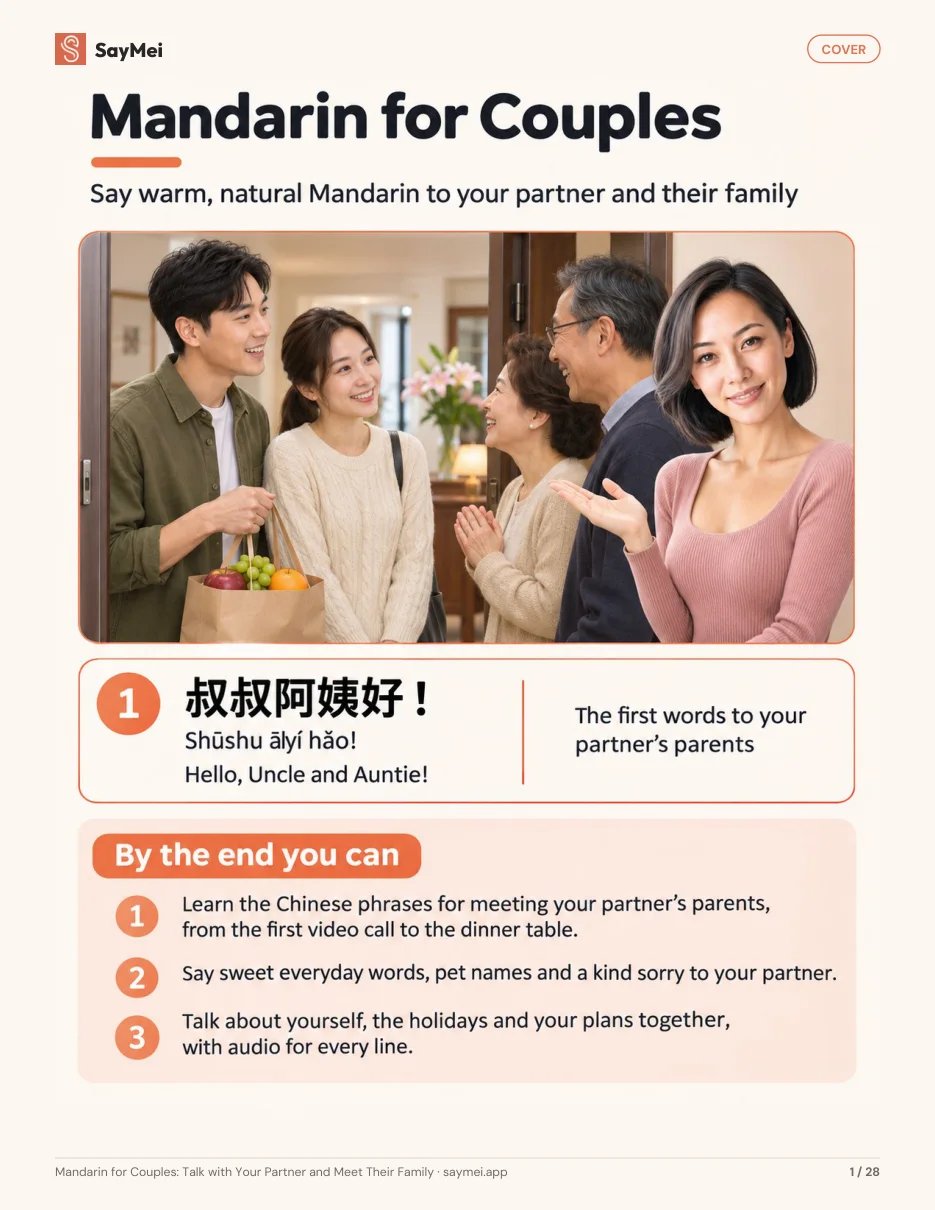
叔叔阿姨好! · Shūshu āyí hǎo! · Hello, Uncle and Auntie!
By the end you can
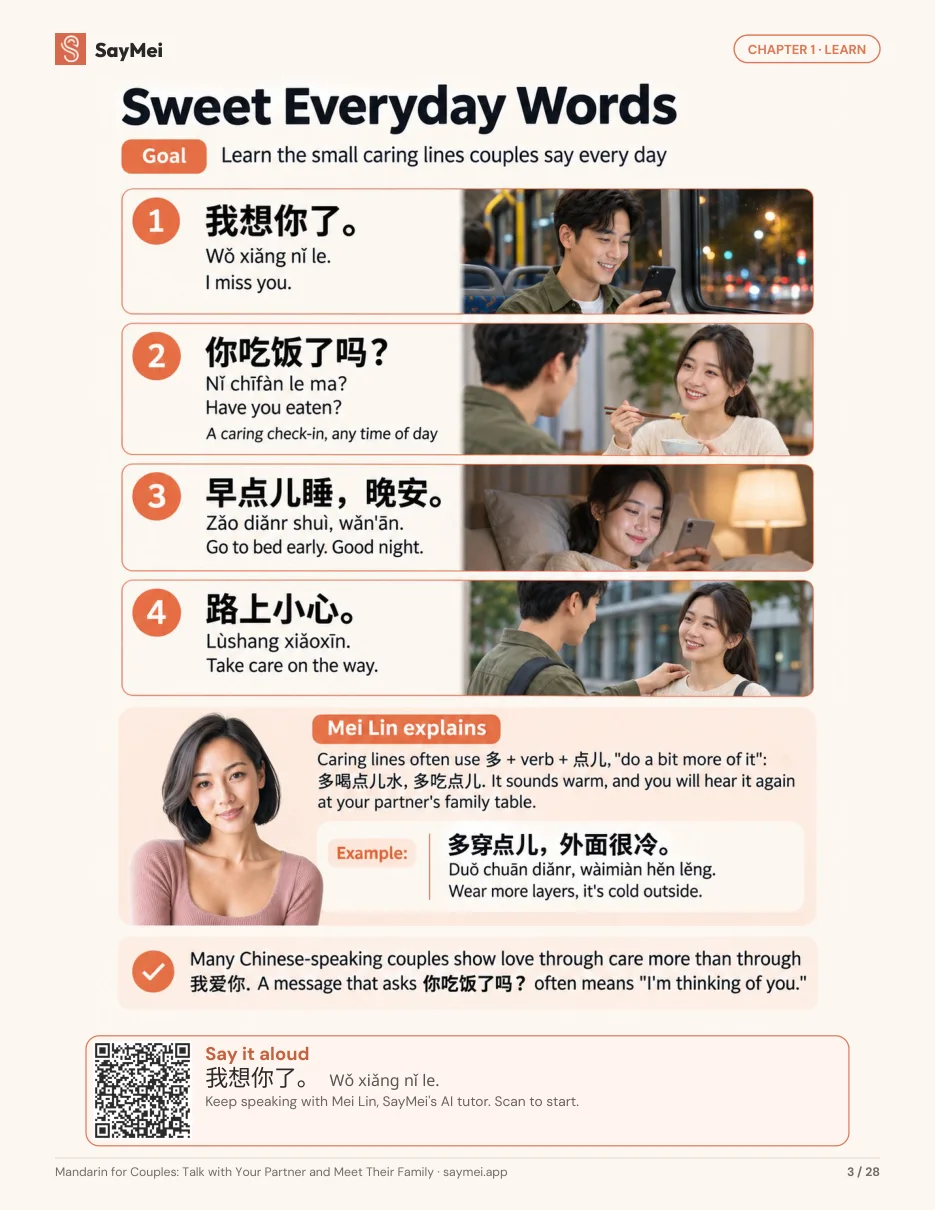
- Say sweet everyday words and choose what to call each other. Check in with 你吃饭了吗?, call your partner 亲爱的 or 宝贝, and introduce them with 对象 or 爱人, words that fit any couple.
你吃饭了吗? · Nǐ chīfàn le ma? · Have you eaten? - Get through the first video call with your partner's parents. Greet them as 叔叔 and 阿姨, say you're happy to meet them, ask them to slow down, and end the call warmly with 下次再聊.
我的中文不太好,请说慢一点儿。 · Wǒ de Zhōngwén bú tài hǎo, qǐng shuō màn yìdiǎnr. · My Chinese isn't very good; please speak a little slower. - Bring the right gift and greet the family at the door. Skip clocks and sets of four, hand the gift over with both hands, say 打扰了 as you walk in, and greet the oldest person first.
阿姨,这是给您的,一点儿小礼物。 · Āyí, zhè shì gěi nín de, yìdiǎnr xiǎo lǐwù. · Auntie, this is for you, just a little gift. - Praise the food, say you're full and make a toast. Say 太好吃了, serve yourself with 我自己来, stop more food kindly with 我吃饱了, and toast an older person with your glass a little lower.
谢谢阿姨,我真的吃饱了。 · Xièxie āyí, wǒ zhēn de chībǎo le. · Thank you, Auntie, I'm really full. - Answer the parents' questions about you. Say what you do, that you're learning Chinese and how big your family is, and say how long with the time after the verb and 了.
我们认识两年了。 · Wǒmen rènshi liǎng nián le. · We've known each other for two years. - Give holiday greetings and plan where to spend New Year. Wish the family 过年好 and good health at Spring Festival, say 中秋节快乐, and take turns between families with 去 and 过.
今年我们去你家过年吧。 · Jīnnián wǒmen qù nǐ jiā guònián ba. · Let's spend New Year at your family's this year. - Say sorry and make up after a small fight. Take the blame kindly, ask to talk calmly, and use 别 + verb + 了 to ask your partner to stop being angry or put the phone down.
对不起,是我不好。 · Duìbuqǐ, shì wǒ bù hǎo. · I'm sorry, it was my fault. - Talk about your plans together. Use 想 for a wish and 打算 for a plan, so you have an answer when the parents ask 你们有什么打算?
我们打算明年结婚。 · Wǒmen dǎsuàn míngnián jiéhūn. · We plan to get married next year.
What’s inside
- Chapter 1: Learn: Sweet Everyday Words · Practice: Sweet Words in Action
- Chapter 2: Learn: What You Call Each Other · Practice: Names for Each Other
- Chapter 3: Learn: A Video Call with the Parents · Practice: Your First Video Call
- Chapter 4: Learn: Before the First Visit · Practice: Gifts and Questions
- Chapter 5: Learn: At the Door · Practice: Greet the Whole Family
- Chapter 6: Learn: At the Dinner Table · Practice: Dinner Practice
- Chapter 7: Learn: Talking About Yourself · Practice: The Parents' Questions
- Chapter 8: Learn: Holidays Together · Practice: Spring Festival Together
- Chapter 9: Learn: Small Fights and Making Up · Practice: Making Up
- Chapter 10: Learn: Talking About the Future · Practice: Plans Together
- Review: The First Visit
How to use this book
Ten short chapters, each a Learn page and a Practice page. Play the chapter's free audio, say each line in the pause three times, then try it on your partner. At two chapters a week, that's about five weeks.
- Week 1: Words for the two of you. Chapters 1 and 2. Send your partner a voice message with 我想你了 and 晚安, and choose what you call each other.
- Week 2: The first video call and the gift. Chapters 3 and 4. Answer Auntie's three questions on the audio, then ask your partner what the parents like and what to call them.
- Week 3: At the door and at the table. Chapters 5 and 6. Greet the family oldest first, then practise saying no to more food with a smile and making a short toast.
- Week 4: Questions and holidays. Chapters 7 and 8. Answer Uncle's three questions on the audio with your own job and dates, and plan whose family you visit for New Year.
- Week 5: Making up and plans. Chapters 9 and 10. Practise a calm sorry, and say your plans with 打算 so you have an answer ready for the parents.
- Before the visit: Act out the whole visit. Play the review dialogue on page 23 with your partner, swap in your own gift and plans, and check your answers on pages 24 to 28.
Who it’s for
Adult beginners with a Chinese-speaking partner who want to talk with them in Mandarin and meet their family, from the first video call with the parents to Spring Festival at their home. It works for any couple, dating or married.
Before you start: Nothing. Every line has characters, pinyin and English, and the free audio reads each one with a pause to say it back. The answers to the Practice pages are at the back.
Frequently asked questions
What's in the book?
Ten short chapters that follow a relationship: sweet everyday words, what you call each other, the first video call with the parents, the gift before the first visit, the door, the dinner table, the parents' questions, holidays, making up and plans together. Page 23 acts out the whole first visit.
Does the book work for any couple?
Yes. Where Chinese has a word for husband or wife, like 老公 and 老婆, the book also gives one that fits everyone: 对象 for the person you're dating and 爱人 for your spouse. Both sound clear and respectful in front of parents.
What if the parents ask about marriage, money or children?
These questions can come early, and they come from care. The book suggests a smile and 我们还在想 ("we're still thinking") or 我们还没想好 ("we haven't decided yet"). Chapter 10 shows how to share a small plan with 打算, which parents are glad to hear.
Is there audio?
Yes, free on the book's audio page: one track for each chapter and one for the review, with every Chinese line read once and a pause to say it back. The listening questions on pages 8 and 16 are on the audio too, and the code on page 2 opens it.
How long does it take?
At two chapters a week, about five weeks. Say each line three times in the audio pause, then try it on your partner, and act out the whole visit on page 23 before you go. The answers are on pages 24 to 28.
Do I need a SayMei account?
Yes, to download the PDF, and the account is free: sign up with Google, Apple or your email address. With it we email you a copy of the workbook, keep every workbook you download on your account on all your devices, save your place in the free online practice, and you can practise speaking with Mei Lin, SayMei's AI tutor.
How do I print it?
The PDF is US Letter size. On A4 paper, choose "Fit to page" (or "Scale to fit") in the print dialog so nothing is cut off. Print the whole workbook or only the pages you need; colour looks best, and black and white works too.
Keep going
Keep a Mandarin Conversation Going · Talk About Your Day: Mandarin Daily Routines Workbook · Hobbies in Chinese: Sports, Free Time and Invitations · Spoken Mandarin Days 15–30: Your Next Two Weeks of Speaking · Browse all 294 workbooks
Version 2026-11 · Updated Nov 4, 2026 · Report a correction