Characters · Beginner to intermediate
The 1,000 Most Common Chinese Words: Frequency List with Pinyin and Audio
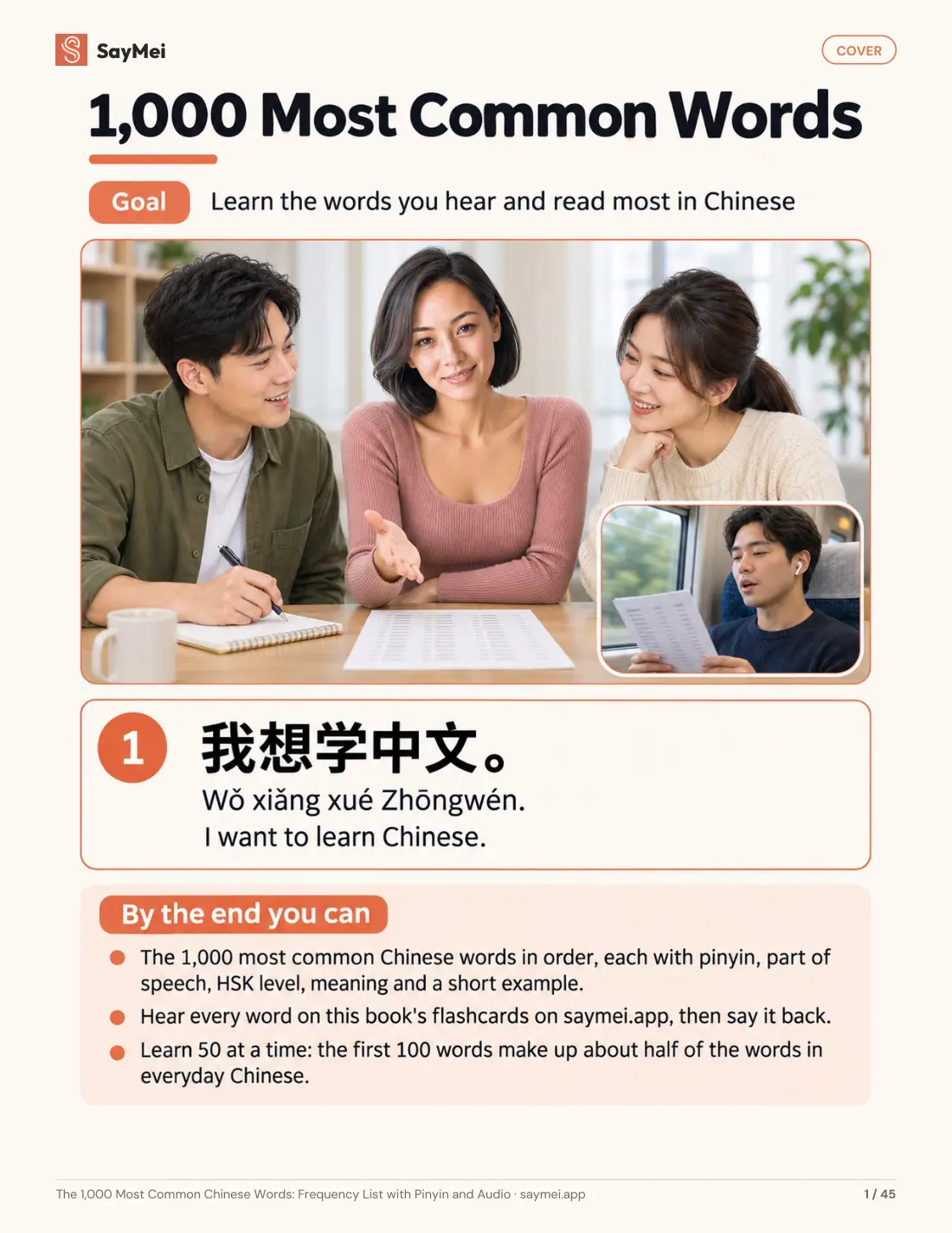
The 1,000 words you'll hear and read most in everyday Chinese, in order, each with pinyin, part of speech, HSK level, meaning and a short example phrase.
- Level:
- Beginner to intermediate · HSK 1–3
- Format:
- Reference guide · PDF · 45 pages · US Letter (prints on A4)
- Price:
- Free · free with a saymei account · updated Nov 11, 2026
Listening audio: play every track free, no account needed.
Download the free PDF: create a free SayMei account on this page, and we'll email you a copy too.
我想学中文。 · Wǒ xiǎng xué Zhōngwén. · I want to learn Chinese.
By the end you can
- Learn the words that fill most everyday sentences. The first 100 words make up about half of the words in the everyday texts we counted, so every word near the top pays off on every page you read.
我们 · wǒmen · we, us - Use each word in a short, natural phrase. Every word comes with a short example phrase with pinyin and English, like 好久不见 for 久 and 别担心 for 别, so you learn it the way people say it.
好久不见 · hǎojiǔ bú jiàn · long time no see - Know what kind of word it is. A small tag under the pinyin gives the part of speech and HSK level, so you can tell a verb from a noun and see what to learn for your next level.
觉得 · juéde · to feel, to think - Get the little words right. Particles and short words like 了, 吧 and 别 sit near the top of any frequency list. Each one has a plain-English note on what it does and a phrase that shows it.
别 · bié · don't - Say each word with the right tones. Pinyin follows how the words are said, including the tone changes of 一 and 不, as in 一起 yìqǐ and 不要 búyào.
一起 · yìqǐ · together - Track your progress 50 at a time. Tick the box when you can say a word and use it in a phrase without looking. Each block of 50 fits on two facing pages.
知道 · zhīdào · to know
What’s inside
- Start Here: How a Frequency List Works · Self-Check: Top-List Words
- Word list: The 1,000 Most Common Words
How to use this book
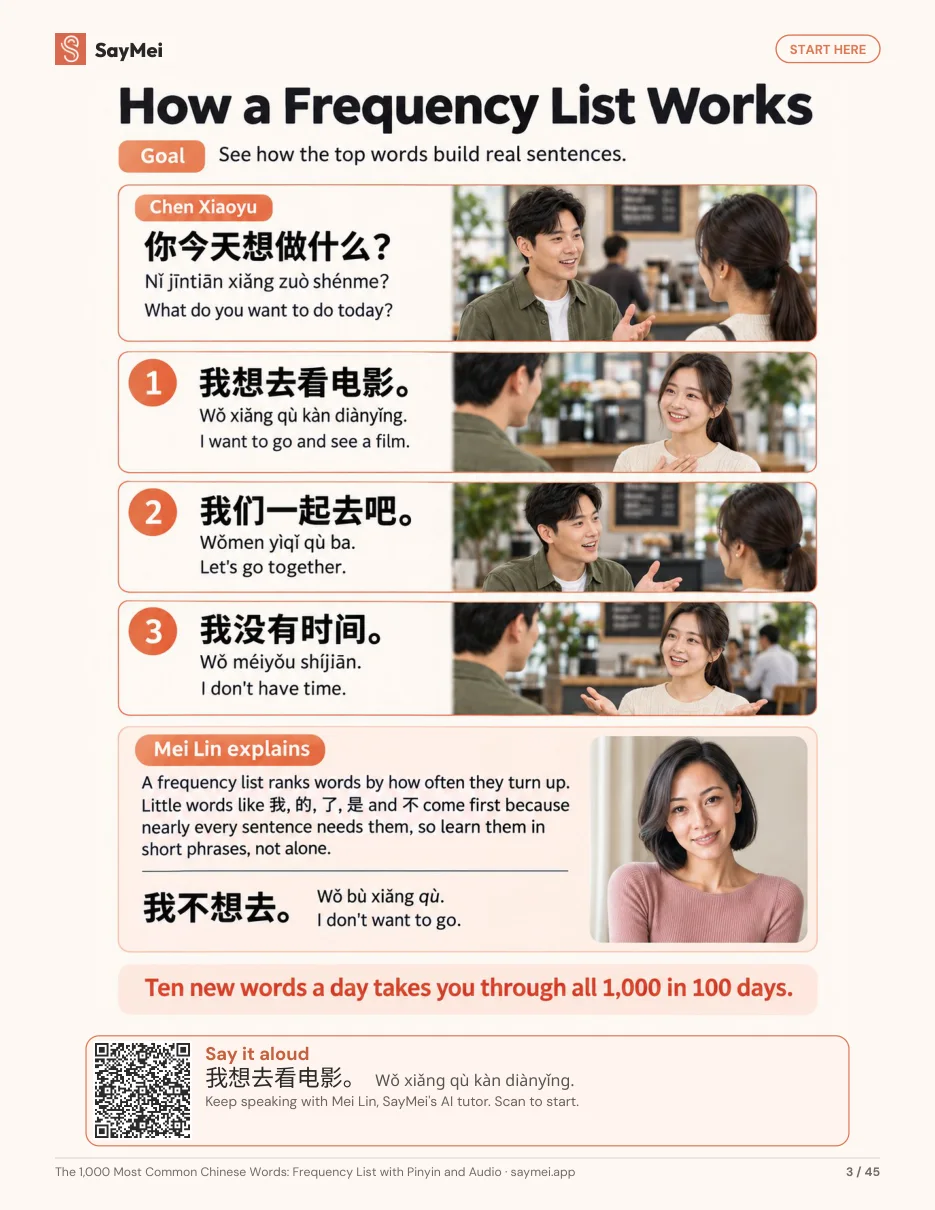
Start with the two Start Here pages, then learn ten words a day. Say each example phrase aloud, check it on the flashcards with audio, and tick the box once you can use the word without looking.
- Day 1: Start Here. Pages 3 and 4. See how the list works, read the top words in an exchange and do the self-check.
- Days 2–11: Words 1 to 100. Ten a day. These alone make up about half of the words in everyday Chinese.
- Days 12–51: Words 101 to 500. Ten a day, one block of 50 every five days. Review each block on the flashcards before you start the next.
- Days 52–101: Words 501 to 1,000. Ten a day, then change one word in each example phrase to make it about you.
Who it’s for
Adult learners and students who want the words that matter most in one printable frequency list, in order, to learn on their own or beside any course.
Before you start: Knowing pinyin helps: every word and example has its pinyin and English. The book's flashcards on saymei.app play every word.
Frequently asked questions
How was the order worked out?
We split about 2.2 million characters of everyday Chinese into words: Tatoeba's conversation sentences, SayMei's stories and SayMei's lessons, with names left out. We then ranked the HSK 3.0 words by how often they appear. So "most common" means most used in everyday Chinese, counted by us. Sentence counts use Tatoeba (tatoeba.org), CC BY 2.0 FR.
Why are there single characters in a word list?
Many of the most common Chinese words are one character long, like 我, 是, 去 and 吃. They're full words on their own, so they're in the list next to two-character words like 朋友 and 喜欢.
Is there audio?
Yes. Scan the QR code on the list pages to open this book's flashcards on saymei.app, which play every word. The Start Here pages have their own audio too.
How is this different from the HSK word lists?
The HSK lists group words by level. This list puts the words in order of how often they're used, so you learn the most useful ones first, and it shows each word's HSK level beside it.
What should I use next?
The 1,000 Most Common Chinese Characters shows the characters these words are built from, each with a common word. The Chinese Verbs List and Chinese Adjectives List give 100 verbs and 100 adjectives with full example sentences.
Do I need a SayMei account?
Yes, to download the PDF, and the account is free: sign up with Google, Apple or your email address. With it we email you a copy of the workbook, keep every workbook you download on your account on all your devices, save your place in the free online practice, and you can practise speaking with Mei Lin, SayMei's AI tutor.
How do I print it?
The PDF is US Letter size. On A4 paper, choose "Fit to page" (or "Scale to fit") in the print dialog so nothing is cut off. Print the whole workbook or only the pages you need; colour looks best, and black and white works too.
Keep going
Traditional vs Simplified Chinese: See the Difference and Read Both · The 1,000 Most Common Chinese Characters: Printable List with Pinyin and Audio · All 214 Chinese Radicals: Printable List and Chart with Pinyin and Meanings · 100 Common Chinese Characters, Learned by Component · Browse all 340 workbooks
Version 2026-11 · Updated Nov 11, 2026 · Report a correction