Pronunciation · Total beginner
Pinyin and Tones Practice Book: Pinyin Chart, Pronunciation Guide, Tone Pairs and Tone Changes in One PDF
You learn every Mandarin sound the English-speaker way, spell any syllable in pinyin, hear and say tone pairs and tone changes, then test yourself. For beginners who want their pronunciation right from the start.

- Level:
- Total beginner · HSK 1
- Format:
- Practice book · PDF · 156 pages · US Letter (prints on A4)
- Price:
- Free · free with a saymei account · updated Nov 17, 2026
Download the free PDF: create a free SayMei account on this page, and we'll email you a copy too.
我会说四个声调。 · Wǒ huì shuō sì ge shēngdiào. · I can say the four tones.
By the end you can
- Say the Mandarin sounds English speakers get wrong. Book 1 compares each sound with English: the puff of air in p, the smile for j, q and x, and the lifted tongue for zh, ch and sh.
喜欢 · xǐhuan · to like - Split any syllable into initial, final and tone. Book 2 teaches pinyin in twelve lessons, from the first sounds to where every tone mark goes.
妈 · mā · mum - Spell pinyin correctly with the full chart. Book 3: the 21 initials, the final families and the spelling rules, such as why 六 is liù and 去 is qù.
鱼 · yú · fish - Name and say any two-syllable tone pair. Book 4 maps all 20 tone pairs with a key word for each and audio to listen and repeat.
文化 · wénhuà · culture - Make the third tone, 一 and 不 change the way speakers do. Book 6 covers tone sandhi: why 你好 is said ní hǎo and when 不 becomes bú.
不是 · bú shì · is not - Check your tones and sounds with a scored test. Book 7: 50 listening questions with audio and six items to read aloud, with score bands that name what to practise next.
我的声调对吗? · Wǒ de shēngdiào duì ma? · Are my tones right?
What’s inside
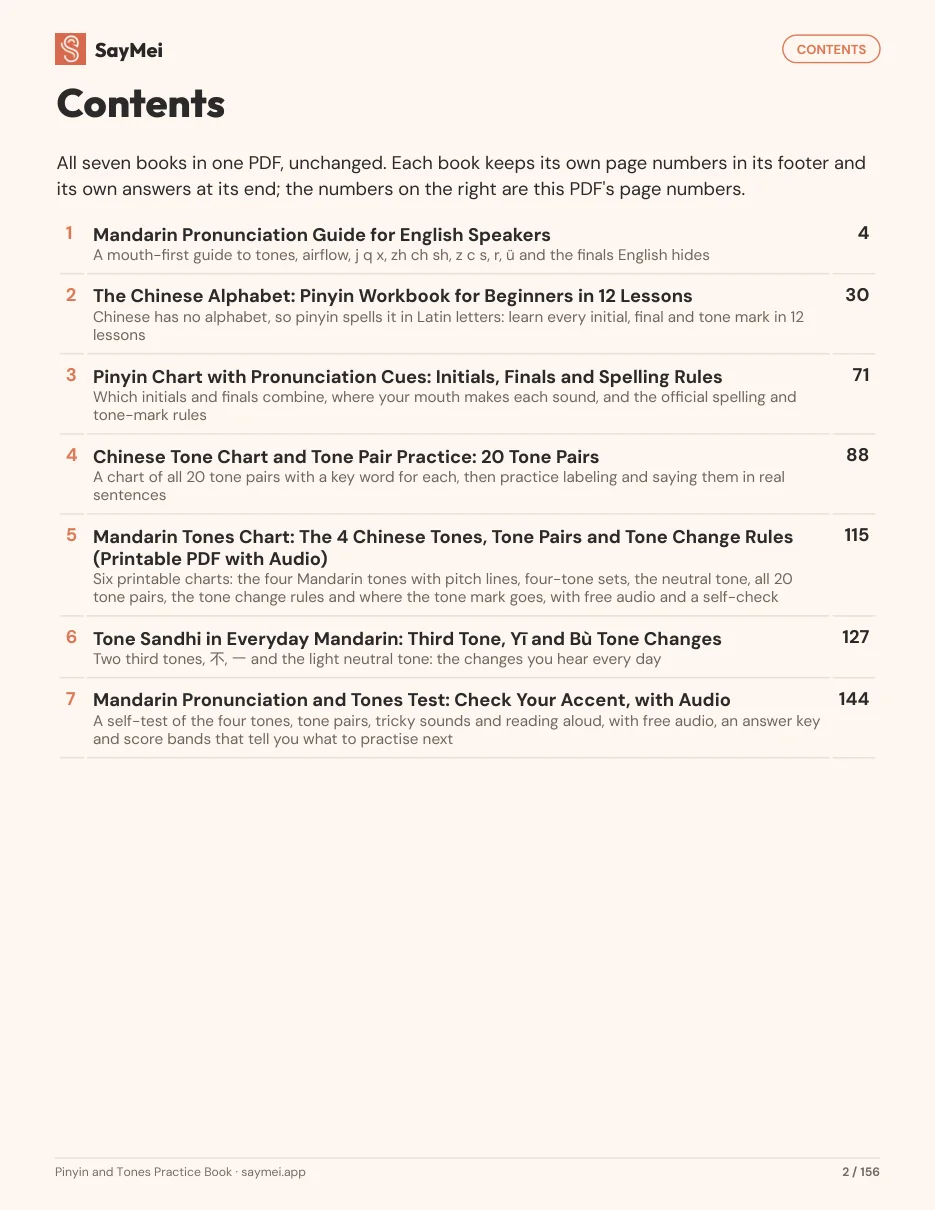
- Book 1: Mandarin Pronunciation Guide for English Speakers: every Mandarin sound compared with English. Mandarin Pronunciation Guide for English Speakers
- Book 2: The Chinese Alphabet: Pinyin Workbook for Beginners in 12 Lessons, from initials and finals to tone marks. The Chinese Alphabet: Pinyin Workbook for Beginners in 12 Lessons
- Book 3: Pinyin Chart with Pronunciation Cues: initials, finals and the spelling rules, with practice. Pinyin Chart with Pronunciation Cues: Initials, Finals and Spelling Rules
- Book 4: Chinese Tone Chart and Tone Pair Practice: the 20 tone pairs, with a key word for each and audio. Chinese Tone Chart and Tone Pair Practice: 20 Tone Pairs
- Book 5: Mandarin Tones Chart: the four tones, tone pairs and tone change rules, with audio. Mandarin Tones Chart: The 4 Chinese Tones, Tone Pairs and Tone Change Rules (Printable PDF with Audio)
- Book 6: Tone Sandhi in Everyday Mandarin: the third tone, yī and bù tone changes, with practice. Tone Sandhi in Everyday Mandarin: Third Tone, Yī and Bù Tone Changes
- Book 7: Mandarin Pronunciation and Tones Test: 50 listening questions with audio, read-aloud items and score bands. Mandarin Pronunciation and Tones Test: Check Your Accent, with Audio
How to use this book
Work through the six books in order, a few pages a day, saying every example out loud. Keep the pinyin chart in book 3 beside you as a reference, and take the test at the end.
- Days 1–5: Sounds. Book 1: the sounds English speakers get wrong, a section a day, out loud.
- Days 6–17: Pinyin. Book 2: one pinyin lesson a day, then check the answers.
- Any time: The chart. Book 3: the full chart and spelling rules, to look things up and practise spelling.
- Weeks 4–5: Tones in real words. Books 4 to 6: tone pairs with the audio, the tones chart, then the tone changes.
- At the end: Test yourself. Book 7: take the test, score it, and practise what the score band names. Take it again a month later.
Who it’s for
Total beginners who want pinyin and tones right before they learn many words, and learners who picked up Mandarin by ear and keep mixing up sounds, spellings or tones.
Before you start: Nothing. Every example word is printed in characters, pinyin and English, and the books start from how a syllable is built.
Frequently asked questions
Is this the same as the seven separate books?
Yes. It puts seven SayMei pronunciation books into one PDF, unchanged, with a cover, a contents page and a page on how to use the book. Each keeps its own answers at its end.
Is there audio?
Three of the books have audio. The tone pairs in book 4 have free audio on that book's listening page (its address is on the how-to page); the tones chart (book 5) and the tones test (book 7) have QR codes and links on their pages. The other four are made to use without audio.
I already know some pinyin. Where should I start?
Take the test in book 7 first. Its score bands name what to practise next; then go to the book that covers it: sounds in books 1 to 3, tone pairs in books 4 and 5, tone changes in book 6.
Does it cover tone changes like 你好 and 不是?
Yes. Book 6 covers the third-tone change, yī and bù, with practice for each rule.
Is it for adults or children?
Adults and teens. For children, see SayMei's kids pinyin and tones books.
Do I need a SayMei account?
Yes, to download the PDF, and the account is free: sign up with Google, Apple or your email address. With it we email you a copy of the workbook, keep every workbook you download on your account on all your devices, save your place in the free online practice, and you can practise speaking with Mei Lin, SayMei's AI tutor.
How do I print it?
The PDF is US Letter size. On A4 paper, choose "Fit to page" (or "Scale to fit") in the print dialog so nothing is cut off. Print the whole workbook or only the pages you need; colour looks best, and black and white works too.
Keep going
The Chinese Alphabet: Pinyin Workbook for Beginners in 12 Lessons · Chinese Tone Pair Flashcards: 80 Cards for All 20 Tone Pairs · Mandarin Pronunciation Guide for English Speakers · Chinese Short Stories with Pinyin: 23 Graded Stories for Beginners · Browse all 379 workbooks
In these collections: Free Chinese Textbooks and Course Books (PDF) · Pinyin and Tones Workbooks · Chinese Workbooks for Complete Beginners
Version 2026-11 · Updated Nov 17, 2026 · Report a correction