World classic, retold in simple Mandarin
Jack and the Beanstalk
杰克与魔豆
Jack and the Beanstalk (杰克与魔豆, Jiékè yǔ mó dòu) is a fairy tale by Joseph Jacobs, retold in simple Mandarin as a 5-chapter story with audio for learners at about HSK 1 (Beginner).
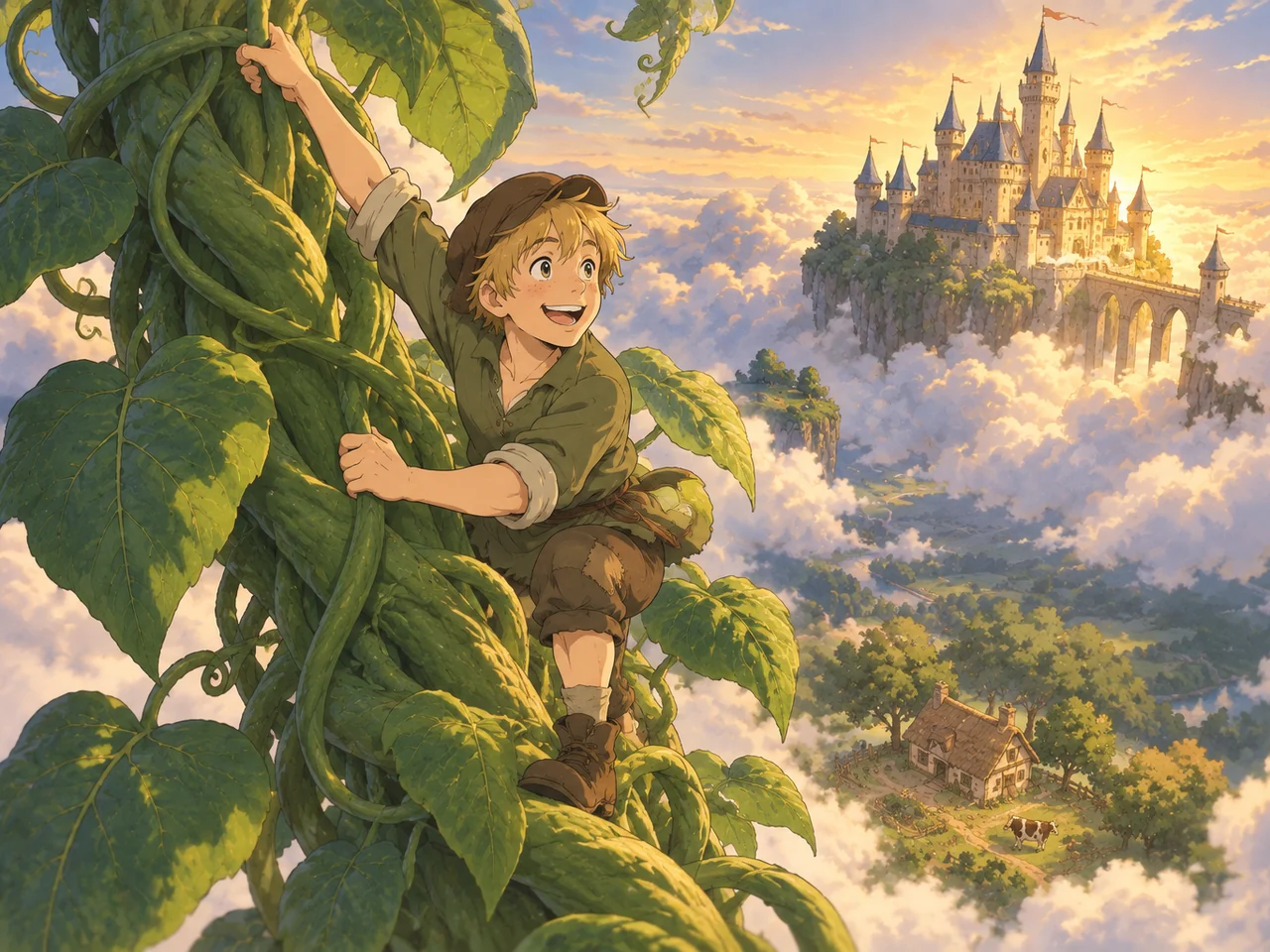
Retold from the English fairy tale in Joseph Jacobs's English Fairy Tales (1890): Jack swaps the family cow for five magic beans, and by morning a beanstalk has grown all the way up to a giant's house in the clouds.
Meet the voices
- Narrator · 旁白 — An old storyteller who tells Jack's tale plainly and warmly, like a grandfather by the fire.
- Jack · 杰克 — A cheerful, cheeky country boy who is always hungry, thinks fast, and says “Don't worry!” just before things get exciting.
- Jack's Mother · 妈妈 — Jack's poor, hard-working widowed mother, who worries about everything and cries “Oh my heavens!” at every surprise.
- The Old Man · 老爷爷 — A funny little old man on the road to market who loves a riddle and keeps five magic beans in his pocket.
- The Giant's Wife · 巨人太太 — The giant's big, kind-hearted wife, who can never turn a hungry boy away and is tired of hearing about her husband's nose.
- The Giant · 巨人 — A huge, greedy, always-hungry giant with a very good nose and a chant he bellows whenever he smells a child.
- The Hen · 母鸡 — The giant's little hen, who lays an egg of solid gold whenever she is told to and cackles proudly every time.
- The Golden Harp · 金竖琴 — A magic golden harp that sings the sweetest lullabies and cries out for its master when anyone carries it off.
5 chapters, one journey
Chapter 1: Five Magic Beans
五个魔豆
Jack is sent to market to sell the family cow, but a funny old man with a riddle offers him something much stranger than money: five magic beans.
Free to read
Chapter 2: The House Above the Clouds
云上的大房子
At the top of the beanstalk, Jack finds a road across the clouds, a door taller than his whole house, and a big woman with a warning about her husband.
SayMei Stories
Chapter 3: The Hen That Lays Golden Eggs
会下金蛋的鸡
When the gold runs out, Jack climbs back up, but the giant's wife remembers him, and the giant keeps something even more amazing than gold.
SayMei Stories
Chapter 4: The Singing Harp
会唱歌的金竖琴
The golden eggs make Jack and his mother rich, but Jack wants one last look inside the giant's house, where there is a treasure that can sing.
SayMei Stories
Chapter 5: Down Comes the Beanstalk
魔豆倒了
The giant is right behind Jack, the harp won't stop shouting for its master, and the only thing that might save him now is Father's axe.
SayMei Stories
Key words in Jack and the Beanstalk
Behind the story
Jack and the Beanstalk is an English folk tale. Its oldest known printing dates from 1734, and Benjamin Tabart published his own version in 1807. This book follows Joseph Jacobs, who put the tale in his English Fairy Tales in 1890, telling it, he said, the way he had heard it as a child in Australia: the cow Milky-white, three climbs up the beanstalk, a bag of gold, a hen that lays golden eggs and a harp that calls out for its master.
In Chinese the story is often called 杰克与魔豆, “Jack and the Magic Bean,” and it is a favorite in Chinese picture books and collections of 英国童话, English fairy tales. This retelling gives the giant a Chinese chant of his own and lets him land safely in a pond; in Jacobs's version, the fall is the end of him.
Did you know?
- The giant's chant is older than any printed Jack story: in Shakespeare's King Lear, written around 1606, a character mutters an early version of it.
- Tabart's 1807 version added a fairy who tells Jack that the giant once robbed his father, to make taking the treasure seem fair. Jacobs left the fairy out.
- English speakers warn against “killing the goose that lays the golden eggs.” Chinese gives the same warning with the idiom 杀鸡取卵, “killing the hen to get the eggs.”