World classic, retold in simple Mandarin
Momotaro, the Peach Boy
桃太郎
Momotaro, the Peach Boy (桃太郎, Táo Tàiláng) is a fairy tale, retold in simple Mandarin as a 4-chapter story with audio for learners at about HSK 1 (Beginner).
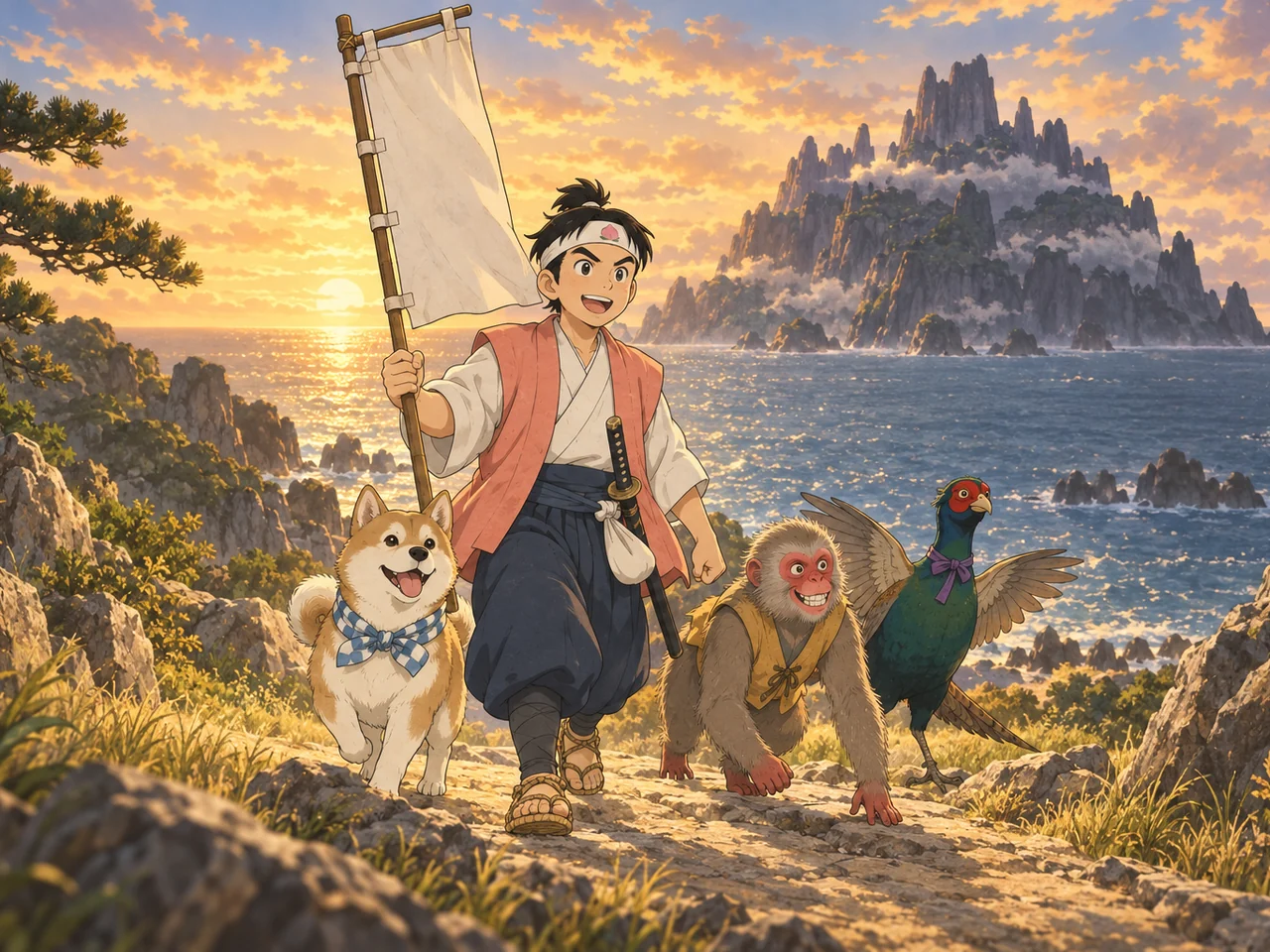
Retold from the Japanese folk tale: a giant peach floats down the river with a baby boy inside, and at fifteen he sets off for Demon Island with a pouch of millet dumplings, making three friends on the way.
Meet the voices
- Narrator · 旁白 — An old storyteller who tells the Japanese tale plainly and warmly, like a grandfather by the fire.
- Momotaro · 桃太郎 — The boy who came out of a giant peach: cheerful, polite, as strong as ten men, and generous with his grandma's dumplings.
- Grandpa · 老爷爷 — The old woodcutter who raises Momotaro, a jolly joker with a big appetite and a soft heart.
- Grandma · 老奶奶 — The old woman who finds the peach in the river and makes the best millet dumplings in Japan, and knows it.
- The Dog · 小狗 — A loyal, eager dog with a big nose and a bigger appetite, who never quite trusts the monkey.
- The Monkey · 猴子 — A clever, cheeky monkey who loves to show off, and loves teasing the dog even more.
- The Pheasant · 山鸡 — A proud green pheasant who sees everything from the sky and keeps the dog and the monkey apart.
- The Ogre King · 鬼大王 — The huge red chief of the ogres of Demon Island, a bully who turns out to be a crybaby.
4 chapters, one journey
Chapter 1: The Giant Peach
大桃子
A little voice calls “Grandma!” on the river, and the biggest peach an old woman has ever seen floats by. When her husband lifts the knife, the peach has a surprise of its own.
Free to read
Chapter 2: One Dumpling, One Friend
一个团子,一个朋友
Grandma packs the best millet dumplings in Japan, and on the road to the sea a hungry dog sniffs them out. But someone else has been listening from the trees.
SayMei Stories
Chapter 3: Three Friends
三个朋友
The monkey learns he only had to ask, the dog gains a rival, and a proud pheasant drops out of the sky. Then the little boat reaches Demon Island.
SayMei Stories
Chapter 4: Demon Island
鬼岛
At the gate of Demon Island, Momotaro has a job for every friend. But the huge red Ogre King has an iron club, and a hundred ogres behind him.
SayMei Stories
Key words in Momotaro, the Peach Boy
Behind the story
Momotaro, the Peach Boy, is one of Japan's best-loved folk tales. It was already a favorite in the Edo period (1603–1868), when it was printed in cheap picture books for children. In many early versions the old couple eat the peach, grow young again and then have a son. The version with the baby inside the peach became the standard one in the Meiji era (1868–1912), when the tale went into Japanese school readers and children's books.
In Chinese the tale keeps its Japanese characters, simply read the Chinese way: 桃太郎, Táo Tàiláng. 桃 means “peach,” and 太郎 is a classic Japanese name for a family's eldest son. Chinese readers know him from collections of Japanese folk tales, 日本民间故事, where one word often needs explaining: the 鬼 of 鬼岛 are not the ghosts the character means in Chinese, but oni, the horned, club-swinging ogres of Japanese folklore.
Did you know?
- Momotaro's dumplings are kibi dango in Japanese, 吉备团子 in Chinese; this book simply calls them 小米团子, “millet dumplings.” Kibi means millet, and it is also the old name of the Okayama area, which proudly calls itself Momotaro's home: a statue of the boy and his three friends stands outside Okayama Station.
- Peaches were thought to drive away evil in both countries. In Japan's oldest book of myths, the god Izanagi escapes from the underworld by throwing peaches at the army chasing him, and Chinese families once hung peach-wood charms, 桃符, on their doors at New Year: the ancestors of today's Spring Festival couplets.
- Japanese has a saying for two people who never get along: they are like a dog and a monkey. This retelling lets Momotaro's dog and monkey live up to it.