Langua review: is it good for learning Chinese?
Our Langua review for Mandarin: where pinyin shows up, whether it checks tones, what 660 store reviews say, every price and how refunds work. November 2026.

Langua calls itself "the world's best AI Chinese tutor", and reviewers praise its lifelike voices. But its Chinese page never mentions pinyin, tones or the HSK, and pinyin only reached its app in July 2026.
This review is for you if you're learning Mandarin and deciding whether Langua is worth a trial, or which plan to buy. We read its website, help centre, release notes and terms in November 2026, and 660 written reviews from the App Store and Google Play.
Key takeaways
- It's a conversation partner, not a Chinese course. You talk through role-plays, debates and chats about your interests, and nothing in it follows the HSK.
- You choose how you're corrected. Its correction styles, from "Off" to "Ask me to repeat", are its standout feature.
- Pinyin is patchy. It shows in chat mode, but not in calls, flashcards or podcasts, Langua's help centre says.
- It doesn't claim to check your tones. Its help centre lists pronunciation scores only for Spanish, French and English. For Chinese, you mostly see what the app thought you said.
- Written reviews have cooled. In our count of 660 reviews, average stars fell every half-year, and complaints about mishearing tripled.
- Where you pay decides your refund. Website and Google Play plans come with a money-back guarantee; App Store plans depend on Apple.
Strong for talking, thin on Chinese specifics
Langua does one job very well: it gives you a patient partner to talk to, and lets you decide how it corrects you. For a Mandarin learner, several other jobs are only partly done, or missing.
We scored each one from Langua's own pages and what learners report:
What you need · Verdict · What Langua gives you
Lots of speaking practice
Strong
30 minutes of calls a day on Standard, far more on Unlimited
Corrections you can tune
Strong
Five correction styles, feedback reports and audio summaries
Words you'll remember
Partly
Saved words become flashcards and stories, though Chinese cards have no pinyin yet
Pinyin when you need it
Partly
In chat mode since July 2026, not yet in calls, flashcards or podcasts
A gentle start from zero
Partly
A short beginner course, being rebuilt language by language
Feedback on your tones
Missing
Langua's help centre never mentions tones, and lists pronunciation scores only for Spanish, French and English
A path tied to the HSK
Missing
Langua's Chinese page never mentions the HSK
Sources: Langua's help centre, release notes, Chinese page and App Store listing, and 660 written store reviews, all read on 6 November 2026. Each row is explained below.
If you can already hold a simple conversation in Mandarin, Langua is one of the best-equipped AI partners you can pay for. If you're starting from zero, or want your tones checked, you'll need something else alongside it.
What you get: a talking partner with a big toolbox
Langua is made by LanguaTalk, a US company that began in 2021 as a marketplace for human tutors and launched Langua in 2024. Its iPhone and Android apps arrived in December 2024, and it also runs on the web, best in Chrome.
One subscription covers all 23 of its languages, Chinese among them, and the app works the same way in each. By Langua's own pages, you can:
- Talk to a tutor with a cloned voice. Each voice is cloned from a real person, some of them YouTubers that Langua partners with.
- Pick the kind of conversation. Role-plays, debates, grammar and vocabulary practice, chats about your interests, or exercises you write yourself.
- Chat or call. In chat mode, you speak or type one turn at a time, with the conversation on screen. Call mode is hands-free, and you can interrupt. Since September, its newest version hears your voice directly and can look things up online.
- Choose how you're corrected. Corrections can be off, written under your reply, worked quietly into the tutor's answer, pointed out, or a request to say it again.
- Get a report. After a chat, a feedback report lists your mistakes, better ways to say things and cultural tips. There's an audio summary too.
- Keep your words. Save words from chats, podcasts or imported texts, photos and PDFs, then review them as flashcards, short stories or chats built around them.
- Follow a path, or don't. My Path suggests what to practise next, and the tutor remembers facts about you unless you switch its memory off.
Here's the correction view, from Langua's own App Store listing:
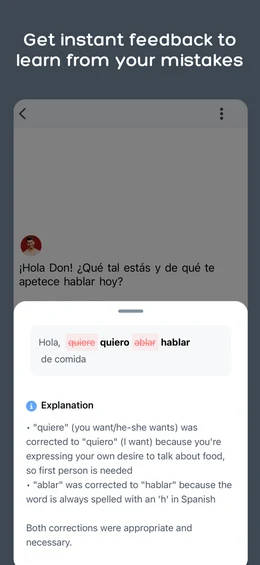
That example is Spanish. None of the 7 iPhone images on its App Store listing, or the 8 on Google Play, shows Chinese.
Langua is candid that its corrections aren't perfect. In its own testing, it says the AI spots mistakes about 95% of the time, and it can correct something that was fine. Each written correction has a "check & explain" link that asks the AI to look again.
For speaking practice, that's a deeper toolbox than most AI tutors we've reviewed. The question for you is how much of it works in Chinese.
Chinese support arrived late, and still has gaps
Chinese is one of Langua's newer languages, and its support is still catching up. Langua's help pages first listed Chinese in mid-2025, and its phone app only got pinyin in July 2026.
Pinyin is Chinese spelled in Latin letters, with tone marks, and it's how most learners read their first Mandarin. Here's where Langua shows it today, by its help centre:
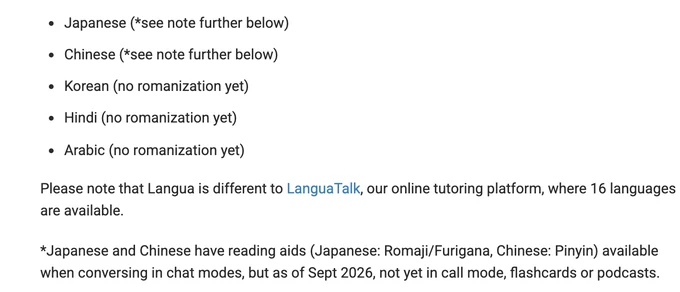
We pieced together what Langua offers a Mandarin learner, feature by feature:
| Feature | On Langua, for Chinese |
|---|---|
| Pinyin in chat mode | Yes, switched on automatically since August 2026 |
| Pinyin in calls, flashcards and podcasts | Not yet, as of September 2026 |
| Simplified and Traditional characters | Both, since July 2026 |
| A pronunciation score | Listed only for Spanish, French and English; a beta in guided lessons since January 2026 |
| Feedback on tones | Not mentioned anywhere we looked |
| HSK levels | Not mentioned; you set your own level |
| Cantonese | Not offered as a language to learn |
Source: Langua's help centre, release notes and App Store version history, read 6 November 2026.
The gaps matter most in calls. Call mode is Langua's best way to practise speaking, but with no pinyin on screen, a beginner has to follow spoken Mandarin by ear, or read characters.
On the phone app, pinyin is new. In January 2026, Langua's help centre warned Chinese learners that the app had no pinyin, though the website did. The July update brought pinyin to the app, along with Simplified and Traditional characters.
Two reviews show what that gap cost learners. One on Google Play, in March 2026, said: "Pinyin doesn't show up for mandarin which makes the app useless". In October, an App Store reviewer said they still couldn't see pinyin or tone marks when previewing new words.
The HSK is missing too. Langua's Chinese page never mentions it, and nothing in the app is sorted by HSK level. On Langua's public roadmap, a request for mock exams, the HSK among them, has 102 votes.
If you read characters, or you're happy to practise in chat mode, the gaps are small. If you rely on pinyin, learn to read it well before you start calling.
Does Langua check your Chinese tones?
Not that it says. We found no help page or store listing where Langua mentions tones, and its help centre lists pronunciation scores only for Spanish, French and English, on the website.
Tones matter because they change words. Say buy, 买, with a falling tone, and you've said sell, 卖.
For Chinese, Langua's feedback on your speech is indirect. If you mispronounce something, its help centre says, the transcript will show the wrong words, because the AI couldn't understand you. Then you can try again.
That's a weak signal for tones. Speech recognition picks the most likely words for the context, so it can write the word you meant even when your tone was off. A review of 15 studies found that speech-recognition feedback had a large effect on learners' individual sounds, but a small one on their rhythm and pitch. Tones are pitch.
Langua's own notes show the limits. A shadowing drill added in April 2026, in which you copy the tutor, comes with a note that the AI can't hear you.
The newest call mode, from September, hears your voice rather than a transcript, but Langua doesn't say it judges your pronunciation. Its guided lessons got pronunciation feedback in January, in beta, with no word on which languages.
Even LanguaTalk's own guide to learning Chinese with AI admits that AI tools can struggle with the subtleties of tones.
Chinese learners' reviews point the same way. In February 2026, an App Store reviewer got stuck repeating one phrase for about 20 minutes, with no help to pronounce it. In April, a Google Play reviewer said a lesson marked their words as mispronounced, then said "great job" and moved on. They had wanted to work on their tones.
Learners of other languages describe the same leniency. Three reviewers say Langua praised gibberish or the wrong word, one of them after saying "Tiramisu" when asked for "Sayonara".
Our advice: use Langua to practise talking, and check your tones another way. Our guide to learning tones shows how to train your ear. SayMei hasn't published a test of its own tutor's tone-catching either, so the same caution applies to us.
Lifelike voices, with the odd Mandarin slip
When reviewers praise Langua, they most often single out its corrections and its voices. Each voice is cloned from a real person, and many languages have several accents. Langua doesn't list which voices or accents it has for Chinese.
Lifelike isn't the same as always right, though. A UK learner noticed in August 2025 that the voice kept reading 还 as huán where hái was meant.
The character has two readings. It means still, 还, in I'm still learning, 我还在学. It means give back, 还, in return a book, 还书.
The same learner said a correction kept changing what they meant, swapping their word for a different one. Both are slips a native speaker wouldn't make, and a beginner wouldn't catch.
Langua updated its voices in October 2026. In November it added a switch back to the old "Classic" style, for learners who missed it.
Our advice: when a word sounds odd, check it before you copy it. Tap it for the translation, or look it up in a dictionary such as Pleco.
Beginners will struggle; intermediate learners gain most
Langua's help centre says it's most popular with basic and intermediate learners, and its reviews agree. In our count, 44 of the 660 reviews say it's hard for beginners or lacks structure. Many happy reviewers add that it works best once you can hold a basic conversation.
Langua does have help for beginners:
- A beginner course. Lessons for the first levels teach a few set phrases, then use them in a role-play. Langua rebuilt it in October, starting with four languages, and is rolling it out to most others.
- Suggested replies. Tap the lightbulb to read, hear and repeat a possible answer.
- Your own language. Say what you can't in English, and the tutor helps you say it in Chinese.
- Slower audio. Replies play slower for beginners, and you can slow them further.
But you set your own level, because there's no level test yet. On Langua's public roadmap, a level test has 232 votes, and Langua marks it as planned or in progress.
Chinese learners felt the gap. A Google Play reviewer couldn't find how to lower their level for Chinese. Another reviewer said his wife tried Langua to learn Chinese and found it wasn't built for that.
Our read: come to Langua once you can answer simple questions in Mandarin. Before that, a course will teach you more per minute, and our guide to speaking Chinese shows where to start.
Ratings glow, but written reviews have cooled
Langua's star ratings are high on both stores: 4.6 on the US App Store and 4.4 on Google Play. Its written reviews are cooler.
Here's the average, by store and by who's rating:
Langua's written reviews average about a star below its store ratings
Average stars from all ratings on each store, and from every written review we collected there, to 4 November 2026
| Store | Written reviews | All ratings |
|---|---|---|
| US App Store | 3.67 | 4.57 |
| UK App Store | 3.46 | 4.42 |
| Google Play | 3.47 | 4.37 |
Sources: Langua's US and UK App Store listings and its Google Play page, read 6 November 2026, with Apple's public review feed and Google Play's English reviews. The all-ratings counts are 2,784, 527 and 2,137.
The gap has a likely cause. Anyone can tap a star rating, often when the app asks, while written reviews come from people with something to say. Of the written ones, nearly half give five stars and a quarter give one.
We read all 660 and sorted them by what they raise. Most praise the app, and a quarter report bugs:
Source: Apple's public review feeds for seven English-speaking countries and Google Play's English reviews. We sorted reviews by keyword rules, then read them and corrected the rules by hand; the Methods explain how.
The praise is real, and specific. Happy reviewers single out the corrections and feedback, then the voices and accents, and many say Langua finally got them talking. One US reviewer in August 2026 called it "truly like having a 24/7 tutor."
Most reviewers are learning European languages, though. Of the reviews that name a language, more than half mention Spanish, and only 11 mention Chinese.
The complaints are mostly about reliability. And they're growing. Here's how the written reviews changed, half-year by half-year:
| Half-year | Reviews | Average stars | Say it mishears them |
|---|---|---|---|
| Jan–Jun 2025 | 136 | 3.94 | 5% |
| Jul–Dec 2025 | 164 | 3.68 | 10% |
| Jan–Jun 2026 | 207 | 3.27 | 17% |
| Jul–Nov 2026 | 153 | 3.20 | 15% |
Source: our count of the 660 reviews. The first half of 2025 includes one Google Play review from late December 2024.
Reviewers choose themselves, so these shares show what goes wrong, not how often. Still, the direction is clear, and Langua knows it: its September notes say it upgraded the speech recognition behind calls.
Our advice: try the free plan with your own Mandarin before you pay. If the app often mishears you, the rest of it can't help much.
What Chinese learners say about Langua
We found only nine reviews from Chinese learners among the 660, five on the App Store and four on Google Play, from August 2025 to October 2026. They average 2.1 stars.
That's too few to measure anything. But each one makes a specific point:
- No pinyin where they wanted it. Two, quoted above: none for Mandarin in March 2026, and none when previewing new words in October.
- Speech practice that stalls. Two: one stuck on a phrase for about 20 minutes, and a lesson that talked over the end of each Chinese phrase, then praised mistakes.
- Chinese that was off. One: the 还 reading, and a correction that changed their meaning.
- Too hard to start. One couldn't lower the level for Chinese.
- No Traditional characters. One, in March 2026. Langua added them in July.
- Bugs. One found voice messages stuck, after Langua had warned that Chinese could be buggy.
- Not useful. One, with no detail.
The two warmest give four stars. One, from the UK learner who heard 还 misread, calls Langua very good and extremely useful, with Chinese that needs minor improvements.
On Reddit, the one thread about Langua we found on r/ChineseLanguage, from January 2026, asked how to see pinyin alongside characters.
So the pattern is consistent. Chinese learners run into pinyin and speech recognition first. Langua is working on both, and both are what you should test before you pay.
How much does Langua cost?
Langua has two paid plans, Standard and Unlimited, on top of a small free plan. Standard costs $19.99 a month, or $12.50 a month if you pay for a year.
Here's what each plan includes, by Langua's help centre and terms:
Free
- How much you can talk
- 3 minutes of calls a day and about 20 chat messages a week
- US price
- $0
Standard
- How much you can talk
- 30 minutes of calls and 75 chat messages a day
- US price
- $19.99 a month or $149.99 a year
Unlimited
- How much you can talk
- No daily cap on calls; up to 350 chat messages a day, under fair use
- US price
- $29.99 a month or $199.99 a year
Sources: Langua's help centre, terms and US App Store listing, 6 November 2026. Flashcards, stories, podcasts and feedback have no limit on either paid plan.
Paying for longer cuts the price. Here's what each plan on the US App Store works out to per month:
Source: Langua's US App Store listing: $69.99 and $49.99 for 3 months, $199.99 and $149.99 a year.
Langua's website charges the same per month, plus sales tax where it applies, and schools and companies get custom plans from $500 a month. Here are the plans on its Chinese page:
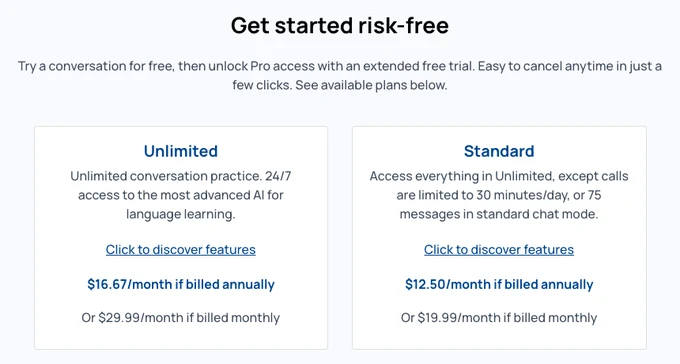
Google Play lists purchases from $19.90 to $199.90.
A few rules matter before you start. The free trial needs a card, lasts 5 days on a monthly plan or 7 on a yearly one, and charges nothing while it runs. Plans renew automatically, so a trial becomes the plan you picked unless you cancel. And discount codes work only on the website.
Is it worth it? At $19.99 a month, Standard costs more than HelloChinese or SuperChinese, which teach full Chinese courses, and a little more than Speak's monthly plan. What it buys is plenty of talk time, which makes it cheap per minute if you use it, as we show below.
Where you paid decides your refund
Langua's refund promise depends on where you bought your plan:
- On the website or Google Play. A 30-day money-back guarantee, on top of the trial: ask within 30 days for a full refund. It works once, and you then wait three months before you can subscribe again.
- On the App Store. No guarantee from Langua. Refunds are Apple's decision, under Apple's rules.
- On a US iPhone or iPad, billed by Stripe. Some US iPhone and iPad plans are billed through Stripe, not Apple, and Langua's terms don't say which refund rules cover them. To cancel one, you're asked to finish by email; one US reviewer in September 2026 said the cancellation link never came.
To cancel, Langua's help centre says: on the website, go to Settings, then Manage Subscription. In the app, tap Account, then My Subscription. Or cancel in your phone's Apple or Google Play subscriptions.
Cancelling keeps Pro until the end of the period you've paid for, with no refund for the days left. An email to Langua doesn't cancel anything, its terms say, though Langua will help if you can't log in.
Charges come up in 29 of the 660 reviews, a quarter of them about a free trial that turned into a paid plan. So decide before you start. If you might want your money back, subscribe on the website or Google Play, and set your own reminder before the trial ends.
One more check: the App Store has another app called Langua. LanguaTalk's has a red logo.
Reviews from before July 2026 describe a different app
Langua changes fast: its help centre says it ships improvements every 5 to 10 days. For Chinese, most of what matters arrived in 2026.
Here's what changed and when, dated from Langua's release notes, help centre and App Store version history:
| When | What changed |
|---|---|
| December 2024 | The iPhone and Android apps launch |
| By May 2025 | Chinese joins Langua's language list, with pinyin on the website only |
| January 2026 | The help centre warns that the app has no pinyin yet |
| 6 July 2026 | Version 2.1 brings pinyin to the app, with Simplified and Traditional characters |
| 22 August 2026 | Version 2.3 turns pinyin on automatically for Chinese |
| September 2026 | A new call mode hears your voice; pinyin is still missing from calls |
| October 2026 | New voices, and a rebuilt beginner course in four languages first |
| 28 October 2026 | Version 3.0, the latest when we checked |
Sources: Langua's latest updates, help centre and US App Store listing; archived copies of its languages page from April and August 2025.
That's why the reviews that rank well can mislead a Mandarin learner. The ones we found test Langua in Spanish, Korean, Finnish or English, or don't test it at all. One earns a commission when you subscribe, and another is by the founder of a rival app. LanguaTalk's own guide ranks Langua first for Chinese: it's their app, as SayMei is ours.
So date anything you read about Langua's Chinese, including this review.
Who should use Langua, and who shouldn't
We'd pick Langua if:
- You can already hold a simple conversation. It shines once you can answer questions and want much more practice.
- You want control over corrections. Few AI tutors let you choose so precisely how you're corrected.
- You want talking and vocabulary in one app. Words from your chats become flashcards and stories.
- You learn more than one language. One subscription covers all 23.
- You read characters, or you're happy to chat rather than call. Chat mode is where its Chinese support is strongest.
We'd skip it, or pair it with something else, if:
- You're starting from zero. Learn pinyin and tones with a course first.
- You want your tones checked. It makes no claim to check them, so use a pitch tool or a teacher.
- You're preparing for the HSK. Nothing in Langua maps to the exam. Our HSK exam guide covers what to use.
- You need pinyin in calls. It isn't there yet.
- You're buying for a child. Langua's terms set the minimum age at 13, with a parent's permission until 18.
The best alternatives for each goal
No app does everything. If Langua isn't the right fit, here's our pick for each goal:
A Chinese course built for speaking
- Pick
 Speak
- Price
- $17.99 a month or $83.99 a year
- Why
- A course to B1, with a pronunciation lesson in every unit
A gentle start from zero
- Pick
 HelloChinese
- Price
- $11.99 a month or $69.99 a year
- Why
- Pinyin, characters and grammar, step by step
A score on every line you say
- Pick
 SuperChinese
- Price
- $11.99 a month or $59.99 a year
- Why
- A course from zero to about HSK 5
Some free talk every day
- Pick
 Talkpal
- Price
- Free for 10 minutes a day, or $19.99 a month
- Why
- A free plan with a daily limit
A human ear for your tones
- Pick
 An italki tutor
- Price
- About $20 an hour
- Why
- The median Chinese teacher's price
A tutor made only for Mandarin
- Pick
 SayMei
- Price
- $5.99 a month for 200 minutes
- Why
- Mei Lin corrects your tones as you talk
Sources: Speak, HelloChinese and SuperChinese on the US App Store and SayMei's pricing page, 6 November 2026; Talkpal from our Talkpal review; italki from our tutors guide.
For more AI conversation partners, our reviews of Praktika, Talkpal and Pingo cover Langua's closest rivals. Our Speak review covers the one with a real Chinese course.
Where SayMei fits, and where it doesn't
SayMei is our app, and it's built for one language. Mei Lin, SayMei's AI tutor, holds spoken lessons in Mandarin and English, sorted by HSK level, and corrects your tones as you answer. Your level sets how much English she uses and how fast she talks, and the transcript can show characters, pinyin or both.
SayMei Premium costs $5.99 a month for 200 minutes with Mei Lin. It runs in the browser on any phone or computer.
Here's where Langua beats us:
- Far more talk time. Standard allows 30 minutes of calls a day. Our 200 minutes a month come to about six and a half a day.
- Phone apps. Langua has iPhone and Android apps as well as its website. SayMei runs in the browser instead.
- A bigger toolbox. Flashcards from your chats, short stories, podcasts with transcripts, imported texts and feedback reports.
- More control. Several correction styles, calls you can interrupt, and a tutor that remembers what you've told it.
- More languages. One Langua subscription covers 23; SayMei teaches only Mandarin.
- A money-back guarantee. Langua refunds website and Google Play plans within 30 days. SayMei's terms make no such promise.
Langua is also cheaper per minute, if you use what you pay for. Counting call minutes alone:
Source: our arithmetic from each app's US prices; the Methods show the sums.
So it depends on how much you'll talk. Paid monthly, Langua costs less per minute than SayMei once you talk for about 22 minutes a day; paid yearly, once you pass about 14. Below that, SayMei costs less, at under a third of Standard's monthly price, and unused minutes roll over while you're a member.
And one gap we share. Like Langua, SayMei hasn't published a test of how accurately its tutor hears your tones.
If you already speak some Mandarin and want lots of practice with plenty of tools, Langua may suit you better. If you want a tutor whose whole job is Mandarin, with pinyin whenever you want it, start with SayMei.
What to do next
- Try the free plan in Chinese first. A few days of short chats show whether it hears your Mandarin.
- Learn pinyin and tones before you call. Calls show no pinyin, and the app doesn't claim to check your tones.
- Buy on the website or Google Play. That's where Langua's money-back guarantee applies.
- Set your own trial reminder. Cancel before the trial ends, in the place you paid.
- Check your tones another way. A pitch tool or a tutor catches what a transcript can't.
If you're choosing between AI tutors, our comparison puts Langua next to Speak, SuperChinese, Talkpal and more.
FAQ
Is Langua good for learning Chinese?
For speaking practice once you know the basics, yes. Its lifelike voices, choice of correction styles and vocabulary tools make it one of the richest AI conversation apps. It's weaker as a Chinese teacher: pinyin appears in chats but not in calls, it makes no claim to check tones, and nothing follows the HSK. The nine Chinese learners' reviews we found average 2.1 stars, mostly over pinyin and speech recognition.
How much does Langua cost?
On the US App Store, Standard costs $19.99 a month, $49.99 for 3 months or $149.99 a year, and Unlimited costs $29.99, $69.99 or $199.99. The website's prices work out the same per month, plus sales tax where it applies. Standard caps calls at 30 minutes a day, while Unlimited has a fair-use limit of 350 chat messages a day.
Is Langua free?
Only a little. The free plan gives you about 3 minutes of calls a day and about 20 chat messages a week, enough to test it but not to practise. To try Pro, you need a card for a free trial: 5 days on a monthly plan or 7 on a yearly one. Plans renew automatically unless you cancel before the trial ends.
Does Langua show pinyin?
In chat mode, yes. Since July 2026 the app has shown pinyin in chats and exercises, and since August it switches pinyin on automatically for Chinese. As of September 2026, Langua's help centre says pinyin isn't in call mode, flashcards or podcasts yet. Before July only the website had pinyin, which is why older reviews say it's missing.
Can Langua correct your Chinese tones?
Not that it says. Langua's help centre lists pronunciation scores only for Spanish, French and English, and never mentions tones. For Chinese, your feedback is mostly whether the transcript matches what you meant, and speech recognition can write the right word even when your tone was wrong. Chinese learners describe getting stuck on a phrase, or being praised despite mistakes.
Does Langua teach Traditional Chinese or Cantonese?
Traditional characters, yes: an update in July 2026 added Simplified and Traditional Chinese, so you can read in either. Cantonese, no: it isn't one of Langua's 23 languages, though the app's own menus can now be shown in Cantonese or Mandarin. Langua doesn't say which Mandarin accents its Chinese voices have, so try a few in the settings.
How do I cancel Langua and get a refund?
Cancel where you subscribed: on the website under Settings, then Manage Subscription; in the app under Account, then My Subscription; or in your Apple or Google Play subscriptions. Website and Google Play plans have a 30-day money-back guarantee, once. App Store purchases are refunded only by Apple. Some US iPhone and iPad plans are billed through Stripe, and Langua asks you to finish cancelling those by email.
Is Langua better than Praktika or Talkpal for Chinese?
For a learner who already speaks some Mandarin, Langua has more tools: several correction styles, flashcards from your chats, podcasts, and pinyin in chat mode. Talkpal has the more generous free plan, 10 minutes a day, and Praktika added Chinese only in July 2026. None of the three shows it can check your tones. Langua's Standard plan and Talkpal Premium both cost $19.99 a month.
Sources
Checked 6 November 2026 unless noted. No accounts were created and nothing was bought.
Langua
- Langua on the App Store: description, in-app prices, ratings, version history and listing images
- Langua on Google Play: ratings, downloads, price range, What's new and listing images
- Langua's Chinese tutor page, with its plans and FAQ
- Langua's help centre on its languages, pricing, the free and Pro plans, cancelling, refunds, pronunciation, transcription, corrections, beginners, the mobile app, who made it and its latest updates, updated 5 November 2026
- Langua's terms and privacy policy, updated 23 October 2026
- Langua's public roadmap
- Archived copies of Langua's languages page from 20 April 2025 and 7 August 2025
- LanguaTalk's guide to learning Chinese with AI, updated 16 October 2026
Reviews
- Apple's public review feeds for Langua: every written review from the US, UK, Canada, Australia, New Zealand, Ireland and Singapore
- Google Play's English reviews of Langua, 26 December 2024 to 28 October 2026
- Reviews of Langua by Lingtuitive, Lingrow, OnlineCourseing and TechYorker
- Reddit: Pinyin in Langua App on r/ChineseLanguage, January 2026
Other apps
- Speak, HelloChinese and SuperChinese on the US App Store
- Talkpal and Praktika: our Talkpal and Praktika reviews, checked 5 November 2026
- SayMei: pricing
- italki's median price: our guide to online Chinese tutors
Research
- Ngo, T. T.-N., Chen, H. H.-J. & Lai, K. K.-W. (2024). The effectiveness of automatic speech recognition in ESL/EFL pronunciation: a meta-analysis. ReCALL 36(1). doi:10.1017/s0958344023000113
Methods
We read Langua's website, Chinese page, help centre, release notes, terms and roadmap, and its App Store and Google Play listings, on 6 November 2026. Archived copies of its help centre dated when Chinese arrived. We didn't subscribe, sign in or take lessons, so every feature here is what Langua says or what learners report, and we say which.
- The 660 reviews are every written review in Apple's public review feeds for seven English-speaking countries, 306 in all, and every review in Google Play's English-language list, 354, from 26 December 2024 to 4 November 2026. All but about 15 are in English.
- The subjects come from keyword rules for each one. We then read every review of one to three stars in full, and every rule match among the rest, and corrected the rules by hand. A review can count under several subjects.
- Praise counts reviews that praise the app or its practice. Nearly all of them give four or five stars.
- The Chinese learners' reviews are the nine whose authors say they learn Chinese with Langua, or describe its Chinese. We read each one in full.
- The averages for all ratings are the stores' own. Ours are simple averages of the written reviews.
- Prices are US prices: the App Store's in-app purchases, Google Play's range, and the website's, read from Langua's public Chinese page in a browser. Other countries, and sales tax, can differ.
- Prices per month divide each App Store price by its months: $49.99 and $69.99 by 3, $149.99 and $199.99 by 12.
- Cost per minute divides a price by the most call time it buys: $149.99 by 30 minutes a day for a year, $19.99 by 30 minutes a day for an average month, and $5.99 by 200 minutes.
- The scorecard is our judgment from those sources, not a test of the app.
- The screenshots are Langua's own App Store image and two of its public web pages, shown unedited for review.
- The Mandarin examples were checked against the CC-CEDICT dictionary.
If you spot a mistake, tell us: we fix errors.