Yoyo Chinese review: what its video courses teach, and what they leave out
Our Yoyo Chinese review: 1,272 video lessons, the new Advanced course and apps, how it teaches tones and every plan's price, checked November 2026.

Search for a Yoyo Chinese review and you'll read that it only works in a web browser and stops at upper intermediate. Both stopped being true in the last fifteen months.
This review is for you if you're weighing Yoyo Chinese's video courses, or deciding which of its plans to buy. On 6 November 2026 we read Yoyo's own pages, every article in its help centre, its app listings and four years of its archived price page. We also read what learners have said about it since January 2025.
Key takeaways
- It's a teacher on video, not a game. About 1,270 short lessons, most followed by flashcards and a quiz.
- The course now reaches advanced. An Advanced course arrived in March 2026, and Yoyo now has apps for iPhone and Android.
- Pinyin and tones are its strength. A whole level teaches the sounds, and its pinyin chart and tone-pair drill are free.
- Nothing listens when you speak. You record yourself and compare by ear, and no feature scores your tones or answers back.
- Its HSK labels use the old exam. On the new HSK, which starts on 13 December, each conversation course ends about a level lower.
- Buy Learn, yearly or once. The cheaper Watch plan drops the practice, and lifetime pays off only after two years.
Is Yoyo Chinese worth it?
For a self-taught beginner who likes a teacher explaining things, we think so. For anyone who mainly wants to talk, it does far less. We read what Yoyo says about each part of its course, and what learners report, then scored each part:
What you need · Verdict · What Yoyo Chinese gives you
Clear explanations from zero
Strong
Short videos from a teacher who explains in English
Pinyin and tones
Strong
A full level on sounds, plus a free pinyin chart and tone-pair drill
Real spoken Chinese
Strong
Street interviews and unscripted conversations, with slow audio
Reading characters
Partly
600 common characters in two courses, plus a comic-strip reader
Feedback on your pronunciation
Partly
You record yourself and compare by ear
Conversation practice
Missing
Nothing that talks back, from a teacher or an app
A path to the new HSK
Partly
Labels from the old exam, and a course not built for the HSK
Sources: Yoyo Chinese's website, help centre and app listings, and learner threads on Reddit, read 6 November 2026. Each row is explained below.
So we'd use Yoyo as the teacher in your week: the part that explains. Plan from day one where you'll speak and be corrected.
Nine courses and 1,272 lessons, from zero to advanced
Yoyo Chinese is a video course first and an app second. Yangyang Cheng, a Chinese teacher and former TV presenter, started it on YouTube, and Yoyo's FAQ says she'll be your teacher through its videos.
It's bigger than most reviews describe. We counted every course on the course list that any visitor can load:
Source: the course list on yoyochinese.com, 6 November 2026. The four conversation courses hold 818 of the 1,272 lessons.
We think of the conversation courses as the spine. Each one has six levels, and Yoyo's help centre says you can take the character courses alongside them or afterwards. The two series are short collections on grammar points and everyday phrases.
Lessons are short. Yoyo says each video runs about five minutes, so by our sums the whole library is roughly 100 hours of teaching. Practice and quizzes come on top.
Yoyo's help centre says each of the first three conversation courses can take as little as six to eight months. Here's the list as Yoyo's own App Store image shows it:
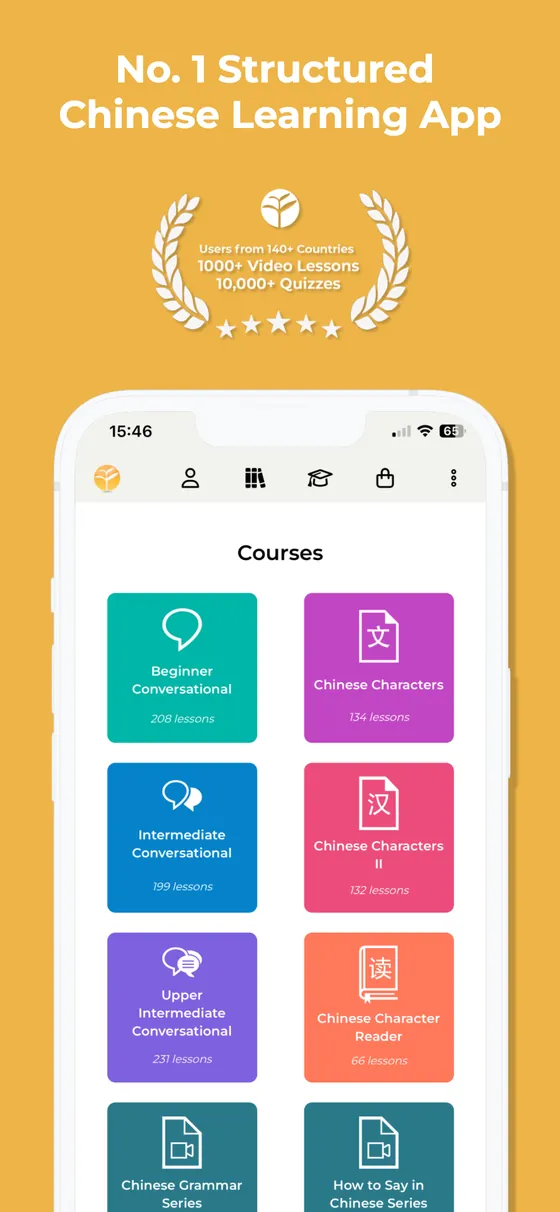
So we'd expect most learners to spend their first year or two inside the Beginner and Intermediate courses. That's where Yoyo's teaching style matters most.
The new Advanced course fills Yoyo's old gap
The most common complaint in older reviews was the top. Fluent in 3 Months, in a review last updated in 2023, said Yoyo had no advanced course, so even its intermediate material felt like review to an advanced learner.
That changed in March 2026, when Yoyo launched Advanced Conversational Chinese. It has 180 lessons in units of five, and every unit follows the same steps:
- An animated dialogue set in a real situation.
- A breakdown of the dialogue's words and expressions.
- A longer, freer conversation between the hosts, with harder vocabulary.
- A culture lesson on what lies beneath the words.
- A review video that replays the whole unit.
The units cover adult life in China: hotels, food and takeaways, travel and transport, shopping, work, doctors, banks and renting a flat.
One caveat. When it launched, the course's quizzes weren't ready, and Yoyo said its teachers would release them gradually. In November, the lesson data Yoyo's website loads for visitors still listed no quiz for any Advanced lesson; lessons we checked in its other courses list ten questions. So open its first lessons, which are free, before you count on the quizzes.
None of the nine reviews we read from Google's top results mentions the course. We think it's the biggest change to Yoyo in years: if you'd outgrown it before, there's now somewhere to go.
A lesson is a short video, then practice and a quiz
A Yoyo lesson is a video first. In the Beginner course, Yangyang explains in English and shows the Chinese on screen. Later courses use more Chinese, more interviews and more storytelling, as one long-time learner on the App Store noted.
After the video, you practise. Here's what a lesson can hold, according to Yoyo's help centre:
- Flashcards for the lesson's new words, with normal and slow audio.
- The dialogue, line by line, also at two speeds.
- Audio Review, a recording that prompts you to say words and phrases from memory.
- Lecture notes as a PDF, and an FAQ where you can send the team a question.
- A 10-question quiz, with a gold medal for a perfect score.
Yoyo's App Store image shows the pattern on an Upper Intermediate lesson:
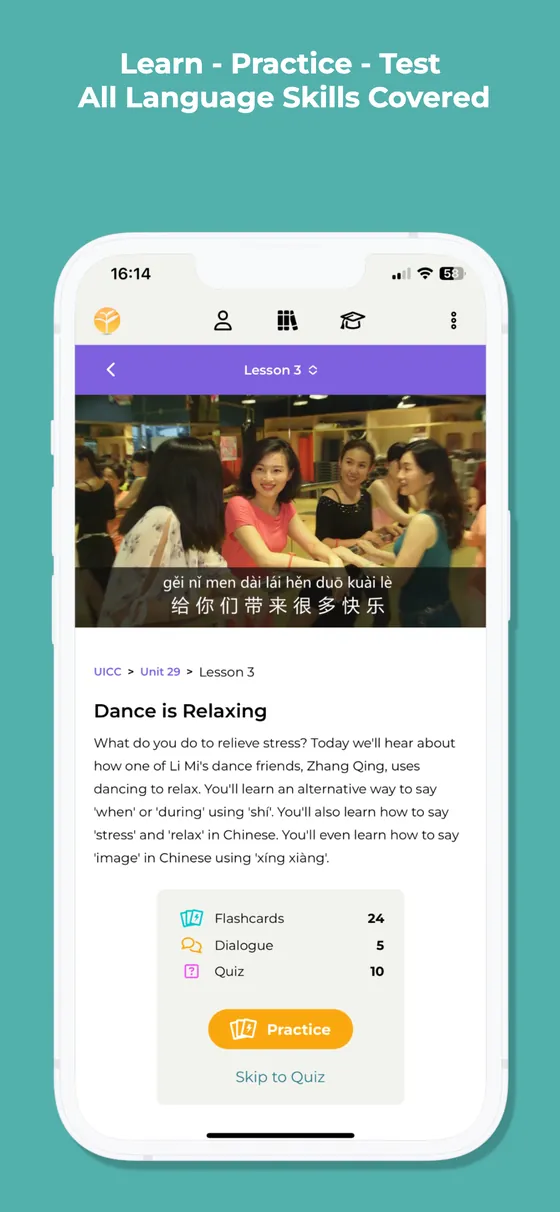
The quizzes mix question types. In one App Store image, a Beginner quiz has you translate 我会说一点儿中文 wǒ huì shuō yìdiǎnr Zhōngwén, "I can speak a little Chinese", by tapping English words into place.
The videos' best trick is real speech. From the Beginner course on, Yoyo mixes in short street interviews with native speakers, so you hear people talk fast, slur words and use regional accents. Then a lesson breaks the clip down, and later courses build whole units around unscripted conversations.
We'd lean on the slow audio, because Yoyo's help centre warns that its native speakers talk fast. And we'd keep Yoyo's own rule: if you score under six on a quiz, redo the lesson before moving on.
We think that's most of Yoyo's value: a study flow you'd otherwise have to build yourself.
Pinyin and tones are where Yoyo is strongest
Yoyo spends its first level on sound. Pinyin, 拼音, is the system that spells Chinese sounds in Roman letters, and Level 1 of the Beginner course teaches it with the four tones and some basic grammar.
Two free tools back it up:
- The Interactive Pinyin Chart. It plays audio for every syllable, and Yoyo counts 409 sounds. Its explainer videos need a free account.
- Tone Pairs. A grid of the tone combinations, with a common word and a native speaker's recording for each. A button loads a new set of words.
Tone pairs are the right unit to practise. Many everyday Chinese words have two syllables, and tones change shape next to each other. Teacher, 老师, is a third tone then a first, and you say lǎo low, without the rise a third tone has on its own.
On Reddit, learners praise this part more than any other, as our count further down shows.
There's one catch for app users. Yoyo's August 2025 letter says the pinyin chart and Tone Pairs stay on the website for now, because they suit bigger screens.
If you're starting from zero, Yoyo's first level and its free tools are worth your time even if you never pay.
Nothing listens back when you speak
Yoyo trains your ear well, but nothing in it judges your voice. Its speaking practice is a recorder: on a flashcard, you press and hold the microphone, then play your recording next to the native speaker's.
Audio Review works the same way. A recording asks you to remember how to say words and phrases from the lesson. It's good recall practice, and you're the only judge of how you sounded.
Here's the recorder in Yoyo's own App Store image, behind a quiz:
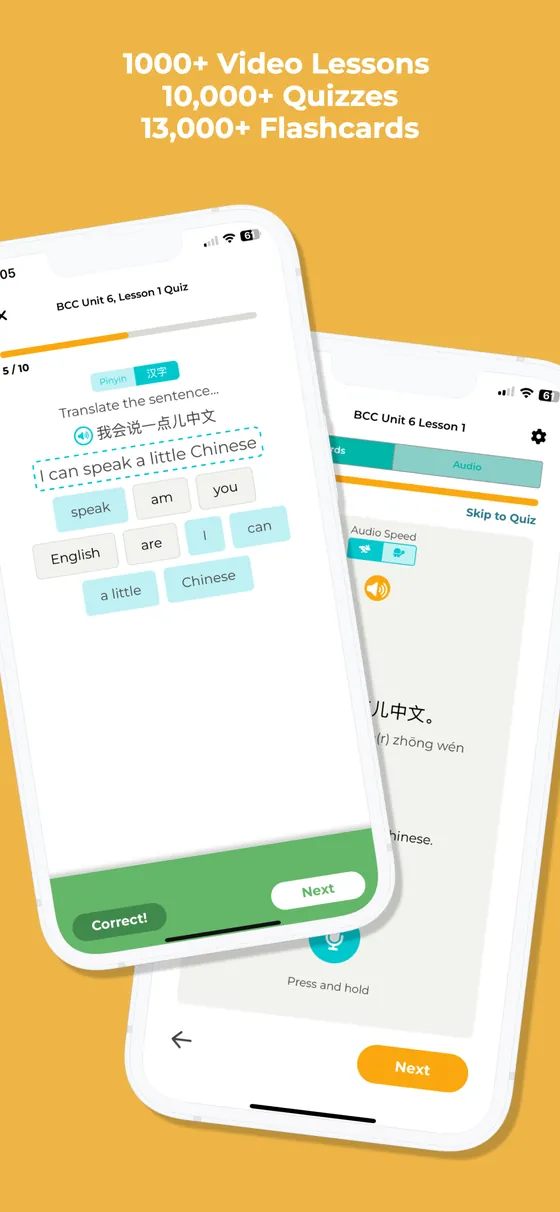
We found neither speech scoring nor a conversation feature on any page Yoyo publishes. Yoyo's home page makes a point of it: it says it doesn't use AI or AI-written dialogue. In its 2025 letter, the team said it was exploring AI practice partners and instant corrections, but we found nothing launched.
We think that gap matters more in Chinese than in most languages, because a tone slip changes the word. To buy, 买, and to sell, 卖, differ only in pitch. Comparing by ear works only as well as your ear, which is the thing you're still training.
So we'd add something that hears you: a tutor, a language partner, or a tool that shows your pitch. Yoyo itself has no live lessons, though its FAQ says it helps students find tutors when they ask.
Characters get their own courses
Yoyo teaches reading separately from speaking. Its two character courses teach 300 characters each, most common first, and Yoyo says the first set alone makes up over 60% of written Chinese.
The method leans on memory aids. Each character gets a picture or story to hang it on, and the course puts typing ahead of handwriting. Every lesson includes stroke order and a practice sheet, but writing by hand is optional.
The Character Reader comes after both. It tells animated comic-strip stories built on the same 600 characters, plus a few new ones, voiced by native speakers.
The videos use Simplified characters, the script of mainland China. You can switch flashcards and quizzes to Traditional, the script of Taiwan and Hong Kong, and Yoyo says 70% of its 600 characters look the same in both.
We set the two courses against the characters the new HSK asks you to recognise:
Source: Yoyo Chinese's help centre; the 2025 HSK syllabus, counted in our HSK 3.0 guide. This compares sizes, not the characters themselves.
Yoyo says its 600 characters make up nearly 80% of written Chinese, a solid base for simple texts. The new HSK 6 asks you to recognise about 1,940, so plan a reader or a second course once you finish.
Yoyo's HSK levels come from the old exam
Yoyo doesn't teach to the HSK, China's proficiency exam, and says so. Its course has its own curriculum, though Yoyo's FAQ says students have passed the HSK using only Yoyo.
What it does publish is a rough HSK level for each course. Those estimates sit in a help article last updated about four years ago, and they use the old six-level exam. The new HSK, which starts on 13 December 2026, asks for more words at every level.
We set each estimate against the new word lists, using our match of the old lists against the new ones:
Beginner Conversational
- Yoyo's estimate, on the old HSK
- HSK 1–2; old HSK 2 has 300 words
- Closest new level by size
- HSK 1: 300 words
- New-list words the old list lacks
- 30%
Intermediate Conversational
- Yoyo's estimate, on the old HSK
- HSK 3–4; old HSK 4 has 1,200 words
- Closest new level by size
- HSK 3: 1,000 words
- New-list words the old list lacks
- 37%
Upper Intermediate Conversational
- Yoyo's estimate, on the old HSK
- HSK 4–5; old HSK 5 has 2,500 words
- Closest new level by size
- HSK 4: 2,000 words
- New-list words the old list lacks
- 38%
Sources: Yoyo Chinese's HSK article, using the top of each range; the old HSK lists and the 2025 syllabus, as matched in our HSK 3.0 guide. This re-reads Yoyo's labels; it doesn't test Yoyo's own vocabulary.
On the new exam, each of these courses ends about a level lower than its label suggests. Even at that lower level, the old list misses about a third of the new words.
None of this makes Yoyo a poor course, in our view. It means its HSK labels need translating. If an exam is your goal, check yourself against the new HSK word lists as you go, and add exam practice before you book.
"Conversational in six months" means the basics
Yoyo's home page promises conversational Chinese in six months or less, at 30 minutes a day. That promise belongs to the Beginner course, and Yoyo's own FAQ says it means beginner-level conversation.
We think its list of what you'll manage by the end is honest. You'll greet people and introduce yourself, chat about daily life, give opinions, make plans and get around in China.
By the table above, that's about new HSK 1. It's a real milestone, and we think it's the right first goal. It's also the start of a long road: our guide to how long Mandarin takes shows where it leads.
So we'd read "conversational" as "basic conversations about yourself". The Intermediate course, another six months by Yoyo's estimate, is where it promises longer conversations with native speakers.
The apps are new, and mostly the website on your phone
For more than a decade, Yoyo lived in a web browser. Its iPhone app arrived in August 2025, and its Android app appeared on Google Play in June 2026.
Both carry the whole course, and your progress syncs with the website. We compared the two listings on 6 November:
| iPhone and iPad | Android | |
|---|---|---|
| Available since | August 2025 | June 2026 |
| Rating | 4.9 from 19 US ratings | 4.8 from 18 ratings |
| Downloads | Not published | 5,000+ |
| Last update | August 2025 | August 2026 |
Source: Yoyo Chinese on the US App Store and Google Play, 6 November 2026.
Two limits apply on both. The videos only stream, so you can't save a lesson for a flight. And the pronunciation tools stay on the website, so keep a laptop for the pinyin chart.
The iPhone app hasn't been updated since its launch month, August 2025. The Android app had its latest update this August.
What learners say: clear teaching, thin practice
Yoyo's apps are too new to tell you much, with fewer than 20 ratings in each store. We read all 24 written reviews, and every one gives four or five stars.
Most come from existing fans: 17 say or imply they used Yoyo's website first. So the stores mostly show how fans like the app. Their requests are telling: two wanted an advanced course before March brought one, and one wants a way to search old lessons.
Reddit gives a wider view. We read every comment that mentions Yoyo on the r/ChineseLanguage forum since January 2025. Here's what the 96 people who gave a view raised:
Source: our coding of 210 comments from 120 people, read through the public Arctic Shift archive of Reddit. Method below.
Two in three recommend Yoyo, and half point to its pinyin chart, tone pairs or free YouTube videos. Several of the people we counted recommend those free tools without saying they've paid for anything.
About one in five calls Yoyo a beginners' resource, and most of them mean it as praise. The criticism, from seven people, is mostly about fit: one objected that the lessons are mostly someone talking in English. One long-time learner also found Upper Intermediate a big jump from Intermediate.
The sharpest point echoes our own. A learner who also used a speaking app wrote in August 2025: "While I think the material is good, I wasn't speaking at all."
So read the praise as praise for Yoyo's first months, and for its ear training. Its loudest fans are people it taught to hear and say the sounds.
Price: Learn is the plan to buy, yearly or once
Yoyo sells two subscriptions and a one-off lifetime plan, on top of a free account. Here's what each gets you, at the prices on Yoyo's website and the US App Store:
Free
- What you get
- 75+ video lessons, the pinyin chart, 750+ quiz questions and free downloads
- yoyochinese.com
- $0
- US App Store
- $0
Watch
- What you get
- Every video and its notes, without flashcards, review audio or quizzes
- yoyochinese.com
- $14.99 a month, or $107.88 a year
- US App Store
- $14.99 a month, or $107.99 a year
Learn
- What you get
- Everything: videos, flashcards, review audio and quizzes
- yoyochinese.com
- $19.99 a month, or $143.88 a year
- US App Store
- $19.99 a month, or $143.99 a year
Lifetime Learner
- What you get
- Learn, paid once
- yoyochinese.com
- $299, or $199 in a sale
- US App Store
- $299.00
Source: Yoyo Chinese's pricing page and the US App Store, 6 November 2026. The website shows yearly plans as a monthly price, $8.99 and $11.99, billed once a year. Google Play lists its purchases only as $14.99 to $299.99.
We think Watch is a false economy for most learners. It saves $36 a year on Learn and takes away the flashcards, review audio and quizzes, which is where the learning sticks. Yoyo itself recommends Learn to anyone new to Chinese.
The real choice is between paying yearly and paying once. Here's what each option costs per month:
Source: yoyochinese.com/pricing, 6 November 2026. The lifetime rows are $299 divided by 24, 36 and 60 months.
So try a month first, then pay yearly if you're staying. Buy lifetime only once you've kept the habit and expect to study for years.
Yoyo's prices haven't moved in years. We read every archived copy of its price page since late 2022, 36 in all, and each one shows the prices above.
One copy, from Black Friday week that year, showed lifetime on sale for $199, a sale price the page still carries. Learners on Reddit mention lifetime deals of about $150 to $200.
Before you pay, know the terms:
- Free has limits. Yoyo's pricing FAQ says a free account opens the first 30 lessons or so in full; the plan card says 75+ videos.
- We found no free trial. Instead, Yoyo's terms give a 7-day money-back guarantee on your first purchase made on its website.
- Renewals aren't refunded. Plans renew automatically. If you paid through Apple, Yoyo's terms send you to Apple for a refund.
- Cancel anytime. You keep access to the end of the period you paid for, and Yoyo keeps your progress.
- Read the lifetime terms. Yoyo's FAQ says lifetime includes future courses. Its terms describe access to what's available when you buy, for as long as it's supported.
Lifetime means the lifetime of Yoyo Chinese as a business, Yoyo's help centre says, not yours. Yoyo has run its website for more than a decade, but its terms let it change or end its offerings at any time.
Learners on Reddit ask when the next sale will be. Yoyo doesn't publish a schedule, so if $299 feels steep, start on a yearly plan; Yoyo's help centre says it often sends subscribers upgrade deals.
How to get the most from a Yoyo plan
If you do pay, Yoyo works best as a daily routine with one addition. Here's how we'd use it, drawing on Yoyo's own help centre:
- Find your level first. We found no placement test, but the first lessons of every course are free, so try a few before you pick one.
- Follow Yoyo's order in each lesson. Watch the video, read the FAQ, then do the flashcards, the dialogue, Audio Review and the quiz.
- Start slow, then go to normal speed. The dialogues use real speech, so play each line slowly before you try it at full speed.
- Download the Audio Review files. They're recordings you can take on a walk or a commute.
- Ask when you're stuck. Each lesson's FAQ has an Ask button that sends your question to Yoyo's team.
- Add the character course after Beginner. Yoyo suggests finishing the Beginner course before Characters I, so the sounds are solid first.
- Book speaking practice every week. A tutor, a partner or a speaking app turns what the videos teach into answers you can give.
At Yoyo's suggested 30 minutes a day, that's about a lesson a day. One long-time learner on Reddit kept exactly that pace through two courses, and we'd copy it.
Who should use Yoyo Chinese, and who shouldn't
We'd pick Yoyo Chinese if:
- You're starting from zero. The first level teaches pinyin and tones properly, and its first lessons are free.
- You like a teacher who explains. The lessons walk you through the language, in plain English at first.
- You want real spoken Chinese. Street interviews and unscripted dialogues train your ear for how people really talk.
- You study on more than one device. The website, the iPhone app and the Android app share your progress.
- You want one long path. Four conversation courses now run from zero to advanced.
We'd skip it, or pair it with something else, if:
- You want to speak soon. Recording yourself won't prepare you for questions you didn't expect.
- You're preparing for the new HSK. Yoyo isn't built for it, and its labels use the old exam.
- You want to write by hand. Handwriting is optional, and nothing checks it.
- You want games and streaks. Yoyo has streaks and points, but its heart is a lecture plus review.
The best alternatives for each goal
If Yoyo isn't the right fit, or you want a second tool beside it, here's what we'd pick for each goal:
A cheaper course that scores your speaking
- Pick
 SuperChinese
- Price
- $11.99 a month or $59.99 a year
- Why
- It checks each line you say, from zero to about HSK 5
A phone course with handwriting and stories
- Pick
 HelloChinese
- Price
- $11.99 a month or $69.99 a year
- Why
- A course past the new HSK 4 list; the full story library costs extra
Audio lessons that make you answer aloud
- Pick
 Pimsleur
- Price
- $14.95 to $20.95 a month
- Why
- You say each answer before you hear it
Spoken practice that answers back
- Pick
 SayMei
- Price
- $5.99 a month for 200 minutes
- Why
- Mei Lin replies and corrects your tones
A human ear for your tones
- Pick
 An italki tutor
- Price
- About $20 an hour
- Why
- The median of 783 Chinese teachers we read
Source: each company's US App Store listing or pricing page, 6 November 2026; Pimsleur from our Pimsleur review and italki from our tutors guide.
If you want Yoyo's teaching without paying, its YouTube channel has 490 free videos. They come without practice or quizzes, but they're an honest way to see whether the style suits you.
For other video courses, our guide to online Chinese courses compares Yoyo with ChinesePod, Mandarin Blueprint and eight more, and our Mandarin Blueprint review covers the characters-first course in depth. For phone apps, read our HelloChinese review and SuperChinese review.
Where SayMei fits, and where it doesn't
SayMei is built for the part Yoyo leaves to you: speaking and being heard. In a lesson, Mei Lin, SayMei's AI tutor, asks you questions out loud, waits for your answer and corrects your tones and grammar as you go.
SayMei Premium is $5.99 a month for 200 minutes with her. Our pinyin chart, tone-pair trainer and Tone Checker are free. Our HSK workbooks and character writing practice, which checks every stroke, are free with a SayMei account.
We'll be plain about where SayMei loses to Yoyo:
- No video teacher. Yoyo's lessons explain grammar and culture on screen, and SayMei has nothing like its 1,272 videos.
- No street interviews. Yoyo's clips of real people talking at full speed have no match on SayMei.
- No character lessons. Yoyo explains 600 characters on video with memory aids; SayMei's character practice drills writing them, stroke by stroke, without the lessons.
- A different kind of app. SayMei runs in the browser on any phone or computer, while Yoyo has apps in both stores.
Many learners would do best with both: Yoyo's videos to understand the language, and daily speaking practice that answers back.
What to do next
- Start on the free account. The first level shows you whether Yangyang's teaching style suits you.
- Use the free pronunciation tools. The pinyin chart and Tone Pairs are worth an hour even if you never subscribe.
- Buy Learn, not Watch. The flashcards, review audio and quizzes are what make the videos stick.
- Go yearly before lifetime. Commit once you've kept the habit for a few months.
- Add speaking from week one. Find a tutor, a partner or a tool that hears your tones.
If you'd like a cheaper course that also scores your speaking, start with our SuperChinese review.
FAQ
Is Yoyo Chinese free?
Partly. A free account opens Yoyo's Interactive Pinyin Chart, 75+ video lessons, 750+ quiz questions and free downloads, and Yoyo's FAQ says the first 30 lessons or so come with full practice.
The rest needs a paid plan: Watch at $14.99 a month for the videos alone, or Learn at $19.99 a month for everything. Yoyo's YouTube channel adds hundreds of free videos.
Is Yoyo Chinese's lifetime plan worth it?
Only if you'll study for more than two years. Lifetime costs $299 once, while a yearly Learn plan costs $143.88, so lifetime only comes out cheaper once you'd otherwise pay for a third year.
It has gone on sale for $199, which beats two yearly payments. Yoyo ties "lifetime" to the life of its business, and its terms say its offerings can change, so start yearly if you're unsure.
Does Yoyo Chinese have an app?
Yes, since August 2025 on iPhone and iPad, and since June 2026 on Android. Both apps carry the full course and sync your progress with the website.
Two things stay web-only: the Interactive Pinyin Chart and the Tone Pairs tool. Videos stream rather than download, so you can't study offline. In November 2026 the iPhone app had 19 ratings on the US App Store, and the Android app 18 on Google Play.
What HSK level does Yoyo Chinese get you to?
By Yoyo's own estimates, about old HSK 4 to 5 after Upper Intermediate. Those estimates use the old six-level exam, though.
On the new HSK, which starts on 13 December 2026, that's closer to HSK 4 by list size, and Beginner ends nearer new HSK 1. Yoyo gives no estimate for its Advanced course. It isn't built for the exam, so add the new word lists and practice tests.
Is Yoyo Chinese good for speaking?
For understanding spoken Chinese and pronouncing it carefully, yes. Its pinyin and tone teaching is its strongest part, and its street interviews train your ear for real speech.
For speaking practice, it's thin. You record yourself and compare by ear, and nothing scores your tones or holds a conversation. Pair it with a tutor, a language partner or a speaking app.
Does Yoyo Chinese teach Traditional characters?
Partly. The character course videos use Simplified characters, but you can switch flashcards and quizzes to Traditional with one setting.
Yoyo says 70% of the 600 characters in its two character courses are the same in both scripts. If Taiwan is your goal, though, a course built on Traditional characters and Taiwanese Mandarin will suit you better.
Does Yoyo Chinese use AI?
No, as of November 2026. Yoyo's home page says it doesn't use AI or AI-written dialogue, and its pricing page calls its quiz questions handwritten.
In 2025 the team said it was exploring AI practice partners and instant corrections, but we found nothing launched. So Yoyo has no feature that scores your speech or talks back to you.
Is Yoyo Chinese better than HelloChinese?
They suit different learners. Yoyo is a video course with a teacher who explains in English, at $143.88 a year for Learn. HelloChinese is a phone course of short drills, at $69.99 a year for Premium.
Pick Yoyo if you want explanations and real spoken Chinese. Pick HelloChinese for handwriting and a lower price, though its full library of graded stories costs extra. Neither holds a real conversation with you.
Sources
Checked 6 November 2026 unless noted. No accounts were created and nothing was bought.
Yoyo Chinese
- yoyochinese.com: home page and its FAQ; the course list and each course's page
- Pricing, the plan prices the page loads, and its FAQ; terms and conditions: refunds, renewals, the lifetime plan
- Interactive Pinyin Chart and Tone Pairs
- Yoyo's help centre, all 30 articles, including the HSK equivalent of each course, lesson pages, practice and quiz, course order, the lifetime plan and cancelling
- Yoyo's blog: How to Use the Advanced Conversational Chinese (30 March 2026) and A Letter from the Yoyo Chinese Team (20 August 2025)
- Yoyo Chinese on the App Store: rating, purchases, version history, reviews and listing images
- Yoyo Chinese on Google Play: rating, downloads, purchases, What's new and reviews
- Yoyo Chinese on YouTube: subscribers and videos
- The Internet Archive's copies of Yoyo's pricing page, November 2022 to October 2026
- DigMandarin's review, which includes an interview with Yangyang Cheng: her background
Learners
- All 18 App Store reviews from Apple's public feed for the US, UK, Canada, Australia, Singapore, New Zealand and Ireland, and the 6 written reviews Google Play shows
- r/ChineseLanguage: every comment mentioning Yoyo from 1 January 2025 to 6 November 2026, read through the Arctic Shift archive, and threads on how far Yoyo took learners (February 2026), how to study with it (March 2026), Yoyo for tones (January 2026) and lifetime sales (February 2025)
Other reviews
- Fluent in 3 Months (2020, updated 2023), and the other top results we read: All Language Resources (updated August 2026), Perapera (2024), GoEast Mandarin, StudyCLI and DigMandarin
Other apps
- SuperChinese and HelloChinese on the US App Store
- SayMei: pricing
- Pimsleur's prices: our Pimsleur review; italki's median tutor price: our tutors guide
HSK word lists
- The 2025 HSK syllabus and the HSK 2.0 lists, matched in our HSK 3.0 guide
Methods
We read Yoyo Chinese's public website, its pricing page and terms, all 30 articles in its help centre, its blog posts on the apps and the Advanced course, and its App Store and Google Play listings on 6 November 2026. We didn't subscribe, sign in or take lessons, so a feature is what Yoyo says, what its public lesson data shows or what learners report, and we say which.
- Lesson counts are the figures Yoyo's course list loads for any visitor. The Advanced course's 36 unit pages list five lessons each, 180 in all, as the course list and Yoyo's launch post say; per-unit totals elsewhere in the course data add up to 184.
- The Advanced course's quizzes come from the lesson data Yoyo's website loads for any visitor, read for all 180 lessons on 6 November 2026. None lists a quiz question, while the Beginner and Upper Intermediate lessons we checked, locked ones included, list ten each. The site-wide quiz total in that data is the same in archived pages from October 2025 to October 2026.
- Prices are the plan prices Yoyo's pricing page loads, and the in-app purchases on the US App Store. The App Store doesn't name plan lengths; we matched them by price. Google Play lists only a range, $14.99 to $299.99.
- Price history comes from the 36 copies of yoyochinese.com/pricing in the Internet Archive that carry its plan prices, dated 23 November 2022 to 15 October 2026, read with a script.
- The HSK table takes the top of each range Yoyo gives and uses the old HSK's cumulative lists. "Lacks" is the share of words on the new syllabus, up to that level, missing from the old list. It re-reads Yoyo's labels and says nothing about Yoyo's own vocabulary, which it doesn't publish.
- The character chart compares Yoyo's own counts with the 2025 syllabus's lists of characters to recognise.
- Store reviews are every written review in Apple's public feed for seven countries and every written review Google Play shows: 24 in all, from August 2025 to July 2026.
- The Reddit count covers every comment in r/ChineseLanguage from 1 January 2025 to 6 November 2026 that mentions Yoyo: 264, read through the public Arctic Shift archive because Reddit blocks automated readers. We set aside 4 that meant something else, such as a drama channel, and 50 from one account that says it edits another language-learning company's blog. We coded the other 210, from 120 people, by hand; 96 people gave a view, and each counts once per theme.
- Checks on that count. Counting the set-aside account, or dropping the one person who posted Yoyo affiliate links, would move no theme by more than one person. A second reader re-coded a random 40 of the 210 comments without seeing the first codes: the two agreed on 94% of theme decisions, and the second found slightly more recommendations, not fewer.
- The screenshots are Yoyo Chinese's own App Store images, shown unedited for review.
- The Mandarin examples were checked against the CC-CEDICT dictionary and the 2025 HSK syllabus.
If you spot a mistake, tell us: we fix errors.