Duolingo alternatives for Chinese: the best fix for each gap
Duolingo alternatives for Chinese, by the gap you hit: speaking, characters, reading, grammar or the HSK. Plus Speak vs Duolingo, with prices checked Oct 2026.

Most people who quit Duolingo's Chinese course haven't quit Chinese. They've hit something the app doesn't train: talking, writing characters, reading a page, grammar or the HSK.
This guide is for you if you've been doing Duolingo's Chinese course and want something better, or something to add. SayMei makes one of the options here, so we also say where it loses.
We started from our own counts of Duolingo's Chinese course, published in two earlier guides. Then we checked each alternative's price and features on its own pages on 16 October 2026, without signing up for anything.
Key takeaways
- Duolingo's biggest gap is output. In the lessons we counted, more than four in five answers were picked or assembled, not produced.
- Its vocabulary holds up to about HSK 4. Past that, the share of exam words it teaches falls fast.
- Speaking is the gap most worth paying for. Speak, SayMei and tutors make you talk; only a teacher has a proven ear for tones.
- Characters and reading have cheap specialists. Skritter or SayMei Characters for handwriting; Du Chinese or graded readers for reading.
- For grammar and the HSK, change course rather than add one. HelloChinese and SuperChinese explain grammar and follow HSK levels.
- Quitting is optional. Duolingo stays free, so you can keep the daily habit and add one tool for your gap.
What's better than Duolingo for Chinese?
It depends on which part of Chinese Duolingo isn't giving you. Each gap has a better tool, and most of them cost under $15 a month.
Here's each gap, what Duolingo gives you today, and our pick:
Speaking
- What Duolingo gives you
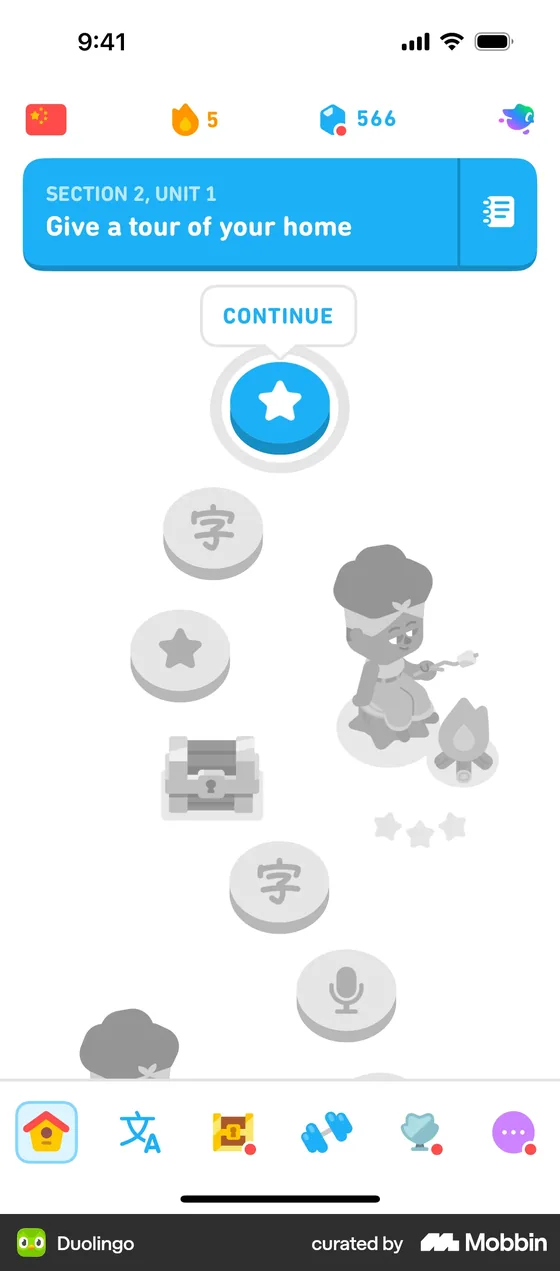
- Lines to read aloud, which you can skip; AI video calls with Max
- Our pick
- Speak
- Also good
- SayMei, which is ours; a tutor on italki
- Price, checked Oct 16, 2026
- Speak: $17.99 a month or $83.99 a year
Characters
- What Duolingo gives you
- A Hanzi tab for reading; no handwriting practice we could find
- Our pick
- Skritter
- Also good
- SayMei Characters, free; Pleco, free
- Price, checked Oct 16, 2026
- Skritter: $14.99 a month or $99.99 a year
Reading
- What Duolingo gives you
- Single sentences; its reading page doesn't list Stories for Chinese
- Our pick
- Du Chinese
- Also good
- Graded readers; SayMei Stories
- Price, checked Oct 16, 2026
- Du Chinese: some lessons free; $14.99 a month or $119.99 a year
Grammar
- What Duolingo gives you
- The right answer when you're wrong; explanations with Max
- Our pick
- HelloChinese
- Also good
- Chinese Grammar Wiki, free; LingoDeer
- Price, checked Oct 16, 2026
- HelloChinese: $11.99 a month or $69.99 a year
HSK exam
- What Duolingo gives you
- Topic units, not HSK levels; no speaking-test or essay practice we found
- Our pick
- SuperChinese
- Also good
- HelloChinese; free official papers
- Price, checked Oct 16, 2026
- SuperChinese: $11.99 a month or $59.99 a year
Sources: each company's US App Store listing or pricing page, checked 16 October 2026; Duolingo's blog and app screens. Speak, Skritter and SayMei start with a 7-day trial.
If you can only fix one gap, fix speaking. Duolingo trains it least, and it's the skill a real conversation tests first.
Speaking: the gap most learners leave for
Duolingo asks you to recognise Chinese far more often than to say it. For our Duolingo review, we counted every answer in five complete lessons:
Source: our count of Duolingo's lesson screens in Mobbin's library, 7 October 2026. Mobbin had no complete Chinese lesson, so these are two French and three Korean lessons; its Chinese screens use the same exercise types.
Picking the right picture shows you recognise a word. It doesn't train you to pull that word from memory mid-sentence, which is what a conversation asks of you.
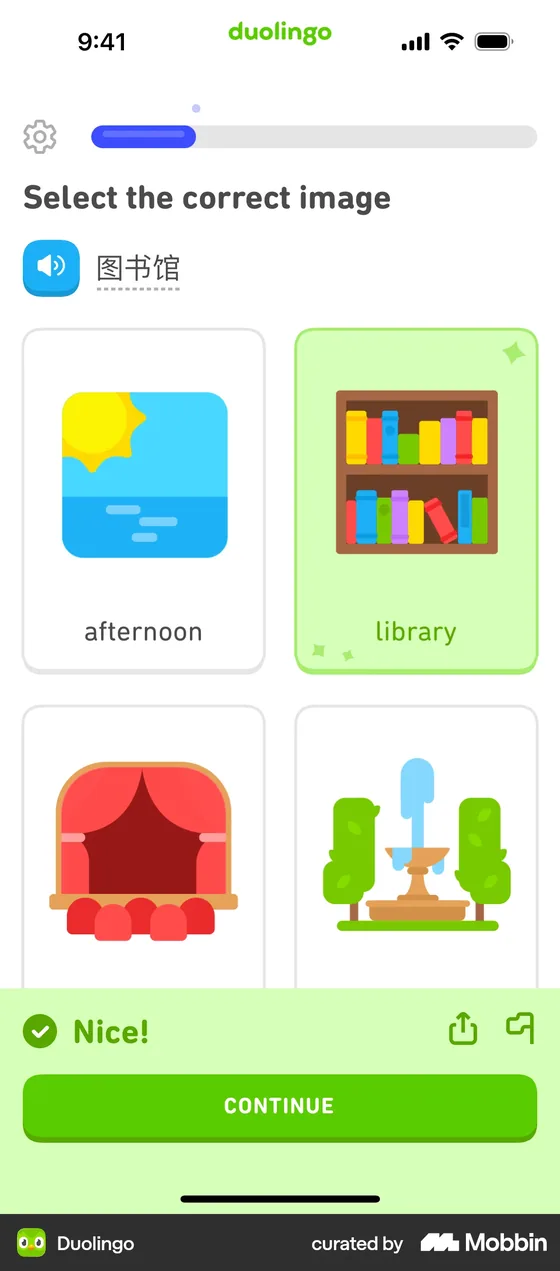
Duolingo does have speaking. Most speaking items ask you to read a line aloud, and a "Can't speak now" button skips them. Its AI conversation, Video Call, is a Max feature, and Duolingo lists Chinese among the courses that have it.
Here are the alternatives that make you talk:
- Speak. Best for: a speaking-first course, if you'll pay. It added Chinese on 2 June 2026, from beginner to intermediate, B1.
- SayMei. Best for: open conversation at your level, for less. That's us: spoken lessons with Mei Lin, your AI teacher, in your browser.
- A human tutor. Best for: correction from a trained ear. italki's median Chinese teacher charges about $20 an hour, by our count.
Each Speak unit starts with a pronunciation lesson, then has you finish tasks in simulated conversations. There's more on SayMei in where SayMei fits, and our comparison of AI apps covers free chatbots and other AI tutors.
One caveat: no AI app, Speak and SayMei included, has published how accurately it judges tones. A review of 15 studies found that speech-recognition practice helps single sounds a lot, but pitch, which carries tones, only a little.
Speak vs Duolingo: talk first, or habit first
Speak and Duolingo are built for opposite jobs. Duolingo gets you studying every day for free, while Speak gets you talking from the first lesson, for a price.
Here's how they compare for Chinese:
Price, checked Oct 16, 2026
 Duolingo
- Free; Super listed at $9.99 to $119.99
 Speak
Speak- $17.99 a month or $83.99 a year
Free version
- Duolingo
- The whole course, with ads and an energy limit
- Speak
- A 7-day trial
Chinese levels
- Duolingo
- Through B2, Duolingo says
- Speak
- Beginner to B1 at launch
What you mostly do
- Duolingo
- Pick answers and tap word tiles
- Speak
- Say lines, then complete spoken tasks
Speaking feedback
- Duolingo
- Checks on lines you read aloud; Video Call with Max
- Speak
- Real-time feedback on pronunciation and phrasing
Sources: both companies' US App Store listings and websites, checked 16 October 2026; Duolingo's April 2026 post; Speak's launch post. Duolingo's listing doesn't say which Super price is which plan.
Speak's own FAQ draws the same line: Duolingo for recognising and translating, Speak for conversation. Both describe their levels on the European CEFR scale, not by HSK level.
Choose Speak if speaking is your goal and you'll pay for it. Choose Duolingo if cost or habit matters more, then add speaking practice. Our Speak review goes deeper.
Characters: write them to remember them
Duolingo teaches you to read characters, not to write them. Its words use about 2,100 different characters, but we found no handwriting practice in its screens, and typing goes through pinyin.
That matters if you want characters to stick. Writing them by hand builds memory for their shapes in a way typing doesn't. Take thank you, 谢谢: you'll soon know it on sight, but writing 谢 from memory means getting 12 strokes in order.
The new HSK syllabus also lists 1,200 characters to write by hand, starting with 100 by HSK 2. Here are the alternatives for characters:
- Skritter. Best for: handwriting, stroke by stroke. You write each character from memory, and it checks every stroke.
- SayMei Characters. Best for: free handwriting practice for the HSK. That's ours: watch, trace, then write from memory, free with an account.
- Pleco. Best for: looking up every character you meet. The dictionary is free; flashcards and other add-ons cost extra.
Skritter's prices are in the table above, and our Skritter review has the details. SayMei Characters brings back every HSK handwriting character on a spaced schedule, with no card needed. Our Pleco review covers the dictionary.
HelloChinese and ChineseSkill also build handwriting into their courses. If you only want to read, handwriting is optional. If you're aiming at the HSK, start early.
Reading: you need stories, not single sentences
Duolingo teaches Chinese reading one sentence at a time. Every Chinese screen we checked showed a single sentence, and Duolingo's reading page lists Stories for seven other languages but not Chinese.
Its April 2026 announcement did promise advanced Stories for the expanded courses, Chinese among them. Until they show up, plan your reading somewhere else.
Volume is what builds reading. Reading lots of easy text is one of the best-supported habits in language learning: a review of 49 studies found a medium-sized gain.
Here are the alternatives for reading:
- Du Chinese. Best for: graded stories with audio, at every level. Some lessons are free, in Simplified or Traditional characters.
- Graded readers. Best for: whole books at your level. Our guide to books shows which readers suit which level, and our reading apps comparison adds news apps.
- SayMei Stories. Best for: long stories with pinyin over every word. That's ours: 165 books, read aloud in Mandarin.
Du Chinese's paid plans are in the table above. SayMei Stories gives away the first two chapters of every book, and all of them cost $2.99 a month.
Read a little every day, at a level that feels slightly easy. That's how speed builds, and it's the one thing a sentence-at-a-time app can't give you.
Grammar: get the why, not just the answer
When you get a Duolingo answer wrong, the free app shows you the right answer, not the reason. Its unit guidebooks explain some patterns, but they sit outside the lessons. Explanations of your own mistakes come with Max:
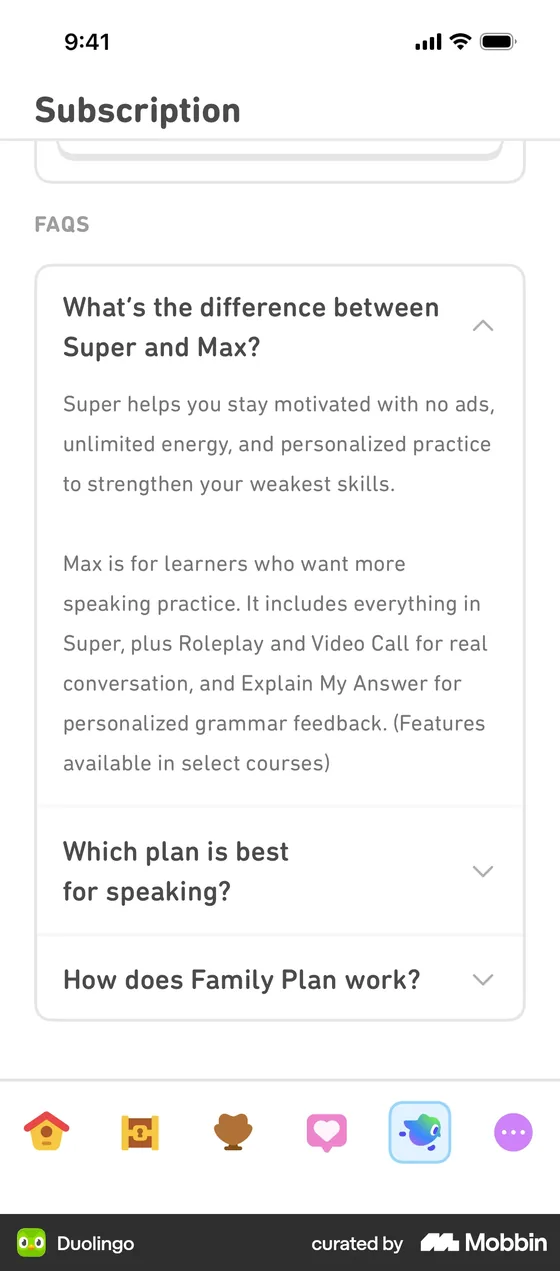
Say you translate "I didn't eat" as 我没吃了饭. The app shows you the right answer, 我没吃饭. It doesn't tell you the rule: when you negate with 没, the 了 goes.
That rule is the useful part. In a review of 40 studies, feedback that explained the answer helped learners more than feedback that only showed it.
Here are the alternatives for grammar:
- HelloChinese. Best for: a Duolingo-style course that explains grammar. Its courses follow HSK levels and teach grammar alongside words.
- Chinese Grammar Wiki. Best for: free explanations of any pattern. AllSet Learning's free wiki has 2,125 articles, sorted by level.
- LingoDeer. Best for: grammar-first lessons with notes. Its course is built around grammar, with tips inside each lesson.
Our HelloChinese review covers its course and prices. A LingoDeer pass to all its languages costs $14.99 a month or $95.99 a year.
If grammar is why you're leaving, switch courses rather than add a tool. Our guide to common grammar mistakes covers the patterns that trip up learners most.
HSK: Duolingo isn't built for the exam
Duolingo's vocabulary goes further than its reputation, but it isn't an HSK course. A quarter of its words aren't on the HSK lists, and its units are named for situations, not levels:
We matched Duolingo's word list against the official HSK 3.0 lists for our Duolingo review. Here's how many exam words you'd still need from somewhere else, counting up from HSK 1:
Source: the official 2025 HSK 3.0 syllabus, and Duolingo's word list as published by duome.eu, community data dated 10 September 2026. Our count, 6 October 2026: exact matches, each word counted once. Counting words inside longer phrases cuts the HSK 6 figure to about 1,200.
So Duolingo can carry your vocabulary to about HSK 4. Past that, the gap grows quickly.
Words aren't the whole exam, either. Under HSK 3.0, first sat on 13 December 2026, speaking is compulsory from HSK 3, and HSK 4 ends with a short essay. We found no practice for either in Duolingo.
Here are the alternatives for the HSK:
- SuperChinese. Best for: a long course up to HSK 5. Its main course covers HSK 1 to HSK 5 and scores every line you say.
- HelloChinese. Best for: a gentler HSK course. Its courses follow HSK levels, with handwriting and graded stories built in.
- Official papers. Best for: free exam practice. Our guide to free HSK practice tests lists where to find them.
Our SuperChinese review has its prices and limits, and our HSK exam guide explains each paper.
If the exam is your goal, keep Duolingo for daily words at most. Give your main study time to an HSK course and real papers.
Apps like Duolingo, made only for Chinese
If you like Duolingo's short, game-like lessons, three apps keep the format and teach only Chinese. Each one scores your pronunciation and adds handwriting, which Duolingo doesn't.
HelloChinese is the gentlest full course, in Simplified or Traditional characters, and its stories give you real reading. SuperChinese goes further, to HSK 5, and also sells PLUS for life at $139.99 on the US App Store.
ChineseSkill is the one for Taiwan Mandarin or Cantonese. It has three full courses: Mainland Mandarin, Taiwan Mandarin in Traditional characters, and Hong Kong Cantonese. Its Premium plan is $11.99 a month or $59.99 a year.
None of the three says its whole course is free, the way Duolingo's is. Our Duolingo vs HelloChinese and HelloChinese vs SuperChinese comparisons go deeper.
For 16 picks by goal, including the tools above, see the best apps to learn Chinese.
Where SayMei fits, and where it doesn't
SayMei is built for one of these gaps: speaking. Each lesson is a spoken conversation with Mei Lin, your AI teacher, at your HSK level, in your browser.
Premium is $5.99 a month for 200 minutes with Mei Lin, after a 7-day trial that needs a card. The Characters practice and the first two chapters of every story are free.
Here's where it fits:
- You speak from the first minute. Mei Lin replies and corrects you as you talk.
- It's cheap per minute. Premium works out at about 3¢ a minute of lesson time.
- It works alongside Duolingo. Keep the free course for new words, and say them out loud here.
And here's where it loses:
- No phone app. It runs in your browser, with no offline mode.
- No pronunciation score. Its tone feedback, like every AI tutor's, has no published accuracy test.
- Capped minutes. Lessons draw on your monthly minutes, so long daily sessions need a top-up.
What to do next
- Name your gap. Pick the one that stops you most.
- Try one fix at a time. Use free trials and free versions before you pay for a year.
- Keep Duolingo if it keeps you going. Its course stays free, so the habit costs nothing.
- Speak out loud every week. Whatever else you use, talk to someone, or something, that answers.
- Study for the new HSK if you're sitting it. Our HSK 3.0 guide explains what changed.
For every app by goal and level, see the best apps to learn Chinese.
FAQ
What is the best alternative to Duolingo for Chinese?
It depends on what Duolingo isn't giving you. For speaking, try Speak or an AI tutor such as SayMei; for handwriting, Skritter; for reading, Du Chinese. For grammar and the HSK, switch to a course built on HSK levels, such as HelloChinese or SuperChinese. Duolingo's word list covers about 85% of HSK 1 to 4, so vocabulary is rarely the reason to leave.
What's the best free alternative to Duolingo for Chinese?
No other full Chinese course is free: HelloChinese, SuperChinese and ChineseSkill sell their full courses by subscription. You can cover most gaps for free, though. Use Pleco as your dictionary, the Chinese Grammar Wiki for grammar, SayMei Characters for handwriting and free graded stories for reading. Keep Duolingo's free course for daily vocabulary alongside them.
Is Speak better than Duolingo for Chinese?
For speaking, yes: Speak has you talk from the first lesson and gives feedback on pronunciation and phrasing. Duolingo is free and goes further, with content through B2 against Speak's B1 at launch. Speak costs $17.99 a month or $83.99 a year on the US App Store, after a 7-day trial.
Are there apps like Duolingo just for Chinese?
Yes. HelloChinese, SuperChinese and ChineseSkill all use short, game-like lessons and teach only Chinese. Each adds handwriting practice and pronunciation scoring, which Duolingo lacks. HelloChinese is the gentlest, SuperChinese runs to HSK 5, and ChineseSkill also teaches Taiwan Mandarin and Cantonese. A year of any of them costs $60 to $70 on the US App Store.
Is Duolingo enough to pass the HSK?
Not on its own. Its word list covers about 85% of the words for HSK 1 to 4, but only about half of HSK 6's new words. It also has no practice for the speaking test, compulsory from HSK 3 under HSK 3.0, or for the HSK 4 essay. Add an HSK course and real practice papers.
Does Duolingo teach you to write Chinese characters?
It teaches you to read them, not write them. Its words use about 2,100 different characters, and a Hanzi tab practises reading the characters each unit introduces. We found no handwriting practice in its screens, and typing goes through pinyin. For writing, use Skritter, HelloChinese's handwriting lessons or SayMei's free Characters practice.
Should I quit Duolingo to learn Chinese?
Not if it's what gets you studying every day. Its whole course is free, so you can keep it for vocabulary and add one tool for your weakest skill. Quit if you're only protecting a streak: in the lessons we counted, more than four in five answers were picked or assembled, which won't get you talking.
What app is best for speaking Chinese?
Speak is a speaking-first course that added Chinese in June 2026 and runs to B1. SayMei gives you spoken lessons with an AI teacher for $5.99 a month. For tone feedback from a trained ear, book a tutor: italki's median Chinese teacher charges about $20 an hour. No AI app has published how accurately it judges tones.
Sources
Checked 16 October 2026 unless noted. No accounts were created and nothing was bought.
Duolingo
- Our earlier measurements: Is Duolingo good for Chinese?, with the lesson count from 7 October 2026 and the word-list match from 6 October 2026, and Duolingo vs HelloChinese
- Duolingo's blog: content through B2, Duolingo Max, reading and Stories
- US App Store listing; the course word list from duome.eu, community data
- App screens from Mobbin's library of Duolingo's iPhone app: Chinese lessons and subscription page
The alternatives
- Speak: Chinese launch post, website and FAQ, US App Store listing
- Characters: Skritter's website, Pleco's US App Store listing, SayMei Characters
- Reading: Du Chinese pricing, SayMei Stories, SayMei pricing
- Grammar: HelloChinese's website and US App Store listing, Chinese Grammar Wiki, LingoDeer's website and US App Store listing
- HSK and courses: SuperChinese FAQ and US App Store listing, ChineseSkill's US App Store listing
- Tutors: italki prices from our tutors guide, read 11 October 2026
The exam and the research
- HSK 3.0: our explainer, from the official syllabus and CTI's announcements
- Ngo et al. 2024 on speech-recognition feedback; Jeon & Day 2016 on extensive reading; Van der Kleij et al. 2015 on feedback; Guan et al. 2011 on handwriting
Methods
- What we reused. Duolingo's numbers come from our earlier work, not new counts. The lesson count covers every answer in five complete lessons on Mobbin, two French and three Korean, because no complete Chinese lesson was captured. The word-list match compared duome.eu's copy of Duolingo's course, about 6,000 words, with the November 2025 HSK 3.0 syllabus.
- What we checked. On 16 October 2026 we read each alternative's US App Store listing and its own pricing or feature pages, logged out. Some listings don't say which price is which plan; we say so where it matters.
- How we picked. One app per gap, by fit: what it trains that Duolingo doesn't, what it costs and what's free. We compared public pages only and didn't sign up for or subscribe to any app.
- Screenshots. Duolingo's screens come from Mobbin's library of its iPhone app, shown unedited. The lesson and path screens are from the Chinese course; the subscription page isn't tied to a course.
- Limits. Prices change, and sales are common. Duolingo's word list is community data, and no app here has published how accurately it judges tones. If you spot a mistake, tell us: we fix errors.