Pingo AI review: is it good for learning Chinese?
Our Pingo AI review for Mandarin: tones, pinyin, what 77 Chinese learners say, every App Store price and how to cancel. Checked November 2026.

Pingo AI says 8 million people use it, and its Chinese page promises feedback on your tones. Yet its store images show no Chinese text, and Chinese learners complain most about its speech check.
This review is for you if you're learning Mandarin and deciding whether Pingo is worth a trial, or if it has charged you and you want out. We read its store listings, website, help pages and terms in November 2026, compared archived copies of its App Store page going back more than a year, and searched nearly 8,000 store reviews for the ones from Chinese learners.
Key takeaways
- It's a speaking partner with no Chinese course. Pingo builds role-plays around your goals, but we found no HSK path, character practice or set course.
- Its tone feedback is unproven. Pingo promises "instant feedback on tone accuracy". We found no test of it, and Chinese learners' top complaint is a speech check that got them wrong.
- Pinyin went missing, then came back. Reviewers said the June 2026 redesign removed it, but a blog review's September screenshots show it above each line, with a switch to hide it.
- Very little is free. Reviewers say the paywall comes after about one lesson, and that the trial needs a card and rolls into a yearly plan.
- Check where you paid before you cancel. Some iPhone users pay through Link, on the web, so the plan isn't in Apple's subscriptions and Apple can't refund it.
- Written reviews are far cooler than the stars. Pingo has 4.6 stars on the US App Store, but its latest 500 written reviews there average 2.3, and half are about money.
Good for talking practice, weak on the rest
Pingo does one job well: it gets you speaking. Give it a goal, such as a trip or a job interview, and it builds role-plays around it. For a Mandarin learner, most of the other jobs are missing or unproven.
We scored each one from Pingo's own pages and what Chinese learners report:
What you need · Verdict · What Pingo gives you
Lots of speaking practice
Strong
Unlimited conversations on Pingo Pro, plus Free Chat and role-plays you design
Practice built around your goals
Strong
A setup chat, spoken or typed, that turns your goals into a plan of real-life scenes
A tutor whose Chinese you can copy
Partly
Mostly praised, though three Chinese learners report wrong or unnatural Chinese
Pinyin next to the characters
Strong
Back above each line by September 2026, with a switch to hide it, after going missing in June
Feedback on your tones
Unproven
Promised on its Chinese page; learners say the speech check passes mistakes
Reading and writing characters
Missing
No character practice that we could find
A path tied to the HSK
Missing
Pingo never mentions the HSK
Sources: Pingo's website, help pages and App Store listing, a blog review's screenshots, and 77 reviews from Chinese learners on the App Store and Google Play, all read in November 2026. Each row is explained below.
If you want to be taught Chinese, our advice is to look elsewhere. If you already know some and want a patient partner to talk to, Pingo is worth a short try, with your own reminder set before the trial ends.
What you get: role-plays and a plan built around your goals
Pingo AI is made by Pingo AI, Inc., a San Francisco start-up from Y Combinator's Summer 2025 batch. Its iPhone app came out in December 2024 and its Android app a few weeks later.
Google Play counts more than 5 million downloads and lists "Chinese (Mandarin)" among its languages, one of the 25 its App Store listing names. The app works the same way for every language. By its App Store listing and website, you:
- Tell Pingo your goals. Since version 5.0, in June 2026, setup is a conversation. A typed version arrived in July.
- Get a plan. Pingo turns your goals into chapters of real-life scenes, like buying a metro ticket or asking for directions.
- Practise in role-plays. Pingo plays a part, such as a barista, and you answer out loud.
- Talk freely. Free Chat, added in 5.0, is for open conversation, questions and role-plays you design.
- Pick up where you left off. Pingo says it remembers your level, mistakes, words and goals, and a September update made it remember more.
- Get feedback. The listing promises instant feedback on pronunciation and grammar.
- Review words. A Vocab Coach quizzes you on words with flashcards.
Here's a plan from Pingo's own App Store listing:
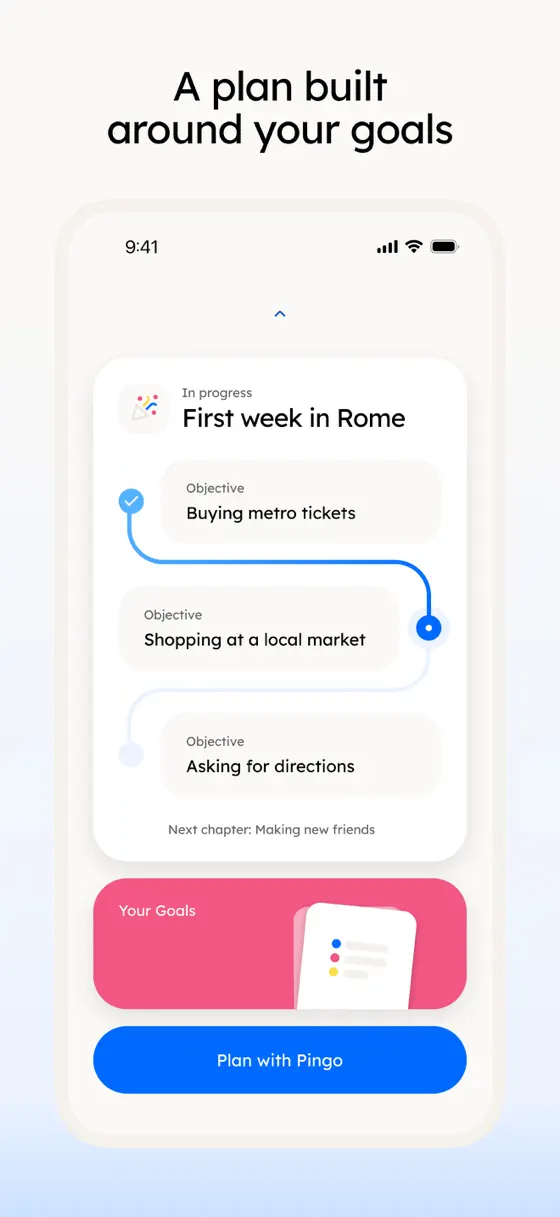
For Chinese, Pingo's Chinese page promises more. Beginners, it says, start with pinyin, the four tones, greetings, numbers and core phrases. Advanced learners get debates, business Mandarin, storytelling and feedback on idioms. The page offers "Three minutes to your first Chinese conversation" and says more than 800,000 Chinese learners have joined.
Some things are missing for Chinese. Pingo never mentions the HSK, either on its Chinese page or in the summary it publishes for AI search tools. Its examples are in Simplified characters, and we found no mention of Traditional characters or Cantonese. One App Store reviewer who wanted Cantonese found no option.
Pingo is also clear about what it isn't. That same summary says it is "not a fit for written-grammar workbooks or human tutoring marketplaces". And we found no web or desktop version: its "Get the app" link opens the App Store.
So think of Pingo as a role-play partner. It decides what you talk about from your goals, but nothing in it follows a Chinese course or an exam.
Does Pingo check your Chinese tones?
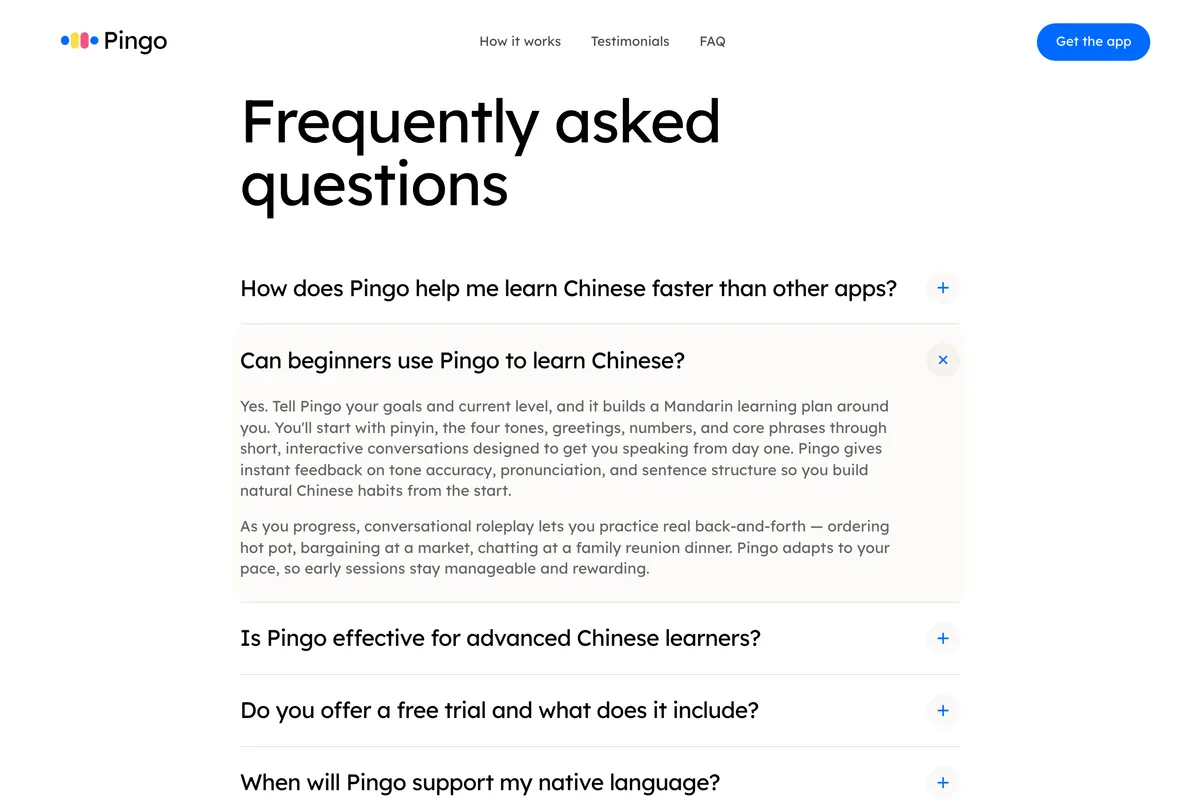
Pingo says it does. Its Chinese page promises "instant feedback on tone accuracy, pronunciation, and sentence structure". We found no public test of how well it hears tones, and some Chinese learners' reviews say it doesn't.
Tones matter because they change words. Say ask, 问, with a dipping tone instead of a falling one, and you've said kiss, 吻.
Here's the promise, on Pingo's Chinese page:
Its other pages are vaguer. The App Store description promises feedback on "pronunciation and grammar", with no mention of tones. None of the listing's six images shows Chinese, and the one about feedback is in French:
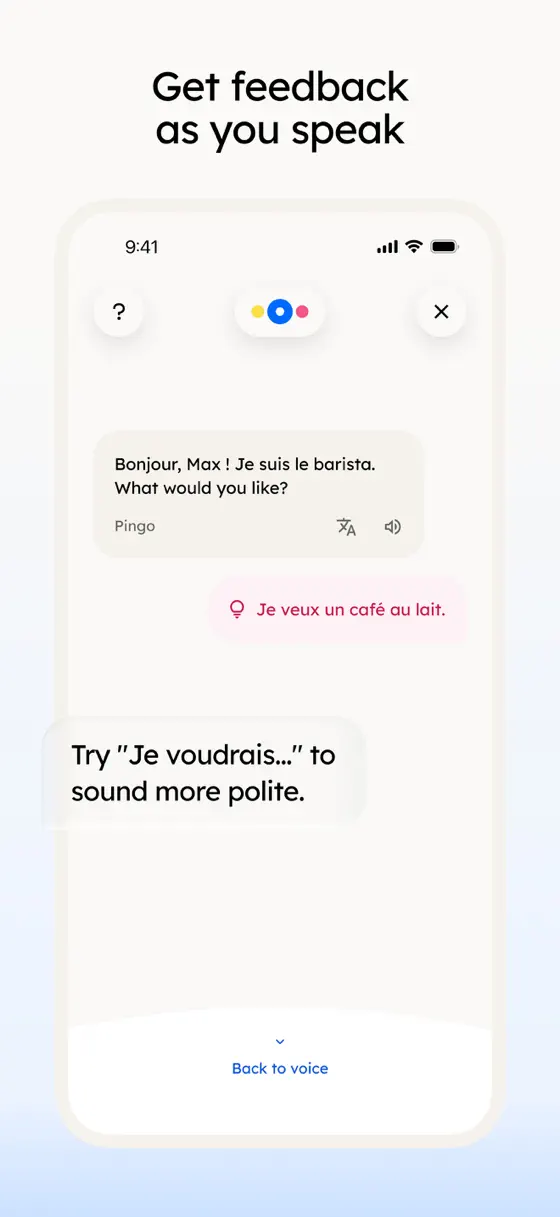
That card offers a politer way to say the line. It's about wording, and it shows nothing about how you sounded.
Chinese learners describe two kinds of mistake. Of the 30 reviews from Chinese learners that raise a complaint or a request, 9 say the speech check got it wrong.
Five say it let mistakes pass. Learners describe making random sounds, slipping in errors on purpose or saying nothing at all, and being praised for it. An Australian learner answered a long sentence with only the first sound of each syllable and no tones, and was told "Perfect!".
One Google Play reviewer put it bluntly in March 2026: "I make random sounds… and the ai said I'm good at it."
Four say it misheard them or marked a right answer wrong. A Canadian learner said pa and was told it sounded like ta, over and over. A US learner was asked to say the word for she, said tā and was marked wrong.
That second case is telling. In Mandarin, he, 他, and she, 她, sound exactly the same. The learner's explanation is that the app assumed the male one. If so, it was judging a written word, because no ear could tell the two apart.
Learners of other languages report the same: in the latest 500 US App Store reviews, 42 say the speech check got them wrong. Reviewers at LanguaTalk and Lingrow, who tried it in French, Spanish and Korean, both found its recognition too forgiving; both are rival businesses, as we are. A German tech site, t3n, found that it mixed up Japanese words that sound alike.
Research gives a reason to be careful. A review of 15 studies of English learners found that speech-recognition feedback had a large effect on learners' individual sounds, but a small one on their rhythm and pitch. Tones are pitch.
Our advice: take Pingo's feedback as encouragement, and check your tones another way. Our guide to learning tones shows how to train your ear. SayMei hasn't published a test of its own tutor's tone-catching either, so the same caution applies to us.
Pinyin went missing, then came back
Pinyin, Chinese spelled in Latin letters, is how most beginners read their first Mandarin. Pingo's Chinese page says beginners start with it, but learners have reported it missing more than once.
Reviews and screenshots tell the story in four stages:
- January and February 2025. Two early Android reviewers asked for pinyin captions in the transcripts, and a UK learner wanted a way to switch pinyin off.
- December 2025. A Google Play reviewer said the dialogue box almost never showed pinyin, and advised pairing Pingo with a more beginner-friendly app.
- June 2026. Two reviewers said Pingo 5.0 removed pinyin, on the day it came out and the day after.
- September 2026. Screenshots of the Android app in a blog review show pinyin above each Chinese line, and a "Show pronunciation" switch in the settings.
The June reviews were blunt. One Google Play reviewer liked the app but noted that "the pinyin is no longer an option when in practice mode", so they had to rely on their ear. An Australian learner gave the update one star, with the lost pinyin first among their reasons.
We couldn't check the app ourselves, and Pingo's release notes don't say when pinyin returned. Most say only "Fixed bugs and improved overall app and conversation experience." The blog's reviewer adds that you can hide pinyin, for when you want to read characters alone.
Pingo's own website still leaves pinyin out. Its Chinese examples, such as hello, 你好, and take your time, 慢慢来, appear in characters only. We've added the pinyin here.
Characters get less attention. The Chinese page says you'll have real conversations "instead of drilling tone charts or character flashcards". One Google Play reviewer found no character practice for Chinese at all.
Our advice: learn pinyin and the tones before you rely on Pingo. A few weeks with a course, our free pinyin chart and a tones drill will make its pinyin and spoken replies much easier to follow.
Learners like the talking and dislike the billing
Pingo's star ratings are high on both stores: 4.6 on the US App Store, from almost 16,000 ratings, and 4.7 on Google Play, from more than 215,000. On both, more than four in five ratings are five stars. Its written reviews are much cooler.
Here's the average rating, by who's doing the rating:
Sources: Pingo's US App Store and Google Play pages, Apple's public review feed and Google Play's English reviews, read on 5 November 2026, and our count of Chinese learners' reviews. The dates of each sample are in the Methods.
The gap has a likely cause. Anyone can leave a star rating without writing a word, often when the app asks, and those ratings skew high: 83% of all App Store ratings are five stars, against 20% of the recent written reviews. Two US reviewers say Pingo asked them for a rating within their first hour.
Written reviews come from people with something to say, and many of them are complaints. Five of the 500 even rated a complaint highly so more people would see it. And Pingo's store images claim 4.8 stars, more than either US store shows.
We sorted the 500 written App Store reviews by what they raise. Half mention money in some way, whether the paywall, a charge, cancelling or the price:
Source: Apple's public review feed for Pingo, US store. We sorted reviews by keyword rules, then read every review and corrected the rules by hand; how we did it is in the Methods.
Where happy reviewers say why, it's usually the conversation practice itself. That's Pingo's pitch, and it's the reason to try it.
Google Play's reviews are kinder. Its latest 2,000 English reviews average 4.0, and by our keyword count few mention a paywall or billing. The billing trouble looks mostly like an iPhone problem, as we explain below.
Pingo replies to reviews on its App Store page, and its help pages say it tries to answer support emails within 24 hours. On Reddit's r/ChineseLanguage, which we read in October, two threads from 2026 recommended Pingo for speaking practice, in a forum that is wary of AI tutors in general.
What Chinese learners say about Pingo
We found 77 reviews from people learning Chinese with Pingo, most of them on Google Play and the rest on the App Store in the US, UK, Canada and Australia. Together they average 3.9 stars, about the same as Google Play's written reviews.
Most are short, though. 47 are praise alone, usually five stars and a line saying they're learning Chinese. The 30 that raise a complaint or a request average 2.6 stars, and here's what they raise:
Source: Google Play's English reviews and App Store reviews from the US, UK, Canada and Australia, read on 5 November 2026. We coded each review by hand.
The praise is real. The most-liked Chinese learner's review on Google Play, marked helpful by 87 people, comes from someone who uses the role-plays to keep up Chinese they already speak. An upper beginner who'd looked for ages for an app at their level wrote in January 2026 that "everything else I tried was too advanced… but Pingo is perfect". Another used it in the week before a trip to Hong Kong.
The complaints are specific. After the June redesign, one learner who'd bought a year says the bot used rice, 米饭, for bread, 面包. They also found they could no longer tap a character to see the word. Another learner found the Chinese voice lagging and pausing.
Two young learners wanted to learn Chinese and couldn't get past the paywall: a 14-year-old whose parents refused to pay, and another whose father's parental controls blocked the card the trial needed.
Reviewers choose themselves, so these counts show what can go wrong. They can't tell you how often. Still, the pattern is clear: Chinese learners enjoy the talking and distrust the checking.
How much does Pingo AI cost?
Usually $14.99 a month or $99.99 a year on the US App Store, by reviewers' accounts. The store itself lists ten Pingo Pro purchases at four prices, and none says how long it lasts.
Here's what each price works out to per month, using the plan lengths Apple's own listing gave in November 2025:
Source: Pingo's US App Store listing on 5 November 2026, and an archived copy from a year earlier that labelled the plans. Reviewers on both stores describe $17.99 as monthly.
Prices move. In June the listing also showed three more prices, up to $119.99, and $17.99 had first appeared there that spring.
Google Play lists purchases from $14.99 to $119.99. Pingo's website shows no prices at all, so the paywall is the only place you'll see yours.
Here's what Pro gets you, by Pingo's Chinese page: unlimited conversations, custom chats on any topic, lessons built around your goals and progress that carries across sessions. The App Store says a subscription is needed for "full conversation practice". In July 2025 its listing said, in capitals, that all conversations require a subscription.
The rules that matter most are these:
- The free part. Reviewers say it ends after about one lesson. A March 2026 reviewer hit the paywall right after their first.
- The free trial. Most reviewers describe 7 days that need a card, and many say the trial rolled into a yearly plan when it ended. Pingo doesn't publish the length, and one reviewer was offered 2 days.
- Renewal. Plans renew unless you cancel at least 24 hours before the period ends.
- Age. Pingo's terms say account holders must be 16 or the age of majority where they live, whichever is higher. The App Store rates the app 4+.
Is it worth it? At $14.99 a month, Pingo costs more than HelloChinese or SuperChinese, which teach full Chinese courses, and less than Speak's $17.99. A year at $83.99 is the same as a year of Speak.
Where you paid decides how you cancel
Pingo sells its plans three ways, by its terms: through the App Store, Google Play or Stripe. Some iPhone users end up paying through Link, Stripe's payment service, on the web. Those plans don't appear in Apple's subscription settings, and Apple can't refund them.
This matters more than it sounds: more than 30 of the latest 500 US App Store reviews describe paying through Link, Stripe or a website, or not finding Pingo in their Apple subscriptions.
On Google Play, none of the 7,259 English reviews mentions Link or Stripe.
Here's how to cancel and ask for a refund, by Pingo's help pages:
- Find where you paid. Look for Pingo in your iPhone or iPad subscriptions, or in Google Play's. If it isn't in Apple's list, you probably paid through Link.
- Cancel in the app. Open Pingo, go to Settings, then Subscription, then Cancel Subscription, and confirm through the App Store, Google Play or Stripe.
- Ask the right people for a refund. Apple handles refunds for App Store purchases. For Google Play or Link, email support@pingo.ai from the address you log in with.
- Don't delete your account to cancel. Deleting the app or your account doesn't cancel the plan or refund you, and Pingo keeps transaction records for up to a year.
One caveat: several iPhone reviewers say they found no Settings menu in the app. Some found the link to manage a Link plan in Pingo's sign-up email instead.
After you cancel, you keep Pro until the end of the period you've paid for, and your progress and streak stay. Cancelling doesn't refund you by itself. And by Pingo's refund page, if it does refund you, your plan ends too.
If you try the trial, set your own reminder two days before it ends, and note which store you started it in.
Reviews from before July 2026 describe a different app
Pingo changes fast. The June 2026 redesign, Pingo 5.0, was "our biggest update yet": a redesigned app, a setup conversation that builds your plan, and Free Chat. Several reviews that still rank well, such as LanguaTalk's, last updated in February, describe the app before it.
Here's what changed and when, dated from Pingo's release notes and archived copies of its App Store page:
| When | What changed |
|---|---|
| 16 December 2024 | The iPhone app launches |
| 2 January 2025 | The Android app launches |
| July 2025 | The listing says all conversations require a subscription |
| November 2025 | Apple's listing labels $14.99 monthly and $99.99 or $83.99 yearly; Pingo claims 800,000+ users |
| 18 November 2025 | Google Play names it 2025's Best Hidden Gem |
| February 2026 | Pingo claims 3 million+ users |
| By June 2026 | $17.99 appears among the prices |
| 29 June 2026 | Pingo 5.0 redesigns the app; reviewers say pinyin left practice mode |
| By 16 July 2026 | Pingo claims 8 million+ users |
| 20 July 2026 | 5.1 adds visual feedback and a typed setup |
| 13 August 2026 | 5.2's release note reads "Mean Pingo" |
| 3 September 2026 | 5.3 says Pingo remembers more about you, with streak grace periods |
| By September 2026 | A blog review's screenshots show pinyin back, with a switch to hide it |
| 1 November 2026 | Version 5.4.8, the latest when we checked |
Sources: Pingo's US App Store listing and its version history, five archived copies of the listing (in the Sources below), Google's Best of Google Play list, a blog review and store reviews.
The user count is Pingo's own claim. It rose tenfold in eight months, to 8 million by July 2026, while its count of US App Store ratings nearly tripled.
Most release notes since the redesign say only that bugs were fixed, so they don't tell you when pinyin came back. Pingo doesn't explain "Mean Pingo" in its notes, but the blog review's screenshots show it as a switch in the settings. Its personality comes up in 15 of the 500 recent US reviews, for better or worse, and one Chinese learner wrote in April that its insults motivate them to study.
So date any review you read, including the ones on the stores. One from before 29 June 2026 describes an app that has since been rebuilt.
Who should use Pingo, and who shouldn't
We'd pick Pingo if:
- You can already say a little. An upper beginner or intermediate learner gets the most from open role-plays.
- You're nervous about speaking. Talking to an app first is lower-stakes than talking to a tutor or a stranger.
- You have a trip or a goal coming up. Its plans are built from the situations you name.
- You learn more than one language. The same app covers 25.
We'd skip it, or pair it with something else, if:
- You're starting from zero. Pingo has no step-by-step course, so learn pinyin and tones with one first.
- You want your tones checked. Learners say its speech check passes mistakes, so use a pitch tool or a teacher.
- You're preparing for an exam. Nothing in Pingo maps to the HSK. Our HSK exam guide covers what to use instead.
- You want to read and write. We found no character practice.
- You study on a laptop. We found no web or desktop version.
- You're buying for a child or a young teen. Pingo's terms require account holders to be at least 16, or older where the age of majority is higher.
The best alternatives for each goal
No app does everything. If Pingo isn't the right fit, here's our pick for each goal:
A Chinese course built for speaking
- Pick
 Speak
- Price
- $17.99 a month or $83.99 a year
- Why
- A course to B1, with a pronunciation lesson in every unit
A gentle start from zero
- Pick
 HelloChinese
- Price
- $11.99 a month or $69.99 a year
- Why
- Pinyin, characters and grammar, step by step
A score on every line you say
- Pick
 SuperChinese
- Price
- $11.99 a month or $59.99 a year
- Why
- A course from zero to about HSK 5
Some free talk every day
- Pick
 Talkpal
- Price
- Free for 10 minutes a day, or $19.99 a month
- Why
- A free plan with a daily limit
A human ear for your tones
- Pick
 An italki tutor
- Price
- About $20 an hour
- Why
- The median Chinese teacher's price
A tutor made only for Mandarin
- Pick
 SayMei
- Price
- $5.99 a month for 200 minutes
- Why
- Mei Lin corrects your tones as you talk
Sources: each app's US App Store listing, Talkpal's pricing page and SayMei's pricing page, 5 November 2026; italki's median from our guide to online Chinese tutors.
Speak is the closest match for what Pingo promises, with a real Chinese course behind it. Our Speak review compares it with Praktika and Talkpal, and our reviews of Praktika, Talkpal, HelloChinese and SuperChinese go deeper on the others.
Where SayMei fits, and where it doesn't
SayMei is built for one language. Mei Lin, SayMei's AI tutor, holds spoken lessons in Mandarin and English, sorted by HSK level, and corrects your tones as you answer. Your level sets how much English she uses and how fast she talks, and the transcript can show characters, pinyin or both.
SayMei Premium costs $5.99 a month for 200 minutes with Mei Lin, less than any Pingo plan works out to per month. It runs in the browser on any phone or computer, so a laptop works as well as a phone.
Here's where Pingo beats us:
- More talk time. Pingo Pro is unlimited, while our 200 minutes a month come to about six and a half a day.
- Phone apps. Pingo is a voice-first app for iPhone and Android. SayMei runs in the browser instead.
- More ways to practise. Free Chat, role-plays you design and plans built from your own goals.
- Memory. Pingo says it remembers your level, mistakes, words and goals from one session to the next.
- More languages. One Pingo app covers 25; SayMei teaches only Mandarin.
And one gap we share. Like Pingo, SayMei hasn't published a test of how accurately its tutor hears your tones.
If you already speak some Mandarin and want unlimited role-plays on your phone, Pingo may suit you better. If you want a tutor whose whole job is Mandarin, with lessons sorted by HSK level, start with SayMei.
What to do next
- Learn pinyin and tones before you pay. Pingo's replies are hard to follow until you can read pinyin and hear the tones.
- Spend your free lesson on Chinese. Reviewers say the free part ends quickly, so use it on a real role-play.
- Check your tones somewhere else. A pitch tool or a human tutor will catch what a lenient speech check misses.
- Note where you paid. If Pingo isn't in your Apple subscriptions, you paid through Link: cancel in the app and email support for a refund.
- Set your own trial reminder. Cancel at least two days before a free trial ends, or it may roll into a yearly plan.
If you're choosing between AI tutors, our comparison puts Pingo next to Speak, SuperChinese, Talkpal and more.
FAQ
Is Pingo AI good for learning Chinese?
For speaking practice once you know the basics, it can be. Pingo builds Mandarin role-plays around your goals and keeps the conversation going. It isn't a Chinese course, though: it never mentions the HSK, and we found no character practice. The 30 Chinese learners' reviews that raise a complaint or a request average 2.6 stars, mostly over the speech check and the paywall.
Is Pingo AI free?
Barely. The app is free to download, but its App Store listing says a subscription is needed for full conversation practice, and reviewers say the paywall arrives after about one lesson. Most describe a week's free trial that asks for a card first, and many say it rolled into a yearly plan when it ended. Plans renew unless you cancel at least 24 hours before the period ends.
How much does Pingo AI cost?
On the US App Store, Pingo Pro is usually $14.99 a month or $99.99 a year. The store also lists $83.99 and $17.99, and names all ten purchases "Pingo Pro" without saying how long each lasts; a year ago it labelled $83.99 as yearly too. Google Play's prices run up to $119.99. Pingo's website publishes no prices, so check the paywall before you start a trial.
Does Pingo AI check your tones?
It says so. Pingo's Chinese page promises "instant feedback on tone accuracy, pronunciation, and sentence structure", but nothing it publishes shows how well it hears tones, and none of its store images shows Chinese text. Nine of the 30 Chinese learners' reviews with a complaint or request say the speech check got it wrong: five that it passed mistakes or random sounds, and four that it misheard them or rejected right answers.
Does Pingo AI show pinyin?
Yes, by the latest evidence, after months when it often didn't. A December 2025 reviewer said the dialogue box almost never showed pinyin, and two said the June 2026 redesign removed it. Screenshots of the Android app in a blog review published in October show pinyin above each Chinese line and a "Show pronunciation" switch. We couldn't check this ourselves, and Pingo's website examples still have no pinyin.
How do I cancel Pingo AI and get a refund?
Cancel where you paid. In the app, go to Settings, then Subscription, then Cancel Subscription, and confirm through the App Store, Google Play or Stripe. Some iPhone reviewers found the cancel link in Pingo's sign-up email instead. Deleting the app or your account doesn't cancel anything. Apple handles refunds for App Store purchases; for Google Play or Link, email support@pingo.ai. If Pingo isn't in your iPhone's subscriptions, you probably paid through Link.
Is Pingo AI legit?
Yes. It's a real app from Pingo AI, Inc., a San Francisco company from Y Combinator's Summer 2025 batch, with more than 5 million Google Play downloads and a Best Hidden Gem award from Google Play. Billing is still the top complaint in its recent US App Store reviews: half mention money, mostly the paywall, charges or cancelling. Its terms warn that AI outputs may be incorrect.
Is Pingo AI or Speak better for Chinese?
For most Mandarin learners, Speak. It teaches a real Chinese course from beginner to intermediate, with a pronunciation lesson in every unit, for $17.99 a month or $83.99 a year on the US App Store. Pingo's $14.99 monthly plan costs less, and Pingo lets you steer open role-plays around your own goals. But it has no Chinese course, and learners report a lenient speech check.
Sources
Checked 5 November 2026, and again on 6 November, unless noted. No accounts were created and nothing was bought.
Pingo
- Pingo AI on the App Store: description, in-app prices, ratings, version history and listing images; archived copies from 13 July 2025, 7 November 2025, 3 February 2026, 4 June 2026 and 16 July 2026
- Pingo AI on Google Play: ratings, downloads, languages, price range and developer details
- pingo.ai, its Chinese page, its summary for AI tools and its terms (last updated 10 March 2026)
- Pingo's help pages on cancelling, refunds, deleting your account and contacting support
- Pingo AI on Y Combinator
- Google's Best of Google Play 2025 (18 November 2025)
Reviews
- Apple's public review feed for Pingo: the latest 500 US reviews, and the latest from the UK, Canada and Australia
- Google Play's English reviews of Pingo, 10 January 2025 to 4 November 2026
- Reviews of Pingo by LanguaTalk (updated 19 February 2026), Lingrow (updated 15 October 2026) and t3n (November 2025, in German)
- Kaohongshu's review of Pingo for Chinese (6 October 2026), with screenshots of the Android app, read 6 November 2026
- r/ChineseLanguage, read 6 October 2026
Other apps
- Speak, HelloChinese and SuperChinese on the US App Store; Talkpal's pricing
- SayMei: pricing
- italki's median price: our guide to online Chinese tutors
Research
- Ngo, T. T.-N., Chen, H. H.-J. & Lai, K. K.-W. (2024). The effectiveness of automatic speech recognition in ESL/EFL pronunciation: a meta-analysis. ReCALL 36(1). doi:10.1017/s0958344023000113
Methods
We read Pingo's App Store and Google Play listings, website, Chinese page, help pages and terms on 5 November 2026, and again on 6 November, with archived copies of its App Store page from July 2025 to October 2026 to date its changes. We didn't subscribe, sign in or take lessons, so every feature here is what Pingo says, what learners report or what a blog reviewer's screenshots show, and we say which.
- The 500 App Store reviews are the latest US reviews in Apple's public feed, from 9 October 2025 to 3 November 2026. We sorted them by keyword rules for each subject, then read every review and corrected the coding of 106 by hand. A review can count under several subjects.
- The Chinese learners' reviews are the 77 we found, from 11 January 2025 to 16 October 2026: 64 among 7,259 English reviews on Google Play, and 13 among 706 App Store reviews from the US, UK, Canada and Australia. We counted only people who said they learn, or tried to learn, Chinese with Pingo, or who described its Chinese, and coded each review by hand. The 30 we single out raise at least one complaint or request; the other 47 are praise alone.
- The Google Play figures cover its English reviews from 10 January 2025 to 4 November 2026; the latest 2,000 run from 8 July 2026. Their themes are keyword counts we didn't check by hand.
- The averages for the stores are their own; ours are simple averages of the reviews in each sample.
- Prices per month divide each US App Store price by its months, using the lengths Apple's listing gave in November 2025 and, for $17.99, reviewers' accounts. They're US prices; other countries can differ.
- The scorecard is our judgment from those sources, not a test of the app.
- The screenshots are Pingo's own App Store images and its Chinese page, shown unedited for review.
- The Mandarin examples were checked against the CC-CEDICT dictionary.
If you spot a mistake, tell us: we fix errors.