Praktika review: is it good for learning Chinese?
Our Praktika review for Mandarin: when Chinese arrived, how it handles tones, what 31 Chinese learners say and every App Store price, checked November 2026.


Praktika started teaching Chinese in July 2026. Its App Store rating is 4.7, but the Chinese learners who've reviewed it since give it about two stars.
This review is for you if you're learning Mandarin and wondering whether Praktika is worth your money. We read its listings, help centre and terms in November 2026, and we went through more than 3,500 store reviews to find the ones from Chinese learners.
Key takeaways
- Chinese is brand new. Praktika added it in July 2026, so a review written before then can't tell you about its Chinese.
- It's a chat partner with no Chinese course. You get patient avatar tutors and role-plays, but no lessons on pinyin, tones or characters that we could find.
- Its tone feedback is unproven. Praktika scores each word you say, but nothing it publishes shows how well it hears Chinese tones.
- Chinese learners are its harshest critics. Their reviews average about two stars, and the top complaint is the tutors' own pronunciation.
- Watch the billing. Problems with charges, often around free trials, are the top complaint in recent App Store reviews.
- It suits a confident intermediate. If you can already hold a simple conversation, the unlimited talk time is the real draw.
Good for talking, weak for learning Chinese
Praktika does one job well: it gives you someone to talk to, any time, for as long as you like. For a Mandarin learner, most of the other jobs are missing or unproven.
We scored each one from Praktika's own pages and what Chinese learners report:
What you need · Verdict · What Praktika gives you
Lots of speaking time
Strong
Unlimited voice chats with avatar tutors on Premium, plus role-plays and video calls
Corrections on grammar and word choice
Strong
A better way to say it, and why, under each message you send
Help in English when you're lost
Partly
A setting that explains in your own language, and translations on Premium
A tutor whose Mandarin you can copy
Partly
Learners say it often misreads words, tones and pinyin
Feedback on your tones
Unproven
A score for each word; nothing says how well it hears tones
Pinyin, tones and characters from zero
Missing
No lessons on them that we could find
A path tied to the HSK exam
Missing
Levels from A0 to C2, with no link to the HSK
Sources: Praktika's help centre, App Store listing and blog, and 31 reviews from Chinese learners on the App Store and Google Play, all read on 5 November 2026. Each row is explained below.
The corrections are the strongest part. Here's one from Praktika's own listing, on an English sentence:
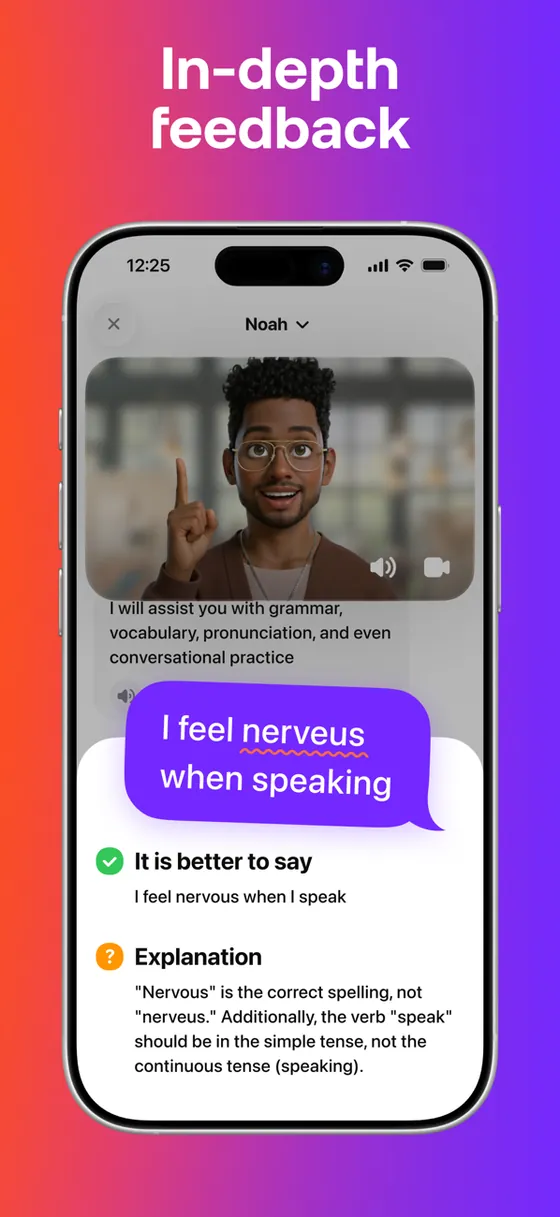
If you want to be taught Chinese, our advice is to look elsewhere. If you want a patient partner and can already get by, Praktika is worth a free try.
Chinese arrived in July 2026
Praktika launched in 2022 and has added languages in batches. Chinese came in July, with Arabic and Russian, announced in an App Store event from 18 July. Dutch and Polish followed at the end of August.
Mandarin learners had been asking for it for months. App Store reviewers asked for Chinese from at least October 2025, and one had downloaded the app for it only to find it missing.
Here's how Chinese reached the app, dated from Praktika's own pages and learners' reviews:
| When | What happened |
|---|---|
| May 2022 | Praktika launches on the App Store |
| October 2025 to June 2026 | App Store reviewers ask for Chinese |
| 12 July 2026 | The first review from a Chinese learner we found, on Google Play |
| 18 July 2026 | An App Store event announces Chinese, Arabic and Russian |
| By 30 July 2026 | Its help centre lists Simplified Chinese |
| 2 October 2026 | Praktika's CEO names it "our pick for Mandarin" on its blog |
Sources: Praktika's US App Store listing, archived on 26 June and 24 July 2026; App Store and Google Play reviews; Praktika's blog and help centre.
The rollout looks uneven. On 26 July, eight days after the event began, a learner in Australia wrote that the app told them Chinese was still to come.
The listings haven't all caught up either. The App Store description names Chinese, but none of its six images shows it: the first displays five national flags, and China's isn't one. On Google Play, the list of languages still stops at nine and leaves Chinese out.
Praktika's release notes can't help you date anything. Every version since 4.0, in December 2025, repeats the same line about its redesign and dark mode.
What you get is Simplified characters only. Its help centre lists "Simplified Chinese (Mandarin)", with no Traditional characters and no Cantonese. If you're learning for Taiwan or Hong Kong, read our guides to Simplified vs Traditional and Mandarin vs Cantonese first.
So check the date on any review of Praktika you read. In our view, one from before July 2026 can't tell you anything about its Chinese.
Plenty of tutors, but no Chinese course
Praktika is one app for 13 languages, and Chinese gets the same tutors, lessons and practice modes as the rest. Apart from the tone features its CEO describes, which we come to below, nothing on its pages was built for Chinese.
Here's what the App Store listing and help centre describe:
- Avatar tutors with personalities. The newest four are Skye from Glasgow, Tama from Hawaii, Raven from Seattle and Noah from San Francisco. Free users get 3 tutors.
- A study plan. A short intro asks your level and goals, then the Lessons tab builds a plan.
- Practice modes. Discussion, role-play, debate, interview and "free talk", where you lead the chat.
- Your own scenes. You choose a topic, your role and the tutor's role, and it builds a lesson around them.
- Your own material. Upload a photo, a PDF, a video or a voice note, and it becomes a lesson.
- Video calls. In video-call mode you talk without holding the microphone button.
- Settings you can tune. Corrections can be soft, balanced or strict, and you can slow the tutor down or shorten its replies.
Here's the Practice tab from Praktika's own listing:
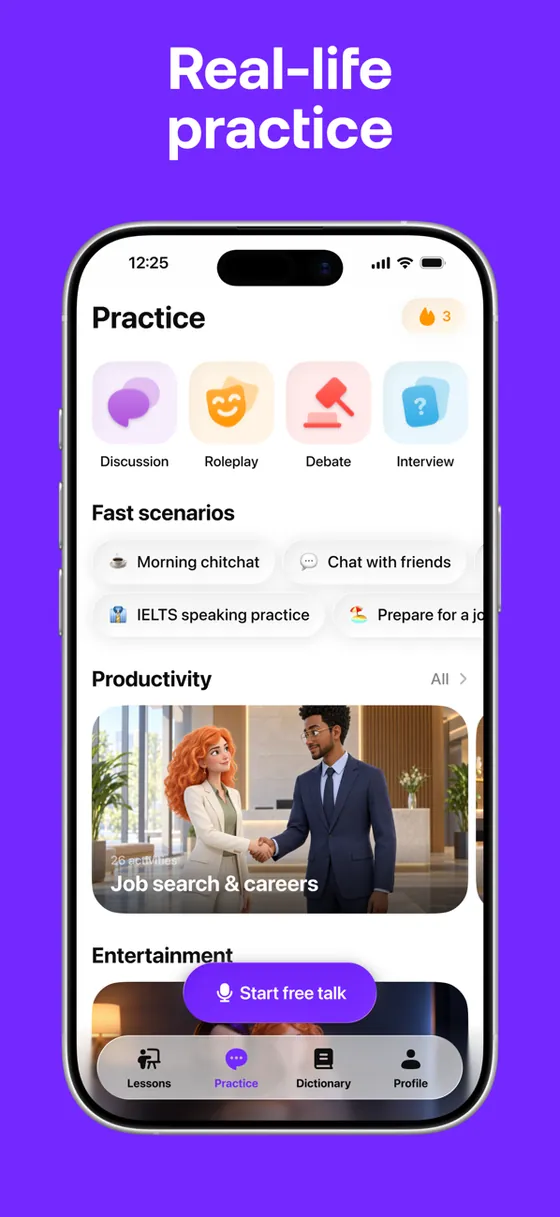
Some of the content is plainly for English learners. The screen above offers IELTS speaking practice, and its help centre's exam page is about English tests too.
The free version is real, but we couldn't find how long its practice lasts. Here's what each plan includes, by its help centre:
| Feature | Free | Premium |
|---|---|---|
| Tutors | 3 | All |
| Speaking practice | Limited | Unlimited |
| Feedback | Basic | Advanced, instant |
| Practice modes | Some | All |
| Translation help | No | Yes |
| More realistic tutor voices | No | Yes |
| Tutor memory and daily challenges | No | Yes |
Source: Praktika's help centre article on its free version, updated 1 September 2026.
One subscription covers every language, which is good value if you learn two. For Chinese alone, the question is whether the tutors' Mandarin is good enough to learn from.
Is Praktika good for Chinese tones?
Nobody has shown that it is. Praktika scores your pronunciation word by word, and its CEO says weak syllables are coloured so a wrong tone shows. But its help centre never mentions tones, and we found no test of how well it hears them.
Tones matter because they change words. Say the word for buy, 买, with a falling tone, and you've said sell, 卖.
Here's how the feedback works, by Praktika's help centre: tap the question mark on a message you've said, and you get an overall score and one for each word. The scores cover pronunciation, fluency, completeness and rhythm. You can play the tutor's version next to yours and try again.
Praktika's App Store listing showed that card on an English sentence in October:
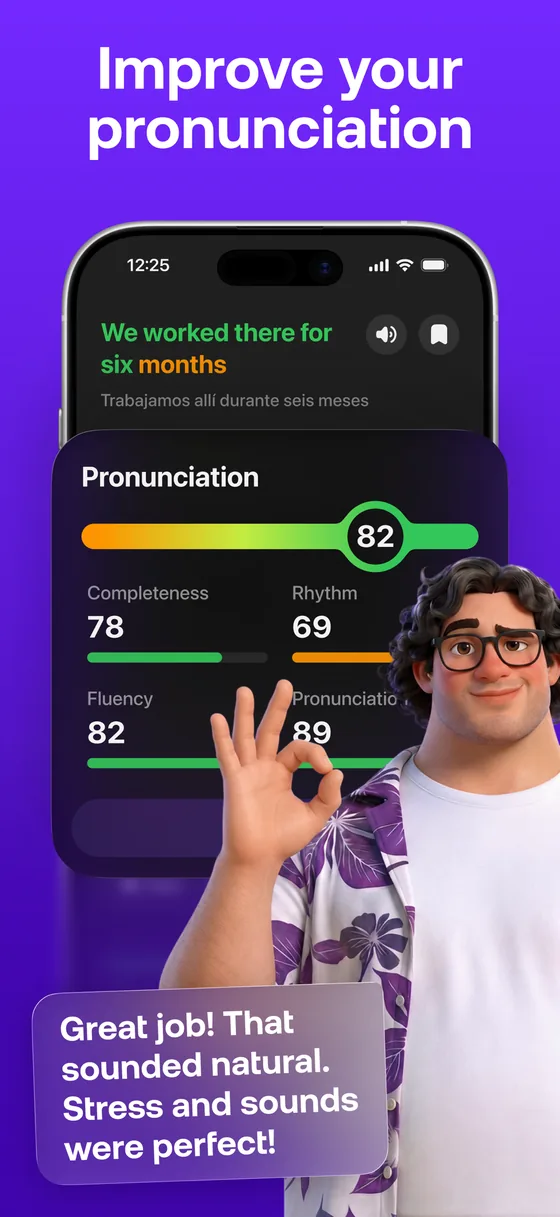
Its CEO goes further for Chinese. In a blog post in October, Adam Turaev wrote that the app grades your speech syllable by syllable. Weak syllables are coloured, he says, so a faulty tone shows at a glance, and tapping a word plays it with its tone exaggerated.
That would be useful, if it works. We couldn't find it described anywhere else: not in the 64 help-centre articles, the App Store listing or its images. Nor is Praktika alone: our comparison of nine AI tutors found no public test of tone feedback for any of them, SayMei included.
Two things make us cautious. First, speech recognition is built to guess the word you meant, which can hide a slip. A Speak engineer has written about exactly this problem. Three App Store reviewers believe Praktika turns your speech into text before it replies, and two conclude it can't really judge how you said it.
Second, research says pitch is where this kind of feedback helps least. A review of 15 studies of English learners found speech-recognition practice improved their individual sounds a lot, but their rhythm and pitch only a little. Tones are pitch.
Four Chinese learners fault its feedback. Three say it let their mistakes pass, and one that it faulted their punctuation, which the app had typed itself. Another says it wrote down their words in Traditional characters, then told them they weren't speaking Simplified.
Our advice: treat the score as a nudge to keep talking, and check your tones another way. Our guide to learning tones explains how to train your ear.
The tutors' own Mandarin is the weak spot
Chinese learners worry less about the scores than about the tutors. The most common complaint in their reviews is that the tutor itself says Chinese wrong.
We found 31 reviews from people who've used or tried Praktika for Chinese since July, across both stores. Here's what they report:
Source: Google Play's English reviews from 27 June to 4 November 2026, and App Store reviews from the US, UK, Canada, Australia, New Zealand, Ireland and Singapore, read on 5 November 2026. We coded each by hand.
The examples are specific. One learner heard the tutor teach one, 一, and then say it like the Japanese ichi. Others say it reads the characters, then reads the pinyin aloud too, and gets that wrong.
Some describe the tutor switching language, into Cantonese mid-sentence in one review and into Vietnamese in another. One heard thank you, 谢谢, read as if it were an English word.
On Google Play, one learner summed it up in October: "chinese tone pronunciation by the app is incorrect and unclear."
To be fair, not every review is negative. A Singapore learner was pleasantly surprised that the tutor understood and replied. Another wrote on Google Play in July that it was "Really helpful for practicing my Chinese." Even one critic said it helped with sentence structure.
Reviews come from people with something to say, so these counts show what can go wrong. They can't tell you how often. Still, for a speaking app, the voice you copy matters most. Check new words against a dictionary's recordings, like Pleco's, before you drill them.
Beginners get dropped into full sentences
Praktika says it suits complete beginners. Many Chinese learners disagree: 10 of the 31 say it's too hard or skips the basics.
Their stories are alike. The tutor teaches a word or two, then asks for a full sentence you don't have the words for, and corrects you when you can't. One beginner's study plan moved on to paragraphs of characters without ever teaching them to read.
The most-liked Chinese learner's review we found on Google Play makes the point. Posted in July and marked helpful by 471 people, it begins: "They finally added Chinese. however, it's a hot mess." It ends more kindly: decent enough, if you can work around the vocabulary.
Even a low-intermediate learner in the UK found it too much. They spent their sessions looking up long replies, and asking the tutor for shorter sentences didn't help.
Learners of other languages say the same. Across all 500 recent US App Store reviews in our sample, 38 say the app was too hard, too fast or had no structure.
Praktika does give you some help. A "Study in your native language" setting has the tutor explain in English, and you can slow its speech or shorten its replies. Learners say these help less than they'd hoped, and one Canadian found even the English explanations hard to follow.
What Praktika doesn't do is teach pinyin, the tones or characters, at least nowhere on its pages. A UK reviewer who tried every language said it skips how to read each script, and named pinyin and tones for Chinese.
Our advice: learn the sounds first. A few weeks with a course, our free pinyin chart and a tones drill will make the tutor's replies far easier to follow.
Written reviews are far harsher than its 4.7 rating
Praktika's star ratings are high on both stores: 4.7 on the US App Store and 4.6 on Google Play. Its written reviews are much cooler, and Chinese learners' are the coolest of all.
Here's the average rating, by who's doing the rating:
Sources: Praktika's US App Store and Google Play pages; Apple's public review feed, 25 December 2025 to 4 November 2026; Google Play's English reviews, 27 June to 4 November 2026; our count of Chinese learners' reviews.
The gap has a likely cause. A star rating can be left without a word of text, often from a prompt inside the app, and those skew far higher. On the App Store, 87% of ratings are five stars, against 39% of recent written reviews.
One reviewer says Praktika asked for a rating after a minute of use. Its homepage still claims 4.8 from 1.2 million ratings, higher than either store shows today.
On Trustpilot, which collects reviews outside the stores, Praktika scores 3.9.
We sorted the 500 written App Store reviews by what they complain about. Billing comes first, ahead of anything about teaching:
Source: Apple's public review feed for Praktika, US store. We sorted reviews by keyword rules, then read every match; how we did it is in the Methods.
Happy reviewers say something different. Where they say why, the most common reason is that Praktika finally gets them talking, sometimes after years on another app. Others like that the tutors are patient and never judge them.
Praktika says its support team answers within two days. On Google Play it rarely replies to reviews, though: we counted replies on 13 of the latest 2,400, and none to the Chinese learners there. It answers far more often on Trustpilot, where it replies to most negative reviews.
For Chinese, the written reviews are the better guide. Read them as warnings about billing and the tutors' Mandarin. On talking practice itself, the happy reviewers have a point.
How much does Praktika cost?
There's no single price. The US App Store lists ten Premium purchases, from $6.99 to $139.99, and the plan you're offered depends on the offer, the store and where you live.
Here's what each Premium purchase on the US App Store works out to per month:
Source: Praktika's US App Store listing, 5 November 2026. "3 Mon + Trial" is also $49.99, and two more purchases, $6.99 and $39.99, don't say how long they last. Google Play lists purchases from $1.99 to $199.99.
The cheap ones are offers, and they don't last. Two reviewers say a cut-price first year renewed at the full price of about $100.
Prices have also gone up. In late July, the App Store still listed a year at $99.99; by early August, that listing had become $119.99.
Prices also differ by country. On the UK App Store, a month is £9.99 and a year is £99.99.
You may not see the monthly price at all. Recent reviewers on both stores say the app offered them only longer plans, and Praktika's help centre sends monthly payers to its website.
Praktika says its website is cheaper. Its help centre promises new users 50% off a first plan there, and its homepage says about $8 a month. We suggest comparing the website's price with the app's before you pay.
The rules that cost people money are these:
- Free version. After the intro, tap the X on the paywall to skip it. You get 3 tutors and limited practice.
- Free trials. Praktika's help centre warns that on an iPhone you must cancel more than a day before a trial ends, or Apple may still charge you. Its terms say the charge comes on the trial's last day.
- Refunds. Apple or Google handle refunds for purchases in their stores. For website purchases, Praktika refunds requests made within 48 hours of a charge; its terms otherwise call fees non-refundable.
- Cancelling. Cancel in your App Store or Google Play subscriptions, or in Praktika's Stripe dashboard if you paid on the website. Deleting your account doesn't cancel anything.
- Discounts. Family plans are closed to new customers. Students who can't afford it can apply for a free year or three months.
Nearly half the billing complaints in our sample are about free trials. People describe a charge when the trial ended, or sooner, often for a full year and without the reminder they expected. If you try Praktika, set your own reminder two days before the trial ends.
Who should use Praktika, and who shouldn't
We'd pick Praktika if:
- You can already hold a simple conversation. The more Mandarin you bring, the less the tutor's long replies get in your way.
- You're nervous about speaking. Learners like a patient tutor who never judges them.
- You learn more than one language. One subscription covers all 13.
- You want unlimited talk on your phone. Premium doesn't cap your practice.
We'd skip it, or pair it with something else, if:
- You're starting from zero. Learn pinyin and tones first; Praktika won't teach them.
- You need a voice to copy. Learners report mispronounced Chinese in the tutors' own speech.
- You're preparing for an exam. Nothing maps to the HSK, and its exam practice is for English tests. Our HSK exam guide covers what to use instead.
- You study on a laptop. There's no web or desktop version.
- You're buying for a child or teen. Praktika's terms say users must be over 18, though its help centre welcomes teens and lets under-13s in with a parent's permission.
Set Praktika up for Chinese before you start
If you do try Praktika for Chinese, a few minutes of setup will spare you the worst of what learners describe. Its help centre says you can simply ask the tutor to change how it speaks.
Learners say requests don't always stick, so repeat them when the tutor drifts. These five lines cover most of what you'll need:
- Please speak more slowly: 请说慢一点.
- Please use simple Chinese: 请用简单的中文 qǐng yòng jiǎndān de Zhōngwén.
- What does this word mean? 这个词是什么意思? Zhège cí shì shénme yìsi?
- Please say it again: 请再说一遍.
- Please correct my tones: 请纠正我的声调 qǐng jiūzhèng wǒ de shēngdiào.
Then change three settings. Turn on "Study in your native language" for your first weeks, so explanations come in English. Set corrections to strict if you want more slips flagged, and slow the tutor's speech in the lesson settings.
We suggest one more habit. Save new words to the app's dictionary as you go, and check each one in Pleco before you drill it, so a tutor's wrong tone never becomes yours.
The best alternatives for each goal
No app does everything. If Praktika isn't the right fit, here's our pick for each goal:
A Chinese course built for speaking
- Pick
 Speak
- Price
- $17.99 a month or $83.99 a year
- Why
- A course to B1, with a pronunciation lesson in every unit
A gentle start from zero
- Pick
 HelloChinese
- Price
- $11.99 a month or $69.99 a year
- Why
- Pinyin, characters and grammar, step by step
A score on every line you say
- Pick
 SuperChinese
- Price
- $11.99 a month or $59.99 a year
- Why
- A course from zero to about HSK 5
Tones drilled by ear
- Pick
 Pimsleur
- Price
- $19.99 or $20.99 a month
- Why
- Audio lessons that make you answer out loud
A human ear for your tones
- Pick
 An italki tutor
- Price
- About $20 an hour
- Why
- The median Chinese teacher's price
An AI tutor made only for Mandarin
- Pick
 SayMei
- Price
- $5.99 a month for 200 minutes
- Why
- Mei Lin corrects your tones as you talk
Sources: each app's US App Store listing and SayMei's pricing page, 5 November 2026; italki's median from our guide to online Chinese tutors.
Speak is the closest match for what Praktika promises, with a real Chinese course behind it. Our Speak review compares it with Praktika and Talkpal, and our reviews of HelloChinese, SuperChinese and Pimsleur go deeper on the others.
Where SayMei fits, and where it doesn't
SayMei is built for one language. Mei Lin, SayMei's AI tutor, holds spoken lessons in Mandarin and English, sorted by HSK level, and corrects your tones as you answer. Your level sets how much English she uses and how fast she talks, and the transcript can show characters, pinyin or both.
SayMei Premium costs $5.99 a month for 200 minutes with Mei Lin. It runs in a web browser, so it works on a laptop as well as a phone.
Here's where Praktika beats us:
- More talk time. Premium is unlimited, while our 200 minutes a month come to about six and a half a day. You can buy more when you run out.
- A free plan. Praktika's free version keeps 3 tutors open, with limited practice. Regular lessons with Mei Lin need SayMei Premium.
- Phone apps. Praktika has iPhone and Android apps, with lessons you can download to practise offline. SayMei needs a browser and a connection.
- More ways to practise. Video calls with an animated tutor, role-plays you design and lessons made from your own photos or PDFs.
- More languages. One Praktika subscription covers 13; SayMei teaches only Mandarin.
- Scores. Praktika scores each word you say. Mei Lin corrects you as you talk but gives no pronunciation score.
And one gap we share. Like Praktika, SayMei hasn't published a test of how accurately its tutor hears your tones.
If you speak some Mandarin already and want unlimited chat on your phone, Praktika may suit you better. If you want a tutor whose whole job is Mandarin, start with SayMei.
What to do next
- Try the free version first. A few chats will show you whether the tutor's Mandarin is clear enough to learn from.
- Learn pinyin and tones before you pay. Praktika won't teach them, and its replies are hard to follow without them.
- Check your tones somewhere else. A pitch tool or a human tutor will catch what a word score can miss.
- Compare the website's price with the app's. The same Premium is sold at very different prices.
- Set your own trial reminder. Cancel at least two days before a free trial ends.
If you're choosing between AI tutors, our Speak review puts Praktika next to Speak and Talkpal.
FAQ
Does Praktika teach Chinese?
Yes, since July 2026. Praktika's help centre lists "Simplified Chinese (Mandarin)" among 14 language options, with European and Brazilian Portuguese counted separately. Every language runs from beginner to advanced. It teaches Simplified characters only, with no Traditional option and no Cantonese. Chinese uses the same tutors and lessons as every other language, and we found no lessons on pinyin, tones or characters.
Is Praktika good for learning Mandarin?
For conversation practice once you know the basics, it can be. On Premium, its avatar tutors chat as long as you like and correct your grammar. For learning from zero, Chinese learners mostly say no. Their 31 reviews since July average about two stars. Many say it skips the basics, or that the tutors mispronounce Chinese. Pair it with a course that teaches pinyin.
Does Praktika correct your tones?
It says it scores your pronunciation. Praktika's help centre describes an overall score and one for each word, for pronunciation, fluency, completeness and rhythm. Its CEO's blog adds that weak syllables are coloured so a wrong tone shows. Nothing Praktika publishes shows how accurately it hears tones, and three Chinese learners say its feedback let their mistakes pass.
Is Praktika free?
Partly. Praktika is free to download, and its free version gives you 3 tutors, limited speaking practice and basic feedback. Its help centre doesn't say how much practice "limited" means. To reach the free version, tap the X on the paywall after the intro. Premium adds every tutor, unlimited practice, advanced feedback and translation help.
How much is Praktika a month?
It depends on the offer. On the US App Store, a month is $9.99 and a year is $119.99. The store lists ten Premium purchases in all, though, and recent reviewers on both stores say the app offered them only longer plans. Praktika promises new users half off a first plan on its website, so compare the two before you pay.
How do I cancel Praktika and get a refund?
Cancel where you paid: in your App Store or Google Play subscriptions, or in Praktika's Stripe dashboard if you paid on its website. Deleting your account doesn't cancel the plan. Apple and Google decide refunds for their stores. For website purchases, Praktika refunds requests made within 48 hours of the charge. On an iPhone, cancel a free trial more than a day early.
Is Praktika better than Speak for Chinese?
For most learners, Speak is the better choice. Speak teaches a real Chinese course from beginner to intermediate, with a pronunciation lesson in every unit, for $17.99 a month or $83.99 a year. Praktika costs less month to month but more for a year, and it lets you chat about anything with avatar tutors. It has no Chinese course, though, and its Chinese is newer.
Is Praktika a scam?
It's a real, widely used app: Google Play counts more than 10 million downloads. But billing is the top complaint in its recent App Store reviews, and about 6% of them use words like scam or fraud, mostly about charges, often after a free trial. Cancel any trial more than a day early, and remember that store refunds go through Apple or Google, not Praktika.
Sources
Checked 5 November 2026 unless noted. No accounts were created and nothing was bought.
Praktika
- Praktika on the App Store: description, in-app prices, ratings, version history and listing images, plus its UK listing; archived copies from 17 April, 26 June, 24 July, 7 August and 4 September 2026
- Praktika on Google Play: ratings, downloads, languages, price range and developer details
- praktika.ai, its terms (last updated 10 August 2026) and its blog: the C-drama post by its CEO (2 October 2026)
- Praktika Help Centre, all 64 articles, including which languages, the free version, the learning process, monthly plans, cancelling, refunds, devices, exam prep and changing how the tutor speaks
- Praktika on Trustpilot
Reviews
- Apple's public review feed for Praktika: the latest 500 US reviews, and the latest from the UK, Canada, Australia, New Zealand, Ireland and Singapore
- Google Play's English reviews of Praktika, 27 June to 4 November 2026
Other apps
- Speak, HelloChinese, SuperChinese and Pimsleur on the US App Store
- SayMei: pricing
- italki's median price: our guide to online Chinese tutors
Research
- Ngo, T. T.-N., Chen, H. H.-J. & Lai, K. K.-W. (2024). The effectiveness of automatic speech recognition in ESL/EFL pronunciation: a meta-analysis. ReCALL 36(1). doi:10.1017/s0958344023000113
- Seongjin Park, Speak's engineering blog (7 May 2026): when speech recognition gets too helpful for language learning
Methods
We read Praktika's App Store and Google Play listings, website, terms, blog and all 64 help-centre articles on 5 November 2026, with archived copies of its App Store page to date its changes. We didn't subscribe, sign in or take lessons, so every feature here is what Praktika says or what learners report, and we say which.
- The 500 App Store reviews are the latest US reviews in Apple's public feed, from 25 December 2025 to 4 November 2026. We sorted them by keyword rules for each problem, read every match and corrected the rules by hand. A review can count under several problems.
- The praise comes from the 230 four- and five-star reviews in that sample. Half are ten words or fewer. Across all 230, 35 say it got them speaking, 12 that it beats apps they'd tried and 12 that the tutors feel natural or patient.
- The Chinese learners' reviews are the 31 we found, from 12 July to 2 November 2026: 20 of the 2,400 English reviews on Google Play, and 11 from the 1,133 App Store reviews we loaded from seven English-speaking countries. We counted only people who'd used or tried it for Chinese, coded each review by hand, then checked every code against its text.
- The averages for the stores are their own; ours are simple averages of the reviews in each sample.
- Prices per month divide each US App Store purchase by its months. They're US prices; other countries, and Praktika's website, can differ. On 5 November 2026 Canada's App Store listed C$12.99 a month and C$129.99 or C$139.99 a year, and Australia's A$14.99 a month and A$99.99 or A$139.99 a year.
- The scorecard is our judgment from those sources, not a test of the app.
- The screenshots are Praktika's own App Store images, shown unedited for review.
- The Mandarin examples were checked against the CC-CEDICT dictionary.
If you spot a mistake, tell us: we fix errors.