Characters · Total beginner
Chinese Flashcards: 200 Most Common Words to Print and Cut
You name your family, count to ten, and say what you eat and how you get to work, from 妈妈 to 米饭 and 地铁. Made for learners starting from zero, with every word and example on the free audio.
- Level:
- Total beginner · HSK 1
- Format:
- Flashcards · PDF · 28 pages · US Letter (prints on A4)
- Price:
- Free · free with a saymei account · updated Nov 4, 2026
Listening audio: play every track free, no account needed.
Download the free PDF: create a free SayMei account on this page, and we'll email you a copy too.
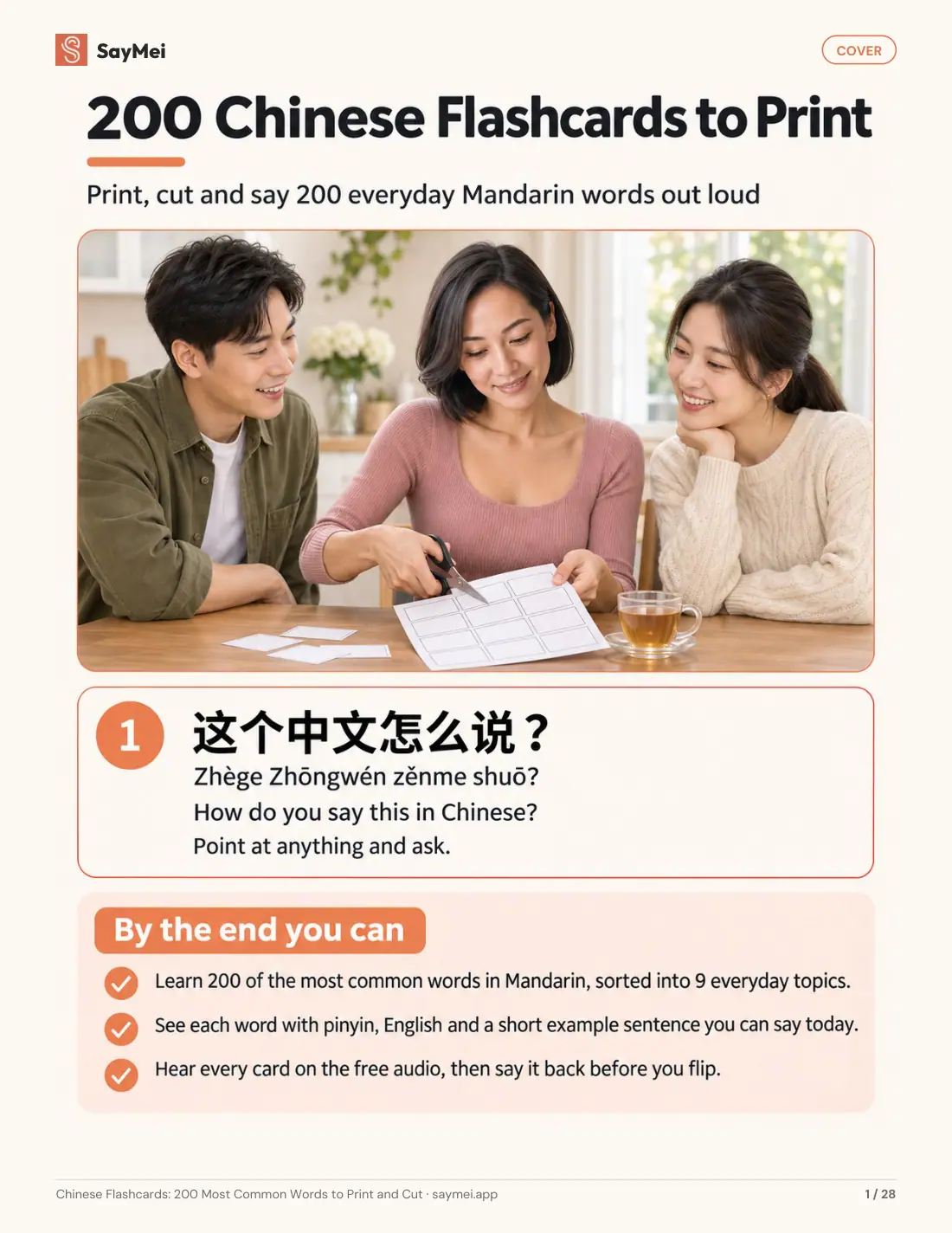
这个中文怎么说? · Zhège Zhōngwén zěnme shuō? · How do you say this in Chinese?
By the end you can
- Name the people in your life. Pronouns, family words and jobs on 24 cards, from 我 and 你 to 妈妈 and 老师, used in short lines like 我爸爸是医生。
朋友 · péngyou · friend - Count to ten and say when something happens. Count one to ten, use 两 for two of something (我要两个苹果。), and say today, tomorrow, the hour with 点 and the week with 星期.
两 · liǎng · two (of something) - Say what you eat and drink. From 米饭 and 面条 to 咖啡, 饺子 and 包子, with the meals of the day and a line to praise a dish: 这个菜很好吃。
饭馆 · fànguǎn · restaurant - Name places in town and say how you get there. Hospital, supermarket, airport and station, travel with 坐 (我坐地铁上班。), and where things are with 前面, 左边 and 旁边.
旁边 · pángbiān · next to, beside - Use the 24 most useful action words. 是, 有, 要 and 想, then 看, 听, 说, 买 and 等, including the three ways to say "can": 会 for a learned skill, 能 for being able, 可以 for being allowed.
可以 · kěyǐ · may, can (allowed) - Describe prices, weather and how you feel. React to a price with 太贵了!, the weather with 今天太热了。 and your day with 我今天很累。, plus big, small, new, far and near.
便宜 · piányi · cheap - Name the things around your home. Phone, computer, table, bed, clothes and money, with 块 for prices you hear in a shop: 一个包子两块。
东西 · dōngxi · thing, stuff - Ask questions, be polite and use the little words. Eight question words, from 这是什么? to 你为什么学中文?, thank you, sorry and please, and the small words like 吗, 也 and 都 found in almost every sentence.
多少 · duōshao · how many, how much
What’s inside
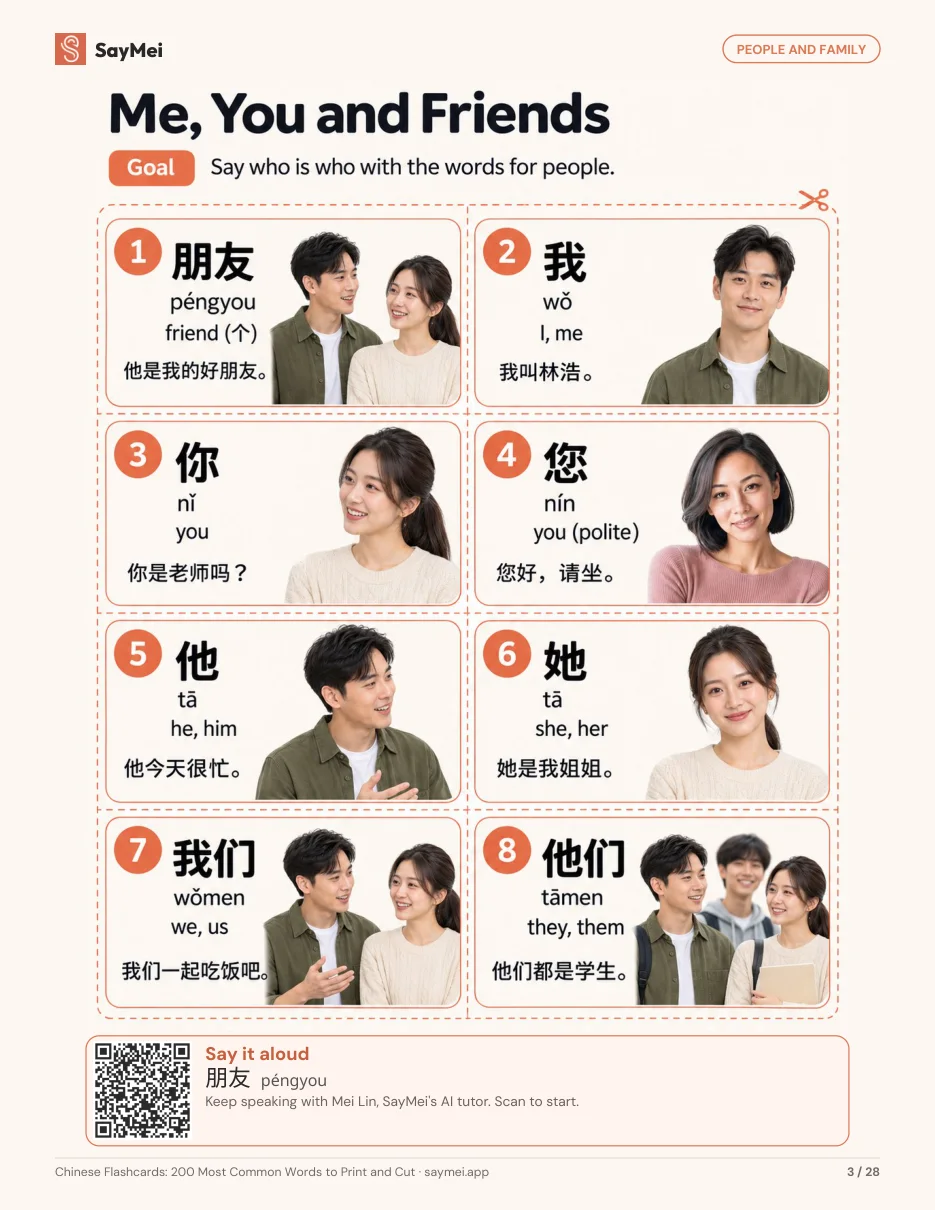
- People and Family: 24 cards: I, you, he and she, family from 爸爸 to 妹妹, and children, jobs and names. Me, You and Friends · My Family · Children, Jobs and Names
- Numbers and Time: 24 cards: one to ten and 两, today, tomorrow and yesterday, and years, months, weeks, hours and minutes. Numbers One to Eight · Today, Tomorrow and Now · Days, Hours and Minutes
- Food and Drink: 24 cards: eat and drink, rice, noodles, tea and coffee, fruit and bread, the three meals and eating out. Eat, Drink and Rice · Coffee, Fruit and Bread · Meals and Eating Out
- Places and Travel: 24 cards: places in town, go, come and take the train, and here, there, left, right and next to. Places in Town · Going and Getting There · Here, There and Next To
- Everyday Actions: 24 cards: be, have, want and can, look, listen, read and write, and buy, sleep, phone and wait. Be, Have, Want and Can · Look, Listen, Read and Write · Buy, Do, Sleep and Wait
- Describing Words: 24 cards: good, big, small and new, expensive, cheap, hot and cold, and busy, tired, right and late. Good, Big, Small and New · Price, Speed and Weather · Busy, Tired, Right and Late
- Home and Things: 24 cards: things on your desk, rooms, clothes and money, and the weather, pets and free time. Things on Your Desk · Rooms, Clothes and Money · Weather, Pets and Words
- Questions and Feelings: 24 cards: what, who, where and why, how you feel, and thank you, sorry and please. Question Words · How Do You Feel? · Thank You, Sorry, Please
- Little Words: 8 cards: 的, 了, 吗, 不, 也, 很, 都 and 在, each in a short line like 我也是学生。 Eight Little Words
- Ways to play: Five card games, from a one-minute round to a sentence chain, and a ten-day plan to tick off. Five Ways to Study the Cards
How to use this book
Print, cut and spend about ten minutes a day. The last page has a ten-day plan: two topics every two days, then a round with all 200 cards.
- Before you start: Print and cut. Print on thick paper and cut along the dashed lines. Each card has the word, its pinyin, the English and a short example.
- Days 1–2: People and Family, Numbers and Time. Cover the English with your thumb, say the word and its meaning, then check. Sort each card into "I know it", "almost" and "not yet".
- Days 3–4: Food and Drink, Places and Travel. Play the topic's track on the free audio. It reads each word, then its example, with a pause for you to say it back.
- Days 5–6: Everyday Actions, Describing Words. Try a sentence chain: pick three cards and say one sentence that uses all three, like 我 + 喝 + 茶.
- Days 7–8: Home and Things, Questions and Feelings, Little Words. Add the last three topics. Study the "not yet" pile every day and the "I know it" pile once a week.
- Days 9–10: All 200 cards. Set a timer for a one-minute round with all 200 cards and write your score, then go back to your "not yet" pile.
Who it’s for
Total beginners who want the most useful words first: travellers, people with Chinese-speaking family or friends, and anyone who learns best with cards in their hands.
Before you start: Nothing. Every card has the word in characters, pinyin and English, and the free audio reads each word and its example so you can hear the tones.
Frequently asked questions
Which 200 words are in the set?
The everyday words a beginner needs first, in 9 topics: People and Family, Numbers and Time, Food and Drink, Places and Travel, Everyday Actions, Describing Words, Home and Things, and Questions and Feelings (24 cards each), plus 8 little words such as 的, 了 and 吗.
Do the example sentences have pinyin?
The words do: each card shows the word, its pinyin and the English. The example sentences are in characters only, and the free audio reads every one of them, so you can hear a sentence before you say it.
Is there audio?
Yes, free on the book's audio page, one track per topic. It reads every word, then its example, with a pause for you to say it back. The code on page 2 opens it.
How long does it take?
About ten minutes a day for ten days. The last page pairs up the topics over Days 1 to 8, then on Days 9 and 10 you do a one-minute round with all 200 cards and go back to your not-yet pile.
How should I study the cards?
Page 28 gives five ways: three piles for know it, almost and not yet, a one-minute round to beat your score, a sentence chain that uses three cards in one sentence, flipping from English to Chinese, and a topic pick where you say what you ate today.
What should I use next?
Chinese Phrase Flashcards: 96 Everyday Phrases to Print and Say moves from single words to whole phrases you can say in one go.
Do I need a SayMei account?
Yes, to download the PDF, and the account is free: sign up with Google, Apple or your email address. With it we email you a copy of the workbook, keep every workbook you download on your account on all your devices, save your place in the free online practice, and you can practise speaking with Mei Lin, SayMei's AI tutor.
How do I print it?
The PDF is US Letter size. On A4 paper, choose "Fit to page" (or "Scale to fit") in the print dialog so nothing is cut off. Print the whole workbook or only the pages you need; colour looks best, and black and white works too.
Keep going
Printable Chinese Character Flashcards: 48 Starter Characters · How to Type in Chinese: Set Up a Pinyin Keyboard and Send Your First Messages · Chinese Stroke Order Chart and Rules · Chinese Symbols and Their Meanings: 40 Characters for Love, Luck, Family and Strength · Browse all 294 workbooks
Version 2026-11 · Updated Nov 4, 2026 · Report a correction